
Two narratives are spreading about Argentina since the World Cup final. One is that Argentina is the most racist and zionist state in the Western hemisphere, having genocided its black and indigenous population to an extent that would make even a 19th century US President blush. Even Samuel L Jackson got in on the action, attacking the country for its racism. No doubt, a large part of this is motivated by Argentina’s national team leaning into the status of FIFA’s heel, fouling everyone else while whining to the referees every time the other team so much as brushed them. This overall poor performance turned a lot of people off the country as a whole. The other narrative is that Argentina is a hopelessly and unfairly maligned victim of colonialism and imperialism, just like every other Latin American country, and we should be supporting it. Yet this story is just as one-sided. Unsurprisingly, a cursory look at the history shows that the reality is more complex than these simplistic narratives.
Argentina is a victim of imperialism, or at least its working classes are. During the Cold War, the country saw considerable meddling by the United States which sponsored brutal military takeovers in the 1960s and 1970s to contain the spread of “communism”. The military dictatorship of the late 70s and early 80s famously disappeared many dissidents, where “disappeared” means “secretly murdered and buried in anonymous graves.” The children of the “disappeared” were adopted off into the families connected to the very junta that murdered them.
This junta produced one of the most famous civil society movements of the Cold War, as family members of the disappeared organized together to oppose the dictators. The dictatorship couldn’t simply get away with murdering the entirety of civil society without the world noticing the way they could the organized leftist groups, so this was able to put real shame on the government. It is also the birthplace of revolutionary icon Che Guevara!
Famously, the junta would try to save itself by seizing the UK-controlled Falkland Islands near Argentine Patagonia. These islands had long been claimed by Buenos Aires but had also long been inhabited by British fishers and shepherds since the 1800s. One would expect that a military junta might be incompetent at running an economy, but would at least know how to fight a war. On the contrary, they simply sent hundred of Argentines to their deaths as their poorly equipped conscripts failed to fend off a modern NATO military. Most of their best soldiers were on the border with Chile, and their fleet and air force couldn’t keep the once-vaunted Royal Navy at bay. What was left of their army on the Falklands (and the nearby South Georgia and Sandwich islands) surrendered after suffering repeated defeats. This loss was such an embarrassment that the junta soon collapsed, while unfortunately Margaret Thatcher in the UK saw a significant benefit from the jingoistic response to their victory.
Yet the Argentine left has also been held down by the baggage of its past. As Marx wrote in the 18th Brumaire:
The tradition of all dead generations weighs like a nightmare on the brains of the living. And just as they seem to be occupied with revolutionizing themselves and things, creating something that did not exist before, precisely in such epochs of revolutionary crisis they anxiously conjure up the spirits of the past to their service, borrowing from them names, battle slogans, and costumes in order to present this new scene in world history in time-honored disguise and borrowed language.
In the case of Argentina, the “tradition of dead generations” was not Che Guevara (for the most part) but Juan Perón, an idiosyncratic military-dictator-turned-democratically-elected-president who ruled prior to the disastrous junta of the 1980s. Perón’s government had elements of leftwing populism, socialism, republicanism, and Italian fascism, but in practice was close to the platonic form of Caudillismo. The caudillo is the idea of a Latin American strongman who maintains legitimacy through transactional relationships with constituents.
Some caudillos, like Hugo Chavez, are clearly men of the left, while others like Colombia’s Avaro Uribe or Mexico’s Porfirio Diaz are more rightwing or centrist. Perón would maintain a certain amount of ideological ambiguity to win support of the working class, while also pursuing a developmentalist, protectionist model of economic management. Perón was very effective in this, reshaping much of the politics of the country in his image. Ever since, much of the Argentine left maintains its Perónist legacy with an emphasis on big state spending, protectionism, and a big bureaucracy. Unfortunately for many working-class Argentines, the breakdown of that model into high inflation and low growth led to the current presidency of Javier Milei, a remarkably incompetent combination of the worst parts of Elon Musk, Donald Trump, and Ronald Reagan.
Another part of the discourse on Argentina is its purported racism. Of course, like all Latin American countries, Argentina does have a problem with racism. Latin America is, if anything, the birthplace of modern Western racism as Spanish colonizers organized the demographics into castas. White, indigenous, black, and the various mixes of these all took up specific roles in the system. Yet while some countries like Mexico or Peru retained a large indigenous elite (swaths of the Mexican nobility could trace their heritage back to Moctezuma himself), the Argentine ruling class was more dominated by a white settler elite. This led to the perception among some Argentines that they are whiter and therefore more civilized than the rest of the continent.
Yet Argentina isn’t all white. It has significant black and indigenous heritage too. While there is some argument that Argentine elites used their black population as cannon fodder in its various wars with countries like Paraguay, the reality is that much of the African population simply intermarried with their white population. Not every country shares the US’s racist “one drop” rule, where even a small amount of African American heritage makes you black.
Argentina also saw significant immigration from Europe in the 1800s and 1900s. While many Latin American countries saw waves of immigration, Argentina was disproportionately a destination for Italian, German, Spanish, Welsh, and other immigrant groups. Today, many Argentines are of Italian descent. Of course, there is a running joke about Nazi immigration to Argentina, and there is significant truth to this joke. Well before the Nazis ever came to power, Germans were moving to Argentina to create whites-only communities (Nietzsche’s sister was one such person). After the war, some Nazis like Eichmann did move to the country. Yet Argentina also saw Jewish migration, and it wasn’t the only country that German bigots moved to (some went to Brazil and Chile too).
On the other hand, Argentina was a colonial country too. This fact seems to have been forgotten, but a simple comparison between Argentina’s borders today and their borders at independence should be a reminder. Initially, Argentina simply consisted of its northern territories, while Patagonia remained a wild frontier. Argentina and Chile would race with each other southwards, trying to colonize as much of the vast territory as they could. The fate of the Mapuche and other indigenous groups in this area would be familiar to anyone who knew their US or Canadian history, as the indigenous people were displaced and sometimes genocided to make room for colonists. General Roca, an Argentine “founding father”, remains a controversial figure to this day due to his role in these conquests. Meanwhile, the conquest has rightwing defenders in Argentina who sound right out of a US culture war.
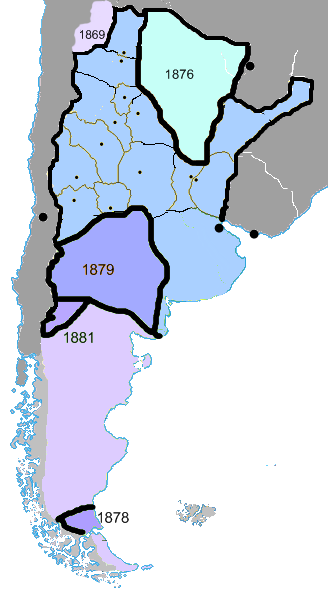
To put it mildly, this complicates Argentina’s case that “Las Malvinas” (the Falklands) are Argentine. This claim came out of the fact that Argentina claimed the islands at independence but lacked the ability to exercise this claim, unlike the British Empire which was still in its superpower phase. Las Malvinas never had an “indigenous” Argentine population, and English is no less an “indigenous” language to the continent than Spanish. Patagonia, notably, is the Argentine territory closest to the Falklands, and the inhabitants of the island (many of whom have lived there for generations and includes at least a few Argentine immigrants) voted near unanimously to remain in the UK. Thus, the Falklanders are no more “settlers” than a majority of the Spanish speaking residents of Patagonia, but unlike the Patagonians they didn’t need to displace tens of thousands of indigenous people to live there.
The Argentine team was criticized for trolling the English team after their victory by holding a banner claiming the islands were Argentinian. This was no doubt a poor career choice for these Argentine players, many of whom have deals to play with UK clubs like Chelsea. While it might set a dubious precedent to punish these players for their speech, it was certainly poor sportsmanship and definitely not a good way to celebrate their semi-final victory. The issue remains a political lightning rod in Argentina, where failing leaders like Milei copy the Junta by bringing up the dispute as a distraction.
No doubt, the Argentine claim over the islands is questionable. It’s not unlike Canada claiming the French-controlled island of Saint Pierre (near Newfoundland) and insisting this claim is simply decolonization … or the same for Trump’s claim over Danish-controlled Greenland. While the Falklands, Greenland, and Saint-Pierre are certainly legacies of colonialism, so are the US, Canada, and Argentina. The biggest difference between Argentina and the other two is that it suffered more under US hegemony during the Cold War, but that’s not directly relevant to the sovereignty over the islands.
Yet none of this should be taken as reason for folks to talk ignorantly about how terribly racist Argentina is. There are still Mapuche and other indigenous people in Argentina, and some are proud of their country. At minimum, the country is no more racist than the US and Canada, even if some Argentines have made a poor name for themselves by having a kind of superiority complex over their Latin neighbors. The generals and dissidents against the generals were both Argentines too. The poor behavior of their team shouldn’t motivate us to adopt silly, one-sided narratives about this country and its complex history. It is a plurality, a diverse society that has produced great leftist philosophers like Enrique Dussel, revolutionaries like Che Guevara, and of course the great civil society movement against the dictatorship. Instead of making smug, ignorant comments about Argentines as a whole, people should strive to understand this country and stand in solidarity with its working-class resistance against Milei’s free market reforms.
No posts
Comments
Nothing yet. Say the first thing.
Sign in to join the conversation.