
July 5, 2026, Sunday afternoon — It’s been so hot this week here in central Delaware that I just want to go sit under a tall shade tree somewhere, with a sweating glass of lemonade. So I sauntered over to this post I wrote in September 2024. Join me. After all, afternoons are good for nods to F. Scott Fitzgerald and the world that was. I have released this post from behind its paywall so you can slip under the trees with me and savor a pleasant draft of respite and nostalgia.
“And she doesn’t understand,” he said despairingly. “She used to be able to understand. “We’d sit for hours—--”
He broke off and began to walk up and down a desolate path of fruit rinds and discarded favors and crushed flowers.
“I wouldn’t ask too much of her,” I ventured. “You can’t repeat the past.”
“Can’t repeat the past?” he cried incredulously. “Why of course you can!”
He looked around him wildly, as if the past were lurking here in the shadow of his house, just out of reach of his hand.
—F. Scott Fitzgerald, The Great Gatsby, Chapter VI.
F. Scott Fitzgerald came to live in Wilmington, Delaware, in March 1927. With him he brought his wife, Zelda, and his little daughter, Scottie. They stayed two years.
0:00
-7:32
Soundtrack: David Gilmour, “Scattered,” from “Luck and Strange” album, 2024.
The feudal atmosphere in Wilmington under the du Ponts, thought Maxwell Perkins, Fitzgerald’s editor at Scribner’s, would provide the creator of The Great Gatsby with the tranquility he needed to finish his new novel, “The World’s Fair,” and give him material for future work.
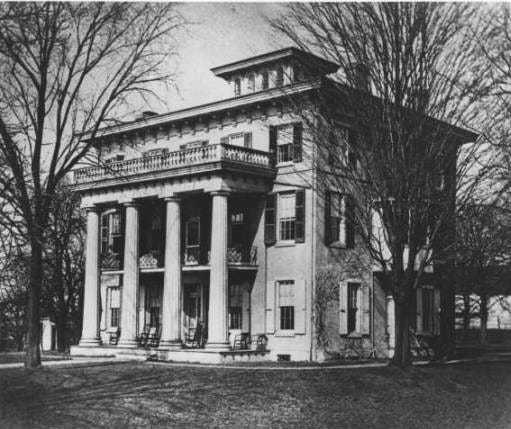
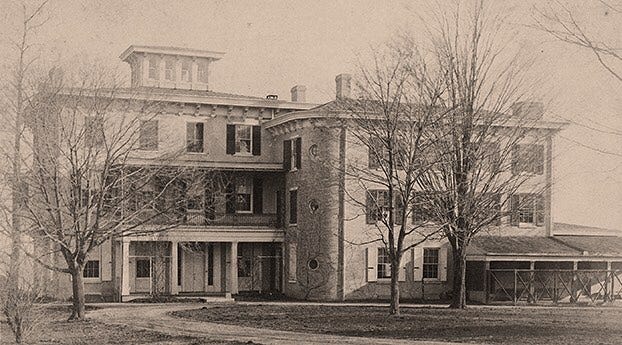
For $150 a month, they leased Ellerslie, the white three-story 1842 Greek Revival cupolaed mansion on the Delaware River in Edgemoor. Wilmington attorney John Biggs, Fitzgerald’s former Princeton roommate, found the house for them.
For the first few months, life at Ellerslie floated along on the wings of a dream. Fitzgerald wrote to Ernest Hemingway: “Address for a year—Ellerslie Mansion, Edgemoor, Delaware. Huge old house on the Delaware River. Pillars, etc. I am called ‘Colonel,’ Zelda ‘de old Missus.’”
Scott and Zelda devised a system of calls and echoes so they could find each other among the 14 of the 27 rooms they kept open. Scottie romped the broad green lawn with the Wanamaker and du Pont children. And from the upstairs window in the room where Fitzgerald wrote, he could see the lights far across the river in New Jersey.
At Ellerslie, in the deep night, amid the whispering old oaks, beeches and horse chestnuts, you might glimpse the suggestion of a figure, perhaps Gatsby himself, standing on the pillared portico of the magnificent house, lifting his arms outstretched toward the dark water.
The dream drifted into summer. But summer was the spawning ground for yet another attack of the Fitzgerald discontent.
Zelda decided she wanted to dance with the Russian ballet. At 28, an age when the careers of most dancers are over, Zelda began classes with Catherine Littlefield of Philadelphia. In Ellerlie’s front hall, at the barre she erected before her huge gilt mirror, that Scott called her whorehouse mirror, she tortured her body from morning until night, day after day, always to the sound of “The Parade of the Wooden Soldiers.”
The incessant noise drove Fitzgerald wild. It bombarded the walls, marched up the grand circular staircase and whirled about the cupola. He wrestled with his novel, presently called “The World’s Fair,” which in contrast to the very structured “Gatsby,” he regarded as a series of sideshows. He was attacked by a nervous irritability. The Fitzgeralds’ tranquil Ellerslie life became a series of sideshows.
There were too many interruptions, too many excuses, too many excesses, like so many unpacked moving crates stumbled into in the night. “Terrible incessant stoppies begin,” he wrote in his ledger. He drank, he smoked, he thought his tuberculosis had become active. He changed from Chesterfields to the milder Sanos.
The invitations went out and the crazy weekends began. Fridays the French chauffeur drove to the Wilmington train station to meet the guests who included Ernest Hemingway, John Dos Passos, Thornton Wilder, Ford Madox Ford, Edmund Wilson, Charles MacArthur and movie starlet Lois Moran (Stella Dallas), who would become the model for Rosemary Hoyt in Fitzgerald’s forthcoming novel, Tender Is the Night, and polo star Tommy Hitchcock, a Fitzgerald idol who suggested to him a kind of Tom and Daisy Buchanan glamour. Jay Gatsby would have been pleased.
Fitzgerald met Lois Moran during his stint in Hollywood in January and February 1927, where his movie script, Lipstick, failed largely due to his falling out with Constance Talmadge who thence refused to star in the film. In Hollywood the Fitzgeralds attended Pickfair parties and at another party gathered the women’s purses and boiled them in tomato sauce. The need for tranquility became evident and at Ellerslie they found that tranquility. And lost it.
So, the chauffeur met the guests at the train on Friday and drove them back on Sunday. In between were dinner dances, polo matches staged with plow horses and croquet mallets, and late-night bedside visits by the resident ghost. If things got dull, they caroused the town: John Biggs received the middle of the night phone calls to get them out of jail.
At Ellerslie, Fitzgerald had turned 30. Indeed, a weekend guest recalled one of the parties as being a virtual funeral wake for the passing of his thirtieth year. His sense of loss plagued him.
“There was a demon within him to be the greatest writer of his generation. He didn’t feel he was accomplishing this,” remembered Biggs.
He got distracted when he started writing. “I get afraid I’m doing it instead of living…. Get thinking maybe life is waiting for me in the Japanese gardens at the Ritz or in Atlantic City or on the lower East Side.”
Yet, although at Ellerslie work on his fourth novel languished, Scott wrote and published numerous short stories in major magazines, particularly in The Saturday Evening Post, and the pay from these stories comprised the majority of the Fitzgeralds’ income during these two years, including stories Zelda had written or Scott had written with Zelda, all published solely under Scott’s byline, because that would bring more money than publishing under Zelda’s. Fitzgerald was serious about his writing and dedicated to it. He didn’t drink when he was writing.
Still, it would be a long time before this novel, begun in 1925 and which would become Tender Is the Night, finally winged its way into the literary world. He took the title from a line in the John Keats poem “Ode to a Nightingale.” In 1927 Scott visited Princeton University. His love for the Ivy League school where he had been a student had never diminished. Just prior to his visit, Fitzgerald wrote of his Princeton memories in an article for the school’s College Humor in which he refers to his beloved Princeton as “a meadowlark among the smoke stacks.” He knew he could never repeat his past at Princeton.
Strewn among the Ellerslie weekends were trips to New York City, where they stayed at the Plaza. Zelda remarked, “We come up for a weekend, then wake up and it’s Thursday.” On one such excursion Fitzgerald saw a forlorn newsboy standing in the rain and bought all his papers.
Fresh from their racy adventures in New York, Zelda was finding the staid little red-brick town clutching the sides of the hills stifling. “Wilmington has turned out to be the black hole of Calcutta,” she said.
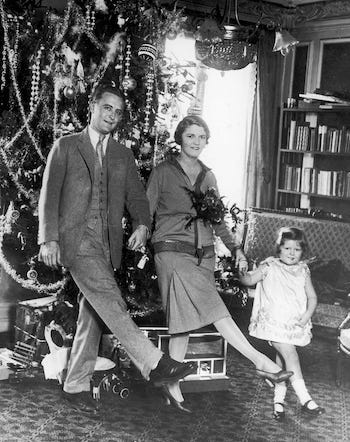
The Fitzgeralds interrupted their two years at Ellerslie voyaging to Paris in April 1928. There, Zelda, wanting to work with the Russian ballet, studied with Lubov Egorova.
In Paris that summer, at a dinner party hosted by Sylvia Beach, founder of Shakespeare and Company, Fitzgerald met James Joyce, where he was so overawed by the genius of the Irish author that he referred to the evening as “The Festival of St. James.” Scott sketched a picture of the dinner party seated at table, portraying himself on bended knee, kissing the hand of the great author of A Portrait of the Artist as a Young Man and Ulysses. After their meeting, Fitzgerald and Joyce exchanged notes of gratitude and mutual admiration, and in response to Fitzgerald’s awe, Joyce referred to himself as “pusillanimous,” characteristic of his essential nature. Joyce was working on Finnegans Wake, telling Fitzgerald it would take him eight years to complete. Fitzgerald wrote his Scribner’s editor, Maxwell Perkins, noting Joyce’s projection and that he, Scott, had only two more chapters to write of Tender Is the Night.
The Fitzgeralds returned to Ellerslie, according to Fitzgerald, “in a blaze of work and liquor” in October.
Zelda wanted to build a surprise dollhouse for Scottie. Fitzgerald and his little girl waited in their car on a quiet red-brick street corner while she disappeared with some papers through a door lettered “Cabinet Maker.”
It was a fine November day. The last golden leaves clung to the trees, sprinkling little shadows here and there on the sidewalk. The daddy yawned. A very little boy walked up the street, taking very long strides. He went up to a door, took a piece of chalk out of his pocket and proceeded to write something under the doorbell.
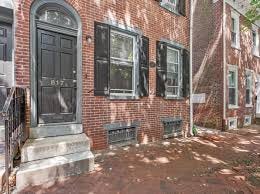
“He’s making magic signs,” the daddy told the little girl. The daddy then wove a tale of fairy intrigue. The little boy was the ogre and he was holding a princess captive behind the closed curtains of the flat on the corner. The king and queen were imprisoned 10,000 miles under the earth.
“And what, Daddy? What?” demanded the little girl, caught up in the magic. The man continued the story. He wanted to be in his little girl’s fairy world with her. A shutter banged closed, then slowly opened. Suddenly the room turned blue. That meant the prince had found the first of the three stones that would free the princess.
The man could remember that world but he knew he would never again see it or touch it for himself. “Outside the Cabinet-Maker’s” was published in The Century Magazine, December 1928.
Leaving Ellerslie for good in March 1929 the Fitzgeralds sailed for Genoa. In April they were somewhere in France. By June they were in Cannes.
After they sailed, Ellerslie was acquired by the Krebs Co.
In Europe Zelda suffered her first major breakdown, most likely bipolar, and spent 15 months in a Swiss clinic. Upon her release the Fitzgeralds returned to the United States to live in Baltimore in 1931, but Zelda broke down again and was treated at the Phipps Clinic at Johns Hopkins Hospital.
Tender Is the Night, begun in 1925 as “The World’s Fair,” winged its way into the literary world in 1934. One year later, the big square rooms of the sweeping white mansion on the Delaware housed the offices of the DuPont Co. pigments plant.
Fitzgerald published “Afternoon of an Author,” a short story, in Esquire magazine in August 1936. In the story he wrote: “He went into the kitchen and said good-by to the maid as if he were going to Little America. Once in the war he had commandeered an engine on sheer bluff and had it driven from New York to Washington to keep from being A.W.O.L. Now he stood carefully on the street corner waiting for the light to change, while young people hurried past him with a fine disregard for traffic. On the bus corner under the trees it was green and cool and he thought of Stonewall Jackson's last words: 'Let us cross over the river and rest under the shade of the trees.' Those Civil War leaders seemed to have realized very suddenly how tired they were—Lee shriveling into another man, Grant with his desperate memoir-writing at the end.”
Fitzgerald took rooms at the Grove Park Inn in Asheville, North Carolina, for the summers of 1935 and 1936. He thought the respite at the inn would help him stop drinking and write more. Tender Is the Night was not selling well: during the Depression people weren't inclined to read about the highlife of the rich. He was supporting Zelda's institutional stay and daughter Scottie's Vassar education. At the Grove Park Inn, Fitzgerald took a room overlooking the entrance so he could watch the comings and goings. He also turned 40.
Some years earlier, Scott Fitzgerald had met Asheville native son, Thomas Wolfe, author of the autobiographical novel, Look Homeward, Angel, through Maxwell Perkins their mutual editor. Perkins and Wolfe marked birthdays around Fitzgerald’s, September 20 (1884) and October 3 (1900) respectively. Wolfe and Fitzgerald maintained a correspondence on the philosophy of writing.
In 1937 Fitzgerald went to Hollywood to write for the movies. Gone With the Wind was one of them. He was also writing a new novel, The Last Tycoon. He stayed at the Garden of Allah residential hotel in Hollywood.
On December 21, 1940, Francis Scott Key Fitzgerald, lyrical prose writer, author of novels, short stories, poems, essays, stage plays and screenplays, died in Hollywood, Los Angeles, California, of a heart attack. He was 44.
Thomas Wolfe died on September 15, 1938, in Johns Hopkins Hospital, his brain riddled with tuberculosis, caused by complications from pneumonia he caught in Seattle. He was 37.
When Scott Fitzgerald heard of the death of Thomas Wolfe, he sent a message of condolence to Maxwell Perkins. "That great, pulsing, vital frame quiet at last," Fitzgerald wrote. "There is a great hush after him."
Maxwell Perkins, a kind father to both these men, died on June 17, 1947 of pneumonia, in Stamford, Connecticut.
Zelda perished in a fire at Highland Hospital in Asheville, North Carolina, on March 10, 1948, when flames ripped through a wooden building where she and eight other patients were housed.
In 1972, the gracious summer home on the Delaware, riddled with termites, was demolished.
F. Scott Fitzgerald, great grandnephew of Francis Scott Key, the author of the lyrics to “The Star-Spangled Banner,” the United States national anthem, was born in St. Paul, Minnesota, on September 24, 1896. A few days belated Happy Birthday, Scott.
Away! away! for I will fly to thee,
Not charioted by Bacchus and his pards,
But on the viewless wings of Poesy,
Though the dull brain perplexes and retards
Already with thee! tender is the night
—from Ode to a Nightingale, John Keats
This Ode to Fitzgerald is adapted from a piece I published in the Wilmington (Del.) News-Journal, “Only the Memories Remain,” under my byline Carol Child, April 24, 1986.
No posts
Comments
Nothing yet. Say the first thing.
Sign in to join the conversation.