
I haven’t been here for a while. Maybe you noticed. I was busy producing a stage play. I wrote a play when I was around 12 years old, but this isn’t the one. Back then, I wrote the script and my brother, three years younger, and I were to perform it. Our family, tickets in hand, all sat in chairs gazing up at the stage, anticipating. There we stood on the stage, show set to begin, when my brother said, “I’m not gonna do it.” And that was that. Writing a play seemed very natural to me, and ever since then I’ve written little plays, most lost, but still have held in the back of my mind to write and produce another. Finally it happened, six decades later. A childhood dream come true.
We presented my Jane Austen Readings & Luncheon play at the historic Smyrna Opera House here in Delaware on the afternoon of May 2, 2026. This presentation was an encore.
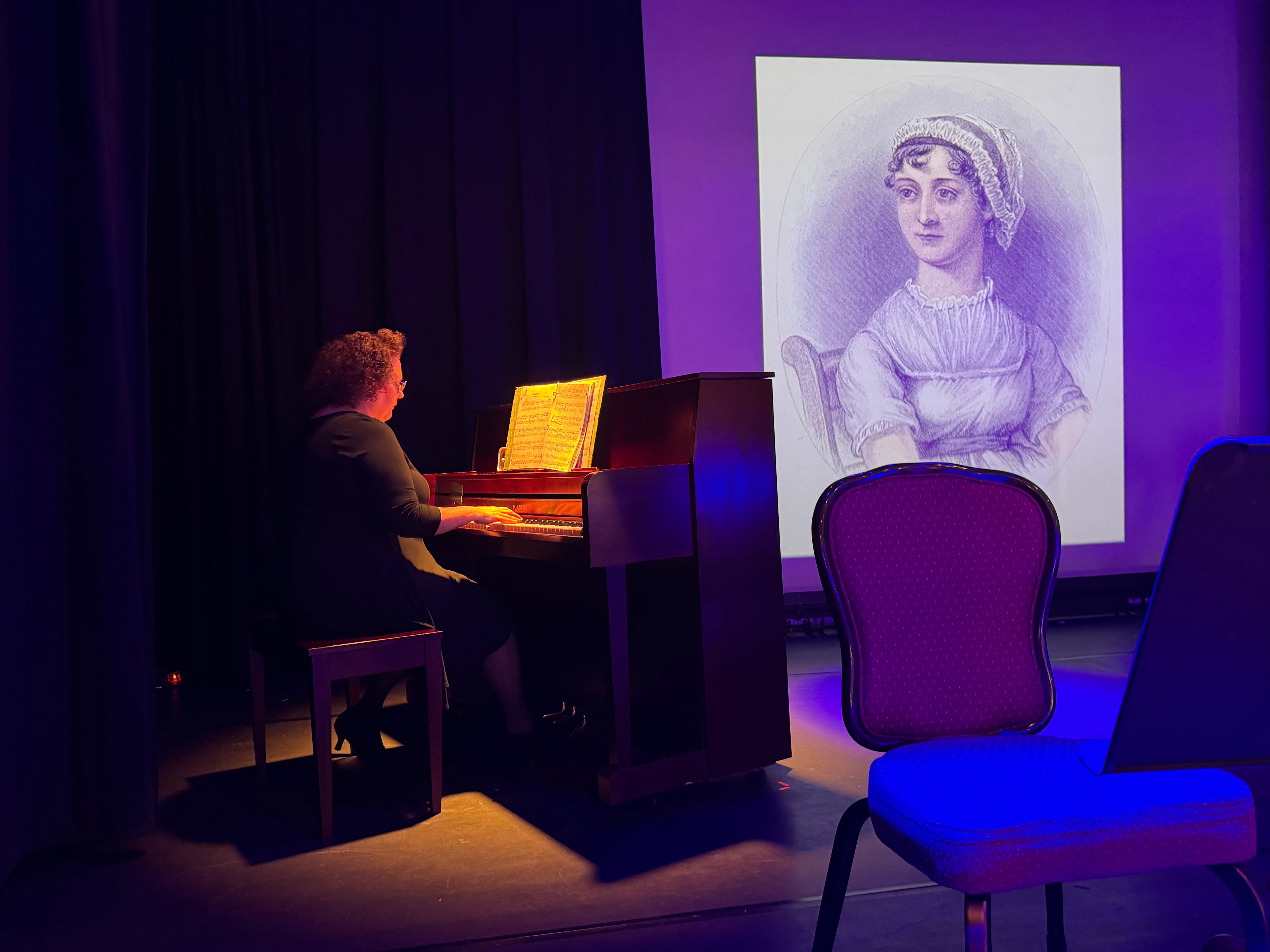
My Jane Austen Readings for Readers Theater was originally performed at the Opera House on June 3, 2017. For that presentation, we had two readers plus the Mistress of Ceremonies and the pianist and we used overhead mics. This time we had four readers plus the Mistress of Ceremonies and the pianist. Both times we enjoyed a lovely buffet luncheon while the performers read to us, and in between reading sessions our pianist played music that Jane Austen might have played. Music was Jane Austen’s first love.
“Without music,” she wrote in Emma, “life would be a blank to me.” She played piano and practiced daily. Accordingly, she features pianos and singing in her stories, and many of her characters are musicians.
Over the past few years, we have updated our theater to include a large projection screen at the back of the stage and digital lighting.
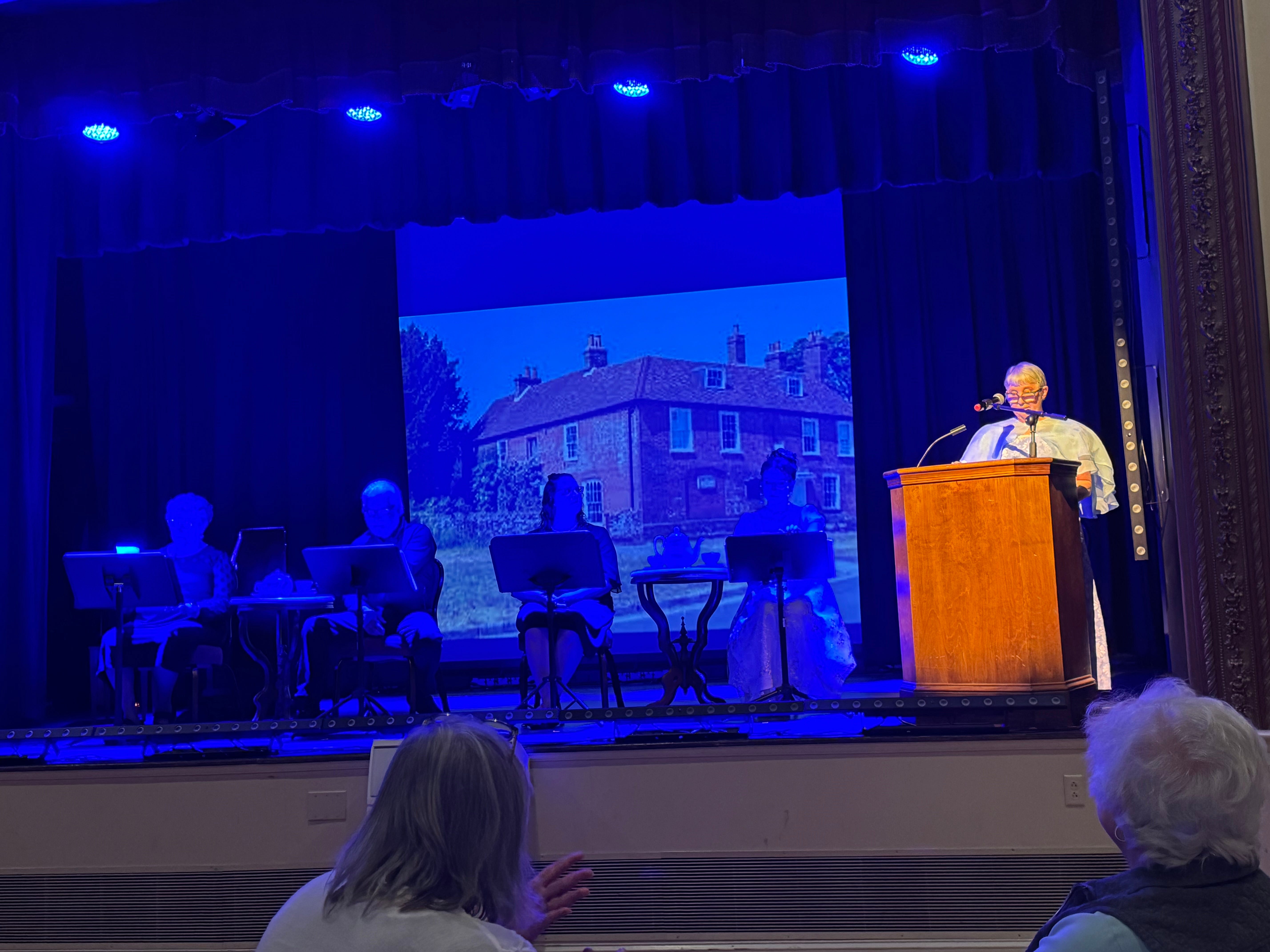
So this time, delightfully, we projected images representing scenes from Jane Austen’s stories onto the screen while the performers read excerpts from four of her novels, Pride and Prejudice, Emma, Northanger Abbey (“The Mysterious Chest”) and Persuasion (“The Letter”). Our lighting and sound man illuminated the stage and the performers not reading in a deep sapphire blue while shining the spotlight on the active reader. You can see that in the picture above.
Our pianist played a prelude, interlude, entr’acte and postlude; that is, she played as guests entered the theater, while they selected food from the buffet table, during intermissions and as guests exited after the performance. Thereby, the piano music and the blue light interwove the segments of the production threading the play scenes and the intermissions through from beginning to end. Thus, when you returned from intermission it was as if you had never left the stories, for you remained within that ambience. Seamless. To put it in musical terms, the experience flowed in articulated legato. The overall presentation purveyed the sense of harmony and beauty while embracing Jane Austen’s spirited wit.
I wish now that I had asked to have the performance recorded. I was too involved in assembling all the pieces to think of that amid the process. So, it remains ephemeral. That will have to do.
Putting together the production for my play, I feel as if I have time traveled. I have been living in Jane Austen’s world, 200 years ago. Now I am back in mine, in the 21st century. My sense is very much like that of the characters in Outlander, the TV series, who come and go, traveling across time a distance of 200 years, or my viewing YouTube vloggers’ tours of British castles; in both, arriving at castles, some dating to the 12th century. The experience is emotionally haunting. Suddenly you’re there among them. I’m surrounded by the ones who lived back then, I can feel them, hear them; they’re buzzing all around me, like bees in a hive, engaged in their activities, stoking the fires in those big walk-in fireplaces; there was much to do in those days — you know, they didn’t have washing machines and vacuum cleaners and microwaves; you traveled distances, but by horse. Or maybe time traveled through the stones.
I spent so much time with Jane Austen that I felt I knew her, that she was my friend with whom I chatted while wandering arm-in-arm across the heath. We shared the same wit, love of gossip and desire for adventure. I learned some piano pieces. She wrote and produced plays for the delight of her family and, of an evening, read to them. I was she. I wrote my play and engaged in the casting, the editing, the directing, the catering, theater ambience, rehearsing, publicizing. I wrote the playbill and a friend designed it to resemble a dance card. I designed the bookmarks. We presented these two pieces as gifts to our guests, some who arrived in period costume. Lovely, simple fresh flower centerpieces garnished the guests’ round tables, laid with cream-color tablecloths. A friend well-versed in gardens created the arrangements. And now that it is done, I have come to the mundane, catching up on household tasks. I think those will never be done. I think it’s the condition of the world now, especially here in the United States. Nothing is easy; even customer service reps from whom you seek help are contentious, like you’re an upstart calling who picked up the phone to ignite a war and it’s all your fault. They get paid for that.
In Outlander, thankfully I’m not there fighting a battle, but Claire has traveled through the stones, back 200 years and suddenly there they are at Lallybroch, the fictional name of one such castle from the 15th century, Midhope, in Scotland. The time is the Jacobite uprising, the Battle of Culloden. I look at the household tasks, a never-ending battle, overwhelming, and I want to travel back through the stones to our stage and live in that deep sapphire blue our treasured lighting and sound person created. It was so peaceful there. Lifted to another place and time.
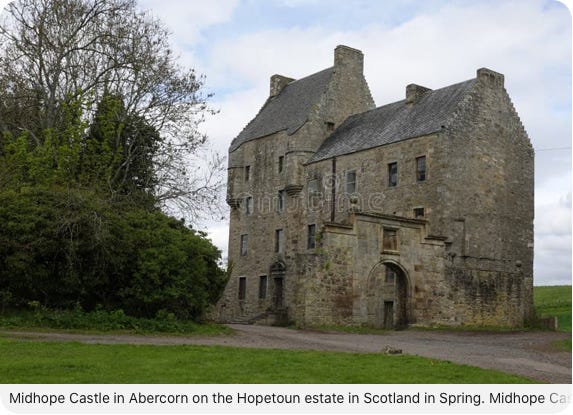
Of course, those 12th century castles with their narrow, stone, winding staircases — how did they do it, wearing those heavy clothes, long skirts (that snag my foot in the hem and trip me) and carrying buckets of water or slop? And, besides, those castles must have been cold and damp despite all those huge fireplaces and chimneys.
Bloopers — During rehearsals our male reader struggled initially with Jane Austen’s language, yet was kind enough not to say, “I’m not gonna do it.” A seasoned performer, he came through. During the dress rehearsal, right near the end, in Persuasion, he reads Captain Harville’s line to Anne Elliot, “I could bring you FIFTY quotations in a moment.” He misread, “I could bring you FILTHY quotations in a moment.” Right? Jane Austen’s gonna write that…. She wrote some risqué things for her day — Emma finding herself riding alone in the carriage that snowy night with Mr. Elton, where endeavoring to make polite conversation, “she found her subject cut up -- her hand seized -- her attention demanded, and Mr. Elton actually making violent love to her.” Oh, my. Mr. Elton! But Jane Austen writes nothing of any violent love when in Persuasion, Captain Wentworth sits at a table composing a love letter to Anne Elliot and eavesdropping as the kind Captain Harville debates with Anne, whether who loves longest, men or women. Spicy didn’t fit the mood of the scene. Of our reader’s misspeak, we couldn’t stop laughing. After the performance, a week or two later, when I saw our male reader again, I told him, “Next year we’re reading excerpts from The Canterbury Tales. He said he was certain he’d be in Florida then, no matter the date, quickly adding that our friend, a guitarist in a rock band, who was present, overhearing to our conversation, had expressed strong interest in doing a reading….
To pierce the lock of another artist’s work, whether it be of literature, music or fine art, raise the lid of that treasure chest and examine the contents is a sacred task. For, you know that work emanated directly from the depths of the artist’s soul.
I raised the lid on Jane Austen’s treasure chest of manuscripts, and for two months, this March and April, explored her writings and by interrelation, her life. I did so to become so intimate with her works that I could adapt a play therefrom. I became conversant with her. And that I became after reading her works over and over, listening to her stories rehearsed aloud, listening to the rhythm and music of her speech and that of her characters until they became the soundtrack for the British Regency era. For, if you listen closely, Jane Austen’s prose sounds like musical phrases rising and falling, replete with rubato.
If you want to read more about Jane Austen and her life during the Regency Era, do consider reading this piece that I published here in December 2025.
Scheherazade Chronicles
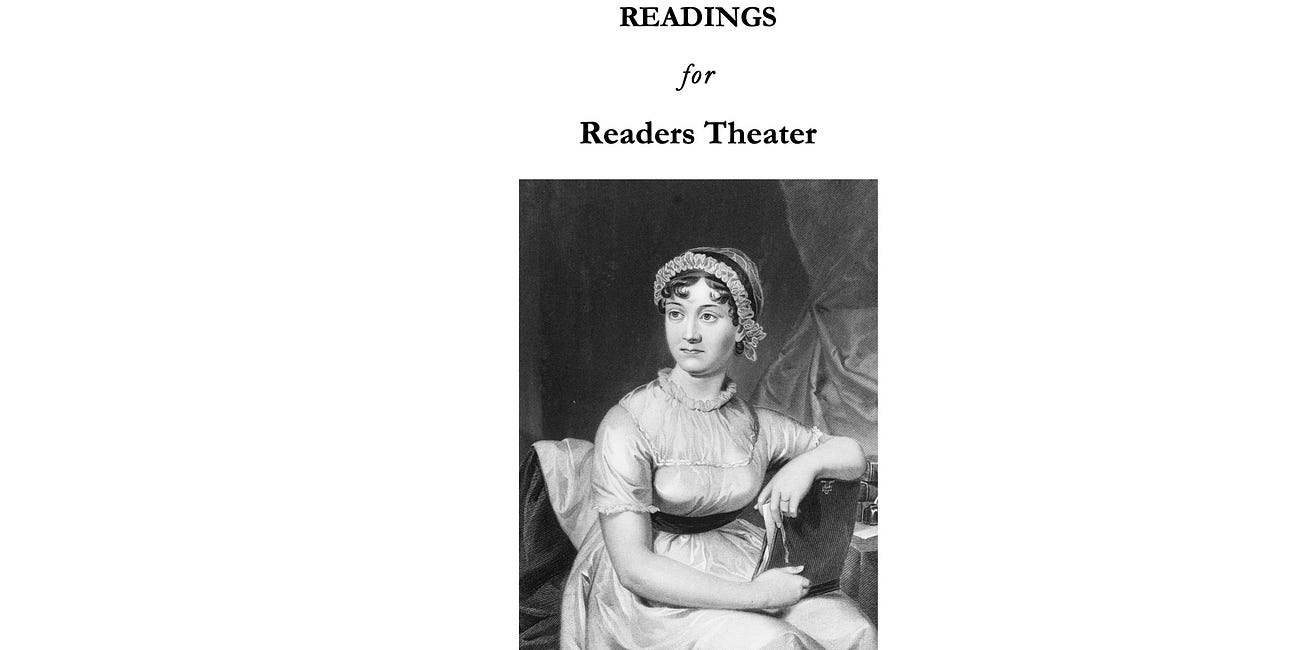
Jane Austen Readings for Readers Theater
·
December 13, 2025
To pierce the lock of another artist’s work, whether it be of literature, music or fine art, raise the lid of that treasure chest and examine the contents is a sacred task. For, you know that work emanated directly from the depths of the artist’s soul.
My book of the play, published under my byline, Carol Child, is available on Amazon in paperback and ebook. Here is the link to the U.S. view.
~Samantha
No posts
Comments
Nothing yet. Say the first thing.
Sign in to join the conversation.