

In 1962, Major League pitcher Hank Dorsey visited a remote village in South America. Despite the fact that the children there had never heard of the existence of baseball, Hank was a real spectacle. The children were not in awe because he could throw a ball fast and strike a precise tree of his choosing from 60 feet away. But because, by skill of a hobbyist, Dorsey could juggle 5 balls at once.
In North America, Dorsey’s most valuable skill was unquestionably pitching a ball. But the fact that his throwing was a more interesting and valuable trait than his juggling was inconceivable to those South American children.
Imagine the possibilities of juggling - it doesn’t even need to be balls, it could be knives! Firey batons! Juggling really does hold a world of possibility that just throwing balls at a target can never approach. Right?
Except then we come to baseball. In this context, we know that factors like the spin of the ball can change a fastball into a slider, that there is a deeper mental game beyond the throwing skill, and that each pitch adds up to a win or loss of a much more interesting game than throwing alone. Experts can recognize even more nuance to the value of throwers, understanding that there are moments when one type of pitcher is needed to maximize their chance of winning a game, vs another.
To the children in South America, Hank Dorsey wasn’t credited with any of this value. They just wanted to see him juggle.
Different audiences value different skills. Some audiences are bigger, so baseball can pay a whole lot more employees overall, and the best performers can make a lot more money individually, too. But none of it is deterministic; in a parallel universe, maybe jugglers make more money.
By the way, Hank Dorsey never existed. This is a metaphor.
A lot of people are getting increasingly nervous about AI and its power to displace human work. All but the most technocentric among us, probably. And maybe AI company CEOs declaring that artificial general intelligence has arrived (it hasn’t).
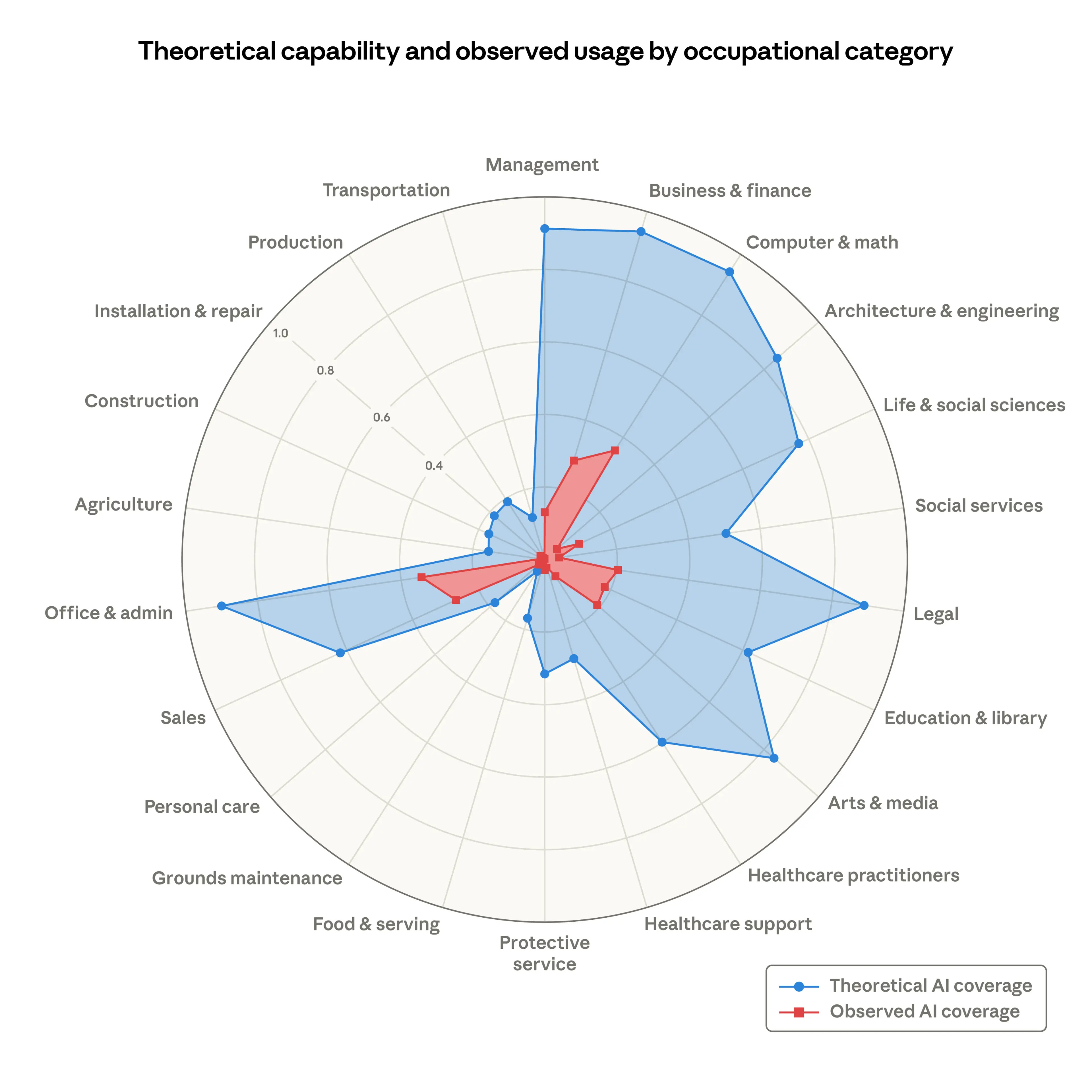
If you follow AI stuff on social media, you’ve probably seen the following chart from Anthropic from a few months ago. It maps “theoretical” AI capabilities with “observed” coverage across industries so far. Their message: AI is going to be taking over a lot of human work in many fields in the coming years.
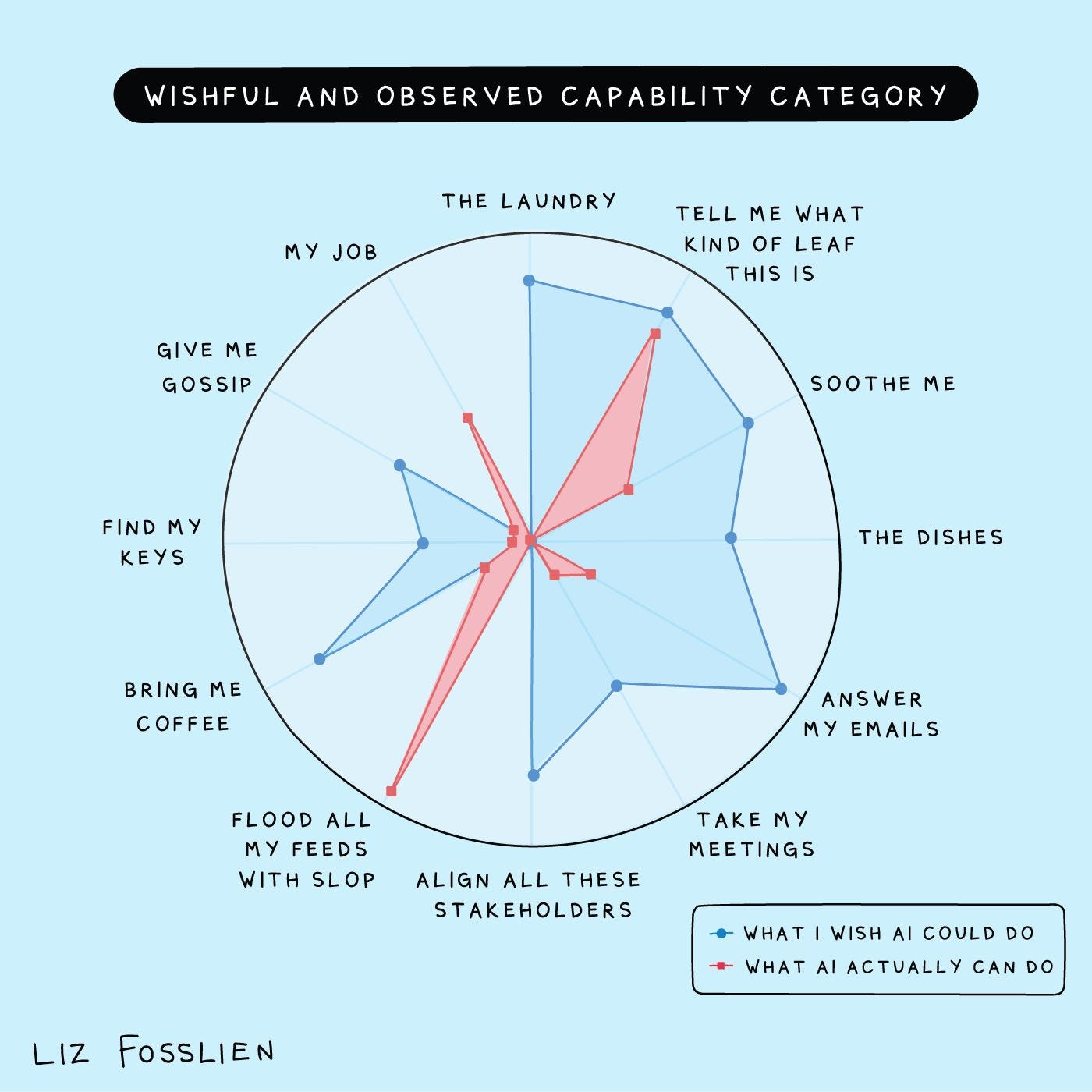
I kind of prefer this more humorous chart comparing what people wished AI actually did for them:
The first chart is scary because you can jump to the conclusion “Oh my gosh AI is going to be able to do my job”. In truth, AI-enabled systems will be able to perform a lot of the tasks that human employees perform for businesses today. Some companies will pounce on that opportunity to eliminate human jobs and enjoy higher profit margins. Some already have.
There are also interesting counterpoints to the AI job doom crowd:
Every technological revolution in human history has led to the explosion of new types of jobs, to a greater degree than it has destroyed the old ones. Humans typically can’t predict new jobs that exist in the future.
Lots of jobs should go away, because they aren’t really dignifying to the workers today, anyway.
Cheap labor means cheap output. Everyone’s living standard can go up. Rising Tide economics is too dense an economic study for this post, though.
Those three counterpoints are worth exploring further, but let’s lay them aside for a moment. I want to take a look at the types of jobs that can be expected to persist. Is the existence of AI taking away the best jobs and leaving us with a techno-nightmare for the average worker?
The clearest space to think about the future is with jobs that are valuable because people watch them.
Yes, Hank Dorsey was a made-up example. But baseball as a total industry globally employs hundreds of thousands of people, not just the top major leaguers making the big bucks. The audience makes the skill economically enormous.
But you may say “Ah, that’s because robots are inferior to humans in baseball. AI (or robotics) is going to be superior to workers in X field”.
Not so fast. Just because a computer is more competent in a specific outcome than humans, doesn’t mean all jobs in that field will disappear. When new technologies “eliminate” job categories, they typically leave the core behind as an art form.
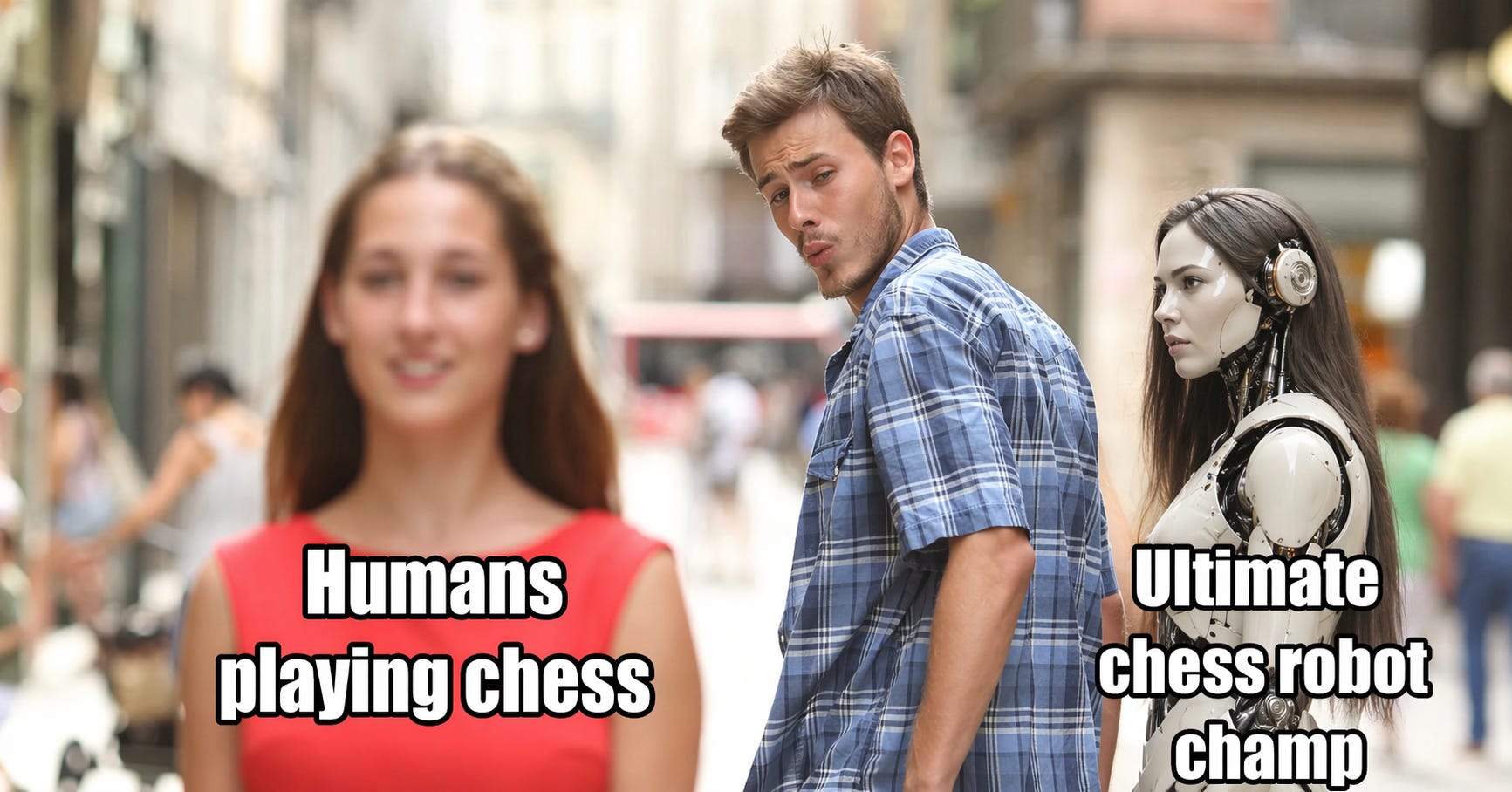
Exhibit A: Computers have been able to cook the best chess professionals for 30 years now. But chess is nearly a $4 Billion industry today, and growing! We, the human audience, do not care one lick about watching computers beat one another in chess, but many of us still love watching humans play.
Jobs that will persist in this category: literally anything that enough people are willing to watch. Youtube and subsequent platforms taught us not to draw these lines narrowly!
Then there's work performed for a single watcher, where the whole value lives in the relationship rather than the reach.
My wife spent several days crocheting a blanket with small flowers worked around all the edges. She gave it to our daughter for her fifth-grade graduation. There is no economic measure for that blanket. You could buy a nicer one, a warmer one, a more technically flawless one, for less than the cost of her time at any wage. None of those would be the blanket. The audience is one child, and the skill's value is inseparable from who made it and for whom.
Jobs that will persist in this category: counseling, coaching, spiritual/pastoral care, personal training, stylists, caregiving, estate planning, advisory, midwifery. Anything where a personal relationship carries weight.
Some work has no audience at all, and is valuable anyway. Two kinds matter here.
True expertise - we don’t watch them work, and we couldn’t evaluate their work if we did. Their value is being right, not just convincing.
Orchestration - the integrator holding the pieces together in their head, mapping processes, delegating work, and owning the outcome. Delegation may be to humans and/or AI agents.
Wisdom, not just intelligence or memory, compounds value for both of these.
Jobs that will persist in this category: anesthesiologist, civil engineer, actuary, surgeon, supply chain operator. Anything where being right matters more than being seen or known.

Real vision and creativity can be useful far beyond entertainment. This includes products (physical or software) and innovative services.
Innovation is a bit different than expertise, because true creative innovation is generating an answer to a question nobody had asked yet.
Innovators and experts alike are more powerful users of AI within their areas of competence. AI powers in the hands of the uninformed, non-creative user produces slop, which most of us have witnessed by now.
Jobs that will persist in this category: founder, author, inventor, composer, director, artist.
Hank Dorsey knew his pitching skill was the most valuable thing going for him, despite the village loving his juggling. I can't always tell which are my most valuable skills, and neither can most of the people I talk to.
It’s been interesting to chat with founders, tech employees, and fellow job-seekers as I myself grapple with that introspective question of what value I bring to the world with my work (vs my own work preferences). The tech job market has a pervasive negative feeling as stocks are through the roof even as hundreds of thousands of employees have been laid off and are competing for new roles.
But consulting focused on non-tech native companies is in a weird spot, too, as many would-be AI project clients want to skip the cost of an AI consultant by making AI a consultant unto itself through vibe coding and the like. That solo approach is rarely successful in practice; many realize they are producing slop or a software for an imagined need too late.
I’ve been grateful to get some quality feedback from a few friends as we compare notes from our career journeys so far, and as I knock on doors looking for the right next chair from which to work. If you’re another friend who would like to chat career path and potentially help one another steer towards the next right seat, please reach out!
No posts
Comments
Nothing yet. Say the first thing.
Sign in to join the conversation.