
Dear Friends,
What is the Source?
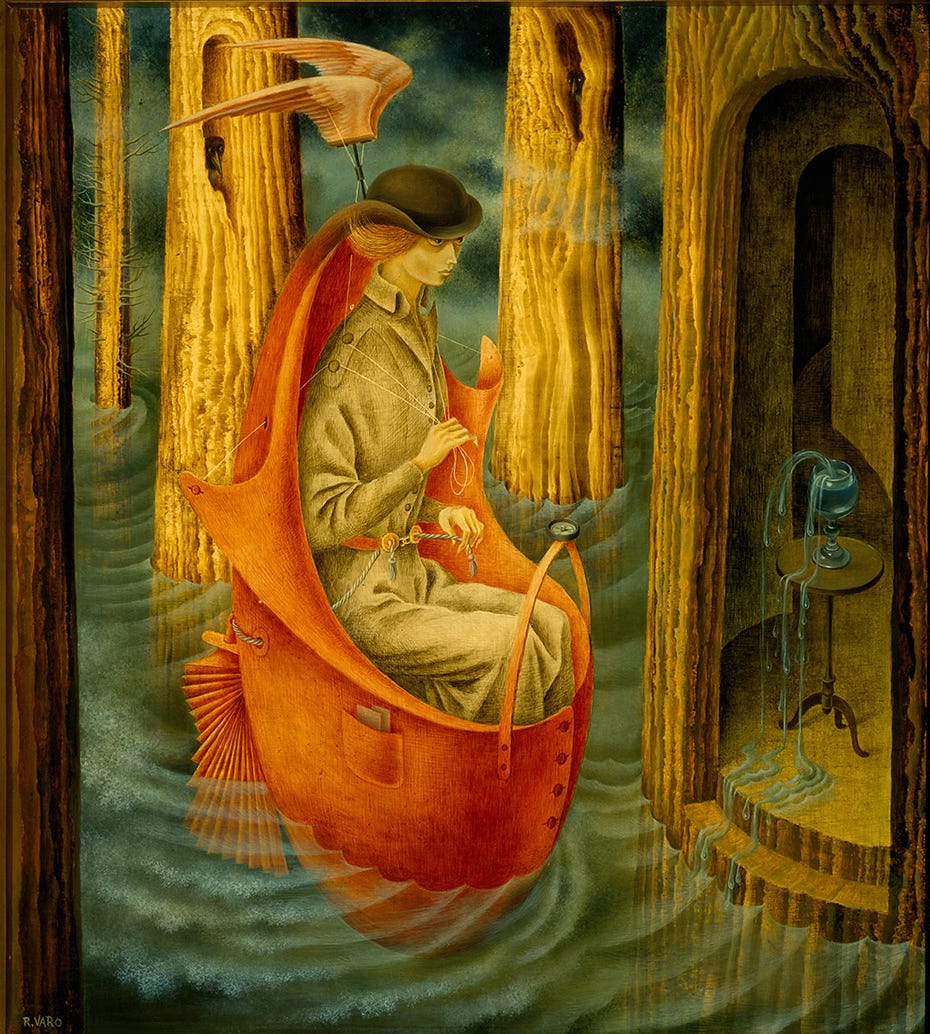
To the painter Remedios Varo, and possibly to Thomas Cole (founder of the Hudson River school), the Source was an overflowing chalice set in a mysterious landscape.
The Source is magical and inexhaustible (like a fairy-tale soup pot), hidden and yet waiting to be found, ready to be discovered not once but endlessly.
— Sal
After Italo Calvino, Verplank Colvin, and Remedios Varo
12:01 PM, 11:33 AM, 9:56 AM, 2:08 AM, the unread emails march backwards in time through yesterday, the day before, and before that. That before that. In this way the universe administers, ministers to itself. I’ve heard it’s the Higgs boson which turns energy to matter, so we have its poetry to thank for everything we’ve ever read. Back there, before the bang, we were all dreaming together. What a cacophony. Now at least we have leaves keeping their own places on the tree outside, gathering, absorbing reflecting the last of this day’s light. All the other things too: whales, factories, grain silos, parades, radiators, mountains, you know what I mean. Waves hand in a swirling gesture. At night, when I can’t sleep, I turn for refuge to the real. The fear is real, and the body, and the bed with its tangling covers, and the wide-awake eyes, and from all that I cannot fall. In the day, when I can’t dream, I turn for refuge to the waters of language, all language and all languages, all the words ever written, recorded, spoken, or thought. Enough words that I cannot see any shore. Where have you been all day, all day, all day, what have you eaten? I must be sick and lay to die. I die into zero, I die to the river that flows back before—before before, beware before. There is no sorrow in the river because it flows both ways, down to the sea and home to the mountains where it rains upwards into sky. Remember, there is a lake there, a lake where the beginning touches the end. The lake is a zero and it is clear, a gate between all the numbers counting down and the numbers counting up. The lake, as the zero, does not judge. A heron flies across, with its expensive wings, and a fish leaps to meet the sharp beak. What was a fish is now a bird. What was warm is now cold. Where there was darkening someone turns on a lamp. Which comes first, being, having, or producing? What if we begin instead in hunger and lack? I write more words and I erase them. Is that loss or production? Each small letter finds its place among the others, they can’t help meaning. They are learning the shuffle dance. Will they remember when they wake up? Today I sang lily lily, lily lily, lily lily and wiped something clean.
Muhheakantuck, “the river that flows both ways,” is the Lenape name for what is called in English the Hudson. Lake Tear of the Clouds was named as its source by Verplank Colvin as part of the Adirondack Survey in 1873.
Far above the chilly waters of Lake Avalanche at an elevation of 4,293 feet lies summit water, a minute, unpretending, tear of the clouds — as it were — a lovely pool shivering in the breezes of the mountains and sending its limpid surplus through Feldspar Brook to the Opalescent River, the well-spring of the Hudson.
From the Center for Land Use Interpretation:
Lake Tear of the Clouds, a small pond on the slopes of Mount Marcy, the highest peak in the state, is usually cited as the headwaters of the Hudson River, though there are higher sources for the streams that feed the river, and the named Hudson River actually begins miles downslope. Nonetheless, the romantically named pond (the tear in its name refers to the drop of liquid coming from an eye, not the tear that is suggested by Mount Marcy’s nickname: cloudsplitter) is certainly one of the sources of the river. Within a short distance after leaving the pond, its waters enter a network of diverted streams, engineered in the 19th century, to propel an early mining operation, known as the McIntyre Iron Works. Even at its roots, near the top of the state, the Hudson River emerges as a constructed artifact of an industrial culture.
Janet Kaplan on Remedios Varo’s painting:
The intrepid traveler in Exploration of the Sources of the Orinoco River is a most determined woman who bears particular resemblance to Varo herself. A courageous heroine, she has set out on a solitary journey to find “the source. Although she is dressed in a marvelously adapted English trench coat and bowler hat, carrying wings overhead that seem to have been borrowed from a theatrical production, the seriousness of her purpose is not compromised. The playfulness of her vehicle—a waistcoat transformed into a fragile little ship with notes in the side pocket and a compass instead of a watch fob— does not negate the intensity of her expression nor the somber watchfulness of the dark birds that attend her from the hollows of nearby trees. What she confronts is a simple wineglass, set on a modest table in a hollowed-out tree. A magical liquid flows out of the goblet, becoming the source of the river on which she travels.
This painting exemplifies the multiple levels of association that cohere in Varo’s imagery—oneiric, autobiographical, occult.The waistcoat boat and flooded woods are wonderfully evocative, dreamlike images of subconscious travel. They also reflect Varo’s real travels in Venezuela to the site of forests flooded by the Orinoco River, where her friends had joined an expedition in search of gold. But the goblet (or Grail) with its inexhaustible flow of holy elixir also locates the scene within ancient mythic traditions. Thus the search of this woman can be understood on a spiritual level, the gold being philosopher’s gold, the alchemical liquid of transformation. Just as alchemy is both a scientific study and a mystical search, so Varo used exploration of the river’s source as a metaphor for the spiritual quest. This painting also exemplifies the contradictions inherent in much of Varo’s work: no matter how intrepid, her travelers are rarely if ever free. Here the traveling outfit, while a wonderfully inventive means of transport, acts also as a form of restraint, binding the woman into her boat with an elaborate network of interlaced cords.
From Janet Kaplan, Unexpected Journeys, The Art and Life of Remedios Varo, currently out of print, but available to borrow from the Internet Archive.
More Remedios Varo here:
Friend, this letter is a letter to you. Write back! Have you found the Source, are you looking?
Further adventures and new ways of seeing can be found in my book, The Uses of Art.
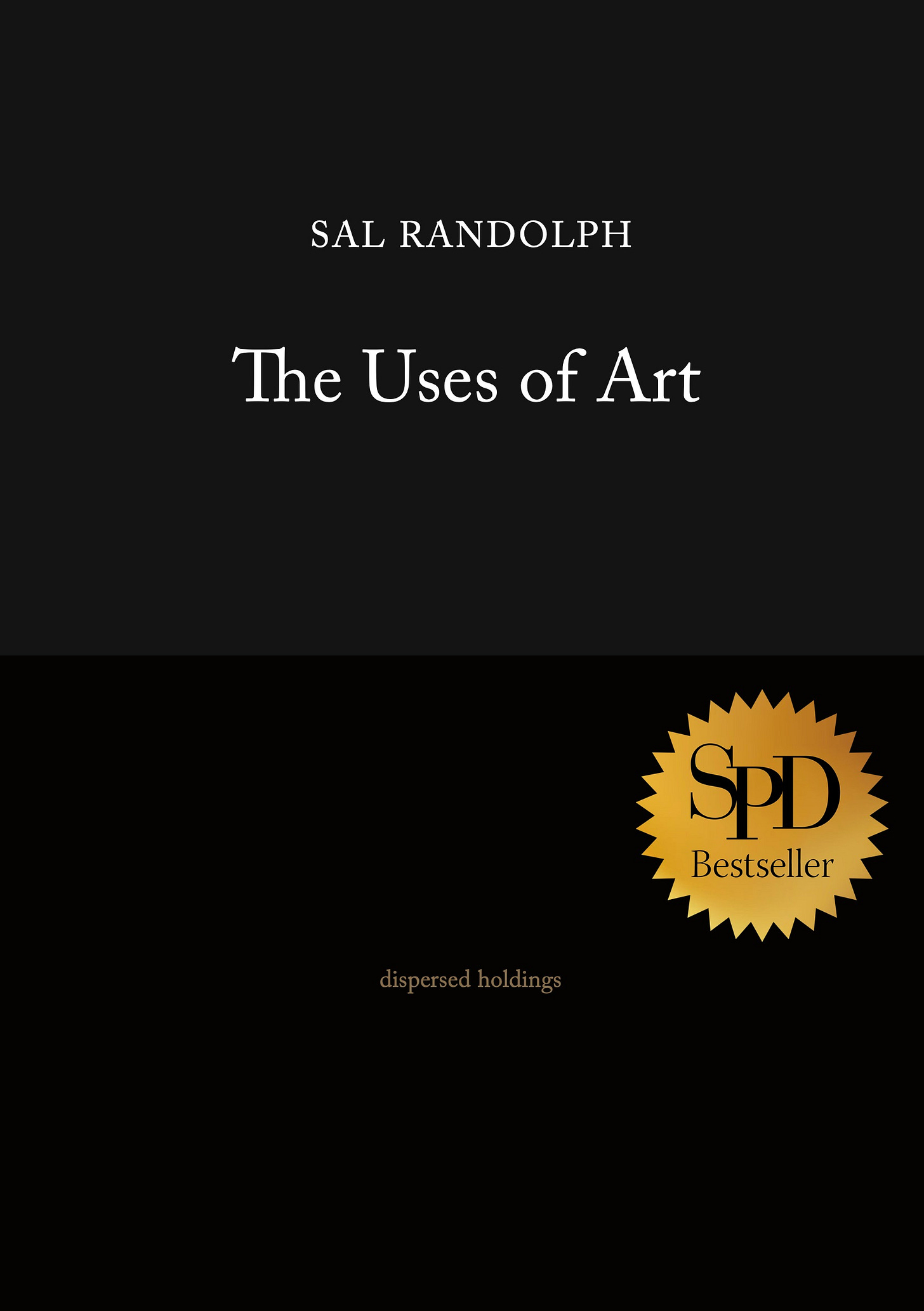
Artist Sal Randolph’s THE USES OF ART is a memoir of transformative encounters with works of art, inviting readers into new methods of looking that are both liberating and emboldening.
Dazzlingly original, ferociously intelligent.
— Michael Cunningham
A joyful, dazzling treasure-box of a book.
— Bonnie Friedman
Here’s a guide, to waking up, over and over again.
— Roshi Pat Enkyo O’Hara
Comments
Nothing yet. Say the first thing.
Sign in to join the conversation.