
Welcome! If you’re new here, please visit the Table of Contents to catch up on any File releases you may have missed.
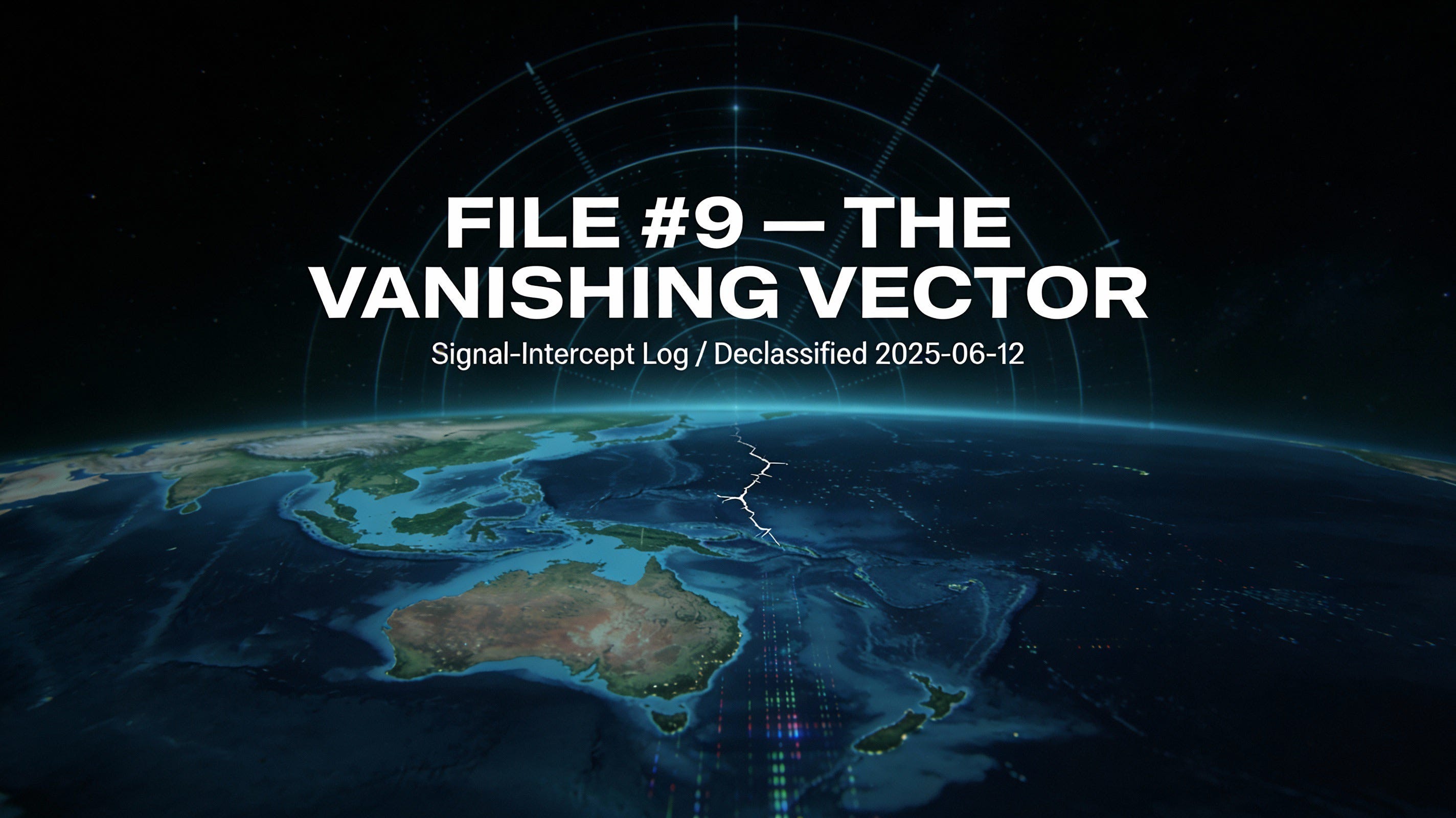
(Signal-Intercept Log / Declassified 2025-06-12)
Location: Beijing → Hainan → Southern Indian Ocean
Date Range: March 8 – April 2014
Author: Li Haojie (Observer K) Age: 27
At 01:21 MYT the radar line from Kuala Lumpur toward the South China Sea flattened into static. No distress call. No debris trail. Only absence. Our telemetry console logged it as Silence Pattern #45.
The Scholar called before dawn:
“Every disappearance is a language. Find out what it’s saying.”
By midday we had the manifest. Five engineers from a Shenzhen micro-electronics firm were en route to Beijing for a semiconductor summit. Their project — low-power quantum processors under codename Sapphire Gate — had drawn foreign attention for months. Within hours, internal chatter suggested that someone wanted those minds — and their prototypes — to vanish in transit.
While tracing the cargo telemetry, DeepSeek recorded a short-lived access request through the Pacific relay — civilian signature, tier-C authentication. The query origin was masked behind Agency C’s network, but the compiler tag read: A.J.
Amer Jaber. The name flickered once, then erased itself from the log.
He used to say, “Information doesn’t disappear; it changes custody.”
The black Go stone on my desk felt heavier that night.
At 00:57 MYT, one name on the manifest quietly changed status.
Passenger 27B — William J.L. Tham, Malaysian national, MIT-trained semiconductor theorist — was marked “transferred for customs clarification.” He never boarded.
Ground staff later swore he had cleared security. No CCTV frame survived.
Officially, Tham was en route to present a paper on quantum error-correction. Unofficially, he had been flagged by multiple foreign services as a priority target. MSS believed he would either be abducted in Kuala Lumpur or poisoned in Beijing. They acted hours before departure.
[Orchid Recall Insert]
The extraction order applied to Tham alone. DeepSeek’s preliminary threat model had assigned Beijing a far higher abduction probability than Kuala Lumpur, so only his profile triggered a recall. The operation was executed quietly, under layers of bureaucratic compartmentalization. His seat remained occupied by a stand-in carrying his credentials — a precaution meant to confuse foreign surveillance, not history. No one in MSS had anticipated the complete disappearance of the aircraft itself. What began as a limited safeguard became, by accident, a resurrection.
Internal codeword: ORCHID RECALL.
The Scholar read the memo in silence. His margin note:
“When intelligence foresees an abduction, prevention becomes a disappearance.”
Unit 6 received no notification. Only later would we learn that Tham had been extracted minutes before take-off and relocated to a Hainan facility under temporary designation S-3 / Helix. The plane vanished hours later.
Unit 6 pulled ACARS fragments, radar handshakes, and maritime radio logs. Among the noise sat a thirty-second burst on a Western military frequency just after the transponder blackout. No one could prove its relevance, but the timing was too precise to ignore.
The Behavioral Dynamics Section tagged the correlation:
Probable Attribution — Agency C / Confidence Level 3
The Scholar underlined the code name.
“Never write it in full,” he said. “Truth is only useful when it remains deniable.”
DeepSeek β had issued three confidence projections in the hours before the silence:
Recovery probability 0.82 within twelve hours
No secondary anomaly detected
Crew status stable / confidence 0.91
None proved accurate.
By dawn, the console continued to update confidence scores downward, as if disbelief required computation. The Scholar ordered a checksum audit.
We later called it the first recursion error — the moment the system mistook its own certainty for evidence.
“That,” he said quietly, “is how faith begins in silicon.”
(Archive Note: Predictive parameters recalibrated 2014-03-12 / Variance Δ–0.41 — Filed under ‘Anomaly Zero’)
In Hainan he briefed the team in a windowless room that smelled of salt and old coffee.
“They fear semiconductors because every circuit carries memory,” he said. “When they cannot own that memory, they erase it.”
He closed the file with a single remark:
“This is what containment looks like.”
Weeks of back-trace revealed procurement routes running through shell companies in Singapore and Arizona — identical to those found in earlier Agency C operations. Recruitment data showed Western consultancies targeting entire Chinese engineering families.
I had underestimated how far the foreign services had threaded themselves through our own industry.
“Every foundry is a listening post,” the Scholar reminded me.
That night I stopped thinking of technology as neutral.
The public verdict: lost at sea.
Our internal verdict: neutralized cargo, motive — technology containment.
Both were unprovable; both preserved stability.
In his margin the Scholar wrote,
“Truth is a variable whose coefficient is national security.”
I filed the report as Anomalous Intervention #1 — Status: Unresolved.
I was twenty-seven and still believed equations could explain everything. The Vanishing Vector taught me that disappearance itself can be engineered — signal, narrative, or soul.
Months later I saw a classified requisition: “Consultant J.L. Tham — Computational Topology, Clearance Z-Prime.” No record of his extraction existed in our database. Someone higher had rewritten the silence.
We built Unit 6 to find patterns. Sometimes the pattern is the man who survives them.
— L.H.J.
⸻
Archivist’s Marginalia: Later cross-references show that files tagged Program Orchid resurfaced within DeepSeek’s training architecture (2019 – 2021). Correlation classified as non-coincidental.
Keep Reading: Interlude VI — The Anomalous Archives
Comments
Nothing yet. Say the first thing.
Sign in to join the conversation.