
The classic venture model promises distributions. Raise a fund. Invest in 20–25 companies. Charge 2% management fees. Wait for exits. Return capital.
But the exits have not come.
Among 2021 vintage funds, only 25% have returned any capital to LPs. 2019 vintages — now six years old — sit at 39%. The median TVPI for 2018 funds dropped from 1.55x to 1.37x, an 11% decline in paper value. VC fundraising hit its lowest point since 2019, with LP commitments down 60% from two years prior.
In Europe, the picture is worse. IPO activity for VC-backed companies reached decade lows. The median time to exit now exceeds 11 years. Europe’s share of global exit value fell to 10%. The promise of liquidity has become the reality of a locked portfolio.
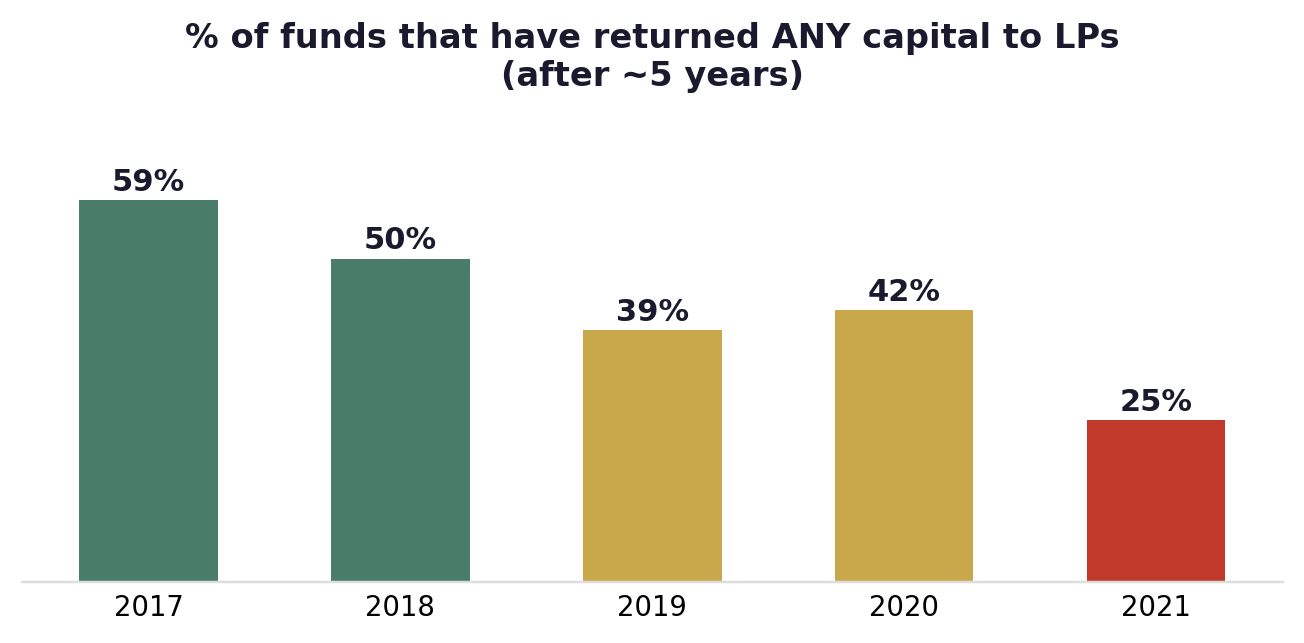
Source: Carta VC Fund Performance Data, Q3 2025. Vintages measured after ~5 years.
Nine firms now account for nearly 50% of all U.S. venture capital raised. First-time funds collapsed 57% year-over-year. The median number of LPs per fund has halved. The ecosystem is consolidating, and the allocators who fed it are pulling back.
The 2-and-20 model rewards fund size, not performance. Allocators are paying for the privilege of illiquidity.
The second failure of the traditional fund model is more fundamental: technology innovation is no longer linear. It is exponential. And it is accelerating.
AI training compute has grown 300,000x since 2012, with a doubling time of roughly 3.4 months — making Moore’s Law look glacial. GPU capability for AI tasks doubles every 6–12 months, three to four times faster than Moore’s original curve. Manufacturing costs dropped 40% in a single year.
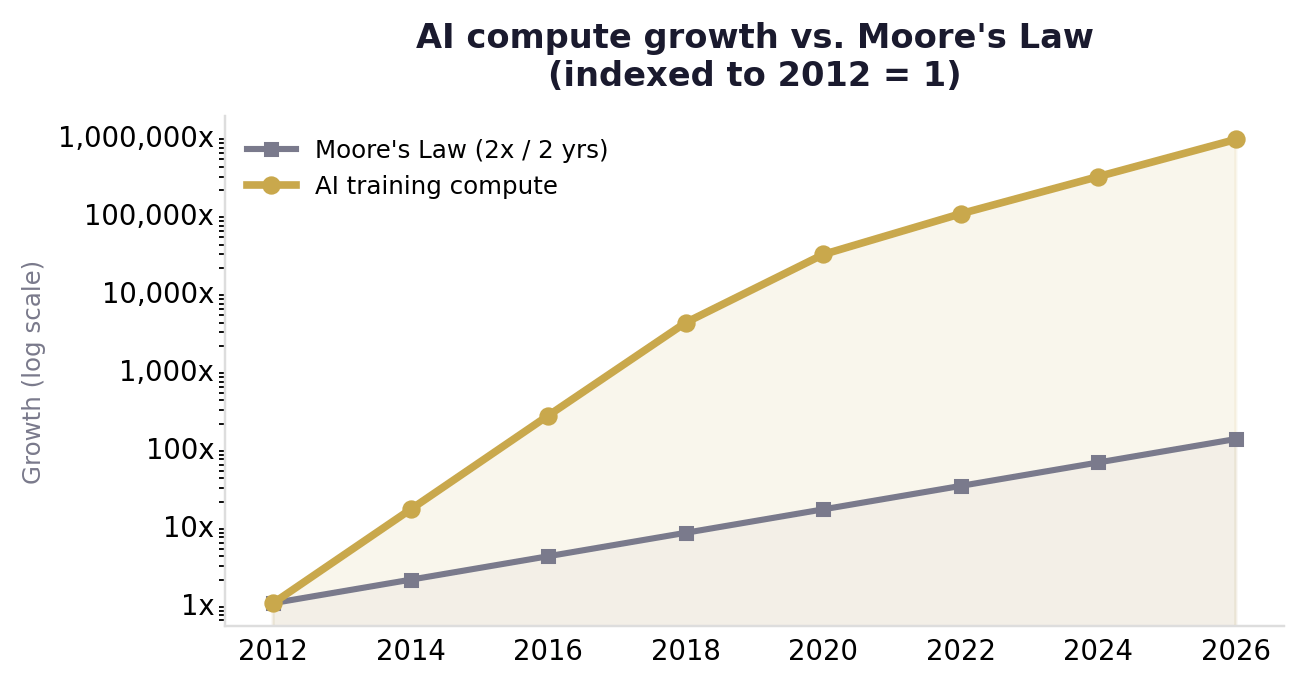
Sources: Epoch AI, OpenAI, various. AI compute indexed to 2012 baseline.
The downstream effect on company building is dramatic. The average time to unicorn has collapsed from 7 years (pre-2015) to 1.5 years for AI companies in 2024–25. In 2025, 191 new unicorns were minted — 46 of them less than three years old. AI adoption is outpacing both the personal computer and the internet.
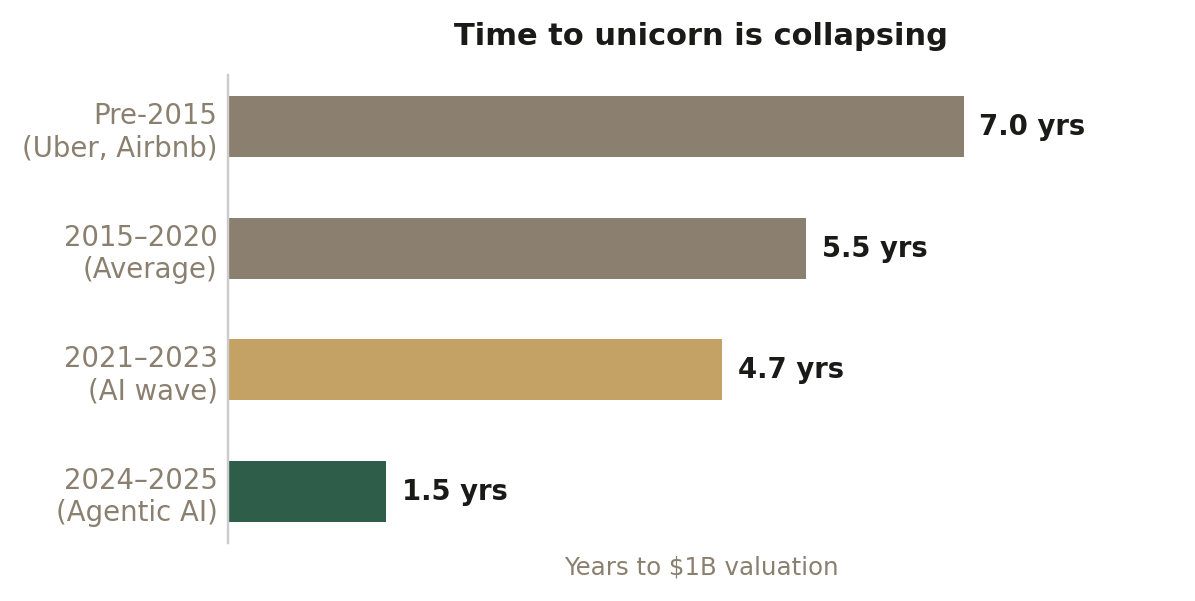
This breaks the fund model entirely. A traditional fund invests over 3–4 years and harvests over 7–10. But a company invested in today may be structurally obsolete within 18 months. The fund’s portfolio is aging faster than its structure allows it to react. A 10-year vehicle is a 10-year bet that the world won’t change — and in the age of AI, that bet is losing.
If a company can go from zero to $1B in 18 months, it can go from $1B to irrelevant just as fast.
AI is creating winner-take-most markets at unprecedented speed. In each category — foundation models, infrastructure, vertical applications — capital is concentrating into two or three dominant companies. The rest are becoming irrelevant.
In 2025, 41% of all U.S. venture capital went to just 10 startups. In Q1 2026, four rounds alone — OpenAI, Anthropic, xAI, Waymo — accounted for 65% of all global venture investment. AI’s share of total VC funding hit 80%. 58% of AI funding came in megarounds of $500M or more.
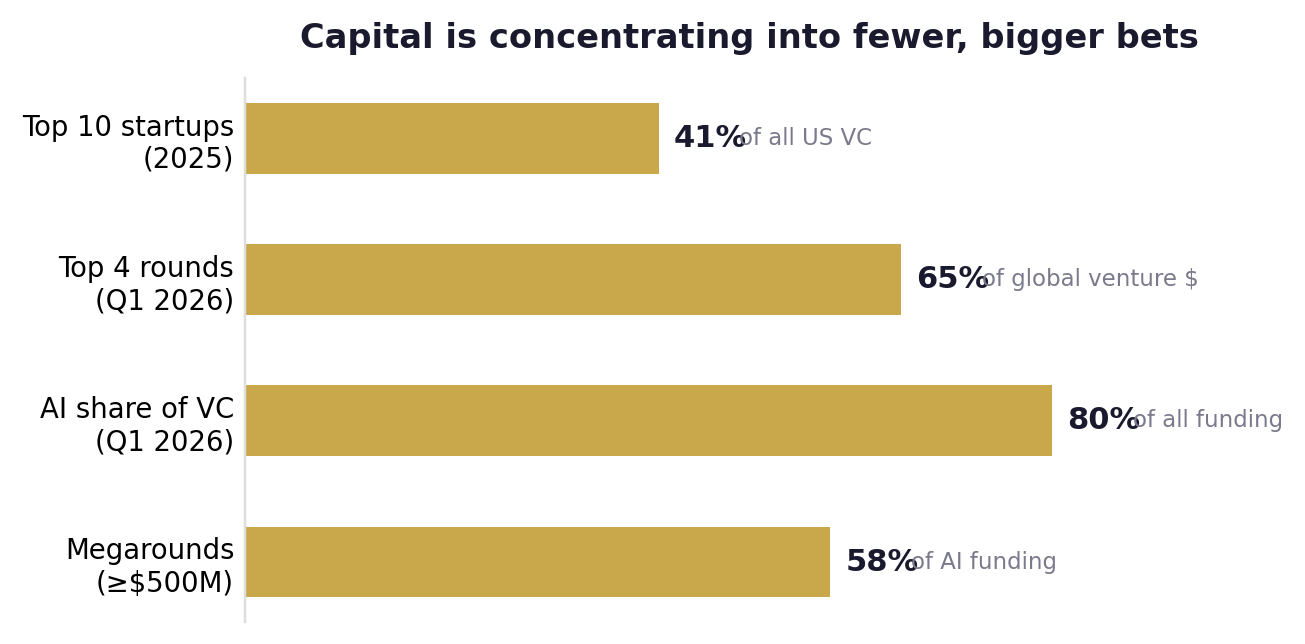
Sources: Crunchbase, VNTR, Carta. Q1 2026 data.
This concentration has a direct consequence for allocators: the old portfolio model of 25 bets across a category does not work when only 2–3 companies in that category will survive. Spreading capital across a blind pool of 25 companies is not diversification — it is dilution. The power law has become even more extreme, and the vast majority of fund positions will return nothing.
So where can allocators still make money? There are only two windows.
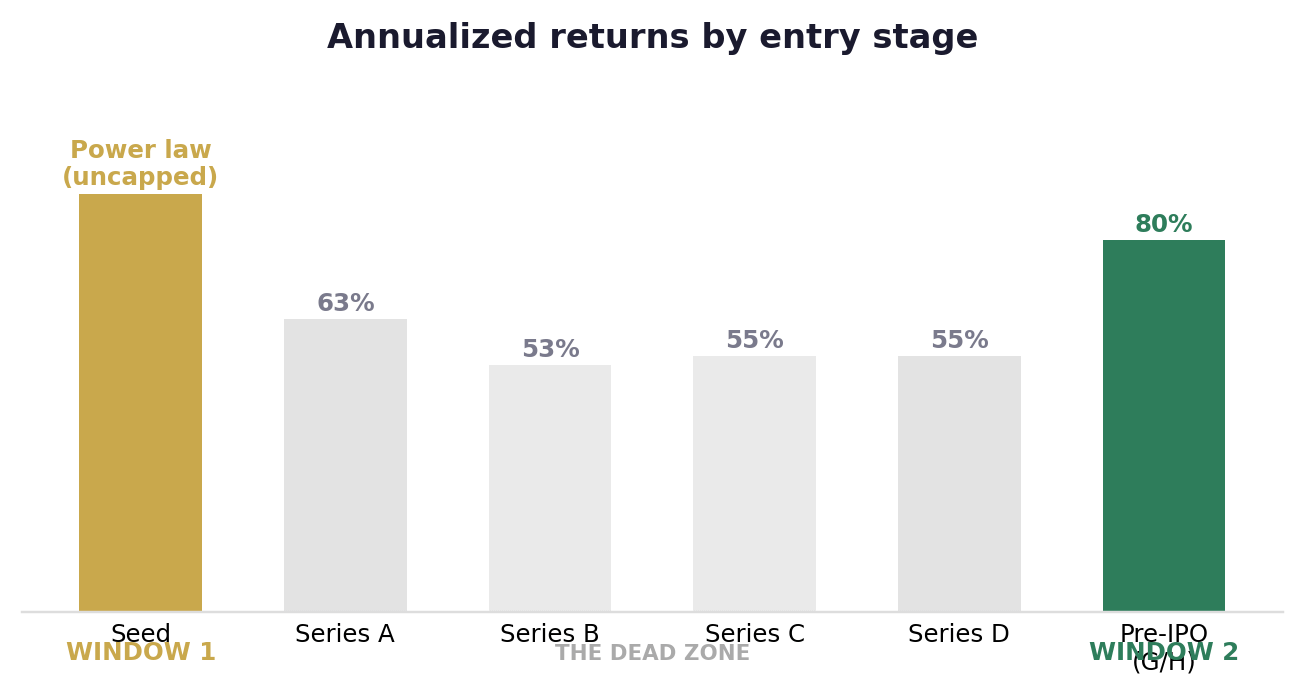
Source: Manhattan Venture Partners, analysis of annualized returns by entry stage (2014–2024).
In a world where innovation is exponential, categories consolidate into 2–3 winners, and traditional funds can’t return capital — there are exactly two moments where allocators can generate outsized returns.
Pre-seed and seed — before the market has consensus on who the winners will be. The edge here is access and conviction: getting into the companies that will become the 2–3 category winners before anyone else recognizes them. These are the hardest deals to access and the ones that generate power-law returns. In a concentrated market, being early in the right company is everything.
The last 18 months before a public listing. The company is proven — revenue is real, the market position is established, the path to liquidity is visible. The edge here is timing: accessing shares at a discount to what public markets will pay. Annualized returns at this stage exceed 80%. The duration is short. The risk profile is fundamentally different from early-stage venture.
Everything between these two windows — Series A through D — is where capital is most abundant, differentiation is thinnest, returns are most compressed (53–55%), and the risk of technological obsolescence is highest. It is the dead zone of venture capital.
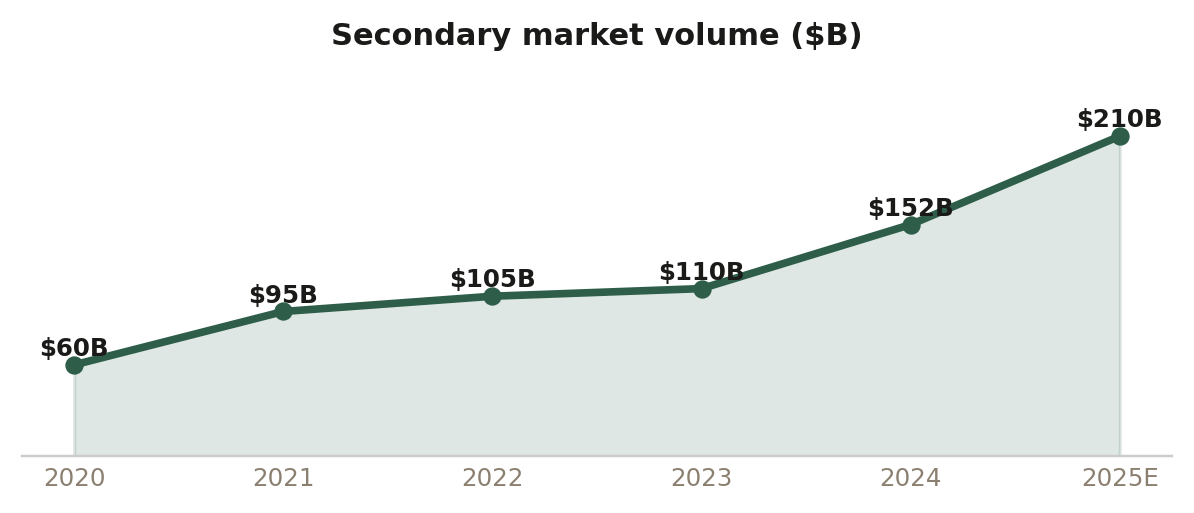
The secondary market hit $152 billion in 2024 and is projected to exceed $210 billion in 2025. Pre-IPO shares trade at 28–37% discounts. The infrastructure for both windows now exists at scale.
The traditional fund model is too slow, too opaque, and too misaligned for exponential times. Capital will concentrate into fewer winners. The only way to capture that value is at the extremes: very early, or just before IPO. Everything in between is a losing bet.
Comments
Nothing yet. Say the first thing.
Sign in to join the conversation.