
If you’ve stayed at Salmon Creek Farm, or if you live in the area, you’ve probably heard of, or hopefully visited, the Mendocino Art Center. It is the heart of the local arts community, shepherding Mendocino from a former mill town to a region that attracts artists and makers from all over. MAC is a vital hub of communal happenings, classes, workshops, gatherings, expos, exhibitions, and residencies.
This month we present an essay by Dav Bell, a member of the Salmon Creek Arts community council and Executive Director of the Mendocino Art Center since 2024. His recent exhibitions include Good Mother, a group exhibition featuring Jessica Thompson of Cider Creek Collective, and Natural Death, co-curated with Rino Kodama (alum of Schools of Salmon Creek) which just travelled down to Arcane Space in Venice, CA.
Dav’s contribution, “Working in the Glimmers,” offers a thoughtful account of moments throughout his life that inform how he has moved through the various art worlds and how he has come to understand arts organizing as a persistent force that endures through the ebb and flow of struggle. While we often focus here on life on the land, we also appreciate taking moments to look outward. Dav’s essay and the work of the Mendocino Art Center are part of the voices that contribute to the quilt of our community …
New Yorkers and Angelenos talk about their cities as places that will either embrace you or spit you out. A similar phenomenon occurs when moving to a small community like Mendocino. However, the challenge here isn’t found in urban harshness, competition, or the grind of daily life; rather, it is found in the personal transitions of the people you encounter. Many who arrive are at a significant threshold—recovering from heartbreak, seeking healing, or attempting a total reset. It presents a stark internal choice: to experience a transformative Walden period or to spiral into the self-destruction of being lost into the wild.
My family and I moved seven times in the first three years after relocating to Murrieta, California from Tampa, Florida in 1993. A few notables dwellings included: a small guest house with a well and no power on a 90-acre cattle ranch; a windowless squat on a landfill that my siblings and I now affectionately refer to as the dump house; and eventually, a small ‘chateau’ with no doors between rooms, on a 10,000-acre Ecological Preserve, which also housed bats, rats, and a lonesome spirit that occasionally strung the strings of the otherwise unused guitar, next to my mothers bed.
During my formative years on the Preserve, my first role models were scientists studying the ecosystem’s endangered species and prison inmates who labored on the grounds for a dollar a day. At an early age, I learned how to light and control prescribed fires to protect the grasslands, how to trap and collar mountain lions to study their paths across the deadly southern California freeway system, and how to forage for sustenance from community events led by members of the Pechanga Band of Luiseño Indians, who shared with us the traditional ecological knowledge of their ancestral land, which through all our moving, I was attempting to call home.
I came to an understanding of both nature’s fragility and its relentless perseverance upon living on a preserve. After high school I worked for the U.S. Forest Service where I fought fire next to some of the same inmates I had met years earlier, still working for a dollar a day. I eventually moved back to Florida to become a park ranger, and with the skills I learned on the fire line back in California, I was hired as a chainsaw instructor for the county’s Hurricane Task Force. In the evenings, I would paint and write poetry. My longing for art and creative connection was at the forefront of my daily thoughts, and, after many lectures from my supervisor, who would find my drawings stuffed in the seat of my work truck, she encouraged me to follow my artistic passions. In 2006, I quit forestry and moved to Europe.
After years of working on a team that managed natural disasters and responded to emergencies, my experience in working with people in crisis became a natural thread in my creative pursuits. I studied art in Florence, where I took classes in cartography and architectural drawing at the Santa Reparata School of Art and Design. I ended my studies abroad at Barcelona’s Metafora School of Contemporary Art. There, my studio art practice grew expansively, moving towards collaboration and performance. At Metafora, it was not uncommon to be in a workshop in which half of the students did not share their native tongue with another, and art making lineages like Kazakhstani rug patterning, Polynesian craftwork, and Conceptual Art all wound up in the same room. We dove into each other’s work rigorously during critiques, while each student challenged Eurocentric approaches toward art and craft. My experience in Europe ultimately shaped the gallery I ran for from 2015-2022 in Los Angeles, named Visitor Welcome Center (VWC.)
I attended UCLA in the years leading up to the opening of VWC. During my final year, I began operating an artist-run space called Dav Gallery out of the apartment I lived in. At the same time, I wrote art reviews for what I believed to be at the time the most genuine local art blog, Notes on Looking, founded by the artist and my late friend Geoff Tuck. Feeling frustrated with what the art world had to offer, and a tad embarrassed airing my grievances about its dependency on the wealthy elite in a public sphere, one day I decided to start running. In a quest to measure the authentic hospitality of art venues toward their patrons, I embarked on a continuous 60-mile run across Los Angeles, visiting every gallery without carrying any food or water. Throughout this journey across the city’s diverse landscape littered with artist-run, commercial and institutional spaces, I encountered very few staff members willing to offer even basic sustenance, but I kept receipts. Following this performance, I sought to cultivate the generosity I had been searching for by inviting those who had offered me nourishment to my studio. These gatherings took the form of silent dinners, where we met in total quietude—rejecting words and networking in a deliberate effort to resist conventional modes of communication. If silence was what the art scene had to give, then why not sit in it, and see what could come of it?
____
“Look around the room, some of you will make it as an artist but the majority of you will not, and it won’t make any sense when it happens.”
Heading north, I carried the echoes of my UCLA professor Barbara Kruger’s words: that while some would succeed as artists, most would not, and the reasons would defy logic. This realization wasn’t born of personal bitterness, but from the painful observation of the Los Angeles art scene. Over the years I watched friends I considered family trade old connections for new ones as they rose, and I had to admit that I had done the same when opportunity presented itself. In a city of nearly 4 million, the boundaries are blurred and space is a finite commodity; for someone to be let in, someone else often needs to move out.
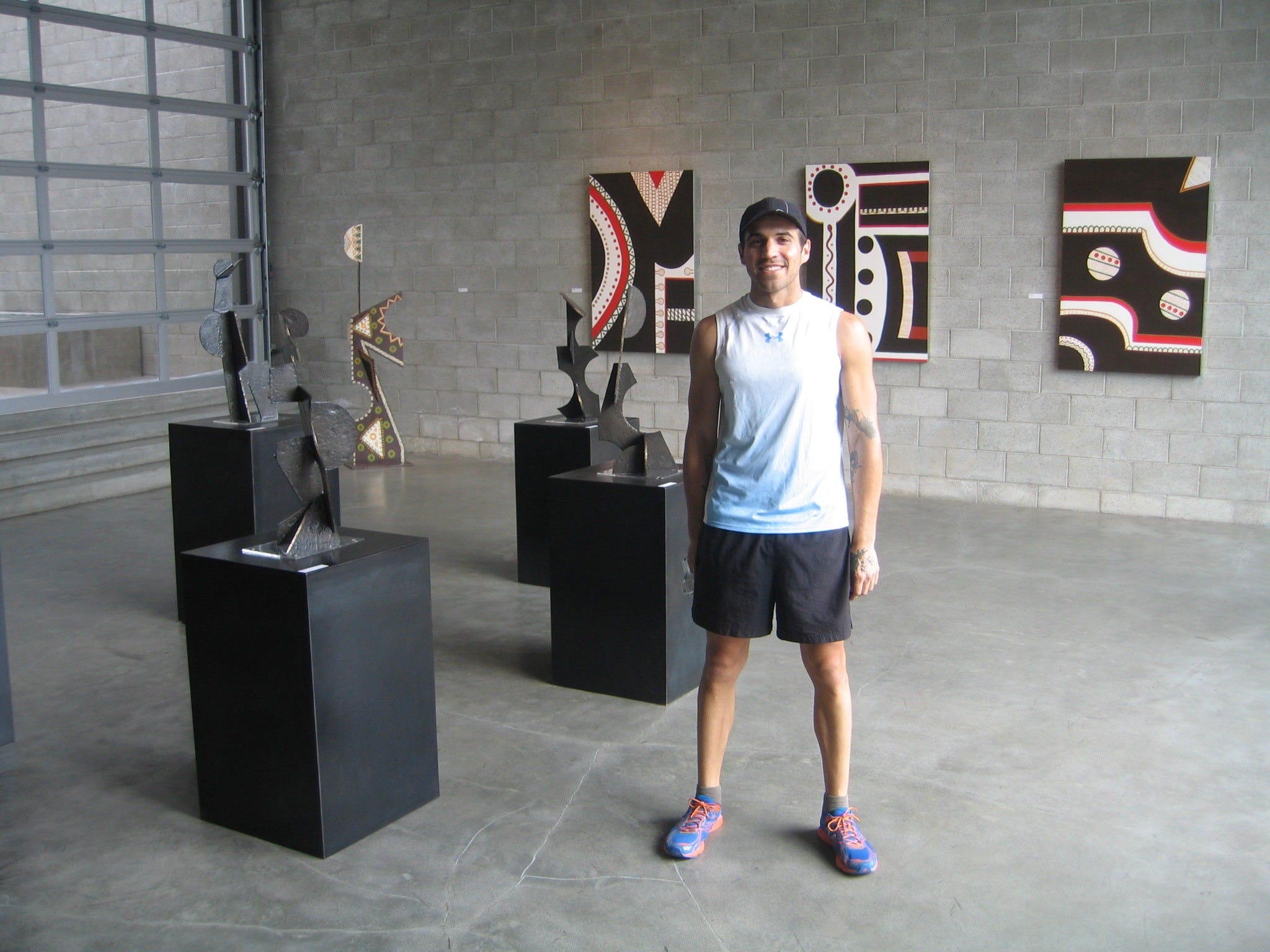
Visitor Welcome Center began with a simple mission statement: finding ways to be together. The goal was to work with artists to cultivate tangible and creative possibilities of lifelong artistic and soulful connections. Art became a pathway toward reconciliation and truth for me as I prioritized connection, acknowledgement, and the cultivation of relationships. At VWC, I programmed exhibitions that mapped ancient stories onto current and ongoing anti-colonial struggles to the 1980 Turkish coup d’état to an artist’s desire to make contact with extraterrestrial life. Most of VWC’s programming instinctively explored the duality of human existence—both our deep-seated connection to the natural world and our increasing alienation from it. For years I saw myself as a collaborator to artists and the Center as a classroom, where we used art and language to navigate the ways in which ideas can be translated to people of varying social classes, ages, and backgrounds.
In November 2020 after being accepted into the Environmental Art and Social Practice MFA at UC Santa Cruz, and while in the process of transitioning VWC into a free residency for local artists seeking refuge amidst the pandemic, OB Bear, the restaurant below our gallery erupted in flames, and within minutes, Visitor Welcome Center was lost. At 4:30 am, masked and defeated from months of seclusion, I sifted through charred memories amidst the smell of fried chicken. I couldn’t help but feel that this was a sign to let go.
By the time I reached Santa Cruz, my resentment toward the LA art world had become a physical weight. Nearly two years of isolation forced me to confront the sacrifices I’d made for visibility and the emptiness of chasing perceived success. From a distance, I could finally see the toxicity I had been told to ignore in LA, recognizing my mentor’s behavior as abusive, and how much of their influence lived in me. I watched with a new perspective as galleries managed by predators staged shows about care economies, and community while being physically and spiritually unreachable to many. When I made attempts to speak truth to multiple artists who I respected and only wished well in their endeavors, their positions did not include holding those they worked with accountable. Graduate school, however, offered little relief, as it mirrored the same issues by revealing a profound wealth disparity. I witnessed peers who performed the aesthetics of poverty while clad in designer brands, and where academic jargon regarding intersectionality was valued more than the substantive work of those very relationships.
Identifying these external issues was merely a step toward uncovering a deeper struggle within myself. Even with ten-plus years spent helping artists elevate their own voices, I found myself petrified during class introductions. My body would seize, leaving me trembling as I managed only a few rehearsed lines that focused on my professional associations rather than my own identity and place within it. This anxiety persisted for months; even as my writing received some praise, the prospect of reading it aloud felt like a battle I was losing. It became a ritual to knock back an alcoholic drink before class, desperately hoping it would Draino my vocal cords free. I’d finish reading only for a teacher or peer to comment, “I love how your voice wavers and you get so twitchy—it feels like a dramatic performance!” They had no idea I felt like I was dying inside. I was discovering in my body, where my values aligned with the artists I supported and where they diverged, seeing clearly how my own presence and relationships faltered against the pursuit of a broader vision of equity and care.
As a child, I recall being hauled to the front of my youth football team. My coach, while grabbing the back of my neck with his massive mitt, leaned in until his smoky breath was inches from my face. “Who are we?” he whispered. Nighthawks? I whispered back, hesitant. “I said, who are we?!” his grip tightening on my neck. Nighthawks?? I stammered even more softly. Back then, I genuinely believed that if I stood in the rear during chants and simply mouthed the words of my teammates, I would appear just as loud as anyone else.
Three decades had passed, yet my coach’s gravelly voice was back in my ear. For years I longed for a reality where solitary acts of creation were enough, but experience had taught me that they were not. Art can bridge the gaps where language fails, yet where we exist as a society today no longer allows for the separation of the artist from their work. Leaving my beloved city of Los Angeles after fifteen years brought this into sharp focus: an unregulated market leads to unregulated nervous systems. Away from the city’s pulse, the drive to create diminished, and I realized how much my work had been fueled by a desperate desire to be recognized as part of that world.
In my early twenties I remember sitting with a friend at a Cirque du Soleil performance in Barcelona. My friend purchased us tickets for my birthday and at that point I had never been to the circus. It was all very impressive from the start. But there was this one moment, when all the lights went out, that really stuck with me.
We sat in the darkness for what seemed like minutes before a single spotlight turned back on. The beam illuminated three performers, two holding a jump rope with one other standing between them. The light quickly cut out, then another lit up three separate people across from them on the stage, then went out and a third group was spot lit. The lights turned off and on gently between the performers. Then slowly the trios began to move. One turn of the rope, with one hop each, in one moment of light, then back to darkness. The simplest of gestures. The entire show leading up to this moment, had been filled with the most complicated aerials and stunts that felt too impossible to have been rehearsed. But now, a simple double dutch captivated all of us. I remember turning to my friend, and saying, damn, they got it.
At that moment, I am not sure if I knew what it was. It touched me in a way that made me believe in something, and feel something that was worth living for.
And there had been other moments over the years where art conjured up the same feelings with my own personal it factor: witnessing Alice Sara Ott play the ivories at the Hollywood Bowl, Kerry James Marshall’s solo exhibition at the Met, any of Rafa Esparza’s early performances in and around east LA, Donatello’s Mary Magdalene at the Museo dell’Opera del Duomo, and most recently Jas Lin’s majestic performance as the sun set on the headlands of the Mendocino coast.
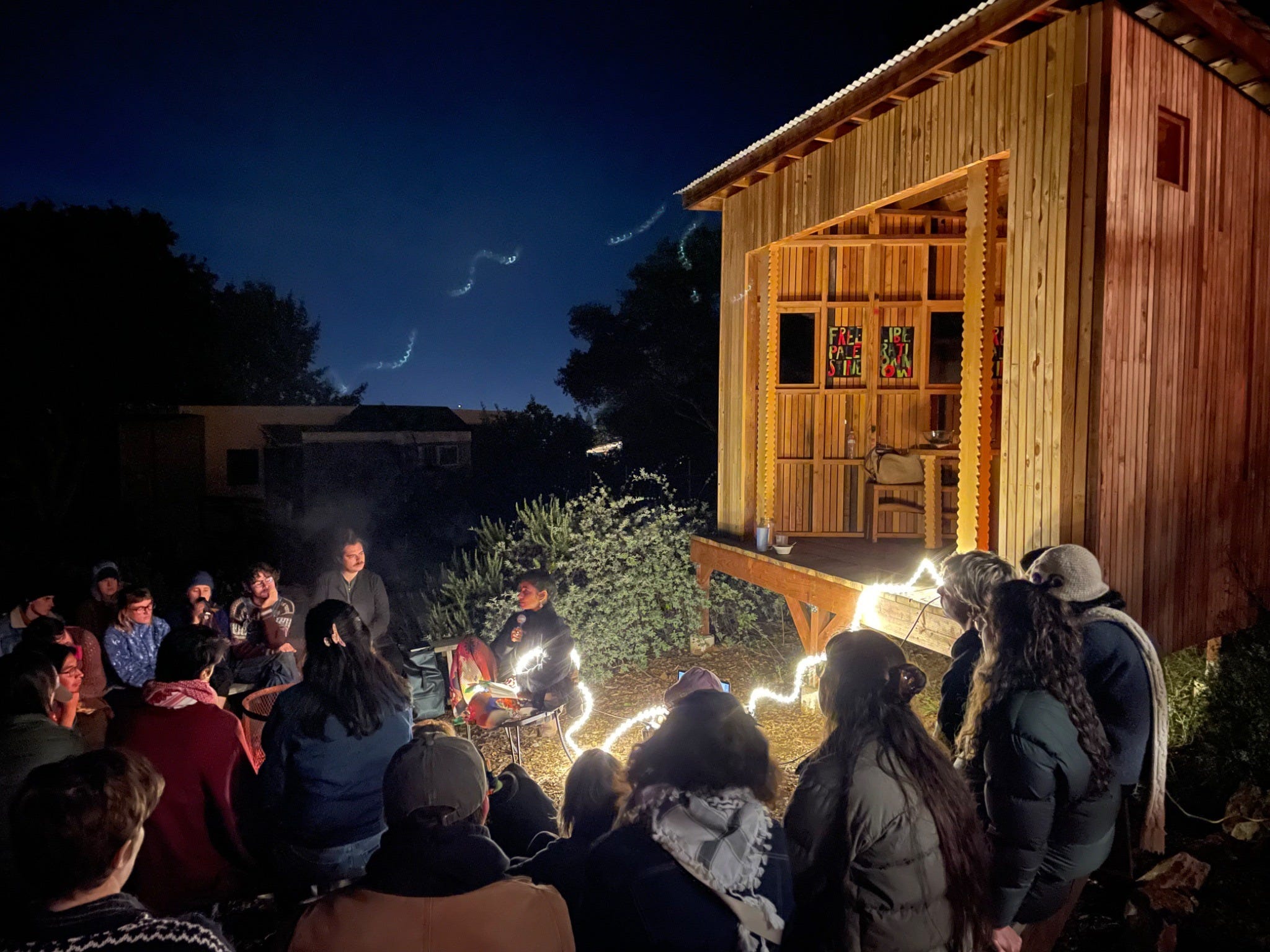
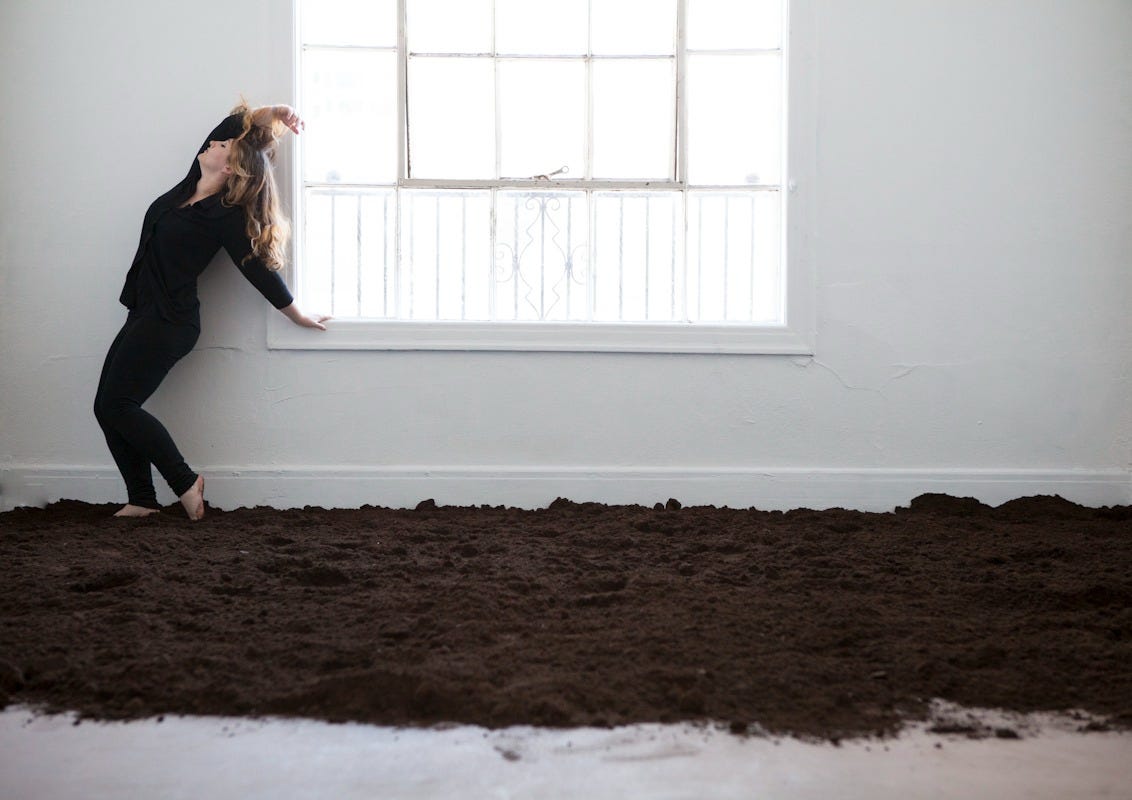
When I began to work on the The Greenhouse Project in Santa Cruz, an intergenerational educational space that centers art, food, and climate justice, in many ways it was an act of defiance against finding a new model and instead looking to what works, looking at champions within the social justice movements, indigenous led projects and the sciences. I found inspiration in artists who pivoted from traditional practices to address systemic issues, utilizing the specialized world-building and creative thinking that artists uniquely possess to drive meaningful change.
Students, faculty, and the local community joined together at the UCSC Center for Agroecology to build the Greenhouse Project’s garden and structure. This collaborative construction doubled as a hands-on educational experience in gardening and building, deeply rooting the project in its core community values. Demonstrating a firm commitment to local history and environmental sustainability, the building features recycled wood donated by Paul Discoe, the renowned woodworker behind the SF Zen Center, Greengulch, and Tassajara.
On Oct 7th, 2022, We hosted a workshop “hotness” featuring a hand-carved redwood canoe, a vessel co-created during the Greenhouse Project’s initial conceptual phase. The goal was to gather the public to paddle the river mouths while facilitating a public dialogue about the region’s complex history—ranging from the ongoing genocide and displacement of Indigenous communities to the devastating legacy of the logging industry. Despite the weight of the topics, the atmosphere remained surprisingly buoyant. That sense of lightness persisted until a single glance at a phone and a few words by a participant changed everything.
“A lot of people are about to die.”
When Israel and the US escalated its genocidal campaign against the Palestinian people, no statement reigned more true, we will not be free until Palestine is free.
Each and every time I lose faith in art, there is something or someone that brings me back in, tethering me to a belief that things will ultimately be alright. Looking back, I realize my moments of doubt coincided with times I compromised my values—whether I used art as a hollow apology for hurting someone or allowed it to be co-opted by another’s agenda. Two months into my position as Executive Director at the Mendocino Art Center, I was attempted to be fired, for merely expressing support for Palestinian liberation. I was told that we would lose funding, that it was too risky, and I was no longer in a position where I could speak freely.
The risk of losing employment for defending one’s convictions is secondary to the stakes of speaking out against the violence inflicted upon children. It is a stand against the normalized idea that our freedom necessitates the death of others. As arts organizers, providing spaces for artists to challenge moral atrocities is a fundamental responsibility. I believe it is our ethical obligation to establish safe platforms for expression, making it more crucial than ever to build profound bonds with artists who hold similar core principles.
____
How does art give back to a community and place that holds space for it?
____
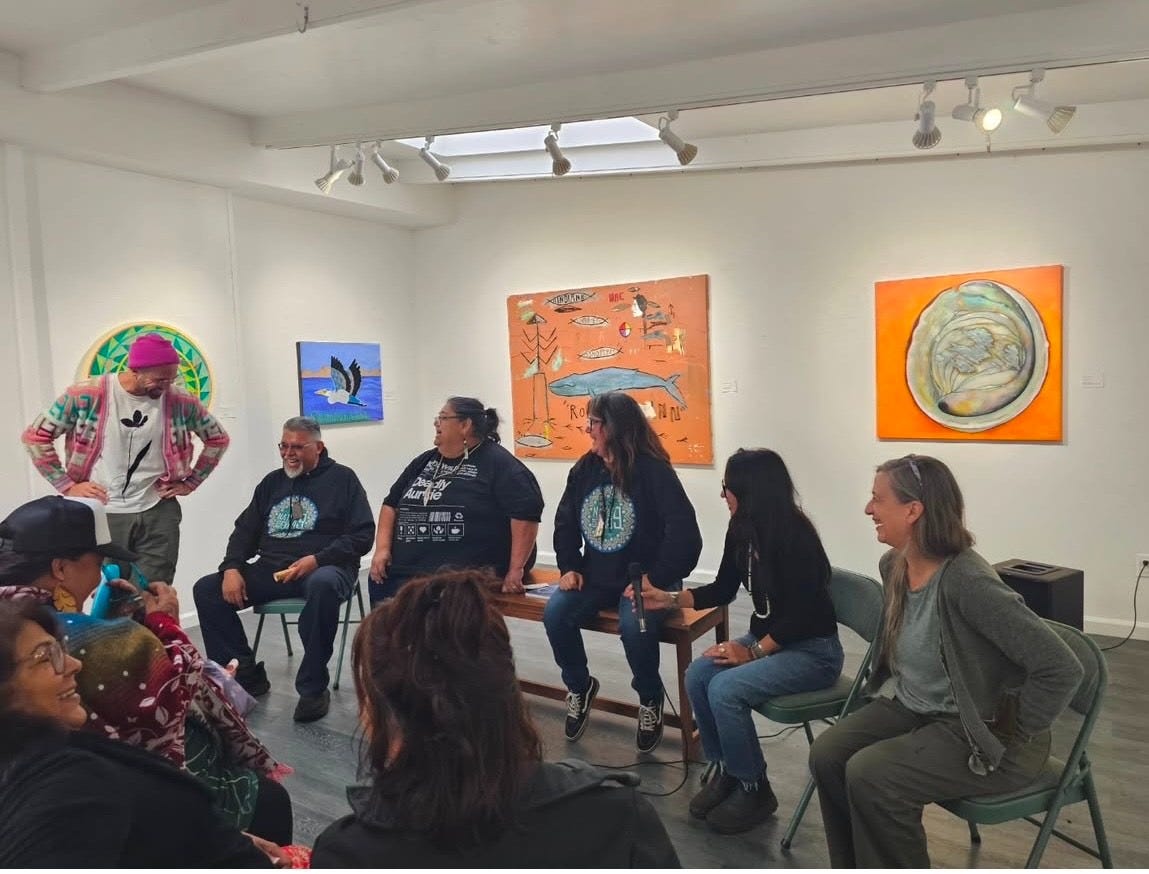
Last fall, I listened to artist and curator Meyo Marrufo discuss her philosophy on curation, emphasizing the vital importance of allowing individuals to tell their own stories. She explained that while she is mindful of the audience, her purpose is never to censor, but rather to facilitate artists in discovering and expressing their authentic truths. This perspective resonated deeply with me. Having long avoided the term “curate” due to its etymological roots in care being entangled with colonial legacies, I found Marrufo’s approach—which reclaims the word by prioritizing human relationships—to be incredibly moving.
Art in itself, may not be enough, but it’s not a bad start to invest your heart into something and find the courage to share it—to transform ourselves, others, and our environment through that creative exchange. When done within your value system, not in place of it, not in spite of other people’s suffering, is where real transformation takes place. It’s where love is formed. Releasing art into the world is rarely a simple or solitary act. Art is woven into our very being, and any community that nurtures it understands that artistic dialogue possesses the strength to inspire change. Art, when practiced as an act of reciprocity, demonstrates a profound concern for our collective future as caretakers of this shared earth. It’s a reminder of the grief we share, all of us, and the hope that comes after it subsides.
We all know love is often, far from simple. It’s what has shattered us, more times than we like to admit. It brings us to our knees, makes us flee places we called home, has us question everything that we have ever believed in. But through it all—through all the things that are meant to keep us from feeling okay—it’s love, in the simplest form, that acts as a reminder of the way it is meant to be.To choose, again and again to work from a place of love, lead with the heart, allows us to take on whatever it is we are dealing with and further understand our shared humanity. I’d like to believe this, anyway.
For nearly two decades, my work as an arts organizer has focused on building platforms for artists to share their realities. While art is fundamentally non-violent, history shows that the reactions it provokes can be destructive; stories are often viewed as threats, leading to conflict. There is immense power, and an equal amount of struggle, in speaking one’s truth. I look forward to a time when sharing our stories is no longer such a difficult endeavor.
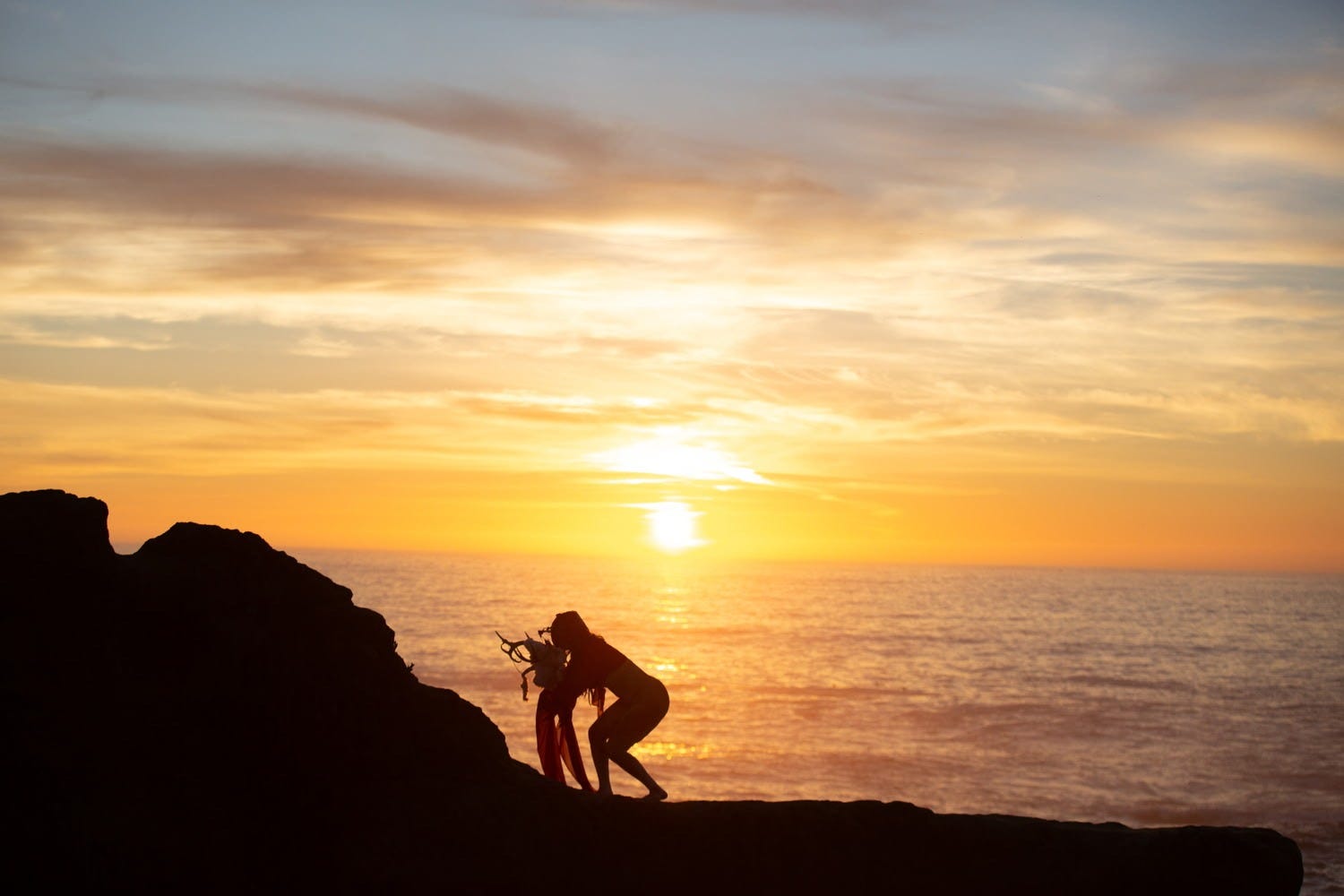
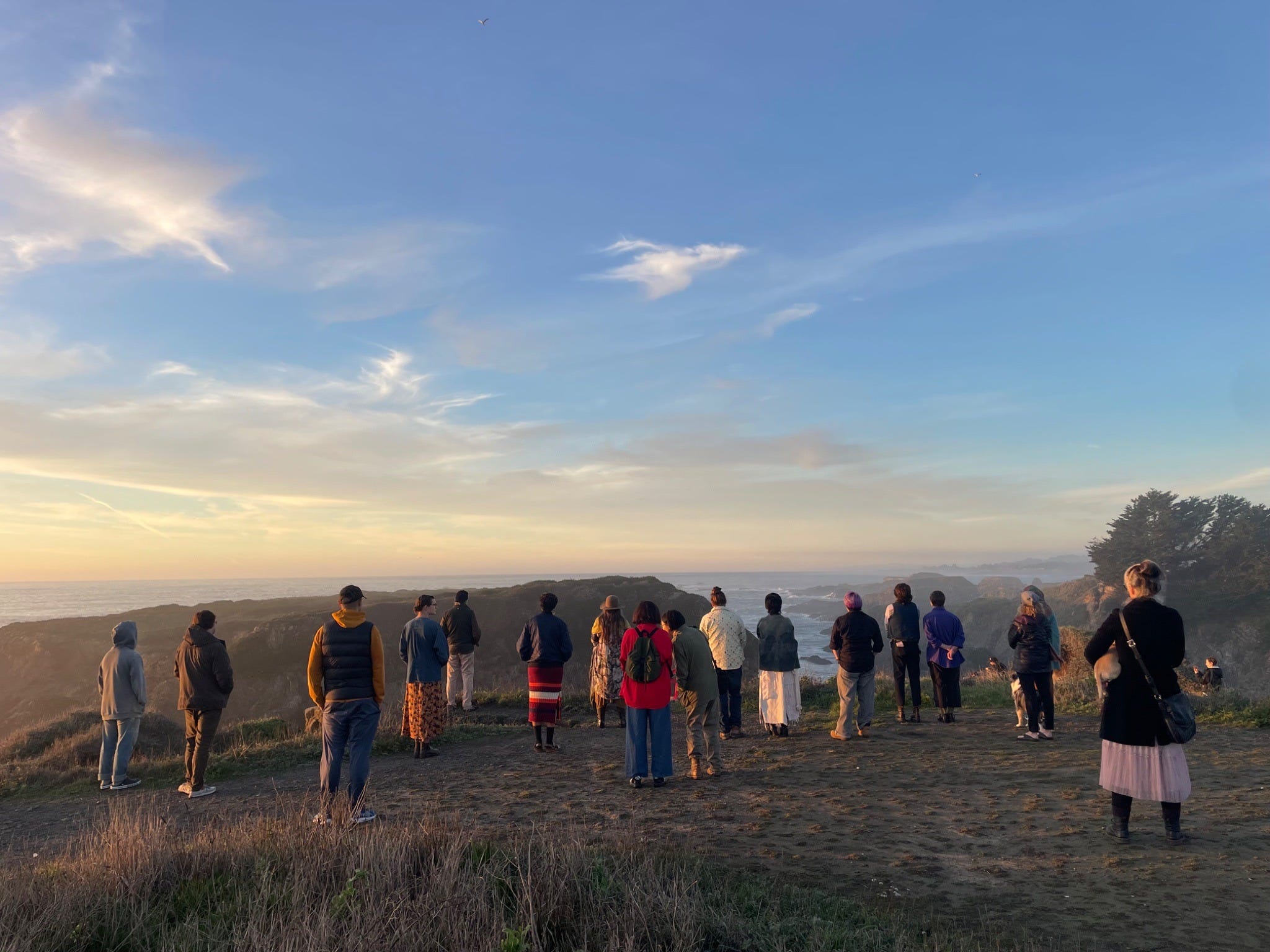
Near the end of last year, I stood upon the headlands of Mendocino observing alongside forty others as artist Jas Lin choreographed the sun’s descent into the Pacific. Dressed in a translucent red sarong with a body coated in white paint, Lin mirrored the horizon’s edge through a sequence of evocative sounds, movements and expressions. At the time, I was navigating my first year of sobriety and the year-long shadow of a painful breakup, watching as the sun dipped toward the sea.
With nearly two decades of experience organizing art gatherings and witnessing countless performances, I found myself pacing the perimeter like a border collie. Emotionally detached, my focus remained fixed on the logistics: managing the schedule, directing the crowd, and ensuring every attendee had an unobstructed view. It was as I navigated the jagged, eroded edge of the cliffs in search of better vantage points that I caught sight of Lin, their figure set against a backdrop of pink lichen-draped stone. Reaching for my phone to capture the moment, the image on the screen left me in awe.
I hurried toward a friend to share the photograph, but they simply nodded, directing my attention back to the live scene. There was Lin, relentlessly attempting to scale a ledge, slipping back down with every effort. Yet, there was no sense of defeat; each time their feet returned to the earth, they immediately reached back for the cliff’s edge, determined to pull themselves upward once more.
No posts
Comments
Nothing yet. Say the first thing.
Sign in to join the conversation.