
Originally published in The Free Press.
When fentanyl arrived in Washington, D.C., around 2014, none of our patients in the methadone clinic knew they were consuming it. They thought they were buying their usual heroin. But the Mexican cartels and major distributors that trafficked heroin across the border were starting to mix in fentanyl, a lab-synthesized opioid. Even the local dealers were unaware.
Our patients could sense that something was different, though. At 50 times the potency of heroin, how could they not? The high from the fentanyl component of what they had just snorted or injected came on more quickly and intensely than did heroin, thereby accelerating addiction to the drug. For dealers, this ensured an even more faithful customer base.
Fentanyl was also more deadly than heroin. Overdose rates, which had been climbing since the early 1990s, soared after fentanyl came to the U.S. Within several years, fentanyl had flooded the East Coast and the Midwest. Its migration west lagged by four to five years, but the drug eventually displaced heroin almost completely in most markets.
Roughly one million Americans have died from overdoses since 1999, the lion’s share with opioids in their bloodstream. No illicit drug in history has claimed so many fatalities. In 1968, the overdose rate was 0.9 people per 100,000, according to data compiled by the Congressional Joint Economic Committee.
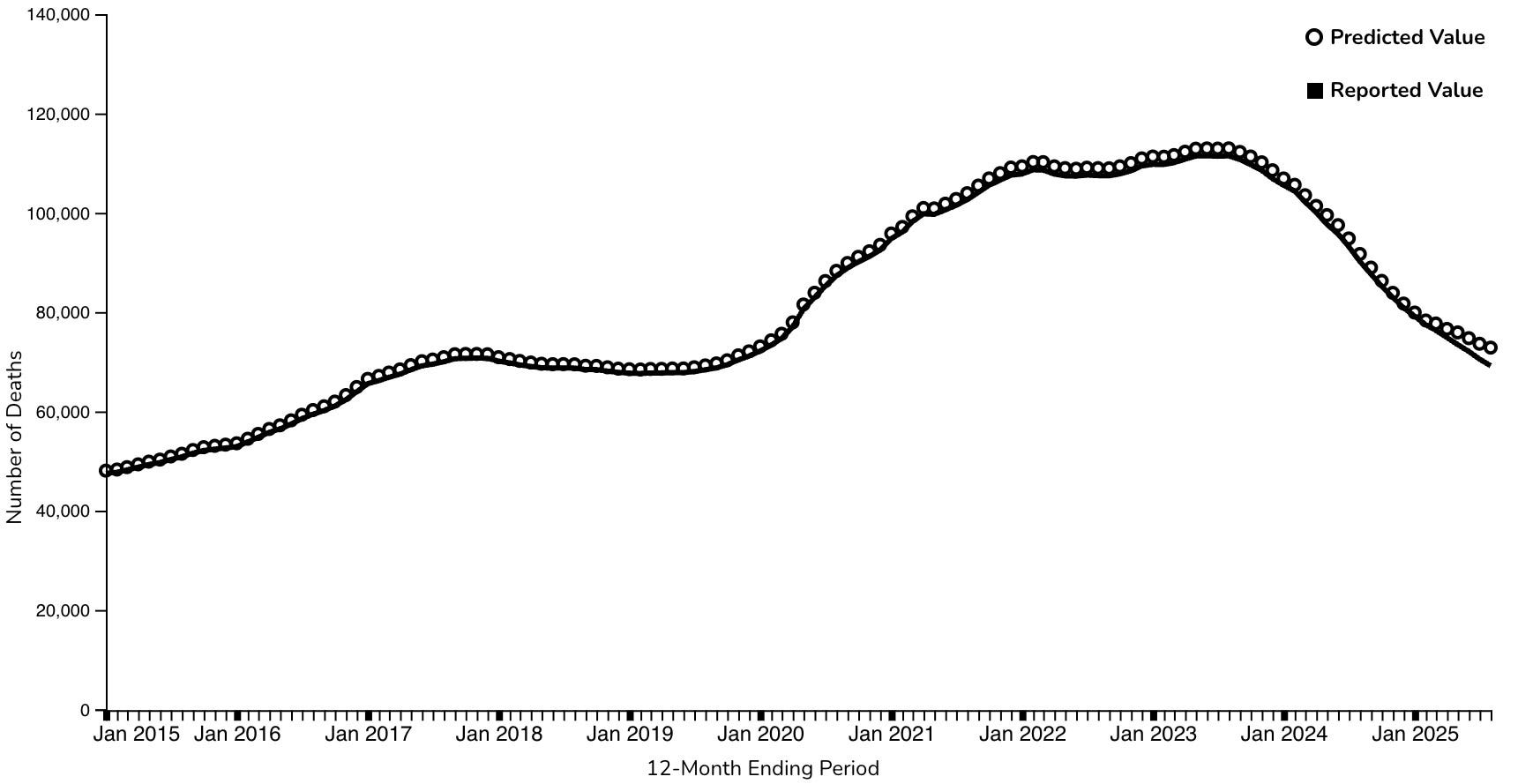
The overdose rate then doubled by 1988, jumped to 3.6 in 1998, ballooned to 13.8 in 2015, and peaked at 32 per 100,000 in 2023, according to an analysis of Centers for Disease Control and Prevention (CDC) data by KFF.
But recently there has been a dramatic, unexpected turnaround. Overdose deaths declined by over 30 percent between the summer of 2023 and summer of 2025. Last week, the CDC estimated that nearly 73,000 people died of a drug overdose during the 12 months that ended last August, down 21 percent from a year earlier.
How did it happen?
The first factor is the widespread use of the opioid overdose reversal agent called naloxone, or Narcan. Commonly administered as a nasal spray, the agent is distributed for free in public health clinics and other facilities in many high-risk communities. In 2023, it became available at pharmacies without a prescription. At our clinic, we practically stuff boxes of Narcan into patients’ pockets. (Too many of our patients still use drugs, though typically in smaller amounts and less frequently than when they were first admitted.)
For better or worse, the use of Narcan has become routine, partly, I am convinced, because it creates a sense of security. For example, when a couple came to get their routine doses of methadone one day, the woman casually informed us that her partner had overdosed earlier that morning—and she had to “Narcan him twice.” Both of them acted like nothing unusual had happened and asked for more Narcan on their way out.
Second, the purity of the fentanyl supply has changed. By the end of 2024, fentanyl purity fell by half from its peak in early 2023, when fentanyl overdose deaths were near their highest, according to a report this month in Science. In parallel, the number and weight of fentanyl seizures by U.S. law enforcement decreased during the same time frame.
Individual fentanyl users all across America are getting less of the drug in any specific purchase—and are therefore less likely to overdose.
This “supply shock,” as the researchers called it, probably emanated from China, the world’s primary manufacturer of the chemical precursors to fentanyl. U.S. officials have long alleged that Chinese chemical makers ship precursor chemicals to Mexico, where U.S.-bound fentanyl is synthesized in secret laboratories. The researchers in Science inferred that Chinese companies sent less to Mexico to comply with international counternarcotics law.
As a result, individual fentanyl users in Washington and all across America are getting less of the drug in any specific purchase—and are therefore less likely to overdose.
Another helpful factor in reducing overdose deaths might be the introduction of adulterants such as xylazine, which has the street name “tranq” because it is a veterinary tranquilizer. Adulterants displace the amount of fentanyl that people buy on the street.
To cartels and gangs, the additives appear to be a way to stretch both product and profit. Users often don’t realize when xylazine has been added to other drugs, and its very low cost might increase profits for traffickers and dealers because they can reduce the amount of fentanyl used in a mixture, according to the Drug Enforcement Administration.
Xylazine began to show up in large numbers in drug purchases around 2019, most famously in fentanyl sold in the Kensington neighborhood of Philadelphia. Medetomidine, a very inexpensive drug that is related to xylazine but is far more potent and fast acting, was first noted in the fentanyl supply in 2022.
Xylazine and medetomidine are not opioids, which means that Narcan cannot reverse them, but they prolong and intensify the sedating effects of fentanyl. They also carry their own risks. Xylazine can cause necrotizing wounds in the skin that sometimes require amputation of a limb. This can happen even if it is snorted.
Perhaps the pipeline of new users has slowed because young people are increasingly put off by fentanyl in the same way that crack became a cautionary tale.
Medetomidine slows the heart rate significantly, increasing the risk of respiratory suppression, and has a dangerous withdrawal syndrome marked by severe spikes in blood pressure. Should medetomidine spread, the medical complications it causes might wind up undoing the lifesaving gains since 2023.
These supply-side explanations coincide with receding demand.
Historically, drug epidemics tend to burn themselves out. And fewer people appear to be starting to use fentanyl. Initiation rates of heroin—or more correctly, heroin with fentanyl mixed in—have been waning since around 2017.
Perhaps the pipeline of new users has slowed because young people are increasingly put off by fentanyl in the same way that crack became a cautionary tale. Contempt for crack’s devastating effect on inner cities and on the people who lived there was a familiar theme of mid-1990s rap. “Listening to songs like ‘Everyday Struggle’ by Biggie or ‘Life’s a Bitch’ by Nas made me certain that I not only didn’t want to do drugs; I didn’t want to sell them either,” wrote Donovan X. Ramsey in his 2023 book When Crack Was King.
Many communities on the East Coast and in the Midwest also have attained “fentanyl saturation,” researchers wrote in The Lancet in November, with most opioid users having already adapted to fentanyl. That is, these users are both physiologically tolerant and experienced. They don’t use fentanyl alone, they keep Narcan handy, and they even use fentanyl test strips.
There is one more grim reason why overdose deaths are going in the right direction. The people who still use fentanyl are the survivors. The vulnerable and the unlucky have, by now, died off.
Although drug treatment seems like an obvious way to reduce demand even more—and I am a strong advocate of treatment—participation rates have been relatively modest. Fewer than one in four people with a substance-use disorder entered drug treatment in the years leading up to the decline in overdose deaths. What’s more, the odds of treatment dropout are disappointingly high, exceeding 50 percent within a year of admission.
The people who still use fentanyl are the survivors. The vulnerable and the unlucky have, by now, died off.
While there are fewer overdose deaths, 48.4 million people who were at least 12 years old in 2024 had a substance-use disorder in the previous year, according to a government survey. That was nearly 17 percent of all Americans—and the percentage didn’t budge between 2021 and 2024.
Will the good news last?
Last week, the San Francisco Chronicle ran this headline: “Fentanyl Crisis Could be at ‘Tipping Point’ as Number of S.F. Overdose Deaths Plateaus.” Recalling what city officials had called a “remarkable” drop in overdose deaths only a year ago, the article also cautioned that “progress against the fentanyl crisis has slowed since then.” San Francisco reported 621 overdose deaths in 2025, a decline of just 2 percent from 635 deaths in 2024. And as of January, deaths from drug overdoses have bounced higher in a handful of states, according to the CDC.
Then there is the perennial concern that an even more dangerous synthetic drug is right around the corner, such as the class of synthetic opioids called nitazenes, or carfentanil, a fentanyl analog. Nitazenes and carfentanil are both far more potent than fentanyl.
Every expert I know presents his or her interpretations and projections as tentative. With hard data often elusive—surveys might be incomplete, national data have limited value because regions vary in severity of drug use and casualties, drug distribution networks sometimes reorganize overnight, and so on—caution in drawing conclusions is warranted.
Here in Washington, overdose fatalities dropped by one-third from August 2024 to August 2025. Along with it, our methadone clinic has seen an admissions drop of at least 25 percent. Yet local public health authorities are unsure of the forces at play. And it’s not just our facility. All treatment programs in D.C. are taking in fewer patients.
Why? We are putting our bets on two key factors: First, fentanyl has gotten cheaper on the street, creating less of an incentive for users to enroll in treatment under the weight of an expensive habit. Second, generous supplies of Narcan are waiting to rescue people in an emergency.
So we are left to keep speculating about what is behind the numbers, and to hope that this trajectory of loss will continue its long-awaited descent.
No posts
Comments
Nothing yet. Say the first thing.
Sign in to join the conversation.