
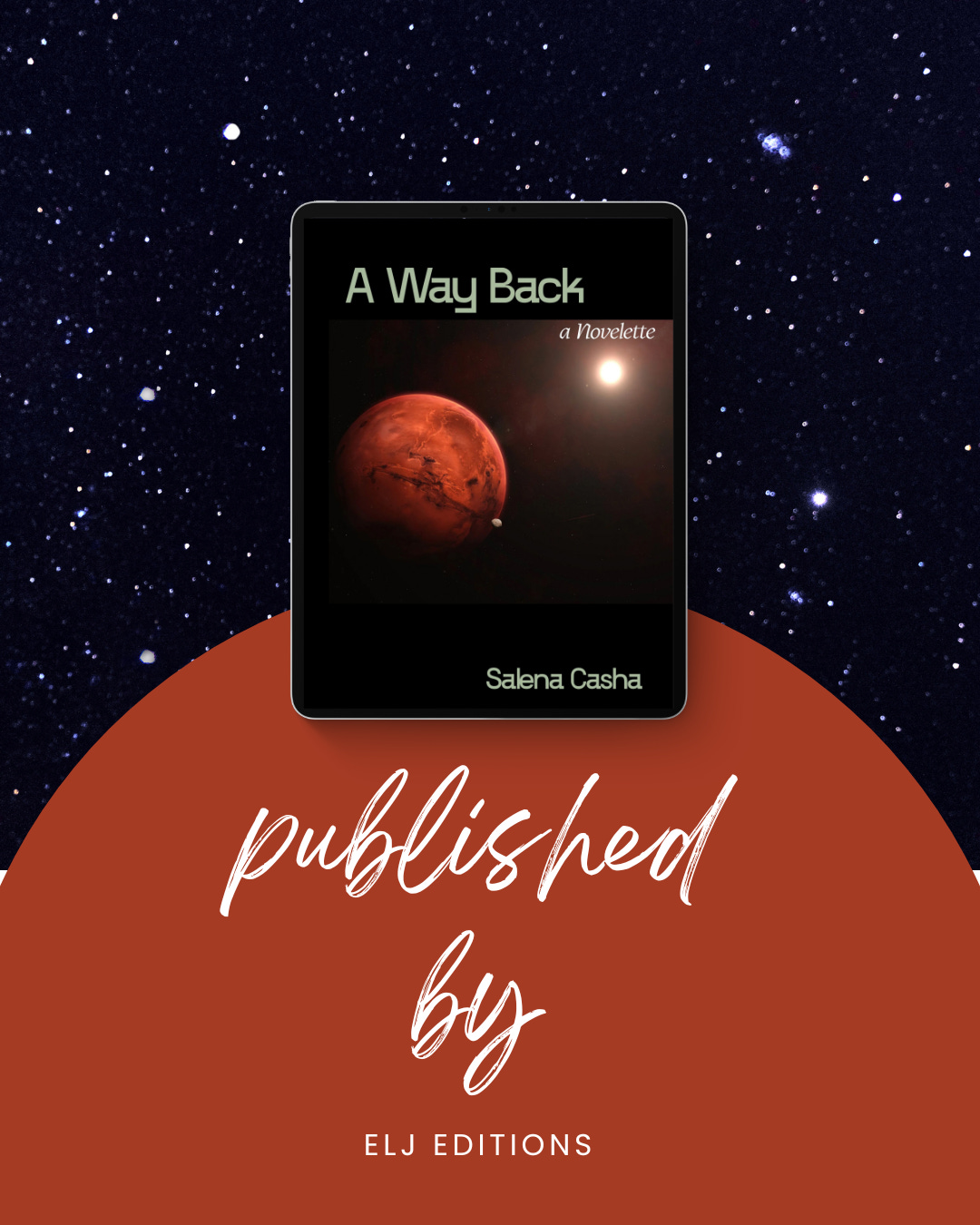
If you follow me on social media, or live with me, or interact with me in any way in the real world, you know that ELJ Editions published my sci-fi novelette, A WAY BACK, last weekend. Let’s take a moment the celebrate the glory of the cover and, yes, you can see it even says a novelette on it.
So, I wanted to take a step back and talk a little bit about the form, my process of writing the work, and where I could have done things differently. You’ll also get a little bit of insight into the way in which Amazon rankings, which update every hour, have been driving me a bit crazy.
The royalties I receive from sales—10 - 20% on the print edition and 40% on the ebook edition—will be donated to the Immigrant Legal Advocacy Project in Portland, Maine, who is doing great work to ensure folks in the community can access legal services and community support during a, frankly, terrifying historical moment we’re in across the US. Obviously, you can also always donate without going through my book, and if you do, I’ll love you forever.
Anyway, let’s get into it.
Outside of genre, categories of writing are often determined by word count. A novelette is essentially a very long short story. Some of these categories blur into each other based on the magazine’s definition and guidelines, but generally, the ranges remain relatively steady. Below, you can find, generally, what most publishers consider when it comes to submission word counts:
Drabble (<100 words)
Micro (<400 words)
Flash Fiction (<1,000 words)
Short Story (2,000 - 7,500 words)
Novelette (7,500 - 17,500 words)
From what I’ve read, novelettes (and novellas) are most frequently found in the science fiction, fantasy, and horror genres. The market for novelettes is markedly smaller than that of short story, flash, and novels and, for those written in literary or contemporary genres, even more narrow.
Novella (17,500 - 40,000 words)
Novel (>40,000 words)
This one highly depends on the genre and audience. Children’s novels will site closer to the 40 - 60k range, while most fantasy novels are often upwards of 100,000 words. Similarly, debut novels are typically encouraged to be on the shorter side ~75,000 word zone but, you’ll sometimes notice the more popular the author, the longer their books might get over time as their fan base might no longer care as much about length. Teresa 2.0 Will See You Now sits at around 78,000 words or roughly 270 - 320 pages, depending on the typesetting and font size.
Some of the most famous novelettes to date include The Yellow Wallpaper by Charlotte Perkins Gilman (63 pages) and The Fall of the House of Usher by Edgar Allan Poe (36 pages). While definitely not in the same league, at 11,000 words (or, in the final typeset print version ~38 pages), A Way Back sits determinedly in the same loose category.
It might seem cliche to me, but the form picked me this time. Typically, I write flash with even my longest short stories and essays only hitting highs of about 3,700 words. But last winter, in the throes of Grub Street’s Jump Start Your Novel course where I wrote the first draft of Teresa 2.0, I got very into scene writing as well as the exercise of starting in the middle of an ‘inciting incident’ or pivotal moment of change for the characters.
At the time, my writing partner, Leigh Loveday, and I were trying to jumpstart a new collaborative piece for a submission call with the theme Phantom Worlds. We created a document with a hodge podge of different ideas to get us started including first lines and even some general plot thoughts. A Way Back started with the following seed from Leigh:
‘Cairnfields’ – just a title I’ve always wanted to write a story for! The cairns could be monuments to/anchors for people who’ve been pulled into pocket worlds while trying to cross dangerous territory – a planetary exploration team who stumbled into reality mines left on a battlefield?
At the time, we were playing around with two ideas we liked and the second got more of our attention initially, eventually resulting in The Sometimes Neighbors published by The Creepy Podcast in June 2025. It’s fun to always look back to see where they started and ended and, so, with all the intentions of ‘Cairnfields’ being our runner up collaborative short story, I started up a doc.
The first draft of the opening started like this:
Dreyer takes a deep breath. She’s the only one left. All the others who came with her to conquer the fields, the captured memories, are marked by cairns. Except, maybe, for the pilot.
She really doesn’t want to do this. “Fuck,” she mutters.
But if she wants off this rock, if she’s going to get back to Annika, Annika who will laugh delightedly upon hearing such a tale of foolishness, hubris and proximity to a cold, forgotten death, she has to fetch the pilot. And the pilot is in the cairnfields. There’s also no guarantee either that he’s marked or not, but it’s a risk, willing or not, that she has to take.
Looking back at this first draft (and everything that followed it) I can’t entirely be sure why I made the changes I did or when I decided to pivot to an alternating dual point of view story between the pilot and Dreyer. I think it was a matter of pacing and realizing that this wasn’t a story that would magically resolve itself in <2,500 words (to both my fear and chagrin). For some reason, writing at length has always made me uneasy; I like the vignette-y type narratives that have sharp language and pack a punch in a half page and that don’t necessarily always require a neat resolution. As I wrote, I realized, this one was going to take:
Some world building
Some character development
Some historical context setting
And so, I just let the voices take over and somehow, three weeks later, I had 13,000 words, very rough and very unedited, on my hands. Leigh bowed out of this particular collaboration and I continued on my own—I’m so grateful to him for his spark of an idea and I’m excited for how our next piece, a dystopian, is forming up. With A Way Back, it felt like it was a story that didn’t merit 7x the additional content that would be required to get it to novel length, and, by the time I was on my fifth read through, I did wonder if the concept held up at all and if it could have used more breathing space.
My answer: Definitely. But was I tired of revising? Had the story run its course through my body? Most definitely.
Total reads & revisions outside of the first draft: 5.
Three were major rewrites that changed plot and introduced the character that became Powell. The pilot found his voice (and name) in the second draft and the sections got shorter as they flipped between Dreyer and Taylor.
The first revision was done just straight on the laptop. The second, I printed out and did the edits with a pen at a local cafe. Interestingly enough, very few of those manual edits made it into the final version and where the writing got tighter and the pacing faster was around draft three. By the time drafts four and five rolled around, I was mostly in sentence-level work and sometimes, I regret not rolling back up to ensure that the portals (and why Earth was so focused on finding them) really made sense. While 11,000 words is not even close to a novel, it was still a lot of words to refine, a lot of language changes that I made, second-guessed, and then remade again. You can see how much it changed, first to final draft below. Also, what was I thinking writing the first version is arial font?!
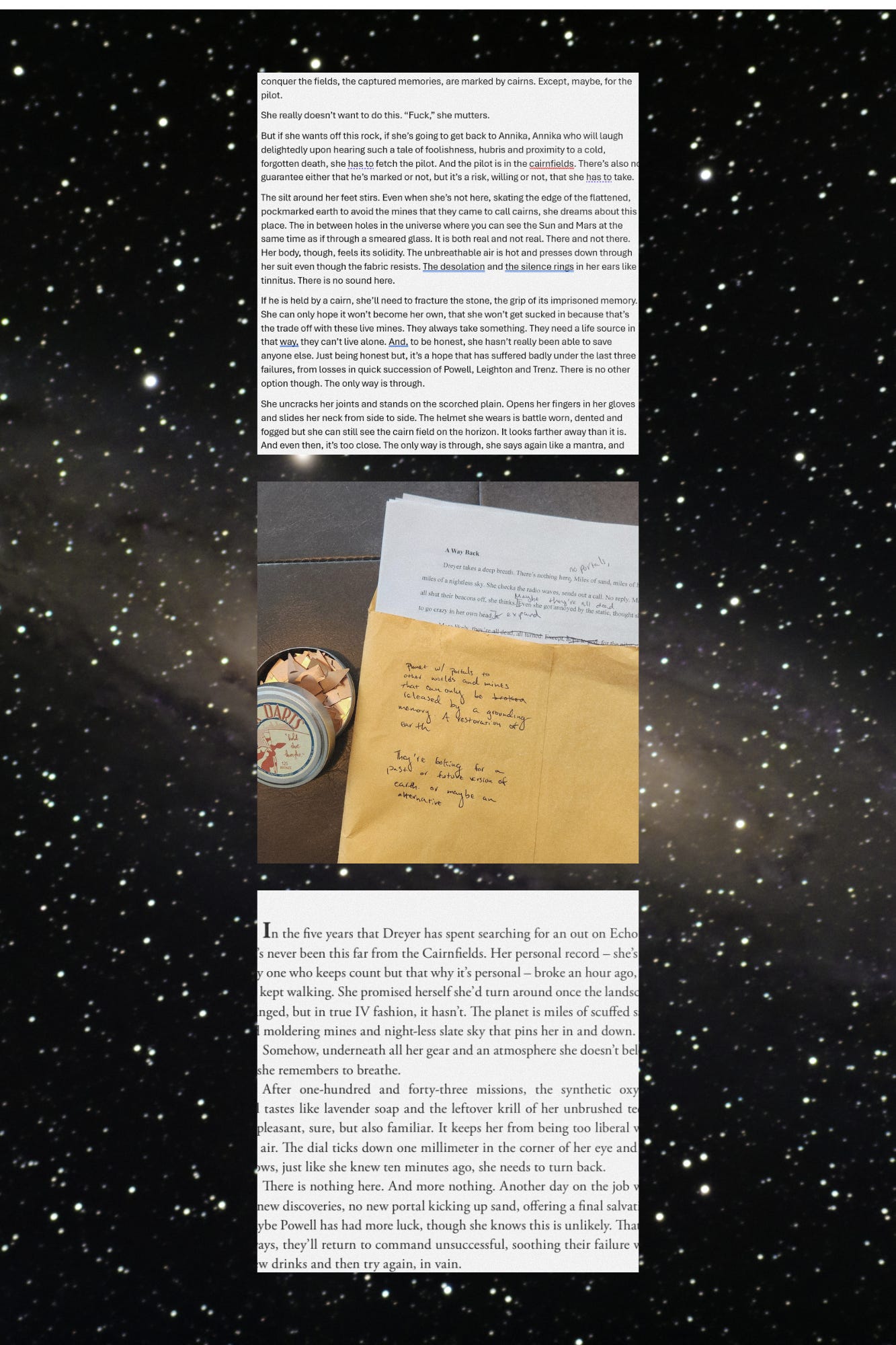
A few examples of the first draft to final draft revisions.
I submitted A Way Back to only four publishers before it got picked up, with the first submissions going out at the end of October. By November 10th, I had a publisher (and a COVER!), thanks to the wonderful ELJ Editions whom a writing partner, R. Tim Morris, had found success with and by early December, we had a signed contract. Far speedier than the experience of some of my short stories. The final edits were due end of December, the majority of which I managed over Christmas break in the UK and then, we did a few proof edits, with my final print approval hitting the inbox on January 11th. It’s always so impressive to see how the interior files, typesetting and spacing are designed; it’s a skillset I can’t even comprehend and, for the humans who do know how to make these things look good on the page, I have much appreciation.
By then, the blurb was up on the website and the publishers went live on Amazon and their site on 2/7.
Check out the blurb - I mean, why wouldn’t you read it? Especially if you’re a sci-fi lite nerd like me.
Somewhere on Echo IV, there is a memory of an older, unmarred Earth that could give humanity a chance at starting over. Mission Control calls the alleged portal ’a way back,’ and Dreyer and her team are tasked with finding it. The planet’s barren landscape, filled with cairns and false memories, doesn’t make it easy for them, but then again, when the team has a leader like Dreyer, easy isn’t in their vocabulary. So, it’s no surprise that when Dreyer disobeys mission guidelines and sets out on her own, she finds herself confronted by a haunted past—just not the one she’s looking for. A Way Back is a punchy cross-genre exploration of obligation, regret, and the futility of trying to escape a future that is all but predetermined by the choices we’ve made.
I won’t find out about number of copies sold or royalties anytime soon, but I have been watching the reviews and rankings like a hawk. The Amazon algorithm is kept under wraps in terms of what the rankings mean for titles sold so I’ve just been watching the varying numbers across categories. So far, A Way Back has been ranked in a slew of categories to date including: Kindle Store, One-Hour Literature & Fiction Short Reads, Short Stories (Books), Contemporary Short Stories, Contemporary Literary Fiction (not entirely sure how I ended up in this one), Short Stories Anthologies, Literary Fiction (apparently different than Contemporary Literary Fiction), and Books. Maybe one day, I’ll see it on the science fiction side, but who knows!
Best Rank: #367 in the “One-Hour Literature & Fiction Short Reads” category
Worst Rank: #731,441 in the Kindle Store
Both of these just mean that my little sliver of a book is actually out in the world and in people’s hands which is just an amazing and terrifying feeling. A big thank you to everyone who has purchased a copy and even sent me photos (I’ve included a few below). I would love to hear what you think (the good and the bad because even I’m not entirely happy with where it landed, but that’s the price of making any art in the end, eh?) and, as the months roll on, we’ll see where the world takes it. However high or low in the rankings it finds itself on any given day, it’s out there.
In the meantime, I’m off to find something new to write. Grateful for each and every one of you.
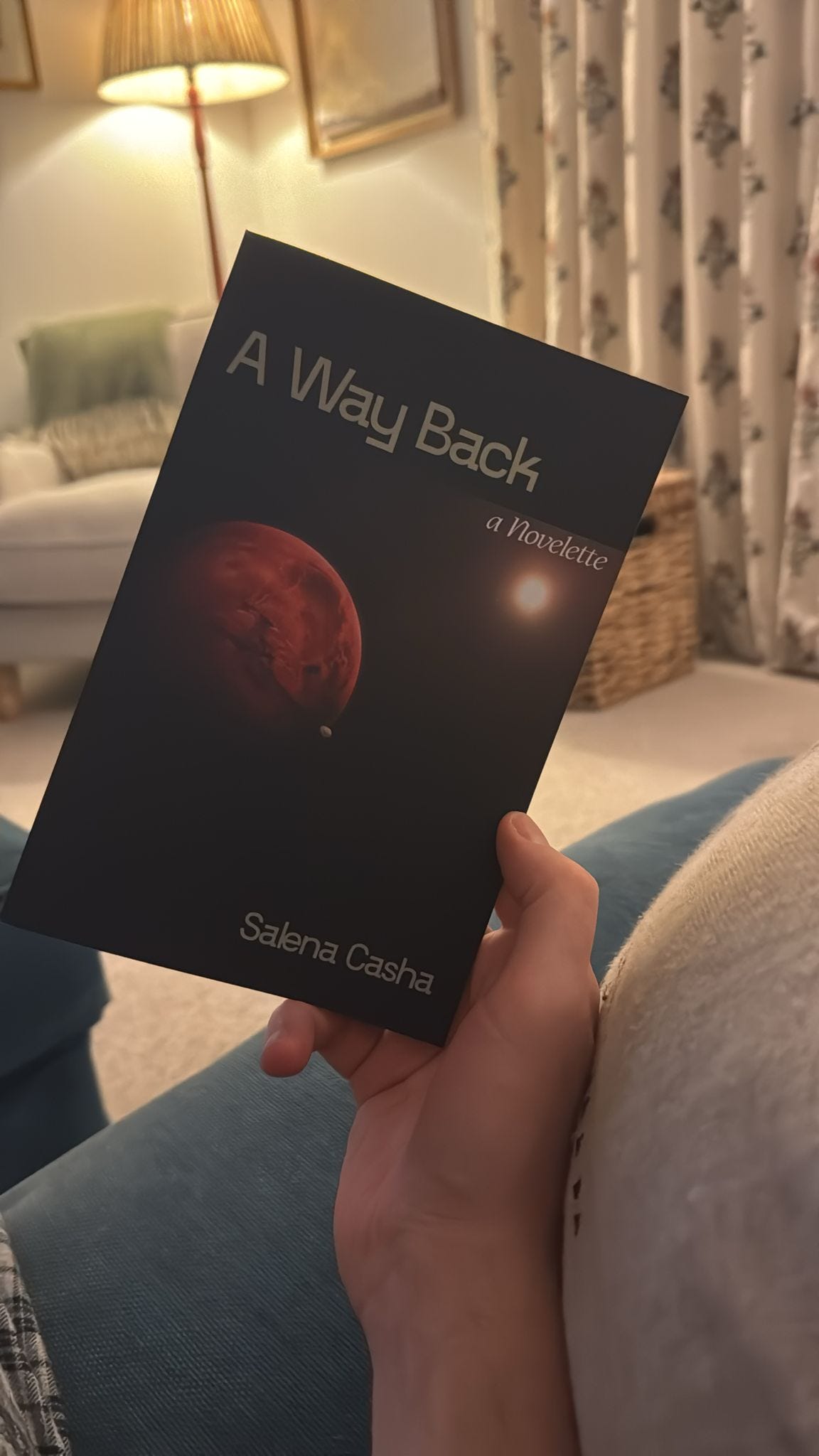
From a good friend across the pond who was also a beta reader for Teresa 2.0
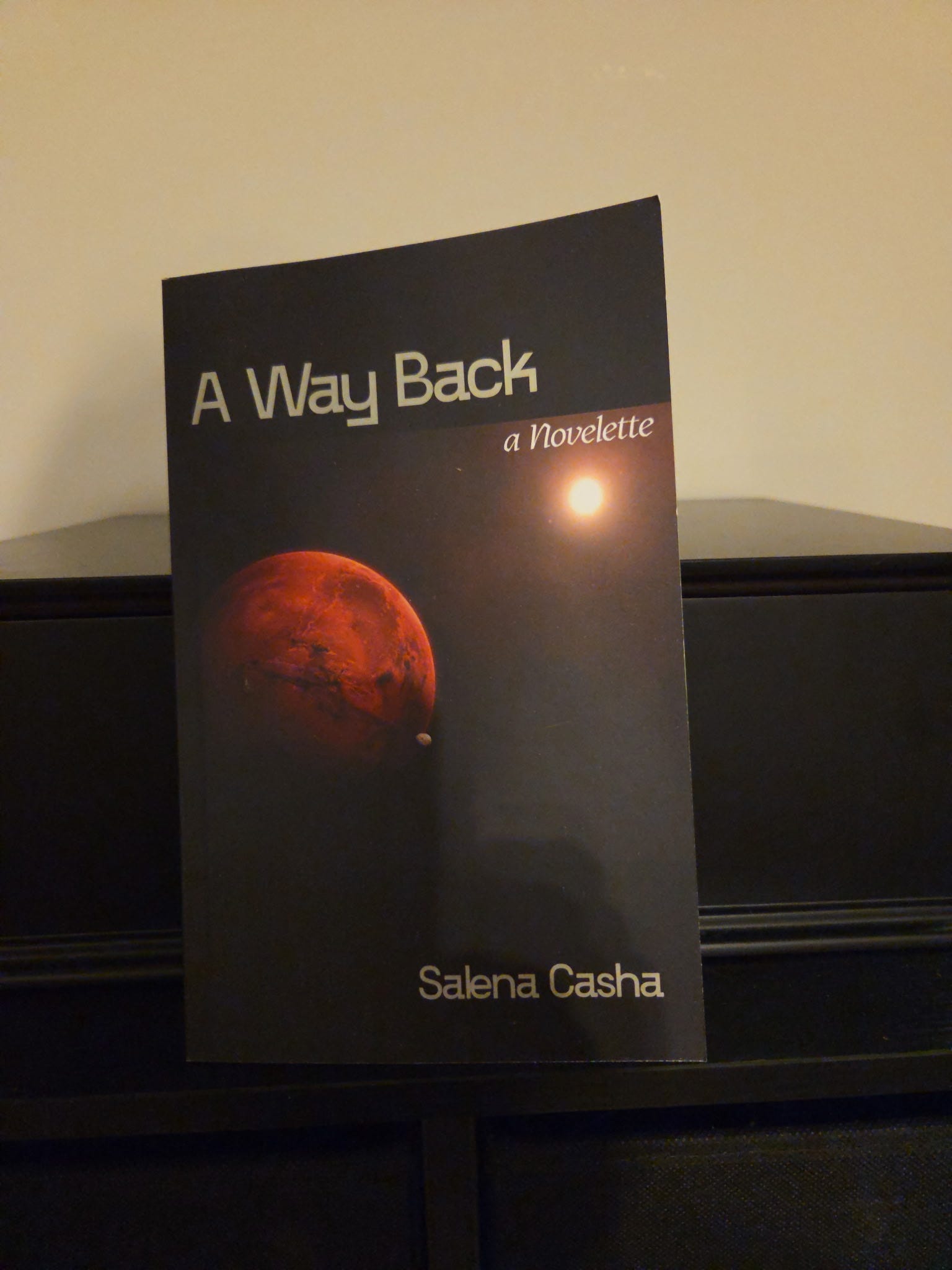
From my number one fan, the person who taught me to read and nurtured my love of writing from the very start.
No posts
Comments
Nothing yet. Say the first thing.
Sign in to join the conversation.