
Last week I released my haterific magnum opus on the thought-terminating cliches of the publishing industry! I’m back today with more of the coded language that makes me hear Kill Bill sirens in zoom meetings, hopefully for the benefit of the collective.
My name is Saint, and I’m the Sunday Times and USA Today bestselling author of A DOWRY OF BLOOD, the Summoner’s Circle queer urban fantasy series, and other gothic novels. I am also, by all accounts, too much of a straight-talking business bitch for this smol bean-oriented industry. But I like to think I use my business bitchery for good to demystify publishing and encourage all authors to practice solidarity, ask for more, and cultivate cunning in the managing of our careers.
Last week focused largely on the state of the author career holistically. This week focuses on marketing and publicity, and hopefully offers alternatives to throwing our hands up in the air and saying we just don’t know how to capture audience attention and move units.
This essay series is about overused catchphrases tossed around by publishing industry people, what they really mean, what they imply and demand, and why they drive me insane.
But first! Housekeeping.
We are three weeks away from the west coast Summoner’s Circle tour, and I’m bringing you stunning goodies to say thanks for waiting five long years to see me! Swag bags include an early look at the DIVINATION (Summoner’s Circle #3) cover art and a collectible bound booklet of the first 25 pages of Moira’s book!
Dress in your witch/magician best and bring me whatever you’d like signed.
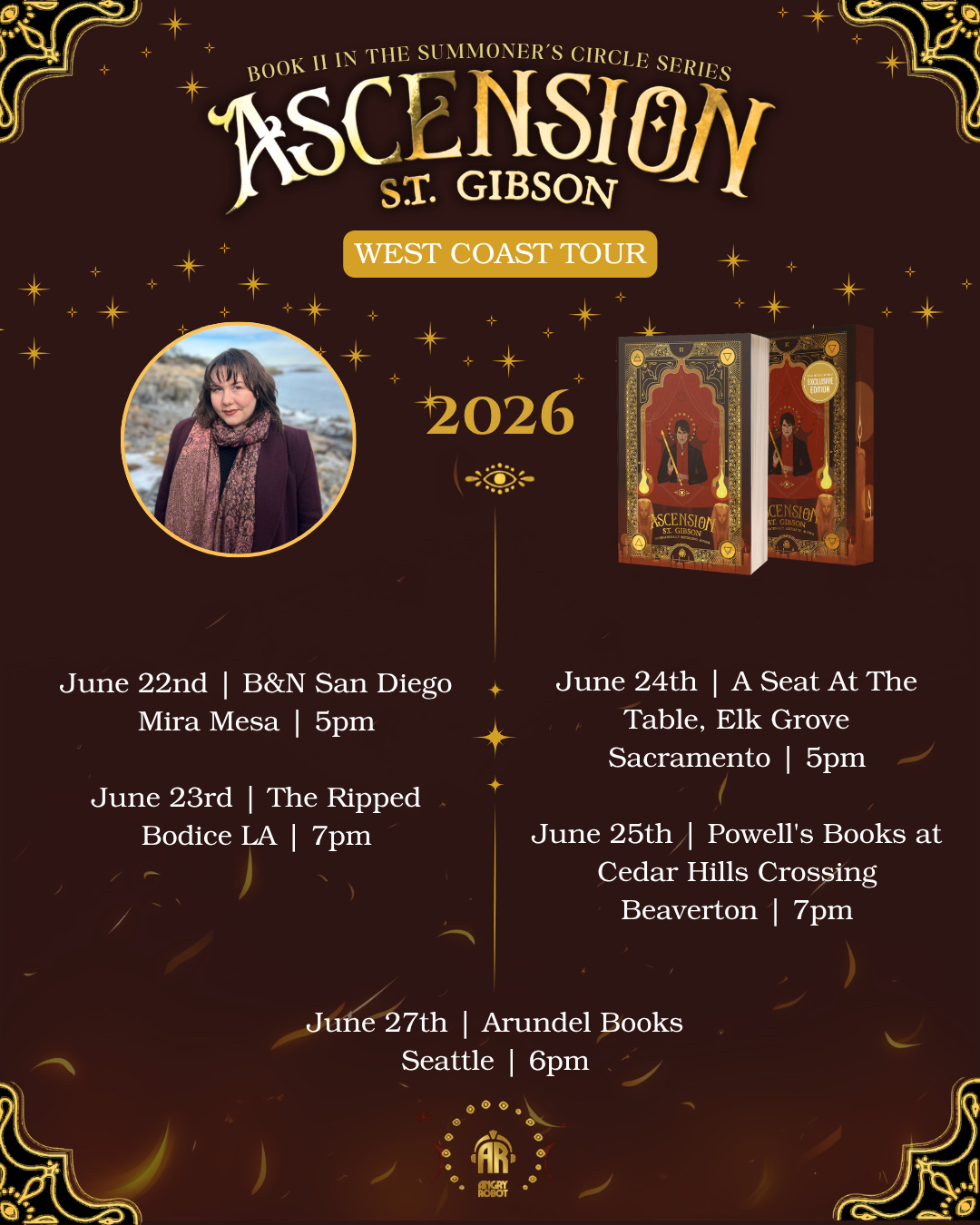
San Diego, Los Angeles, Sacramento, Portland, and Seattle, pencil me into your calendar and bring a friend/lover/enemy to the event! I’m rallying my West Coast fans in person so I can enjoy your shining faces - and show my publisher that it’s worth sending me all the way out there to see you!
With that, let’s look under the hood of the ever-grinding, smoke-blowing, marketing and publicity machine.
A “break out” is publishing industry slang for a blockbuster, a book that outperforms the baseline of its genre/age category/ect. It implies that the book has done better than anyone hoped, reaching new readers based on the momentum of its own hype and the viral spread of word-of-mouth recommendations. It’s a term publishers have enough confidence in to use in acquisitions meetings (“we’re looking for romances that have strong potential to break out in a crowded market” or “we loved this book, but we don’t think we can make it break out, so we’re going to pass on buying it”) but have difficulty defining.
Publishing is much more of an art than a science; we all know that. Making room in business meetings for wibbly wobbly unknown factors like audience response, bookstore buying trends, placement in traditional publicity outlets, and social media visibility can be difficult. It’s healthy to admit that much of a book’s trajectory is out of our hands, or the result of many hands over many years, most of which we cannot predict and do not control.
However, this can lead to a catchphrase that obliterates all nuance: “we don’t know why books break out”.
As in, we have no idea what factors go into making a book a commercial success. Often said with a friendly, hapless smile in an acquisitions meeting or a I-wish-I-could-help-you-shrug from a stressed marketing manager.
Really? You’re sure about that? Because the last time I checked, the foundation for giving a book what it needs to “break out” was advertising and publicity spend, including printing lots of arcs and sending them to the right readers with strong platforms.
It’s can’t guarantee success — nothing can — but it sure will help!
My beloved Print Run podcast hosted an amazing interview with Laura B McGrath, an author and publishing industry researcher, who called out this stock line as a way of washing one’s hands of responsibility over how a book performs. By pretending to be slightly more naïve than we all really are, we overplay the amount of luck and and dice-rolling that goes into a book’s success and treat the process as entirely unreplicable and the market as supernaturally mysterious.

A publisher cannot provide all-hands-on-deck, high-budget support for every title, but as you learned in my last essay, publishers have a bad habit of giving non-answers to questions about marketing instead of a clear no. This is a great example.
It’s easier to say the stock line of “we don’t know why books break out” instead of the truth, which is:
Comments
Nothing yet. Say the first thing.
Sign in to join the conversation.