
HTTP/1.1 chunked transfer encoding lets a server start sending a response before it knows the final content length. The response is framed as a sequence of length-prefixed chunks, followed by a zero-length chunk that marks the end.
In this post, we’ll inspect those frames with curl and trace how a FastAPI streaming response moves through Starlette and Uvicorn. The example uses the backend developed in Streaming APIs with FastAPI and Next.js - Part 2.
What is HTTP chunked transfer encoding?
Chunked transfer encoding is an HTTP/1.1 message-framing mechanism. Each chunk contains its size in hexadecimal, a carriage-return and line-feed pair (\r\n), the chunk data, and another \r\n.
<chunk-size in hexadecimal>\r\n
<chunk-data>\r\n
This framing is useful when the response size is not known up front, such as a live stream or dynamically generated response. It preserves a reusable connection while still giving the client an unambiguous end marker.
When Transfer-Encoding: chunked is present, the client can process data incrementally and knows the response has ended when it receives a zero-length chunk, followed by any optional trailers and the final empty line.
💻 Hands-on Example
Let’s use the FastAPI backend we built.
make start-backend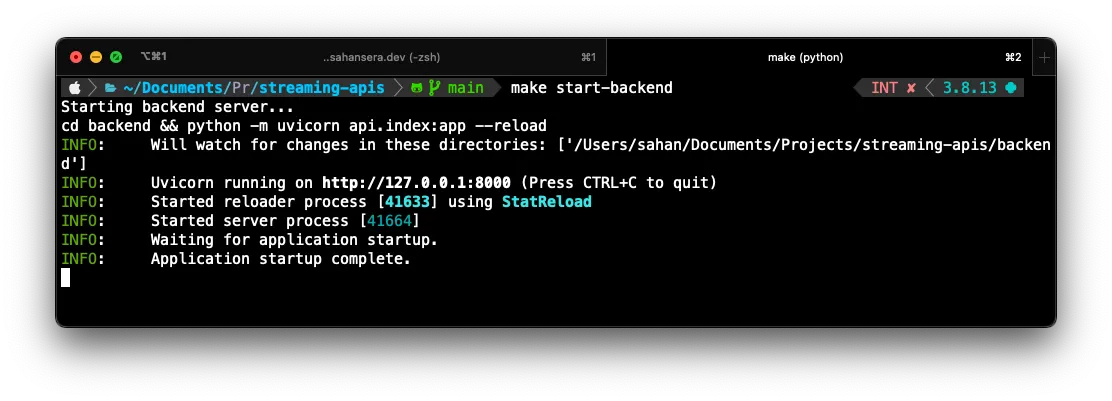
Let’s hit the /stream endpoint with curl to see how chunked transfer encoding works in practice.
curl -i --raw http://localhost:8000/stream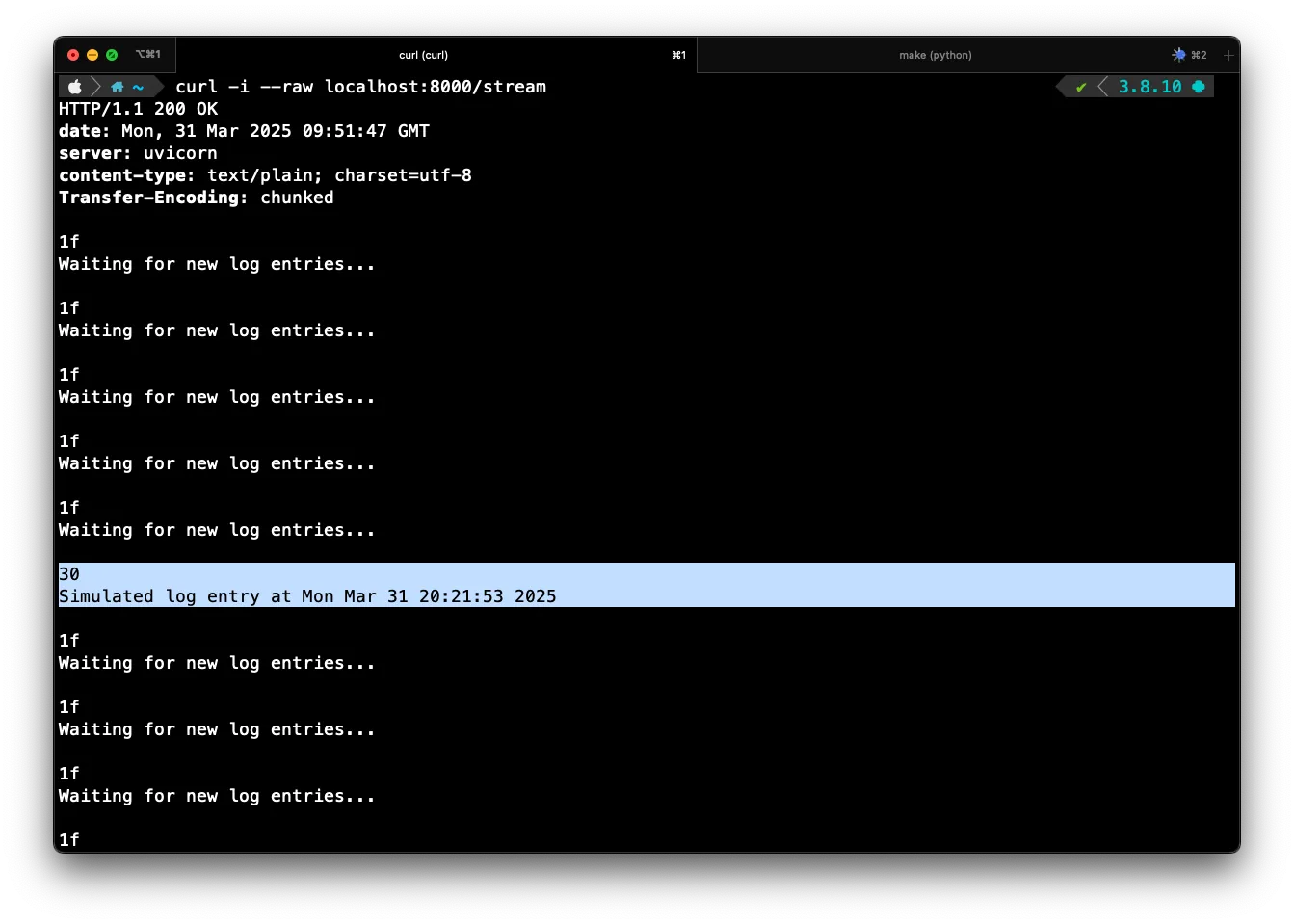
-i: Include headers in output.--raw: Disable curl’s automatic decoding, revealing raw chunked encoding.
Expected output:
curl -i --raw localhost:8000/stream
HTTP/1.1 200 OK
date: Mon, 31 Mar 2025 09:51:47 GMT
server: uvicorn
content-type: text/plain; charset=utf-8
Transfer-Encoding: chunked

1f
Waiting for new log entries...

1f
Waiting for new log entries...

1f
Waiting for new log entries...

1f
Waiting for new log entries...

1f
Waiting for new log entries...

30
Simulated log entry at Mon Mar 31 20:21:53 2025

0
Here’s a diagram to help visualize the chunked transfer encoding:
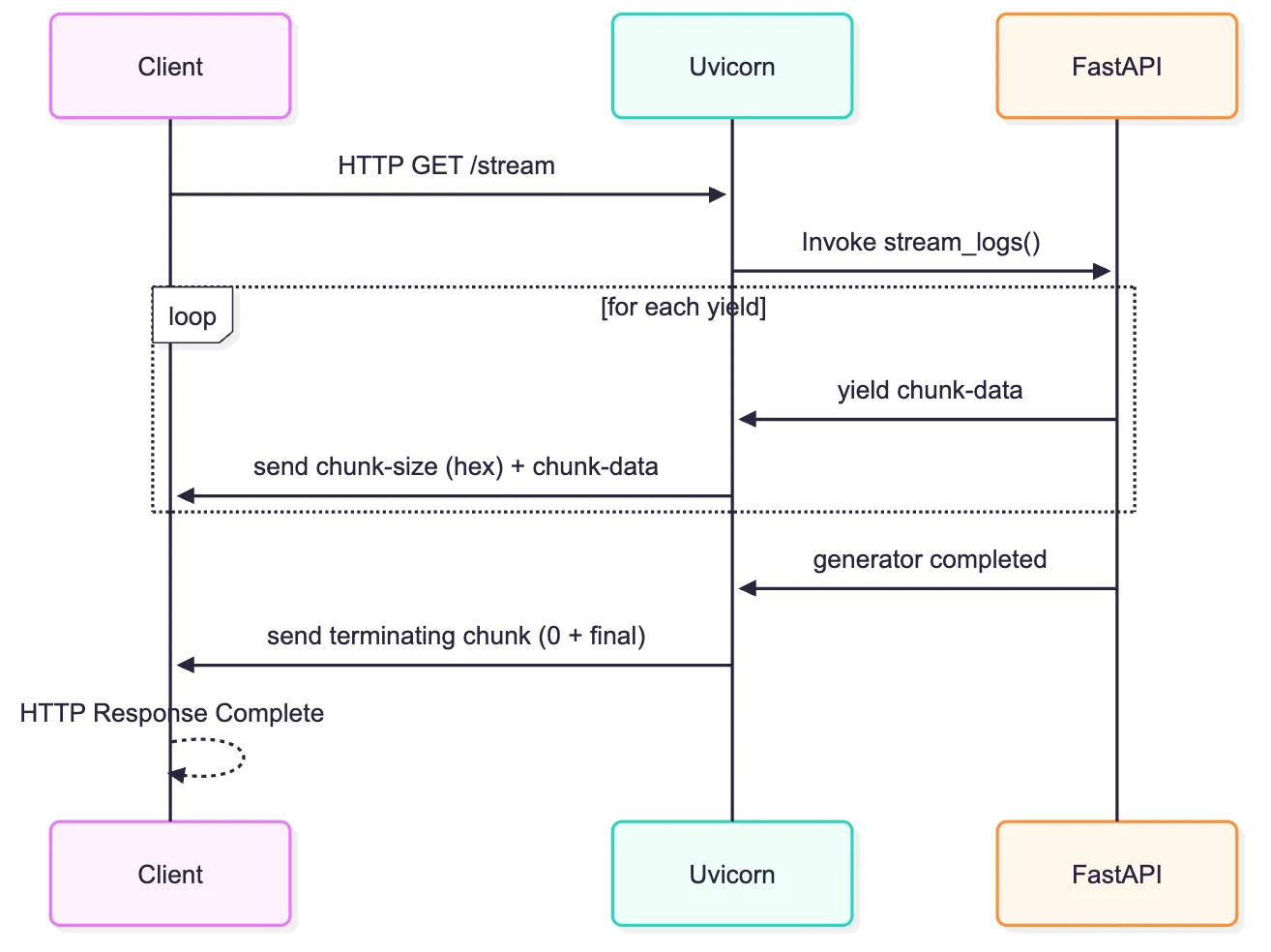
Here’s what’s happening:
- Each chunk starts with its length in hexadecimal (
1f= 31 bytes). - The data follows the length, and the next chunk starts after a newline.
- The chunk with 30 represents a simulated log entry (
30= 48 bytes). - The response ends with a zero-length chunk (
0).
Note: This aligns with the techniques demonstrated in my previous blog series Streaming APIs with FastAPI and Next.js (Part 1) and Part 2.
🛠️ Step-by-Step Breakdown of Chunking
We’ll be using the index.py. Here’s exactly what’s happening under the hood:
1. Generator (yield):
- Every time
yieldis executed, Starlette receives another piece of response body data to send through the ASGI interface. - In this FastAPI and Uvicorn HTTP/1.1 example, Uvicorn frames each non-empty ASGI response-body message as an HTTP chunk. Do not treat those boundaries as an application-level contract: proxies, buffers, and clients can regroup bytes before your code reads them.
For example, the yielded line:
yield "Waiting for new log entries...\n"is packaged into one HTTP chunk.
2. Starlette’s StreamingResponse handling:
StreamingResponsewraps the async generator.- Starlette doesn’t wait for the generator to finish. It sends a sequence of ASGI
http.response.bodymessages, withmore_bodyindicating whether more data follows.
3. Uvicorn’s chunk formatting:
When no Content-Length is present, Uvicorn uses chunked encoding for an HTTP/1.1 response and formats each body message according to the HTTP/1.1 specification:
Each chunk is transmitted as follows:
<chunk-size in hexadecimal>\r\n
<chunk-data>\r\n
Here’s how one of your actual data chunks might look:
1f\r\n
Waiting for new log entries...\n\r\n1f= 31 bytes, the exact length of"Waiting for new log entries...\n"
4. Continuous Chunk Transmission:
- Uvicorn immediately sends each formatted chunk down the TCP connection.
- Your client (like
curl) receives each chunk as soon as it’s sent, which allows incremental processing.
5. Ending the Stream:
- If your generator ever completes (or if the server shuts down the connection), Uvicorn sends a special zero-length chunk (
0\r\n\r\n) to indicate that transmission has ended.
Example final chunk:
0\r\n
\r\n
Does HTTP/2 or HTTP/3 use chunked encoding?
The short answer: HTTP/2+ does not use chunked encoding at all. In fact, the HTTP/2 specification explicitly forbids the use of the Transfer-Encoding: chunked header; if a client incorrectly tries to send it, it’s considered a protocol error.
Instead, HTTP/2 uses a more efficient binary framing layer that allows multiplexing multiple streams over a single connection. This means that chunked transfer encoding is not necessary in HTTP/2 and HTTP/3, as the protocol itself handles streaming more efficiently.
Key Takeaways
Through these practical examples, you’ve seen firsthand how chunked transfer encoding enables incremental streaming of data:
- Responses are sent as a series of chunks, each with a defined size.
- The end of data transmission is indicated by a zero-length chunk.
- Tools like
curl, Python frameworks like FastAPI, and browser developer tools help visualize and debug chunked encoding.
Understanding this helps you build better streaming APIs and debug complex HTTP interactions effectively.
Happy Streaming! 🚀
Comments
Nothing yet. Say the first thing.
Sign in to join the conversation.