
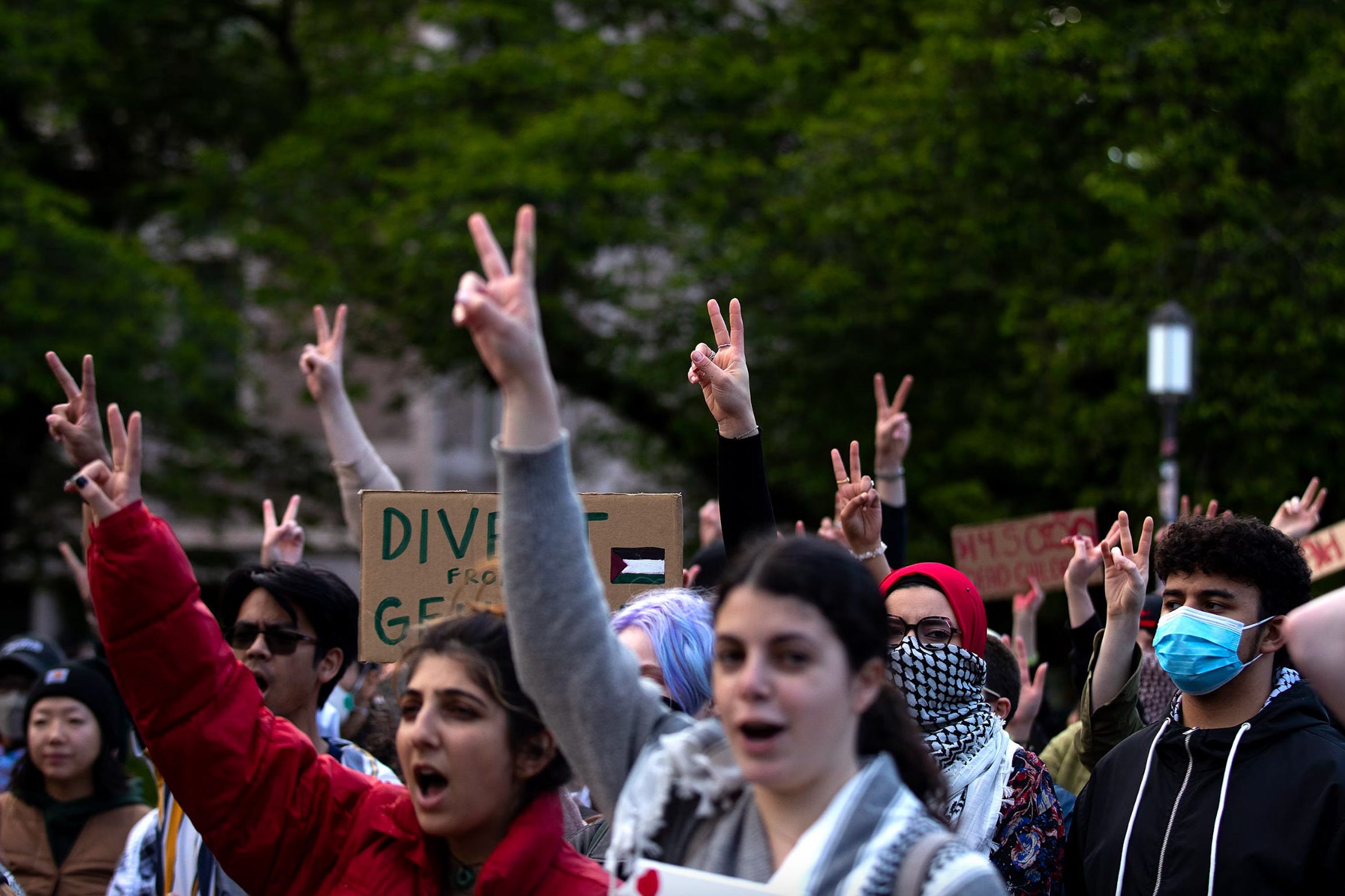
It’s interesting to play with Google News search results to see which keywords come in pairs. While the war in Israel-Palestine remains one of the biggest stories in the world, it does not actually eclipse the news coverage directed at domestic protest movements. Nothing overwhelmed the absolute surge of articles that campus Palestine solidarity protests received, with hundreds of pieces pouring out of the country’s largest publications. This media attention led to ouster of several elite college Presidents, the firing of faculty and expulsion of students, and, of course, an escalation in kind as the protests turned into Occupy-style encampments: students said they will leave when their universities, funded by outlandish amounts of student debt, stop divest from commercial enterprises making money off the genocide in Gaza.
If we look at the terms that come paired with “campus protests'' you'll see phrases like “anti-Israel,” “anti-imperialist,” “anti-war,” or even “woke left.” But the term most often set next to “campus protest” has been “antisemitism,” the implication being that the primary threat, and perhaps biggest story, is that Ivy League colleges are now a bastion of 21st Century antisemitism. Part of the reason these encampments are so frequently called antisemitic is that anti-Zionism itself has been recast as the primary vessel for what is now discussed as an “eternal hatred” of the Jewish people. This ahistorical reinterpretation of what the term antisemitism means both helps to destroy the Palestine solidarity movement through weaponized accusations and ensures that news coverage and congressional action will focus on the perceived rise in bigotry rather than the verifiable violence happening against Palestinians fleeing American-made bombs. And while many high profile magazine pieces have alleged systemic antisemitism at the heart of the American university, more re-assessments are revising those claims. The verifiable rise of antisemitism is on the political Right, and if you seriously crunch the numbers, verify reports, and analyze acts of violence, it becomes obvious that the allegations of collegiate antisemitism are mostly rhetorical rather than factual.
But while we are considering antisemitism and the encampments, particularly where it doesn’t exist, it’s worth meditating for a moment on where it can. After a successful event sponsored by Jewish Community Action in Minneapolis, where we discussed Safety Through Solidarity and talked about building a movement against antisemitism, we next headed to Madison where we met up with a local Jewish faculty member at the University of Wisconsin. They mentioned how they had supported students who organized their own encampment on the college campus, which was, like most encampments, disproportionately Jewish. Hillel and local campus leaders railed against the camp, suggesting it was a threat to Jewish students’ safety, and when a group of Jewish faculty signed a letter in support of the students the charge of antisemitism was extended to some of them as well.
“We also care about the safety of Jewish people in our community. That is why we insist that any conversation about Jewish safety on campus must take into account the safety of Jewish protesters for divestment and ceasefire, who, along with all protesters, the University has placed at risk of violence by inviting the police onto campus to make arrests.,” read the faculty letter, signed by dozens of Jewish professors and lecturers at the university, pointing out the threat that increased policing presents to Jews generally. “Antisemitism is real; we know because we have experienced it here in Wisconsin. We have not forgotten that neo-Nazis marched through downtown Madison just last year. We expect UW-Madison to protect its Jewish community from antisemitic violence, hate speech, and harassment. But we also expect the university to distinguish between antisemitism and criticism of Israel, between Jews and Zionists, between an identity and a political stance. Our safety and our freedom of expression — as well as those of our colleagues and students — depends on it.”
This pattern has proven common as authorities respond to the encampments. After Palestinians and activists of color, it is often Jewish anti-Zionists and Palestine advocates who get the label of antisemite thrown at them most carelessly, a kind of cruel reversal of language and a denial of membership in the Jewish community. As Jewish Voice for Labour pointed out, during the UK Labour Party’s antisemitism scandal, Jewish critics of Israel were thirteen times more likely to be expelled than non-Jews. When Jewish students started having Pesach seders in the encampments, this enraged many Jewish influencers on social media, with one in particular posting a video of the Columbia encampment while her head, superimposed across the video, shook in disbelief. Her contention was simple: Jewish tradition gave us the land, so how could these “Jews” partner with those who would steal our birthright?
This seemed to also be the case in Madison, where Jewish students faced violence from the police who were called in to, well, keep Jewish students safe. “I’m a Jewish student here, my grandparents are Holocaust survivors. I personally did not experience fear or anxiety until I was faced with riot shields," one Jewish Ph.D. at UW-Madison student told the campus paper. "I've spoken to many Jewish students at the encampment that were not uncomfortable until the police were violent toward us.” As Hadas Thier observed recently in The Nation after talking with Jewish activists on campus, the exceptionalization of antisemitism often destroys attempts at solidarity between marginalized communities and makes real situations of antisemitism harder to build consensus around. All of this preferences safety for one kind of Jewish person, the Zionist kind. Put a different way, the "good Jews" can depend on safety if they maintain their connection to pro-Israel politics, and it's on the "bad Jews" who incur danger since they vetoed their claim to security.
Others on the Jewish Right had no compunction about partnering with antisemitic politicians or even wielding antisemitic invective and conspiracy theories themselves to attack the Jewish Left. Republican leaders, the same ones who have bent a knee to Trump’s culture of conspiracism were now the best friends of Jewish establishment organizations, calling the largely Jewish-led American Palestine solidarity movement antisemitic at an increasingly frenetic rate. The same politician that groups like the ADL had ostensibly fought when they had tried to establish Christian nationalist policies were now their friends: at least they have the right enemies. This is the same political calculus that many Israeli political leaders have made in building alliances with the European far-right, a series of national populist and fascist-adjacent political parties where open, old-fashioned antisemitism continues to be a motivating factor. At least they defend Israel, and that’s what matters, after all.
So when we see pro-Israel protesters violently attacking Palestine solidarity encampments that are disproportionately Jewish at the same time as pro-Israel voices are more likely to be Gentile Republicans and Christian Zionists, the question of where the antisemitism is actually coming from becomes a live one. When a Jewish communal leader partners with antisemites and initiates violent police incursions that harm Jewish students, does he retain the Right to speak about the horrors of antisemitism? If those defining antisemitism are largely Christian Zionists or Gentile “friends of Israel,” can we still accept their definition of antisemitism? Or can we accept antisemitism as present while acknowledging that it likely appears differently than figures like Bari Weiss or Dara Horn describe it?
There is also a second type of antisemitism that hangs over discourse around the encampments, one that similarly forces us to reconsider the dozens of op-eds and Atlantic features that claim campus protesters have initiated a new period of unshakable Juden-Haus. On April 28th, Patrick Casey, the white nationalist leader who formerly led both Identity Evropa and the American Identity Movement (AIM) decided to take a stroll through the encampment at George Washington University. He had a simple question to pose to those in the camp: would right-wing anti-Zionists be welcome?
He comes from a white nationalist tradition that sees Israel and Zionism in explicitly antisemitic terms: it is just a centerpiece of the global Jewish cabal controlling the fate of the West (they often call the U.S. state the “Zionist Occupation Government”). Fascists have doubled down on their “criticism of Israel” since October 7th in a way familiar to their approach, opportunistically capitalizing on the anti-Israel sentiment in a disingenuous attempt to win recruits. This has happened as an open shift is occurring in the more mainstream Right as small pieces of the National Conservative and MAGA movements are shifting to a more isolationist and Israel-critical positions, while many celebrate the Israeli genocide in Gaza as an attack on the Islamic world from the White West.
Following the lead of groyper leader Nick Fuentes, a not-insignificant piece of the Right is now championing a version of anti-Zionism, but one that has almost no passing resemblance to that found on the Left. If antisemitism is an ideological form of anti-Jewish bias, one that emerges from a particular view of the world, then leftist opposition to Israel’s policies or Zionism itself comes from a completely different set of assumptions, ideas, and wishes than that of the far-right. As has been chronicled in a series of recent books from Marjorie Feld’s The Threshold of Dissent to Geoffrey Levin’s Our Palestine Question, Zionism was itself a minority Jewish opinion until Israel was formed and there has always been a strand of Jewish thought that rejected it. Israel’s creation on Palestinian land, it’s resulting ethnic cleansing of much of the indigenous population, its establishment of a ethnocracy that centers its sovereignty on the enforcement of a Jewish demographic majority, the way that Israeli identity often subsumes Jewish diversity, and the ongoing and acceleration of Palestinian dispossession by the state are all reasonable objects of critique, and there is no reason to naturally assume opposition is motivated by antisemitism rather than the same liberation-minded politics that fuels the entire Left.
The Right’s opposition to Zionism, instead, often comes from an isolationist position that sees Jewish difference with suspicion and understands Israel as the centerpiece of the multi-tentacled beast of Jewish influence, a puppet master who is turning right-thinking Christians into puppets. So despite these two critical perspectives holding no shared DNA, a belief has become common in the pro-Israel world that if the far-right and the far-left both oppose the status quo in Israel-Palestine they should be understood as two sides of the same antisemitic coin. The fact that this is intellectually lazy and historically unserious matters little when those making the claim are now the default sources on this subject for the world’s media.
But Casey is banking on the idea that Zionists are largely correct and that his ideas will, hopefully, find a welcome class amongst the encampment’s residents. This is the kind of assumption that fascists have always made and, on some occasions, they have been correct. Because fascist movements often try on the language of the radical Left, even sometimes agreeing with specific political positions for radically different reasons, they have found some partners inside social movements where theory, analysis, and common sense have failed. So Casey’s search was for the same potential recruits the far-right has always sought after, for those whose hatred of Israel surpasses practical politics and that he can, hopefully, move into his beliefs about “Jewish power.”
So this ends up as a clear, unambiguous example of antisemitism at one of these encampments, except that it was coming from the outside looking to find comrades and converts inside. After many conversations, Casey seemed to have found his answer. As he wrote on his Substack, “right-wing anti-Zionists are not welcome in real world anti-Zionism, a decidedly left-wing phenomenon.” Put another way, Casey was looking for allies of his antisemitism amongst the Palestine solidarity protesters and found none. What he was able to do, however, was take multiple pictures and videos of those at the camp, including Jews, and post them on his reasonably well-trafficked white nationalist publication. In this case, we ended up with a clear situation of antisemitism at an encampment providing a threat to Jews, and it was a white nationalist putting the anti-Zionist Jews at the encampment at risk.
And while white nationalists have been largely unsuccessful in co-opting the protests, there have still been very real incidents of antisemitic signage or invective at some of these demonstrations. When going through the ADL’s Antisemitism Audit data for 2023 I found that while the overwhelming majority of claims of antisemitism tracked from the organized Palestine solidarity movement were without merit, there was a small plurality that did meet a clear standard of antisemitism. There have been signs featuring a Magen David dripping with blood, claims that Israel controls the U.S. and that we should return to an “America First” policy, or, as was reported privately to me, even a Palestinian flag with the phrase “Blood and Soil” emblazoned across it. And there are questions about how these situations are being handled and whether addressing them is a priority for camp organizers. The reality is that all protest movements have some people with poor politics and implicit biases, and you can expect a certain amount problematic expressions of discontent at any political action. At antifascist demonstrations I have regularly heard sexist and homophobic slurs thrown at Proud Boys, a way of challenging their masculinity or simply the result of unbridled frustration and rage from those tired of defending their community against the far-right onslaught. In the case of IDF, we are talking about a military force that is both engaging in genocide and is overwhelmingly Jewish, and there are always those who will grab for the easiest insult or theory that matches their anger. In this case, signaling the perpetrator’s Jewishness or acceding to a conspiratorial view of Zionism’s influence may result: easy answers for a situation that is emotionally devastating.
There is also a real problem with conspiracy theories and even openly reactionary ideas that find their way into the Left, from the transphobia poisoning many areas of the feminist movement to authoritarian and racist ideas tainting environmentalism. Towards the end of Casey’s run through the encampment, he caught one person with a hat that said “Israel Did 9/11” who also told Casey he opposed Israel because Jews reject Christ. Should this person have been removed from the encampment from the beginning? Possibly, and these kinds of questions, who is allowed to stay and who is asked to leave, linger over all demonstrations as they grapple with what it takes to build a coalition capable of wielding power. And while many who are participating in these demonstrations may feel as though they shouldn’t have to answer for problems the fringe brings into their protest space, the reality is that we always have to be on guard against reactionary ideas posing as collective liberation. Without this, we lose the underlying political vision that motivated the movement in the first place.
But what all of these different incidents of antisemitism have in common, both when they emerge from within the encampment or when they make their way in from the outside, is that they demand a similar strategy for response. Antifascist organizers have always been the best suited to both defend leftist movements from attacks from the far-right, as well as to address creeping conspiratorial or racist ideas when they show up amongst the ranks of our activists. First, organized antifascist movements often know who the far-right figures in their area are, and would be able to spot someone like Casey before he was able to make his way in the camp and point his camera at unsuspecting residents.
Second, when far-right pro-Israel movements take violent action against Palestine solidarity protesters, antifascists can engage in the same kinds of community self-defense actions antifascists always have when fascists instigate retribution against leftist activists. And, third, they can address the problematic and creeping antisemitic rhetoric if and when it shows up inside the movement by outlining legitimately antisemitic rhetoric and conspiracism can be concealed in anti-Zionist discourse. Organizer’s shouldn’t have to litmus test protest attendees about their ideas on the conflict, but clear and unambiguously problematic signage are a great place to intervene and redirect messaging to one built on liberatory values. This is a standard that any social movement should take, ensuring that reactionary ideas are not quietly accepted simply because we all allegedly share the same opponents. Broadening the coalition enough to get antifascist groups involved is a great start for helping the encampments to become a site of a mass movement, and a starting point for building relationships with more organizers working in the community.
And that fluidity, sometimes called “becoming like water,” is how every mass movement has ever maintained efficacy as its size becomes unwieldy. The only way to make a dent in the U.S.’ pro-Israel consensus is with profound numbers, and when you have those kinds of mass actions you are always implicitly vulnerable to infiltrators, agitators, and bad ideas, all par for the course as you invite as many people as possible into a shared vision. It’s up to us to figure out how to deal with those issues as they arise so that we can keep the focus on stopping the rising death toll in Gaza. Having a sharp understanding of what antisemitism is, and is not, is essential to this, and ignoring the claims of antisemitism will simply give those seeking to opportunistically attack the movement the ammo they need to divert the conversation.
Last week, the faculty of the University of Wisconsin - Madison who had spoken up against the use of police against pro-Palestine protesters, particularly under the guise of fighting antisemitism, held their own public action. They wanted to present a message to the chancellor that fighting for justice in Israel-Palestine had nothing to do with antisemitism, and that when police are used to attack non-violent protesters (who were disproportionately Jewish), it does little to keep Jews safe.
Several of those (Jewish) faculty members attended our event in Madison and we signed a copy of the book specifically for the chancellor. They organized a march and book “delivery” so that they could push back on the passive consent the school has given to labeling criticism of Israel as antisemitism and subsequently justified violent police interventions. While the chancellor was ultimately unavailable, those activists arranged a “speak out”, let Jewish voices in support of the encampments be heard, and also publicly stated the importance of fighting antisemitism. The encampments have evolved to be places not only where activists demand divestment from Israel, but where other political issues, such as antisemitism and Jewish safety, are also discussed and debated. The question is who will end up determining what those concepts mean, and which Jews will be allowed to feel safe.
No posts
Comments
Nothing yet. Say the first thing.
Sign in to join the conversation.