
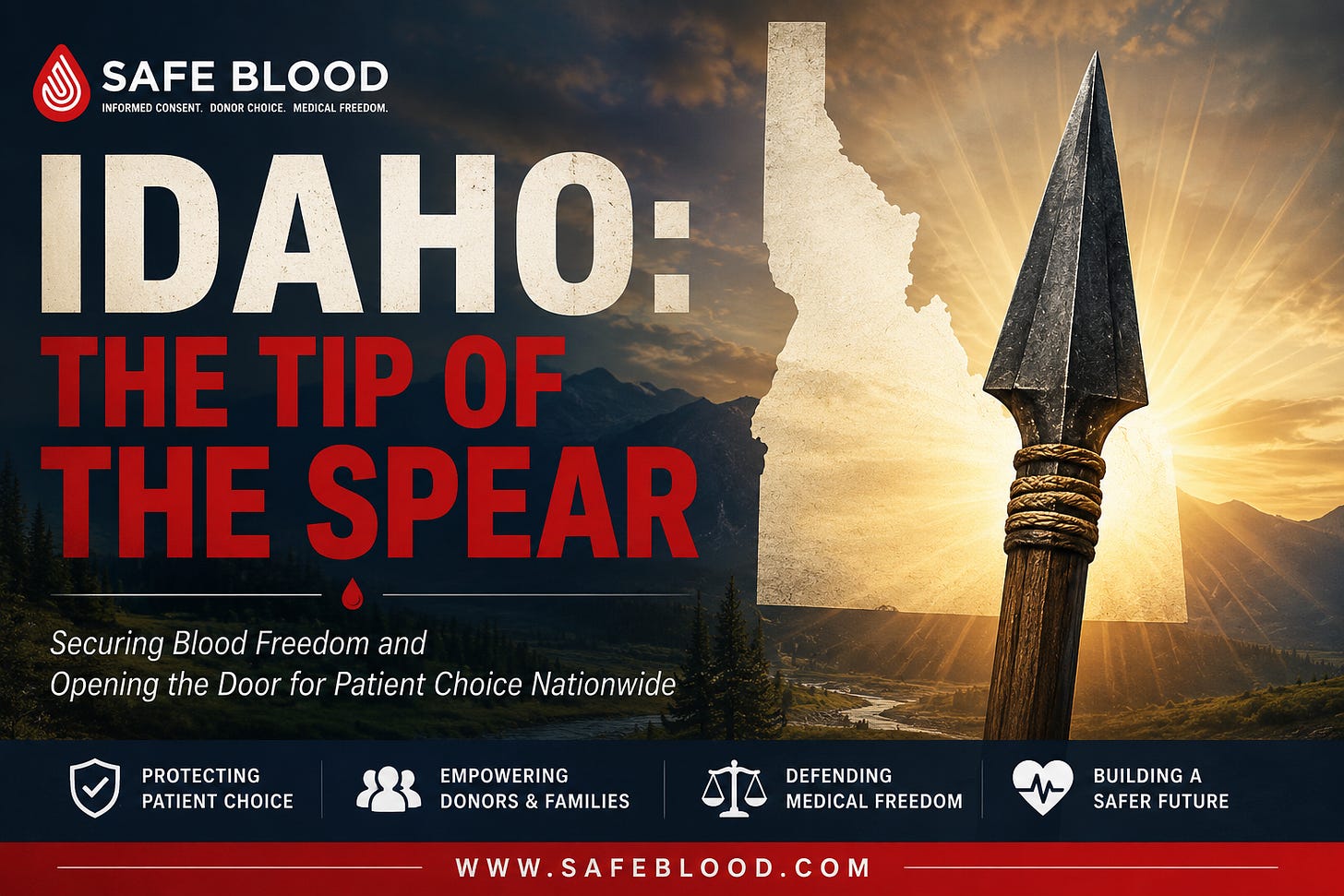
What happened in Idaho this legislative session deserves far more attention than it has received.
On the face of it, Idaho House Bill 528, signed into law, appears to be a relatively modest piece of legislation. It does not restructure the healthcare system or impose sweeping mandates. It does not create an entirely new framework for blood banking and transfusion medicine.
What it does is simple and vital: it secures for Idaho citizens the right to receive their own blood through autologous donation and the right to receive blood from a directed donor of their choosing—all in compliance with the established federal transfusion safety standards and physician approval.
For Idaho families, that is a meaningful victory. For the nation, it may prove to be a watershed moment.
The significance of HB 528 extends far beyond state lines because it represents the first successful legislative effort of its kind in the United States.
Since 2021, advocates of patient choice have worked to protect the natural human right to directed and autologous donations. These rights were not controversial and faced no significant opposition before the rollout of the mRNA vaccines.1
Since then, efforts to protect these patient rights have encountered increasingly fierce resistance from major blood banking organizations and institutional stakeholders. The concern was never difficult to understand: once these rights are successfully protected in one state, they become far easier to protect elsewhere.
Precedent matters. Legislators pay attention to what works in other states, and successful legislation tends to replicate itself.
That is why Idaho is the tip of the spear.
The immediate impact of HB 528 is a window into what is increasingly experienced in states like Washington, Texas, Ohio, and Minnesota, as well as parts of the Midwest and Northeast.
Prior to the passage of this legislation, Idaho was among the most restrictive states in the nation regarding directed blood donations. Decisions governing directed donation policies were largely controlled through local administrative channels. Many patients discovered that obtaining blood from a donor of their choosing was either extremely difficult or outright impossible. In some cases, patients were forced to travel outside the state simply to pursue options that they, their physicians, and their families believed were appropriate.
Therefore, for many Idahoans, this was not merely a theoretical concern.
Families facing surgeries, medical procedures, or high-risk pregnancies often found themselves navigating a system that increasingly prioritized administrative convenience over patient rights. Individuals who wished to arrange directed donations from family members, trusted friends, or non-mRNA vaccinated donors frequently encountered barriers that had little to do with medical necessity and much to do with institutional policy and authorized misinformation.
On July 1, 2026, HB 528 will change that reality.
Introduced by Rep. Chris Bruce (R) in the House and championed by Sen. Tammy Nichols (R) in the Senate, the bill was signed into law by Governor Brad Little on March 16, 2026. It takes effect on July 1, 2026.
Idaho has now ensured that patients retain meaningful rights regarding blood products that may ultimately enter their bodies. It recognizes that informed consent does not end when a physician recommends a transfusion. Rather, informed consent includes the ability to make reasonable decisions about the source of that blood whenever circumstances permit.
The result is a legislative roadmap that can now be studied, adapted, and pursued by state legislatures across the country.
Idaho demonstrated something else remarkable.
When Big Blood lobbyists testify against bills like HB 528, their statements are often treated as the last word from an authoritative source. Idaho proved that when lawmakers are given the opportunity to hear detailed testimony, examine the evidence, and consider the issue carefully, opposing testimony simply crumbles.
Opposition, however, hasn’t retreated. When misrepresenting scientific studies, medical policies, and even simple math no longer worked, opponents didn’t just pack it up.
They adapted and reorganized.
The stunning effectiveness of that adaptation was seen in Nashville, TN, only a month after Idaho’s victory.
That a story for a later post.
What it means for now is that while we celebrate the victory in Idaho and the newly restored freedom of its people, we have only just begun to fight.
SafeBlood exists to protect informed consent, blood transparency, donor choice, and medical freedom.
We believe patients have the right to know their options. We believe individuals should have a meaningful voice in decisions involving blood products. And we believe transparency strengthens healthcare rather than weakens it.
Become a member of the SafeBlood community today.
Join our growing donor network.
Support our educational, legislative, and advocacy efforts by upgrading to a paid subscription.
Paid subscribers are automatically enrolled in the SafeBlood donor network and help us continue advancing patient rights, donor choice, and blood transparency across the United States and around the world.
Visit www.SafeBlood.com
If you cannot choose your donor, you do not have informed consent.
Dr. R. Clinton Ohlers, PhD is Vice President and Director of Media Relations for SafeBlood Donation. He holds a PhD from the University of Pennsylvania and taught and conducted research at the University of Hong Kong, returning to the US in the early COVID outbreak. His work focuses on blood safety, medical ethics, and informed consent, with an emphasis on restoring transparency and patient choice in transfusion medicine.
Prior to 2021 some hospitals stopped offering direct donations due to falling demand not ideological opposition. Better blood testing produced a decrease in requests since its peak during the AIDS crisis in the mid 80s. That trend reversed when the public witness widespread, severe adverse reactions to the mRNA vaccines.
No posts
Comments
Nothing yet. Say the first thing.
Sign in to join the conversation.