
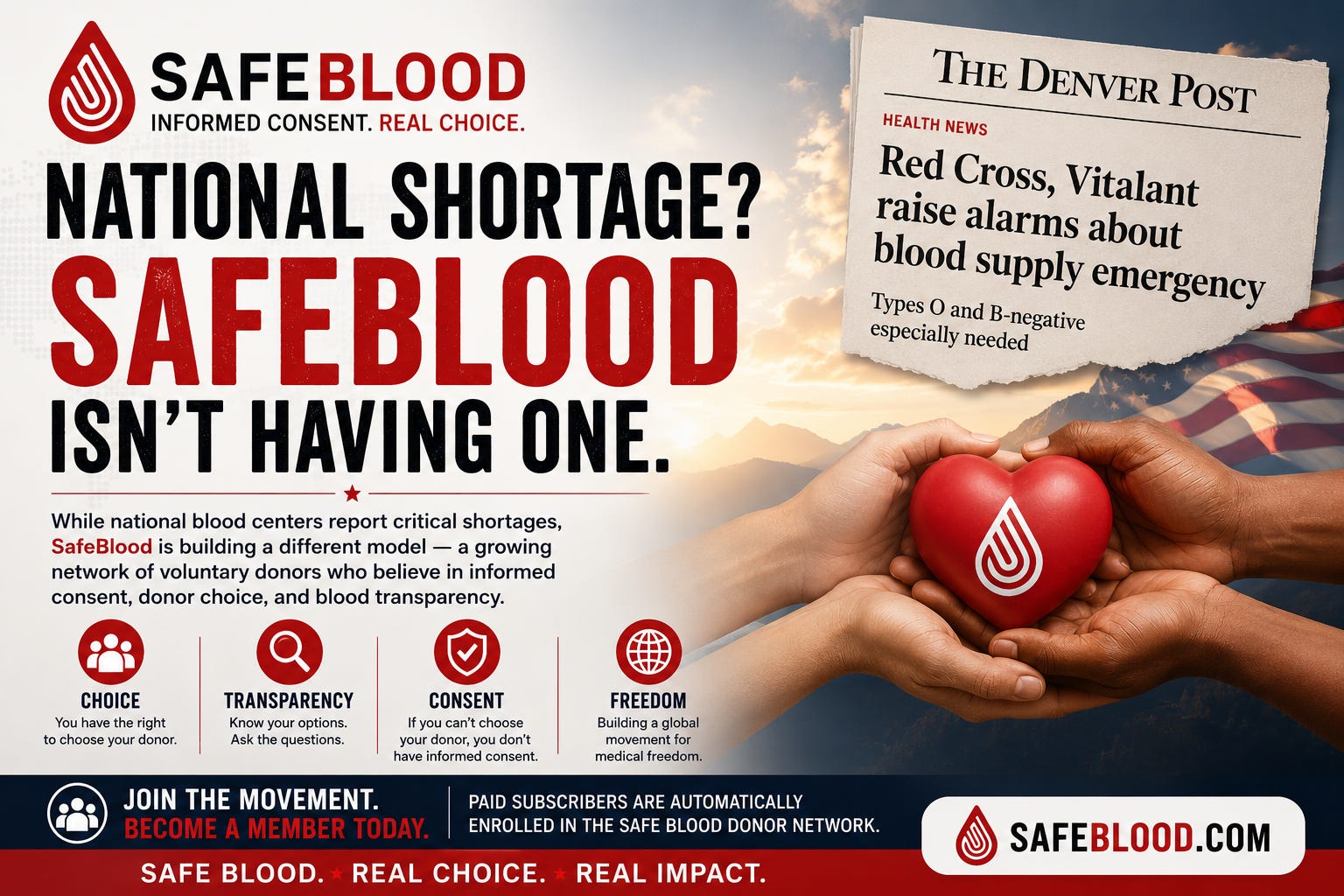
According to a report published by The Denver Post, both the American Red Cross and Vitalant have declared critical shortages of blood, with particular concern surrounding Type O and B negative supplies. The Red Cross reported that available blood units plummeted by approximately 25 percent during June while hospitals are using roughly 3,500 more units each week than expected for this time of year. Vitalant similarly announced a critical shortage throughout Colorado, Wyoming, and neighboring regions, urgently requesting thousands of additional donors to schedule appointments before the end of the month.
The reasons cited by the medical establishment are entirely familiar. Summer vacations reduce donor participation. School blood drives are no longer operating. Seasonal travel and an increase in accidents create additional demand. To encourage donations, these institutions are once again offering incentives ranging from free movie tickets to promotional t-shirts and even automobile giveaways.
At SafeBlood we are not contesting the reality of a donor shortfall for Big Blood, but we question the true nature of it. We frequently interact with former repeat donors to the American Red Cross and others who say they have stopped doing so.
Why?
Because they believe that these institutions have sold out to the false “safe and effective” narrative and do not have patient well-being truly at heart. SafeBlood encounters this anecdotally, but it raises the question of how widespread this phenomenon is.
Does the shortage really reflect seasonal fluctuation and atypically elevated demand? Or is that the cover story for a larger disillusionment among donors?
And what is the real motivation behind companies like Vitalant and the American Red Cross in fighting patients’ rights to directed donations—something that adds donors to the blood supply?
According to SafeBlood’s Dr. R. Clinton Ohlers, PhD, “Studies show directed donations regularly bring new, first-time donors into the blood supply. Yet, companies like Vitalant and the American Red Cross regularly oppose us before state legislatures, fighting bills that protect patients’ rights to the blood they believe is the safest for them—directed and autologous donations—which bring new donors into the system and lessen the net demand.”
He continues, “Plasma products alone are a $24 to $26 billion-dollar-per-year export in the US. All blood products are double that, representing about 2.5% of total US exports annually. This raises the question of whether these constantly reported shortages are really about the patients or about fueling a huge for-profit industry.”
“Pregnant mothers,” he adds, “are 10x to 13x more likely to need a transfusion during delivery than the general population. Dr. James Thorp, MD (OBGYN) recommends that pregnant mothers, whether delivering in the hospital or at home, bank blood for themselves ahead of time. That requires directed donation from matched donors, as very rarely will a mother have the necessary levels to store her own blood.”
“Then, when directed donations aren’t used, they commonly go into the general supply. That depends upon local policy at the hospital where the transfusion would occur, but you can see that when mothers arrange directed donations for their delivery and then do not need the blood, that has still given them the benefit of peace of mind and helps others.”
Big Blood’s opposition to the patients’ right to directed donations and to state laws protecting this right does not appear rational if the motive is truly patient wellness and accessible blood.
It is very rational if the motive is control of supply and the ability to distribute specific blood to specific buyers. Once a patient has procured a directed donation, only that patient has control of that blood’s destination until it is no longer needed.
At SafeBlood, we have taken a fundamentally different, approach.
Because our organization is built around a growing, decentralized international donor community rather than a fragile, centralized inventory model, we are not experiencing the same type of organizational shortage described in this week’s headlines. Our network continues to rapidly expand because thousands of donors and members recognize a simple forensic reality: building resilient, parallel systems begins long before a crisis develops.
SafeBlood has spent years building a robust, parallel network. Our network is composed of voluntary donors who fiercely believe in informed consent, absolute donor choice, and uncompromising blood transparency. Our mission has never been simply to collect blood. Our mission is to build resilient relationships between donors and recipients long before medical emergencies occur.
When patients contact SafeBlood, they are not simply searching for blood. They are seeking vital options. They are demanding transparency. Most importantly, they are exercising a fundamental human right that has become increasingly difficult to defend within modern medicine. They are demanding the right to make informed decisions about exactly what enters their own bodies.
Some critics within the medical establishment wrongly assume that organizations like SafeBlood somehow compete against the existing blood supply. The exact opposite is true.
Every new donor who joins SafeBlood is another awakened citizen actively committed to donating blood. Every new member represents vital additional capacity within the overall donor community. Patient choice and a strong blood supply are not opposing goals. They completely reinforce one another.
Trust is never created by limiting patient options or suppressing scientific inquiry. Trust is created exclusively through absolute transparency.
That has always been SafeBlood guiding principle.
SafeBlood exists specifically because patients should not be required to surrender their autonomy at the exact moment they become medically vulnerable.
If you cannot choose what enters your bloodstream, you do not have informed consent.
Science progresses through inquiry. Ethics progresses through consent. Both require courage. We invite you to stand with us.
Dr. R. Clinton Ohlers, PhD is Vice President and Director of Media Relations for SafeBlood Donation. He holds a PhD from the University of Pennsylvania and taught and conducted research at the University of Hong Kong, returning to the US in the early COVID outbreak. His work focuses on blood safety, medical ethics, and informed consent, with an emphasis on restoring transparency and patient choice in transfusion medicine.
No posts
Comments
Nothing yet. Say the first thing.
Sign in to join the conversation.