
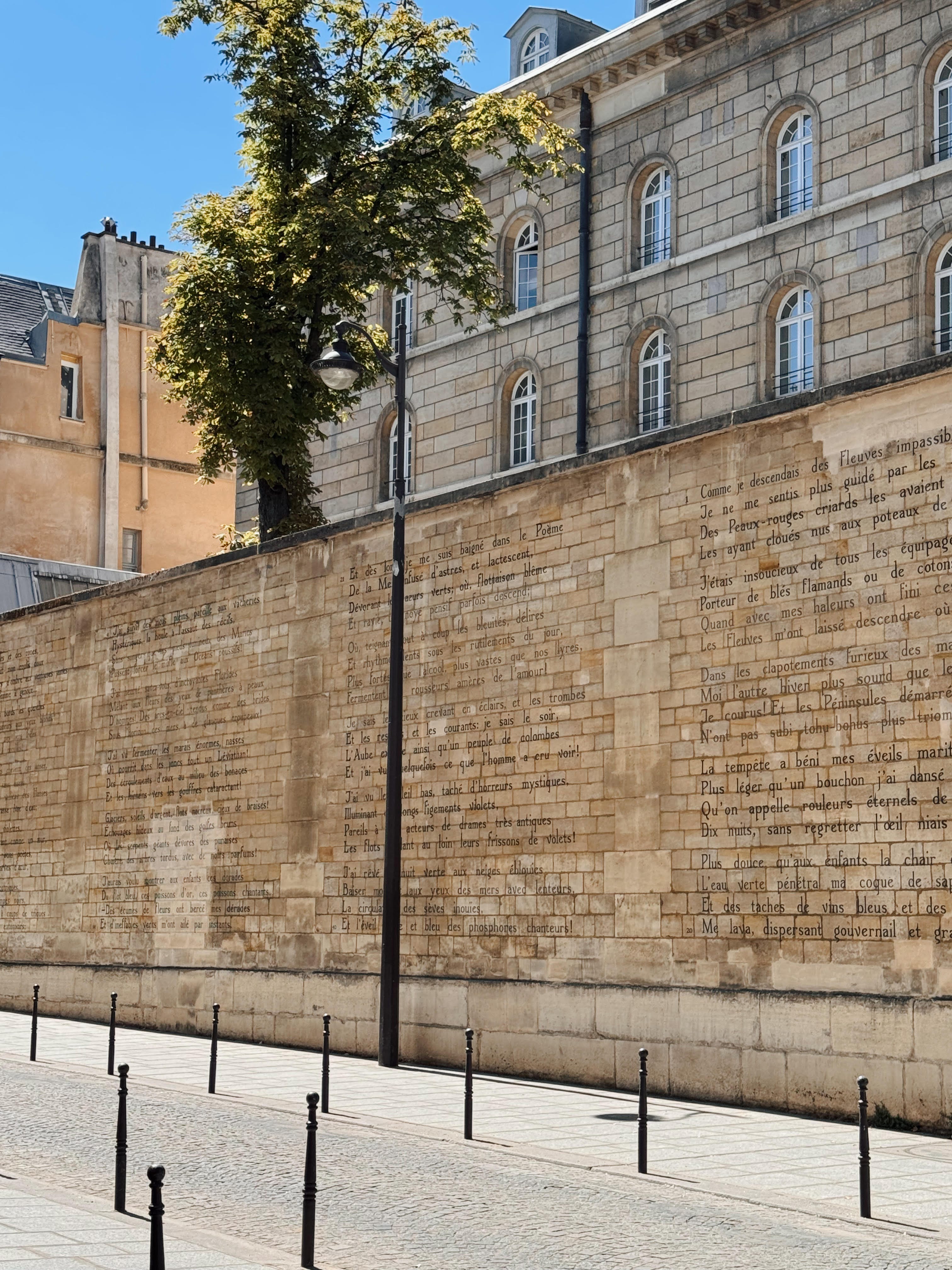
My first apartment in Paris was on rue Servandoni, a narrow seventeenth-century street running alongside Saint Sulpice in the sixth arrondissement. I knew almost nothing then about the literary ghosts of my neighborhood. I knew the church bells, the curve of the streets around the Luxembourg Garden, the particular pleasure of coming home through this old quarter of Paris. I was beginning a life in the city without yet understanding how many lives had already been lived beneath my feet.
Only a few steps from my front door, on rue Férou, an entire poem spills down the wall of a building in enormous black letters.
Le Bateau ivre.
The Drunken Boat.1
Arthur Rimbaud wrote its hundred lines in 1871, when he was sixteen years old. More than a century later, the poem was painted across some three hundred square meters of a wall at 4 rue Férou where Rimbaud personally recited the poem, transforming the pale Parisian stone into a living page of poetry.
I lived beside it without knowing what it would one day mean to me.
Perhaps this is one of the gifts of living somewhere for a long time, a city reveals itself backward. We discover the histories beneath places we already love. A street we once hurried down becomes the former path of a poet. A building becomes a room where someone once dreamed. A café becomes the gathering place of artists and dissidents. A wall becomes a manuscript.
The geography has been there all along.
It is our capacity to see it that changes.
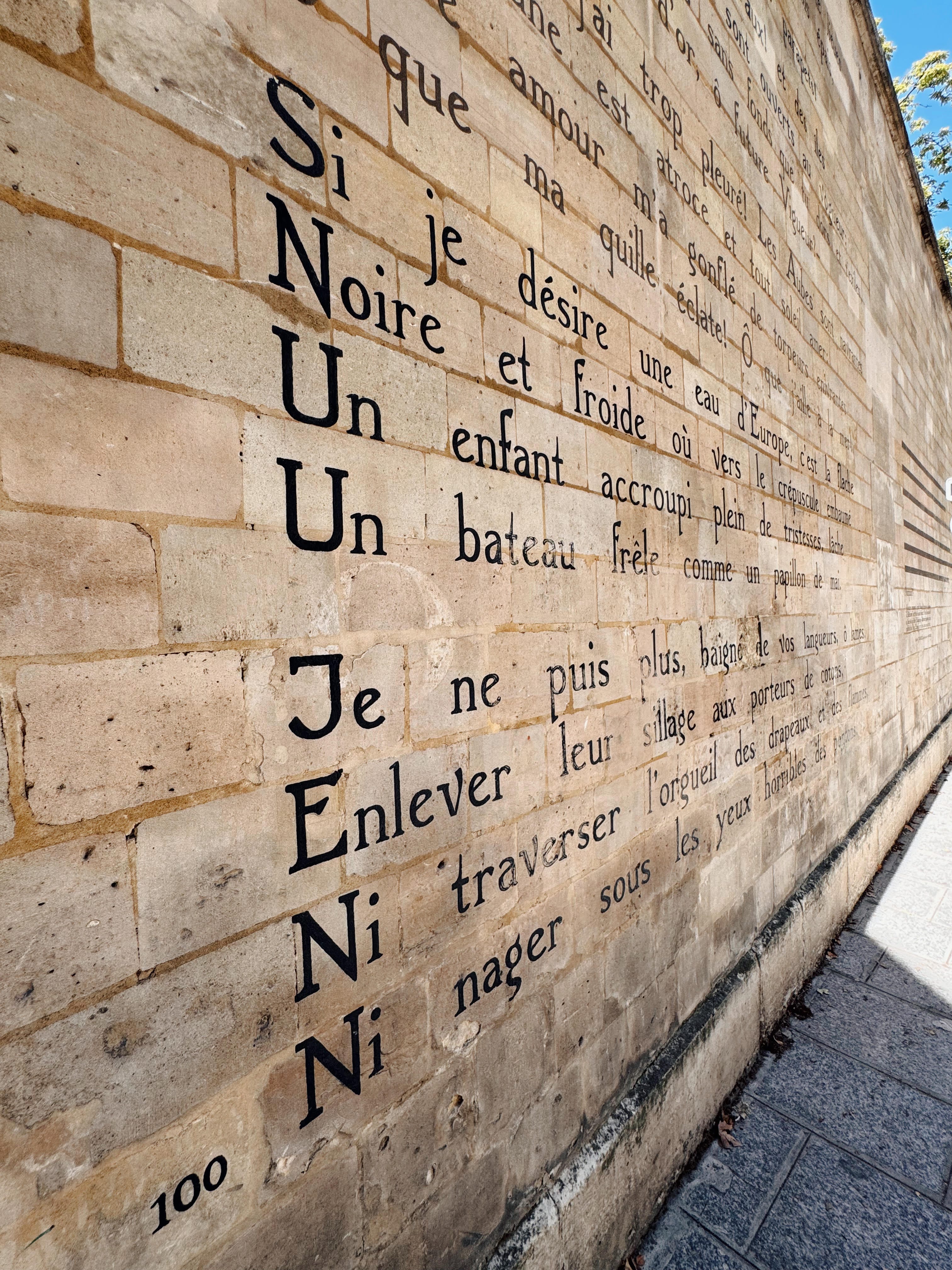
Rimbaud understood something about seeing.
He came from Charleville in the Ardennes, a restless boy who repeatedly tried to escape toward Paris. By sixteen, he was already writing poetry of astonishing originality, he was a poetic rebel. He wanted more than literary success. He wanted poetry to become a way of breaking through ordinary perception.
In his famous letters of 1871, Rimbaud described the poet as a voyant.
A seer.
He believed the poet must somehow disturb the familiar arrangement of the senses in order to reach what he called l’inconnu: the unknown.
It is a startling idea when we remember how young he was. Rimbaud was proposing that poetry was not merely something one wrote, it was something one entered. (Oh do I adore this!) Life itself could become the experiment: walking, hunger, desire, beauty, ugliness, intoxication, rebellion, the body, the street.
The poet would venture beyond the familiar shore and report what he found.
And then he wrote a poem about a boat that does exactly that.
In Le Bateau ivre, the vessel breaks free from those who once guided it and enters increasingly strange waters. It drifts beyond familiar rivers into extraordinary visions of sea and sky, carried farther and farther from everything it has known.
It is difficult not to see the young poet inside his drunken boat.
A boy leaving the provinces.
A poet cutting himself loose from convention.
A human being asking what might become visible once the ropes were gone.
That same year, Rimbaud began sending poems to Paul Verlaine in Paris.
Verlaine was ten years older, already established in literary circles, married and newly a father. Whatever he recognized in the teenager’s poems was powerful enough for him to invite Rimbaud to the capital and send him money for the journey.
Rimbaud arrived in September 1871 carrying his poetry with him.
Among it was Le Bateau ivre.
His first lodging was with Verlaine and his wife’s family at 14 rue Nicolet in Montmartre. The arrangement did not last long. Rimbaud was brilliant, provocative and spectacularly unsuited to respectable domestic life. Soon he was moving between borrowed rooms and temporary beds, staying with poets and friends wherever someone would have him.
Paris became a constellation of impermanent shelters.
He stayed with the poet Charles Cros at 13 rue Séguier and briefly with Théodore de Banville at 10 rue de Buci. He occupied rooms around rue Monsieur-le-Prince and rue Victor-Cousin and, later, rue Campagne-Première.
Much of this life unfolded on foot.
I love thinking about this, it’s impossible not to as you walk the same streets.
Before Rimbaud became Rimbaud, before the plaques and biographies and literary pilgrimages, there was simply a teenage poet walking through Paris carrying poems almost nobody had read.
Around rue Racine and rue de l’École-de-Médecine, Rimbaud entered another Paris entirely.
At the Hôtel des Étrangers, a group of writers had formed the wonderfully irreverent Cercle Zutique. The name came from zut, that particularly French little exclamation of refusal: enough, damn it, to hell with it.
They drank. They wrote. They mocked the respectable literary establishment. They parodied celebrated poets and filled a communal notebook known as the Album zutique with poems, drawings and obscenities.
Rimbaud and Verlaine were among them.
It is easy, more than 150 years later, to polish poets into monuments. We place their books on shelves, engrave their names onto plaques and speak about their work in hushed rooms.
But Rimbaud’s Paris was not hushed.
It was unruly.
The relationship between Rimbaud and Verlaine became equally so. Literary recognition turned into intimacy and love, and eventually obsession, jealousy and violence. Verlaine left his wife, and the two poets departed Paris together in 1872, first for Belgium and later London. Their relationship would end catastrophically in Brussels the following year, when Verlaine shot Rimbaud in the wrist.
The mythology surrounding the two men can easily consume their story.
But when I imagine their Paris, I find myself less interested in the scandal and more interested in the walking and in the Paris they lived.
Two poets moving through the city.
Crossing bridges and boulevards. Sitting in cafés. Sleeping in borrowed rooms. Arguing about poetry. Looking at rain and ordinary things. Watching strangers. Carrying their private storms through public streets.
Verlaine would later write:
Il pleure dans mon cœur
Comme il pleut sur la ville.
It weeps in my heart
As it rains upon the city.
The boundary between the interior landscape and the exterior one disappears. The weather enters the body, and Paris becomes emotional terrain.
Rimbaud goes further still.
The poet does not remain safely on the riverbank describing what passes before him.
He becomes the boat.
I don’t know why, but I have always loved Rimbaud. I love that he was a young talented poet, that he rebelled and forged his own way, that he wrote his heart out and desired a deep life — and that he walked the streets of Paris from this inner place.
There are many ways to move through a city.
Tourism asks a perfectly reasonable question:
What should I see?
The poet asks something else:
How might I see?
The pilgrim, I think, asks the same question.
A pilgrimage changes when the destination stops being the entire point. The streets between sanctuaries begin to matter. The weather matters. The stranger passing us matters. The closed door matters. The wrong turn matters. What we notice becomes part of what we have come to receive.
The city becomes more than scenery.
It becomes text.
I returned to rue Servandoni last week, it had been a long time since I walked in my old neighborhood here. I could feel the depth of my becoming, and how much I have changed since I lived on this street. I could not have known how completely Paris would rearrange my life. I could not have known that walking would eventually become one of the ways I understood this city, or how often I would find myself searching for the sacred histories hidden behind its ordinary doors.
That I would create Sacred Paris, and share this way of being here deeply with others. I found a familiar bench near my first apartment and sat there for a long time feeling all of this. Feeling how familiar this part of Paris is, at the same time feeling into the woman I have become.
And all that time, just around the corner, Rimbaud’s drunken boat was sailing across a wall. A wall I photographed myself in front of in 2017, as a new rebel poet traveling the world and finding herself…
The poem had been there.
I simply hadn’t learned how to read the city yet, and the city was just beginning to love me.
This is what I love most about returning to places we think we know. The sanctuary has not changed, the street has not moved, the words remain written upon the wall.
We have changed.
And so we see again, from this new place.
A Rimbaud & Verlaine Pilgrimage Through Paris
If you find yourself in Paris, I invite you to take this pilgrimage slowly and mostly on foot. Bring a notebook and a few poems. Resist the temptation to research every destination before you arrive.
For once, allow yourself not to know everything about where you are going.
1. Rue Férou — The Drunken Boat
Begin at 4 rue Férou, beside Saint-Sulpice, where the hundred lines of Le Bateau ivre descend the wall.
Stand beneath them for a while.
You do not need to read everything. Choose a few lines. Listen to the French even if you do not understand every word.
Imagine a sixteen-year-old boy writing about a vessel slipping free into unknown waters.
Sacred Question:
What rope am I ready to loosen?
2. 10 rue de Buci — The Wanderer
Walk toward rue de Buci, where Rimbaud briefly stayed with poet Théodore de Banville.
Along the way, read Rimbaud’s Sensation, written before his Paris years. In it, the young poet imagines himself wandering beneath the summer sky, feeling the earth beneath his feet and allowing himself simply to go.
For this part of the pilgrimage, do the same.
Walk without hurrying.
Sacred Question:
Where might I wander if I did not need to know exactly where I was going?
3. 13 rue Séguier — The Stranger
Continue toward rue Séguier, where Charles Cros gave Rimbaud temporary shelter.
There may be little here to announce what happened.
That is part of the pilgrimage.
Stand before an ordinary Parisian building and remember that many of the places that change our lives will never receive plaques.
Sacred Question:
Who has given me shelter while I was becoming someone new?
4. Rue Racine — The Rebels
Cross into the streets around rue Racine and rue de l’École-de-Médecine, where the poets of the Cercle Zutique once gathered.
For this stretch, put your notebook away.
Practice being a voyant.
Notice what you ordinarily edit from your attention: torn posters, overheard conversations, graffiti, cigarette smoke, gutters, doorways, faces, shadows, beautiful things and ugly things.
Allow Paris to remain uncurated.
Sacred Question:
What convention have I mistaken for truth?
5. Rue Monsieur-le-Prince — The Interior Landscape
Walk toward rue Monsieur-le-Prince, another of the streets associated with Rimbaud’s temporary Paris rooms.
Here, bring Verlaine with you.
Read:
Il pleure dans mon cœur
Comme il pleut sur la ville.
Then notice your own interior weather.
Do not improve it.
Do not explain it.
Simply allow it to exist beside the city.
Sacred Question:
What is the weather inside me today?
6. 8 rue Victor-Cousin — The Trace
Continue toward the former Hôtel de Cluny at 8 rue Victor-Cousin, where Rimbaud briefly stayed and where a plaque remembers his presence.
Consider the strange intimacy of a plaque.
Someone slept here.
Someone looked through this window.
Someone left.
And somehow a trace remained.
Sacred Question:
What trace do I hope to leave in the places that have held me?
Do you know someone visiting Paris who might appreciate this poetic pilgrimage through the city?
7. Rue Férou — The Return
Finally, return toward Saint Sulpice.
Pilgrimage often brings us back to where we began, which is one of its oldest mysteries.
The place is the same.
The pilgrim is not.
Stand once more beneath Le Bateau ivre. Find one line that belongs to you now and write it in your notebook.
Then continue around the corner onto rue Servandoni.
The street where I once lived without knowing that Rimbaud’s drunken boat was sailing just beyond my door for a reason, and that my life here in Paris would continue with depth.
There are poems beside all of our doors, histories beneath our feet, invitations written across walls we pass every day without noticing.
The sacred is not always waiting somewhere far away for us to find it.
It has been beside us all along.
And maybe pilgrimage is simply one of the ways we learn to see it.
With love from the path,

Listen to The Drunken Boat in French here:
Comments
Nothing yet. Say the first thing.
Sign in to join the conversation.