
The purpose of this post is to document the process of obtaining an authenticated (aka apostilled) FBI ‘Identity History Summary’ from outside the US, specifically from Portugal, in case it helps others. If you’re never going to need that under those conditions, please skip this post :)
⁂
I needed to get my apostilled US criminal record — or Identity History Summary, background check, etc. — since I lived there for eight years in the past. To get this done from Portugal, the US embassy in Lisbon has a good overview to follow with all the links that you’d need. Here’s a summary:
Get your fingerprints on specific forms.
Apply and post these forms to the FBI.
Wait.
Download report from the FBI’s website.
Post the report to the Department of State for ‘Authentication’ (apostille).
Wait.
Get the apostilled report back.
Success.
The only place to get fingerprinted in Portugal by someone who actually knows what they are doing is through a ‘co-op’ that’s somewhat associated with, but not strictly part of, the US embassy in Lisbon. They have timeslots roughly every week and at a cost of €63 you get two cards with a set of the required fingerprints. When I tried to book a timeslot they were either incredibly busy or, and this is more likely to me, there was a bot snapping them up.
It works like this. Booking for a slot opens exactly [20 days * 24] hours prior to the actual slot’s time. I tried to book several appointments at that exact time and they were no longer bookable within a second or two (either gone, or I’ve gotten an error after initiating the booking). I tried to do things as fast as I can at human speed, without success. I’d say they were booked automatically, or by sheer applicant volume, in less than a second.
At this point I reported my ‘findings’ to the co-op and they were gracious to open more timeslots and offer me one; they are very responsive and considerate! Unfortunately I wasn’t able to make it all the way to Lisbon that time, or for the next slot I booked, so I tried the DIY approach.
There’s nothing magical about the fingerprinting cards; it’s just something that you can print yourself and cut to size (there’s a helpful dashed 8” by 8” border around the form). Annoyingly, there are two similar forms that are used for this kind of thing: FD-258 and FD-1164; the Lisbon embassy and co-op say that it should be FD-258, but the FBI says to use form FD-1164.

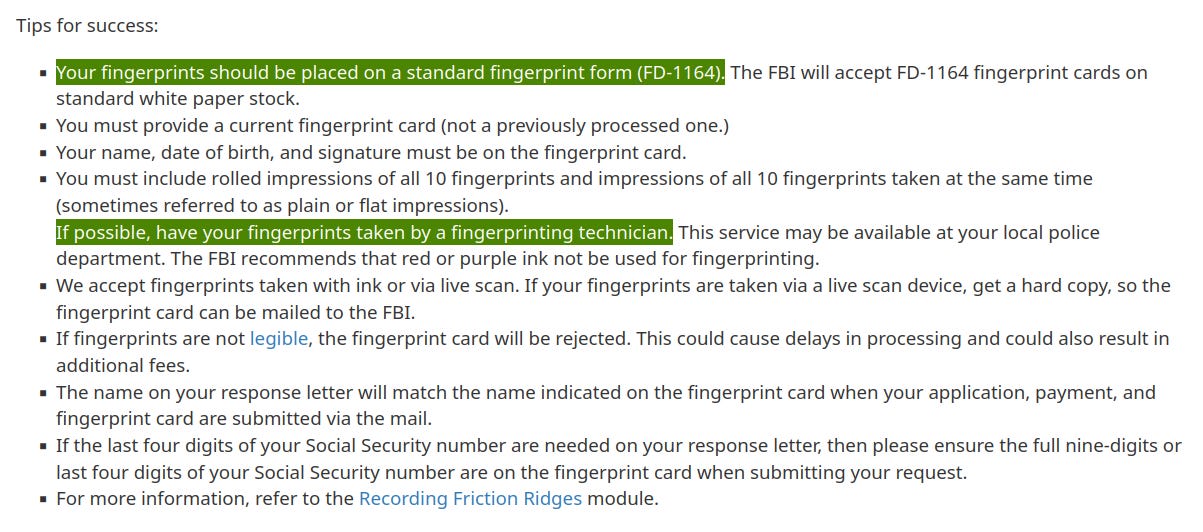
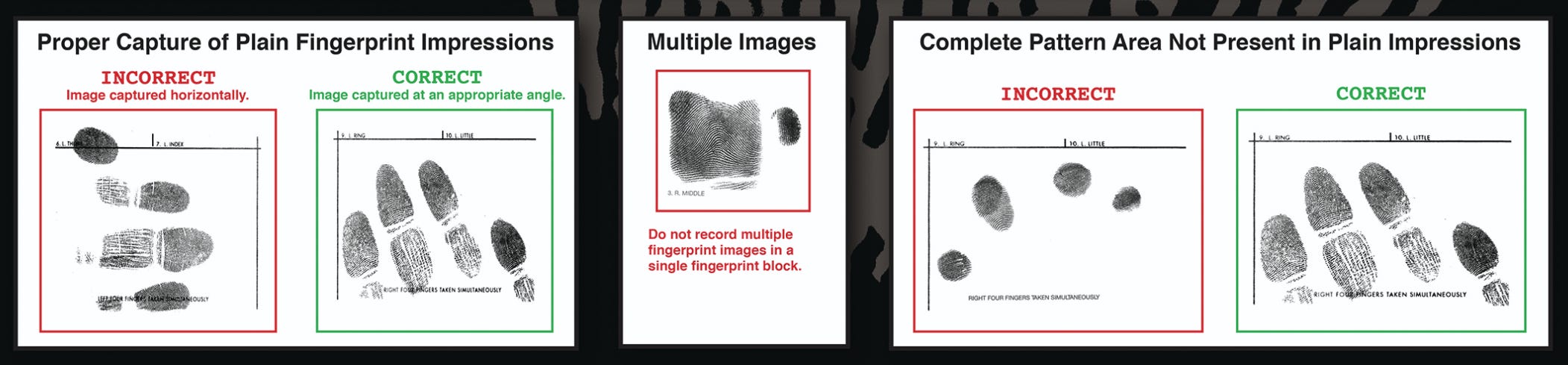
The tricky part is getting the fingerprints done correctly, rolled ‘fingernail to fingernail’ within the small box (this is why you pay a technician or a fancy machine to do it): here’s the FBI’s advice. I’ve watched a bunch of videos and got conflicting information about the entire process. Still, I used some old black stamp ink and practiced rolling my fingers just right, which required some finger dancing and awkward positioning. It was messy and tricky to do without someone holding my fingertips whilst still keeping the card clean of marks from my inked fingertips!
I’ve seen some places that suggest sending multiple cards, presumably so that the technician can pick and choose from them in order to get a complete set. So I’ve eventually managed to create reasonably good sets on three FD-258s and two FD-1164s. Of course I have no way of knowing if the type of card mattered, or if they use more than one card… but the FBI clearly didn’t reject the plethora of cards on their amount alone.
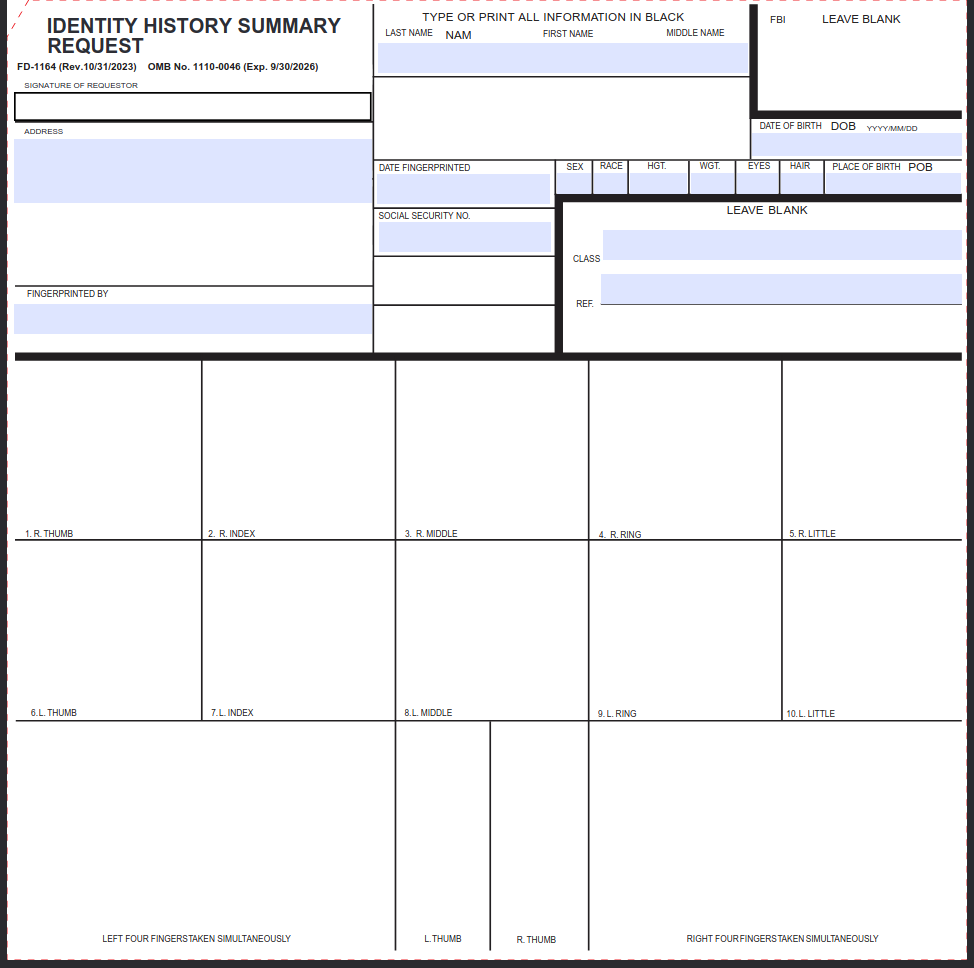
You need to register a request with the FBI, pay $18, print the receipt and post it with the cards to the address that they give you. I’ve sent mine registered with CTT, a package that, of course, got lost! So after about four weeks I created another five fingerprint cards, registered another request, and packaged it all up for another attempt.
Literally less than an hour before I left home to post the second package a message from the FBI arrived:
Your fingerprint card has been received for your Identity History Summary Request and will be processed in the date order in which it was received.
20 minutes later, the report was already available:
Your Identity History Summary Response is now available for review. You can review your response by accessing the secure link and PIN found in the original e-mail previously sent to you. This response is available for 180 days.
So my package did indeed arrive (but was not tracked at all by USPS) and they eventually got to it and processed it immediately. In total it took 28 calendar days from when I posted the package to when I got the report ready for download.
I’ve also asked the FBI to post the report, which is a free optional service available when the report is ready. It arrived within a couple of weeks, and is just the printed form, without any embossed stamps or anything that seem to make it ‘more official’ than something you can print yourself.
It is the US Department of State that authenticates (apostilles) documents. For FBI criminal records, they don’t need the physical piece of paper from the FBI and you can just print what you’ve downloaded from the FBI’s website and send it with your application.
The complication here is that you must provide a paid envelope for the return shipment. A CTT return envelope would be meaningless in the US, of course, so I roped a reliable person in the US to do the following for me:
Print the FBI report.
Print the filled out DS-4194 form.
Fill out and pay for a $20 (plus $1.5 fee) money order.
Pay for a UPS return envelope back to him (UPS won’t create a return envelope to outside of the US… this is why I think that it wouldn’t have worked from UPS Portugal).
Send everything to the Department of State via UPS.
Wait.
Receive the package, scan the apostilled report in case it got lost, and UPS it to me in Portugal.
In total, it took 29 calendar days from when he shipped the package to the DoS to when he received the apostilled report, and a few more days to arrive to me. Bear in mind that there is no way of knowing the progress of the application other than the (UPS) package tracking: you know that it had arrived at the DoS, and you know that it left via the tracking of the return envelope; the DoS doesn’t send you any updates or notices.
It seems possible to send (multiple) DIY fingerprint cards that get successfully processed by the FBI, but it takes practice to get right. The most practical way to get the report appostilled is to have someone in the US post it to the Department of State and then post it to you.
The process, since I managed to keep it fairly streamlined, took just over two months, which is probably the fastest one could hope for without paying extra for expedited services. But it certainly is unnecessarily cumbersome. For example, the FBI could have a tickbox to initiate the appostilling with the DoS, which, in turn, could have a paid option for (international) shipping. The fingerprinting on paper kerfuffle seems anachronistic, weird, and uncommon — the UK doesn’t require it for a similar certificate. In general, I feel that they should make a bit more of an effort to better accommodate the tiny amount of us not living in the US.
Welp. That’s how I did it, but there are some alternatives to this process that are probably more costly, may be faster and/or more convenient, and are likely less prone to problems. You can fly to the US and get fingerprinted in USPS stores with that capability and get your FBI report within a couple of days — or was it a couple of hours? — so super easy. There are also FBI-approved channelers that provide fingerprinting service for those abroad, but I think that you need to be a US citizen for that. Also, paid services exist that will take care of everything for the Department of State stuff… but my impression was that they don’t necessarily save a lot of time unless you pay for an expedited service.
⁂
So. These were my personal experiences, which certainly shouldn’t be taken as advice, that may or may not work for others. The best thing to do, I found, was carefully reading all the instructions and following them to the best of one’s abilities.
Comments
Nothing yet. Say the first thing.
Sign in to join the conversation.