
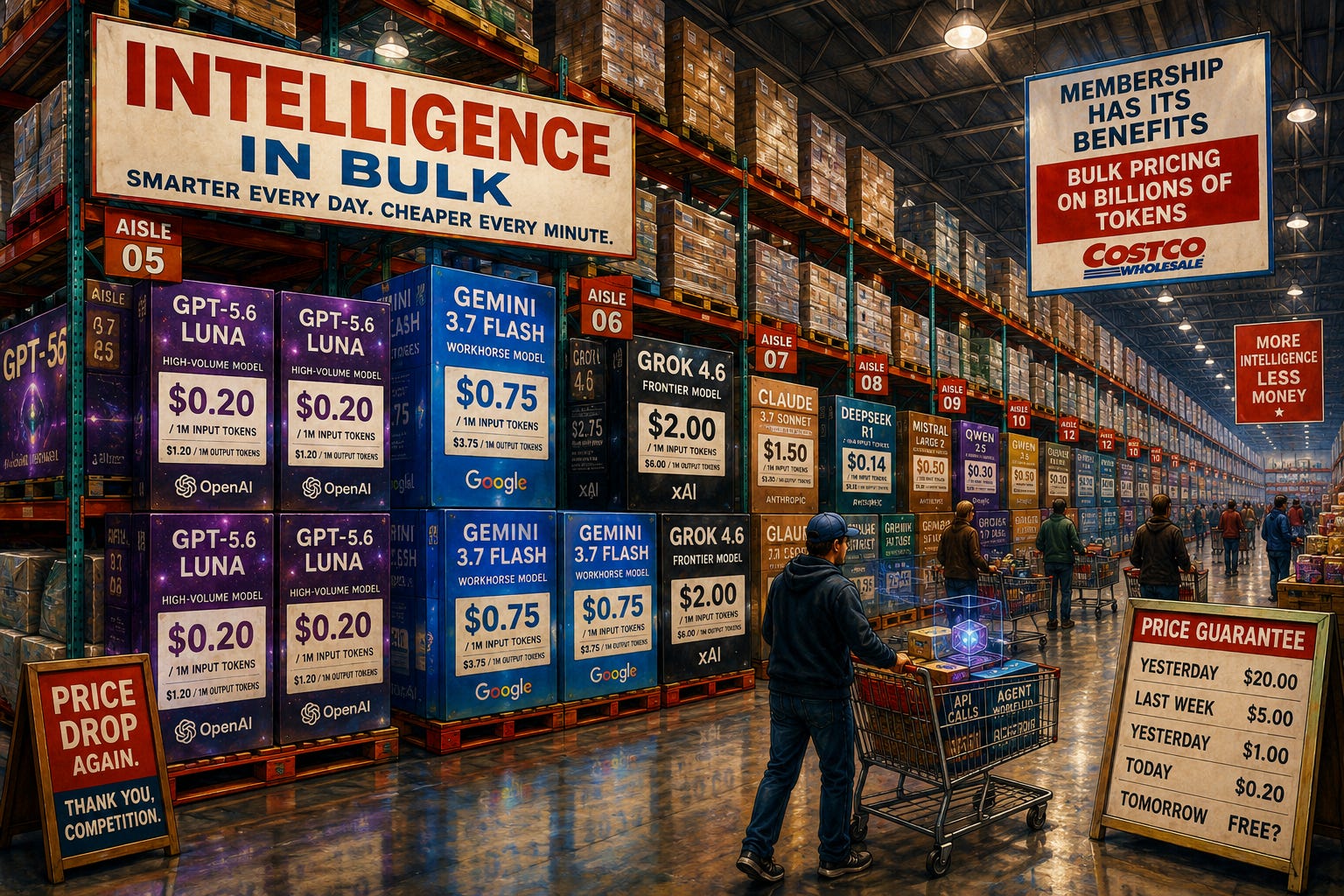
This August, AI competition entered its Costco era. The throughline across the three most important recent model releases was cost.
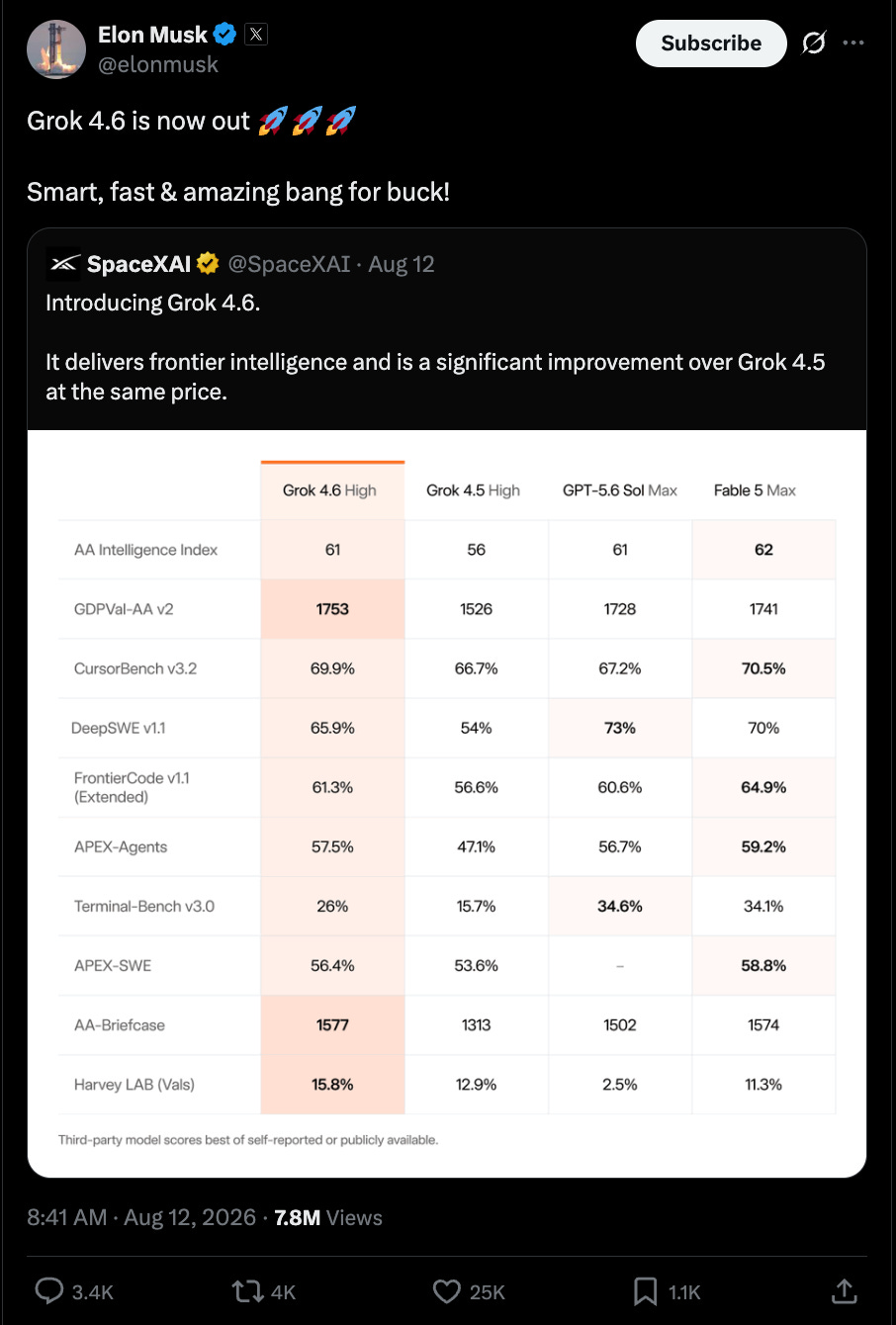
xAI launched Grok 4.6 at $2 per million input tokens, $0.50 for cached input, and $6 per million output tokens below 200K prompt tokens, positioning it as a frontier model for coding, agentic tasks, and knowledge work. Above 200K, pricing doubles to $4/$1/$12.
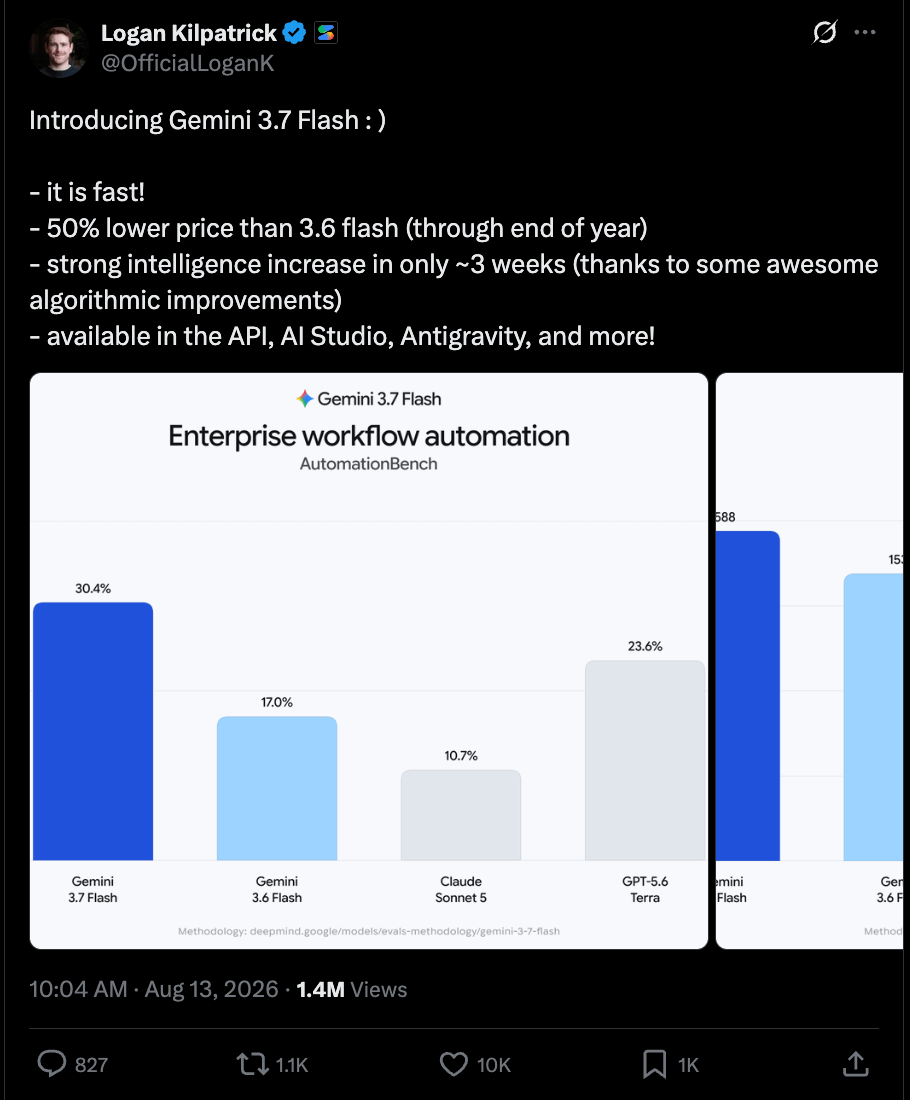
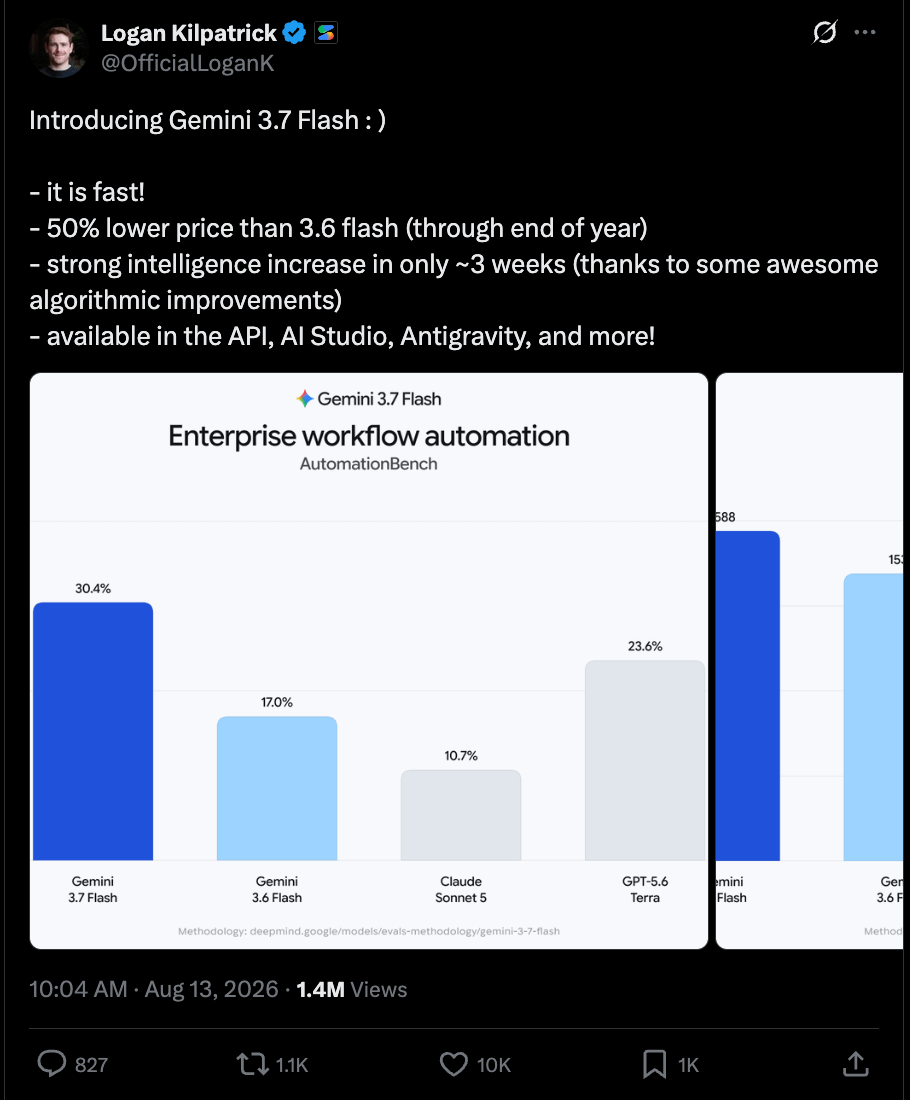
Google launched Gemini 3.7 Flash as its “most intelligent workhorse model” and priced it at $0.75 per million input tokens and $3.75 per million output tokens - half the original price of Gemini 3.6 Flash, a model that was barely three weeks old. Better coding, better agents, fewer retries, and economics designed to make production agents cheaper to run.
OpenAI pushed the argument furthest. It cut the price of GPT-5.6 Luna, its high-volume model, by 80%, from $1/$6 to $0.20/$1.20. Luna now delivers performance comparable to models that were frontier-class a year ago at roughly six cents on the dollar per task - and nearly 9x the speed.
Then OpenAI took the cost curve to its logical conclusion: it started giving the model away. Luna now powers unlimited everyday text chats for free users, subject to abuse guardrails.

This market direction makes sense. Pushing the absolute performance frontier is increasingly expensive, technically difficult, prone to diminishing returns, and involves many meetings with regulators. Pushing down the cost curve, by contrast, expands the addressable market every time you do it.
The frontier still matters enormously. If you are proving a theorem, discovering a vulnerability, or reasoning about protein structures, you probably want every available unit of intelligence.
But most economic activity is considerably more mundane. Extract this invoice.
Write this SQL query. Review this pull request. Classify this customer ticket. Update this CRM record. Search these documents. Book this meeting.
You don’t need Einstein to rename a file. And there are vastly more files to rename than theorems to prove.
Software that runs continuously has to be economical. The more ambitious the AI vision becomes - billions of autonomous agents performing trillions of tasks - the less sustainable it is to use the absolute smartest model for every step. This is why the simultaneous improvement in agent capability and collapse in model pricing is so important. The more work we delegate to AI, the more important the marginal cost of intelligence becomes.
Over time, I think we’re going to move to a model org chart. The expensive frontier model becomes senior management: make the plan, resolve ambiguity, handle consequential decisions. Cheap models become the workforce: execute the plan, call tools, transform data, write tests, check work. This may turn out to be the dominant architecture of agentic software.
There is another story here too: the accelerating speed of intelligence commoditization. OpenAI describes Luna as producing performance comparable to models that sat at the frontier only a year ago, but at a small fraction of the task cost. Google just replaced a three-week-old Flash model with one that is simultaneously better and, on introductory pricing, half as expensive. We are seeing rapid intelligence deflation. A capability that costs $100 today costs $10 tomorrow and $1 next year. This is how a technology becomes infrastructure.
Falling prices rarely mean falling spend. Usually, they mean exploding consumption. When bandwidth got cheaper, we invented YouTube. When computers got cheaper, we put one in every pocket. When storage got cheaper, we stopped deleting photos.
The same thing is likely to happen with intelligence. At $20 per task, you automate only your most valuable workflows. At $2, you automate far more. At $0.20, you start asking why software isn’t reasoning about everything. And when the consumer price reaches effectively zero, entirely new behaviors emerge and things get a whole lot more interesting.
Comments
Nothing yet. Say the first thing.
Sign in to join the conversation.