
As an Iqbal scholar, the most boring question I get asked is about Iqbal’s theory of Pakistan. To the average Pakistani, Iqbal is the hero philosopher-poet who laid the foundation of the two-nation theory for their country. To the average Indian, Iqbal is either a secondary villain to Jinnah responsible for India’s partition, or he is a misunderstood Indian nationalist poet who was appropriated by the Pakistani state.

[My] temperament remained free from the prison of the season
Alas, would there be one who would understand my lament?
It is breathtakingly ironic that the man who gave us perhaps the most sophisticated philosophical deconstruction of nationalism in contemporary Muslim thought is also the one who is only ever mentioned in association with nationalist narratives. Iqbal neither envisioned Pakistan, nor did he dream of a united India – Iqbal dreamt of a political arrangement where both Islam and Muslims would be free. But what did that freedom mean to him?
To Iqbal, freedom meant a socio-cultural, political, and economic system that enabled man to achieve his God-given destiny: the perpetual growth of the human.
As a philosopher, Iqbal is not like Heidegger, whose politics is something that can be separable from his philosophical method and system. Iqbal is uniquely resistant to fragmentation – even though he is most often read in fragments – and so his metaphysics, politics, socio-cultural theory is interconnected and linked. Khudi is not separable from ishq, God from man, man from society, society from state. Iqbal’s system envisions a world that begins in fragments and unites in the end – an ardent critic of duality, Iqbal believed most in tawḥīd, interconnected unity of all things.
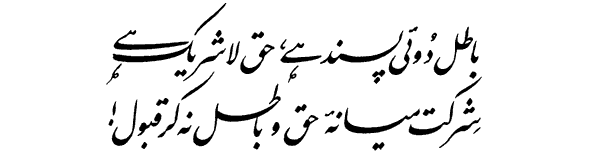
Falsehood desires two-ness – truth has no association
Don’t accept association that moderates between truth and falsehood
Iqbal’s political philosophy was built on his economic philosophy; his economic philosophy was built on his social philosophy; his social philosophy was built on his philosophy of man; his philosophy of man was built on his metaphysics; his metaphysics was built on his direct mystical experience of God. In his system, dysfunction in the realm of politics was evidence of dysfunction in one’s beliefs about God, the universe, and the self. And he took great pains in identifying what dysfunction looked like:
قاهر آمر که باشد پخته کار
از قوانین گرد خود بندد حصار
قاهری را شرع و دستوری دهد
بی بصیرت سرمه با کوری دهد
حاصل آئین و دستور ملوک
دهخدایان فربه و دهقان چو دوک
When a tyrant ceases to be raw
He fortifies himself through law
He gives legal form to tyranny:
The blind being healed by one who can’t see
What’s achieved from legality of kings?
The lords are fat, the peasants are thin
To Iqbal, dysfunctional states are ones that turn the structures of state into a mechanism for tyrannous extraction for the benefit of the elite. All states are colonial states, because the elite – whether foreign or indigenous – colonize their populations. States, flags, anthems, and legal systems are not the end goal of Iqbal’s political thought. To Iqbal, human political organization is a means for the realization of man’s destiny:
“The unity called man is body when you look at it as acting in regard to what we call the external world; it is mind or soul when you look at it as acting in regard to the ultimate aim and ideal of such acting. The essence of tawḥīd, as a working idea, is equality, solidarity, and freedom. The state, from the Islamic standpoint, is an endeavour to transform these ideal principles into space-time forces, an aspiration to realize them in a definite human organization. . .The State, according to Islam, is only an effort to realize the spiritual in a human organization.”
So, according to these principles, is Pakistan a realization of Iqbal’s vision simply because it is supposedly a state for Muslims? Is India? Or was the colonial apparatus never dismantled from British India. Did Pakistan ever become free – truly free, in Iqbal’s understanding of freedom – or did brown hands steal the colonial yoke from white ones? Are either Pakistan or India’s political, legal, and social systems created to inspire and empower individuals to achieve their greatest potentials? Or are they structured to suck as much benefit from the masses for the benefit of the elite?
Perhaps the most tragic of Iqbal’s writings are therefore his letters to Muhammad Ali Jinnah. I reproduce a section here for those of us who still hold the dream of Pakistan close to our hearts to feel the sheer weight of grief that comes from reading them:
“In other matters too, our political institutions have never thought of improving the lot of Muslims generally. The problem of bread is becoming more acute. . .The question therefore is: how is it possible to solve the problem of Muslim poverty? And the whole future of the League depends on the League’s activity to solve this question. If the league can give no such promises, I am sure that Muslim masses will remain indifferent to it as before.
Happily, there is a solution in the enforcement of the Law of Islam and its further development in the light of modern ideas. After a long and careful study of Islamic Law, I have come to the conclusion that if the System of Law is properly understood and applied, at least the right to subsistence is secured to everybody. But the enforcement and development of the Shariat of Islam is impossible in this country without a free Muslim state or states. . .
For Islam, the acceptance of social democracy in some suitable form and consistent with the legal principles of Islam is not a revolution but a return to the original purity of Islam. . .Anyhow, I have given you my own thoughts in the hope that you will give them serious consideration either in your address or in the discussions of the coming session of the League. Muslim India hopes that at this serious juncture, your genius will discover some way out of our present difficulties.”
No posts
Comments
Nothing yet. Say the first thing.
Sign in to join the conversation.