
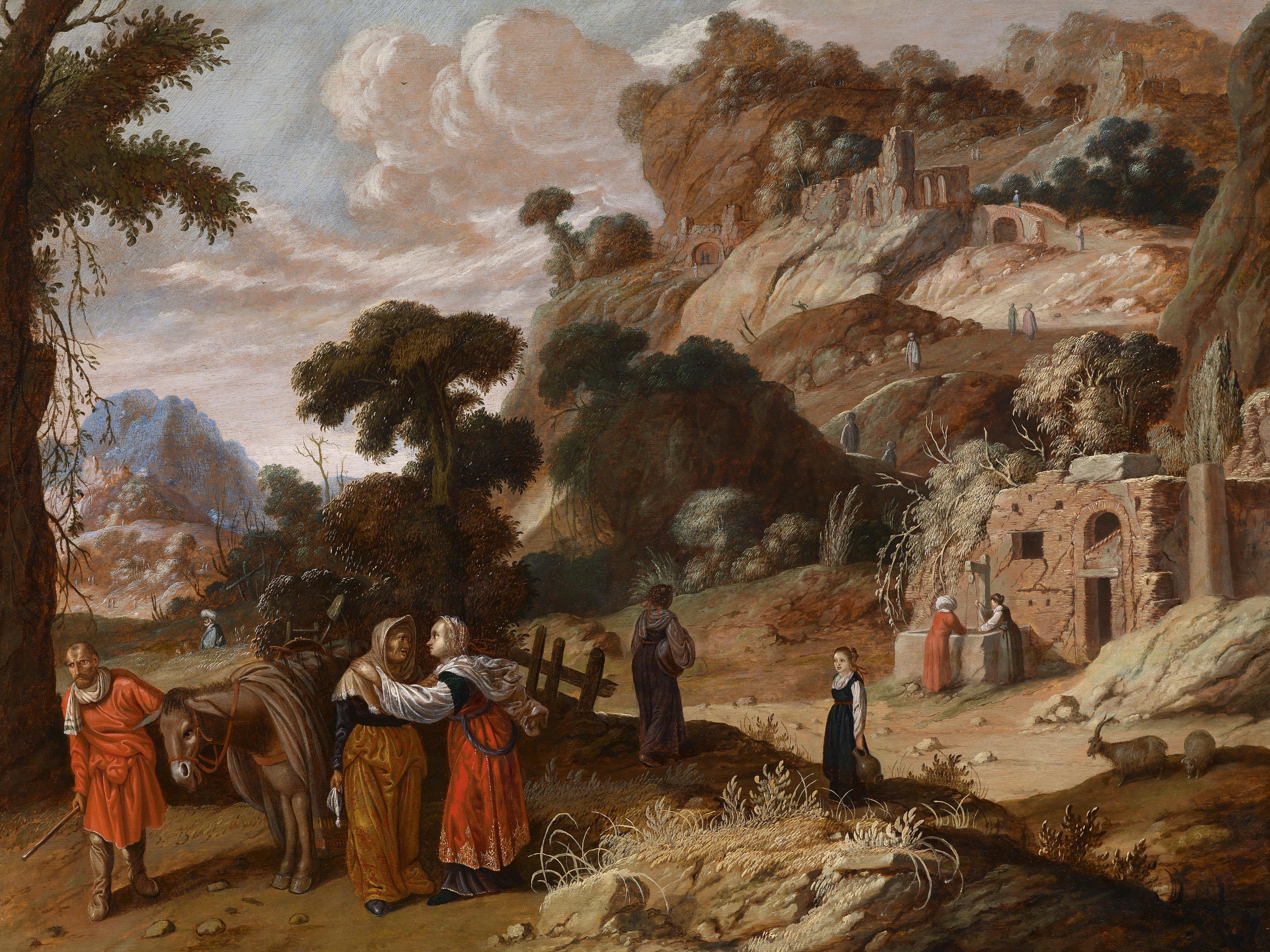
She said to them, “Do not call me Naomi; call me Mara (Hebrew for ‘bitter’), for the Almighty has dealt very bitterly with me.”
~ Ruth 1:20
Do not call me Naomi. Naomi is the name of one whose life is pleasant; Shaddai has made my life bitter. Naomi is the name of one who has not known famine: whose storehouse overflows with grain, who never wants for oil, who eats bread to the full. Naomi need not leave her homeland.
Naomi rejoices in the husband of her youth. He is not a blameless man, Elimelech, but he keeps the moneylenders at bay and, after a fruitful day in the field, lifts you up by the hips like you are a girl and kisses you behind the ear. Naomi does not bid her man farewell in midcourse.
Naomi is blessed with two young men, Mahlon and Kilion. They flash their father’s quick grin when they are up to no good. Their dark eyes and strong chins, gifts of their Abba’s ancestors, ensure they are not bachelors for long. Naomi does not have to commit her boys to Sheol with their father, and with them her heart.
Naomi need not return to her homeland, like a beggar in search of bread, empty of husband or sons or grandsons or future, and only a stubborn Moabitess who clings to her like a burr to show for all her shame.
Do not call me Naomi. Naomi is dead.
So we came to Bethlehem at the beginning of the barley harvest. The Moabitess said, “Ami”—that is what she called me, “my mother”—“Ami, may I go to glean in the fields?” I sent her with my blessing. (Her name is Ruth.) She found herself in a field belonging to a certain landowner.
He was known to be a Man of Standing, of valor—ḥayil, we say. He was not much to look at. You don’t reach his age, with his standing, and lack a wife unless you also lack some other things. But his strength was unmistakable. He hoisted the heavy fruits of harvest in a way that felt familiar. I watched him carefully.
The day wore on and Ruth grew weary. The Man of Standing approached her. He spoke to her, not as a foreman to his laborer, but with tenderness, as a father to his daughter. “Stay close,” he said. “Follow along with the other girls. No one will harm you. Please glean your fill and slake your thirst as you will.”
Ruth bowed to the ground. “Why do you see me?” she asked. “Why should I find favor in your eyes?”
The Man of Standing shook his garments and turned his eyes to the ground. “I have heard of what you have done for your mother in law,” he said. “And I think…well, I hope you may ever find refuge under the wings of the God of Israel.”
Ruth returned when the sun had set with her arms and stomach full, and her eyes and spirit gleaming. I asked of the Man of Standing who took notice of her.
The Moabitess related his kind deeds, how he spoke gently to her and offered her some roasted grain, and gave orders to his men that she be allowed even to gather among the sheaves (though he did not know that she knew this). And then she said, “His name is Boaz.”
Blessed be Shaddai, the God of Israel.
There was nothing in his appearance that we should desire him, but what Boaz may have lacked in looks he made up for in birth. For he is a Redeemer.
In Israel, the Redeemer ensures the future of the family. He avenges unjust murders. He delivers from their bonds those sold into slavery. And when a relative dies before his time—which is to say, before an heir is born to him—the Redeemer will see that the line endures by taking the widow as his wife and giving to their firstborn son his kinsman’s name.
If you have a Redeemer, then your future is assured. And here, Shaddai was gracious: Boaz was such a Redeemer. At least he could be. But two hurdles remained. For the first, I had a plan; for the second, I had a prayer.
If you have a Redeemer, then your future is assured. And here, Shaddai was gracious: Boaz was such a Redeemer. At least he could be.
Ruth was a comely girl, but modest. She wore clothes more befitting a slave three sizes her better. Her face and hands were perpetually caked with dirt. And she smelled like the harvest: ripe. This simply would not do.
My Abba used to say, “Adorn yourself for the life you wish to have.” So I told Ruth to wash with water and anoint herself with the precious perfumes of our family. I told her to put on the embroidered dress she had worn only once before, to wear her fine linen, to bear bracelets on her arms and a necklace about her collar. Which is to say: I told her to adorn herself as a bride.
Let no one question what I instructed her to do next. Look no further than our mother Tamar, who with chutzpah and great faith, called Judah to account and laid claim to her Redeemer. Look no further than Shaddai himself, blessed be He, who found our people in our nakedness and covered us with His generous wings. But I get ahead of myself.
It was the time for winnowing. It is hard labor, and I knew that for his reward for good work Boaz would also be delighting in Shaddai’s good gifts of the fruit of the vine. I suspected he would be in good spirits. I told the Moabitess what to do.
He didn’t wake when she lay down at his feet, but only later in the middle of the night. She said it just like we practiced: “Spread your wings over me, since you are a Redeemer.” Now, it’s not everyday that a man awakes to a nuptial request! But that Man of Standing, the good man Boaz, he did not even try to hide his smile. “Yahweh bless you,” he said. “I would do all you ask and more, except...”
And here we come to the second hurdle. My planning took me as far as it could. Now I could rely on prayer alone.
Shaddai, hear our cry.
The man shared the weaknesses of Boaz without his strengths. One look at him, you knew he was the sort of man who would look to squeeze a penny from a toad. He strode up to the city gate with his hands clenched and his lower lip drooping like a branch after a storm.
He was, alas, also a redeemer. Nearer still than Boaz. Our land was his by right, if he were willing to pay—and not only the land.
Boaz wasted no time. He invited the man to be seated and convened a council of the elders. He paced back and forth. His words came out in a flurry.
“Naomi is back from Moab. She wants to sell her land. Elimelech’s land. Our relative. I know you probably have no interest in it, but you are the closest relative, so I thought that I would at least tell you, just in case—”
“I’ll buy it,” said the man. He put his hands behind his head and yawned.
“You’ll what?” Boaz asked.
“I’ll buy it,” the man repeated, matter of fact. Boaz’s face fell. He swallowed hard. He looked around at the elders. He looked at me. He looked at Ruth.
“Very well, you will buy it,” Boaz said. “And know that, with the field, you must also take Ruth the Moabite, the widow of the dead, to perpetuate the name of the dead in his inheritance.”
The man scoffed. “And compromise my own inheritance? For a filthy foreigner?” He waved his hand. “See to it yourself.”
For the second time in as many days Boaz tried unsuccessfully to hid a smile. “So be it,” he said. “You are all witnesses. I purchase this land from the hand of Elimelech’s widow. And also...” His voice trailed off. His eyes met those of the Moabitess. “I take Ruth for my wife.”
Blessed be Shaddai, who does not forsake the dead.
Ruth bore a son. They named him Obed, “servant.” He is so handsome. He will be a Man of Standing. Kings will come from him. I can see it already.
The young women cooed and cried and carried the baby about, like the firstfruit of spring. Their smiles could bridge the Jordan. But as one of the ladies drew near to set the child in my lap, her face grew pensive. “Here you are...Mara.”
“Call me Naomi,” I said.
No posts
Comments
Nothing yet. Say the first thing.
Sign in to join the conversation.