
On the evening of that day, the first day of the week, the doors being locked where the disciples were for fear of the Jews, Jesus came and stood among them and said to them, “Peace be with you.”
~ John 20:19
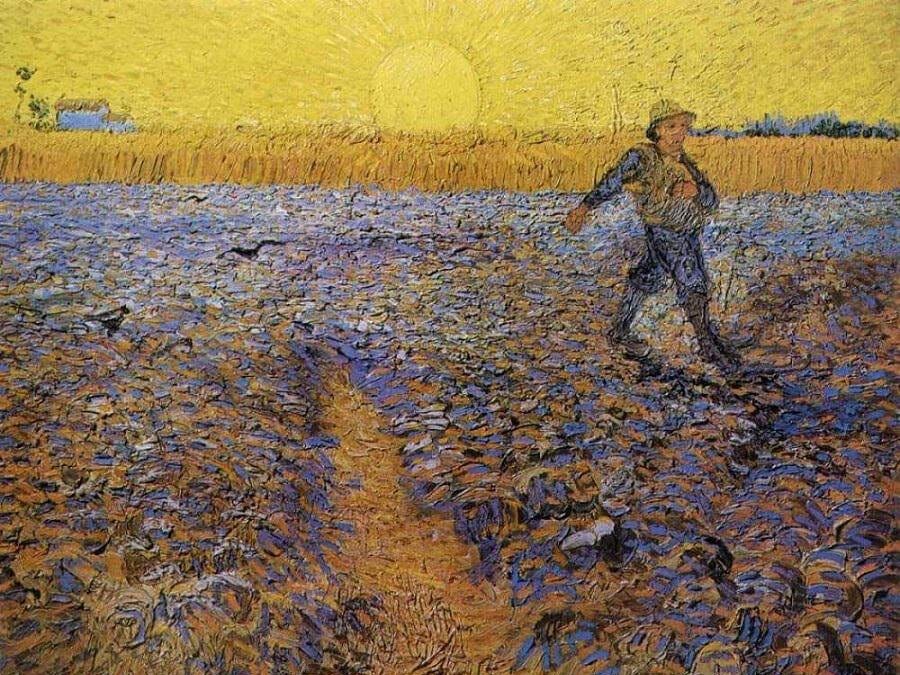
Sowing season is upon us. Ever so slowly (or not so slowly, as in the case of Missouri), the weather is warming and the ground defrosting. Soon, if they aren’t already, all manner of seeds will be in the soil, readying to do their magical, God-ordained work.
I have been thinking about sowing, though not just about the vegetable variety. In my sermon on Sunday at our church here in St. Louis I looked at how Christ Jesus, through His death and resurrection, has restored shalom—that beautiful Hebrew word that gets inadequately translated as “peace,” but which goes well beyond that to mean wholeness, flourishing, well-being.
The resurrected Jesus has now filled us with His Spirit and sends us out into the world to be “instruments of shalom.” To be an instrument of shalom means that, in Christ and by the power of the Holy Spirit, we strive to bring the blessings of redemption to bear on our relationships and in our community.
The phrase “instrument of shalom” is a riff off of the famous Prayer of St. Francis. And that prayer is what has me thinking about sowing—of a more spiritual sort. It begins this way:
“Lord, make me an instrument of Your peace;
Where there is hatred, let me sow love;
Where there is injury, pardon;
Where there is doubt, faith;
Where there is despair, hope;
Where there is darkness, light;
And where there is sadness, joy.”
As I reflect on what it looks like for us—both individually and as congregations—to be instruments of shalom, the petitions of this prayer seem like a natural place to start. So as faithful farmers, if you will, let’s consider six ways we can sow shalom.
“Hatred stirs up strife,” it says in the book of Proverbs, “but love covers all offenses” (10.12). To be sure, there is a kind of hatred appropriate to God’s people; as it says earlier in Proverbs, “The fear of the LORD is hatred of evil” (8.13). You don’t need me to tell you that this is not the kind of hatred most commonly witnessed in our day, however. In a society that is rife with fear and loathing, Christians can be instruments of shalom by sowing the love of Christ.
Being offended can seem like sport nowadays. Our job is not to keep people from being offended, nor to tip-toe around the hard realities of God’s truth. Where there is genuine injury, though, that is an opportunity for us to sow shalom. As it says in Isaiah 61, a passage Jesus quoted in His first sermon, the Spirit of the Lord anointed Him to “bind up the brokenhearted.” Those whose hearts are injured from grief or guilt need the healing medicine of God’s pardon.
Sunday’s Gospel also saw the account of “doubting Thomas” (John 20:24-29), though he might be better called “disbelieving Thomas.” Be that as it may, as Christians we can be instruments of shalom in the lives of those “smoldering wicks” whose faith is flickering. We do so by patiently listening to their struggles and questions, not in a judgmental spirit of “why don’t you have this figured out yet?” but in a gentle spirit that recognizes we are all pilgrims on the journey of faith. Ultimately, we always want to point people back to the rock-solid certainty of Him who is the Way, the Truth, and the Life (John 14:6).
We sow shalom when, in the midst of our world’s sadness, we can point to a deeper gladness.
These are difficult times in our world. So-called “deaths of despair”—from alcoholism, drug abuse, and suicide—are escalating enormously, even causing life expectancy to fall in the United States. Churches can and should be instruments of shalom in this regard. Especially in the isolated communities of our land—rural, urban, suburban—a strong congregation can be a beacon of hope for people who are isolated and alone. We do so by gathering people to a living Lord who “will not leave [us] as orphans” (John 14:18).
There’s no shortage of darkness to draw attention to in our world, but Scripture points up one particular place where we can sow light. “Do all things without grumbling or questioning,” St. Paul writes to the Philippians, “that you may…shine as lights in the world” (2.14-15). We sow shalom by being grateful rather than grumbling, content rather than complaining. Indeed, in this aggrieved day and age, contentment might be one of our most counter-cultural characteristics!
In his poem “The Mad Farmer Liberation Front,” Wendell Berry writes, “Be joyful / though you have considered all the facts.” There is deep sadness in the world and in our lives; we need not deny it. As Christians, we aren’t called merely to be optimists, ever wearing rose-colored spectacles. But having considered all those facts, still we are joyful in Christ. One of my favorite lines from any hymn is this: “In Thee is gladness / amid all sadness, / Jesus sunshine of my heart” (LSB 818:1).
We sow shalom when, in the midst of our world’s sadness, we point to a deeper gladness. “Those who sow in tears,” says the psalmist, “shall reap with shouts of joy” (Psalm 126:5). Christ is risen. By His grace, this old world is thawing. As instruments of shalom, let’s embrace sowing season.
No posts
Comments
Nothing yet. Say the first thing.
Sign in to join the conversation.