
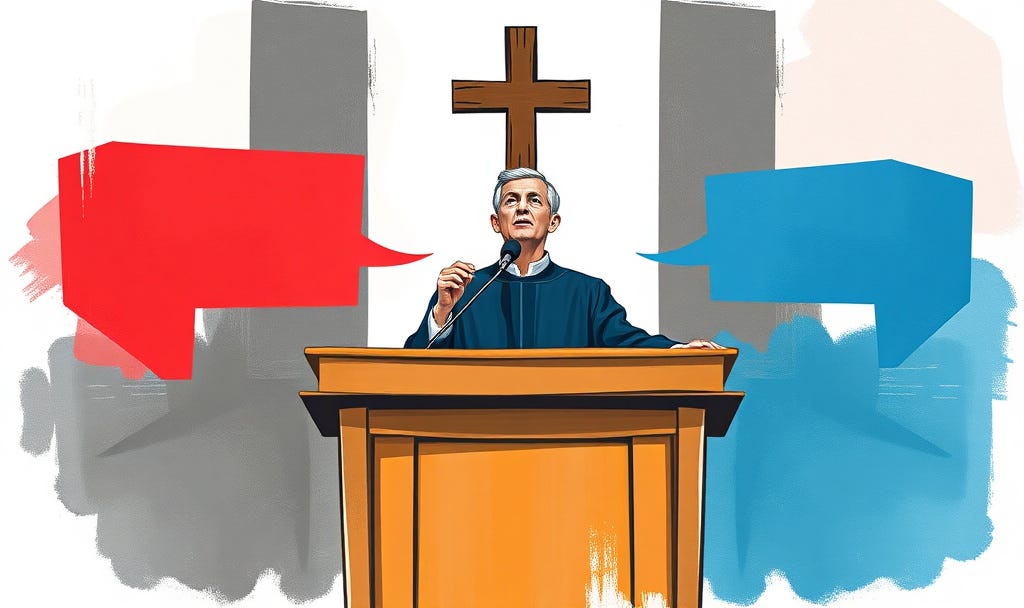
Recently, the question was posed to me: Should pastors talk about politics from the pulpit? I think before answering that question, I want to define a couple of terms.
First, “politics”: For the sake of this discussion, I’m not talking about partisanship. No pastor should ever use the pulpit to endorse a particular candidate or political party. We are first and foremost servants of God and His gospel, not servants of politicians and their “gospels”.
For me, politics simply means the ways that people and cultures come together for the purposes of governance, managing resources, and ordering society. And in these areas, our faith has much to say.
Second, what do we mean by “talk about”? If politics becomes the primary focus of our sermons or sermon series, that’s probably not a good thing. Our calling isn’t to educate people on civic affairs. It’s to teach God’s Word and help people apply it faithfully to every area of life (which includes their political engagement).
With those terms more or less defined, here’s my answer: Yes, pastors should talk about politics from the pulpit. Let me elaborate…
Politics was never the central focus of Jesus or the early church. But it certainly wasn’t absent…
Jesus’ claims about His identity and His Kingdom were theological claims but they had enormous political implications. Declaring Jesus as Lord meant Caesar was not. It meant Rome was not the ultimate authority it claimed to be. In many ways, that’s why Jesus became such a threat. Rome didn’t execute Jesus because they disagreed with him theologically (though that’s why the Jewish leaders wanted him dead), it executed Him because He became a threat politically. That was even the charge written over him on the cross - a rival king.
Many of Jesus’ teachings talked about justice for the poor and vulnerable, which are political categories when it comes to ordering societies.
James, the brother of Jesus, took up that theme and repeatedly confronted the rich and powerful for exploiting the poor and vulnerable. That message is what eventually got him killed in A.D. 62.
Early Christians died in Roman arenas because they refused to offer the political allegiance demanded by the empire. Their confession that “Jesus is Lord” was a public declaration that challenged every earthly authority.
Our faith has inherent political ramifications. So when I preach the gospel, I try to apply it to every area of life, including politics. I don’t make political application every week - I try to do it carefully and sparingly. But if I never make those connections, people might make the erroneous assumption that our faith has nothing to say about politics.
And if people think their faith does not speak to politics, they will look elsewhere for how to think about it. And they do.
Many Christians spend far more time consuming news, partisan media, and political commentary than they do reading Scripture. That’s simply the reality we live in. And too often those sources reverse the proper order of influence. Instead of allowing faith to shape politics, they use politics to shape faith. Christianity becomes a tool for justifying existing political commitments rather than a force that challenges them. The result is often a distorted reading of Scripture.
So yes, I believe pastors should address politics. Not because politics is the point, but because politics is increasingly becoming an idol. More and more people don’t come to church asking, “How should Jesus shape my politics?” They come asking, “Will this church affirm the politics I’ve already chosen?” We’ve gotten the order backwards.
But what does it look like to address politics? Well for me, it’s not about attacking certain political figures or propping up others. But if a passage of scripture speaks to something that has been coded right or left by our culture, it means I don’t shy away from it. Some on the left might be confronted about one thing while others on the right might be confronted about another thing. I’m not trying to be balanced politically, I’m trying to be biblical. But sometimes the bible will in fact speak directly to our politics.
I once had someone tell me I was bringing politics into church too much. But that’s not how I see it. Politics (and partisanship) were already there! In fact, it’s there more than ever. I’m simply trying to apply the gospel to an area of life that already occupies an enormous amount of people’s attention. Am I doing that perfectly? Of course not. But I’m trying to be faithful.
We preach Jesus as Lord over everything, including our political parties and ideological tribes. Jesus will always challenge our partisanship. If He doesn’t, we should probably ask whether we’ve made Jesus conform to our politics instead of allowing our politics to conform to Jesus.
Our goal is not to become better Republicans or better Democrats, but to become more like Jesus.
-side note- All of this doesn’t even touch another important question: Should we hold political leaders to biblical standards? I understand the tension there. We shouldn’t expect people who reject Christ to live like Christians. Fair enough.
But when a political leader publicly claims to follow Jesus, it’s entirely appropriate to evaluate their actions and attitudes against the teachings of Jesus. That’s not mixing politics and religion, that’s just taking someone’s profession of faith seriously. -side note over-
So what do you think? Should pastors talk about politics from the pulpit?
Comments
Nothing yet. Say the first thing.
Sign in to join the conversation.