
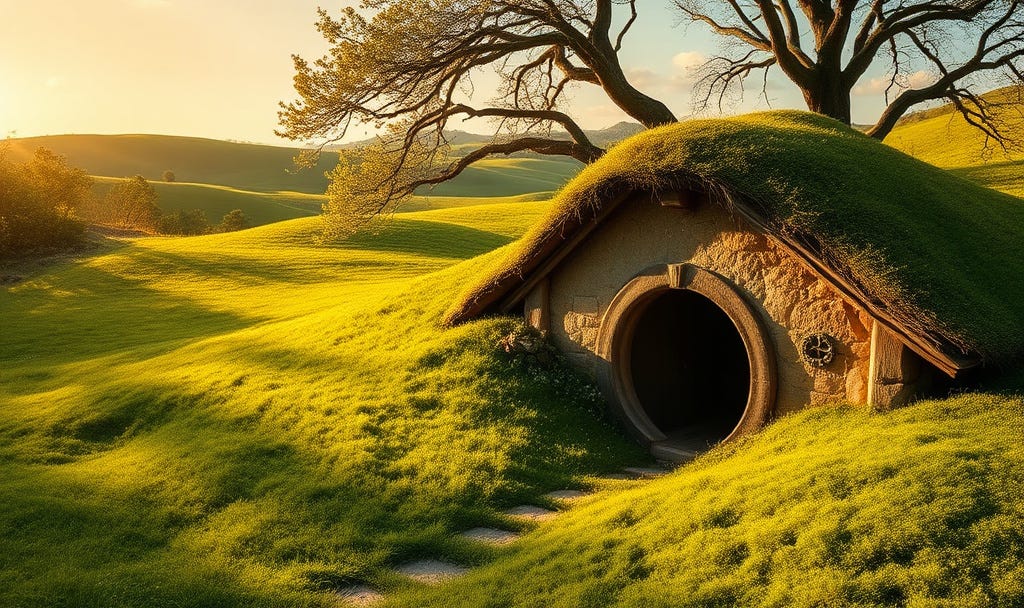
I just finished rereading The Hobbit, by J.R.R. Tolkien and will soon start back into The Lord of the Rings again. I’ve read these books numerous times and I enjoy them more with each read-through. The writing is a joy and I find that the older I get, the more resonance I find. This time around, I found myself taking strange comfort in the very ending of The Hobbit.
Bilbo Baggins has just gone on an epic journey with a group of dwarves. They’ve been attacked by trolls, captured by elves, ambushed by giant spiders, trapped by a monstrous dragon, and been in a huge battle. When the book is over, you feel that you have been on this journey with them.
For a Hobbit, any one of these would have been enough to make their eyes bug out of their sockets because Hobbits are creatures of Home – they love the fields of The Shire, the simple joy of smoking a pipe, smelling the spring air on the wind, and the feel of familiar grass between their never-shoed-toes.
From our modern vantage point, the Hobbit life and values seem simple to the point of being simplistic or even naïve. And part of modern-me is gratified when Bilbo finally sees the wide world and the various creatures and difficulties of evil and pragmatism. “Finally, he’s awakened from his naïve and childish view of the world and can see everything in its vast array of complexity and drama.”
But when the book closes and he is home from his journeys, from saying goodbye to friends who have fallen by the sword, from seeing how wealth can corrupt, how greed can cloud wisdom, and how violence is not glorious, we find him sitting back in his chair with a fresh enjoyment of the sound of his tea-kettle.
One day, long after his travels, one of his dwarf friends, Balin, and his wizard friend, Gandalf, pay him a visit. Balin tells him of how the desolations of the dragon have been remade and life and goodness and beauty is again populating the land of the Lonely Mountain where the previous centuries had only known fear, war, and death. Then we read this:
“Then the prophecies of the old songs have turned out to be true, after a fashion!” said Bilbo.
“Of course!” said Gandalf. “And why should not they prove to be true? Surely you don’t disbelieve the prophecies, because you had a hand in bringing them about yourself? You don’t really suppose, do you, that all your adventures and escapes were managed by mere luck, just for your sole benefit? You are a very fine person, Mr Baggins, and I am very fond of you; but you are only quite a little fellow in a wide world after all!”
“Thank goodness!” said Bilbo laughing, and handed him the tobacco-jar.
And that’s how the story ends. Bilbo, having had a taste of all the wide world, takes great comfort in knowing that he is just a little fellow in a wide world after all. He feels no need to keep on in perilous adventures. He does not feel the need for renown or glory or involvement in world-shaping events. He is content in his home.
The quiet life that seemed naïve and childish at the beginning, is shown to be the true wisdom.
I was a theater major. So a part of me lives for applause and recognition. And yet if I’m honest, the high that comes from it does not last for long. So there is always a “need” to chase it again. Adventures and accomplishing big things can feel amazing. And sometimes we will be called to those. But will we feel the need to make the “big and important” our aim in life?
When our goal is simple faithfulness, it might lead us to big things. But it might not. It might lead us to the life of no renown, the life where only a select few know our names. Where our “big” accomplishments aren’t seen on social media, where our biggest accolades are celebrated by a small few, where our adventures, while perhaps important, do not end with us on a throne, but rather a quiet chair enjoying a fire by ourselves in the winter time.
We are only little fellows in a wide world after all. And in the end, that is a good thing. In fact, it can be that very thing that brings the wisdom that is needed in difficult times. We might be “little fellows”, but we are of immeasurable importance in the eyes of our Maker. And the journeys on which He sends us might take us far and wide or near and close. They might be big or small, dangerous or quiet. But they are always important if we don’t brush them off continually wishing for the bigger, better, or “more significant.”
There is wisdom in contentment, wisdom of being rooted in a place, and letting that be what brings us joy.
Comments
Nothing yet. Say the first thing.
Sign in to join the conversation.