
When I was in fifth grade, my father banned me from moving the VCR out of the family room.
He would regularly come home from work and be unable to watch TV because the back of the box was a mess of disconnected coaxial cables, arranged in a way that suggested he’d been robbed. A minor inconvenience, sure, but in his mind the constant shuffling of electronics up and down the stairs was bound to end in a broken piece of equipment.
So, on a dark day in the Staples household, he shut it down.
At that age, I was never a rule-breaker by nature. A line pusher, maybe. But I’m not talking about sneaking treats from the cookie jar when no one was looking or playing outside past when the streetlights came on. This was different. This was the kind of rule that stood in the way of something that felt more important than the rule itself. The thrill of discovering something I wasn’t supposed to know yet, of learning how a thing worked by touching the parts I’d been told not to touch.
What my father didn’t know was that what started as a way to rob the local video store of repeat rentals had already become my first foray into the world of filmmaking.
That previous summer, I was walking home from my grandparents’ house a few streets over and passed a little old lady having a little old yard sale. To that point in my young life, the only televisions in the house were in the living room and my parents’ bedroom. A blooming cinephile and Simpsons obsessive, I had asked for a TV/VCR combo repeatedly, only to be told that I could get one when I paid for it. No amount of lawns mowed or babies sat could provide the capital needed for a purchase of this magnitude.
That was until today.
Staring back at me from this neighbor’s patch of grass was a 13-inch black-and-white Zenith and a Panasonic top-loading video cassette recorder. The poor woman had no idea what she had on her hands. For the grand theft price of ten dollars, this haul of late-1970s technology was mine for the taking. I ran the five hundred yards home, grabbed a crisp Hamilton from the secret envelope of cash in my desk drawer that I treated like a safe deposit box, and sprinted back to claim my wares.
I was overjoyed. It didn’t even matter to me that, drained of color, the Teenage Mutant Ninja Turtles now all had bandanas in slightly different shades of gray.
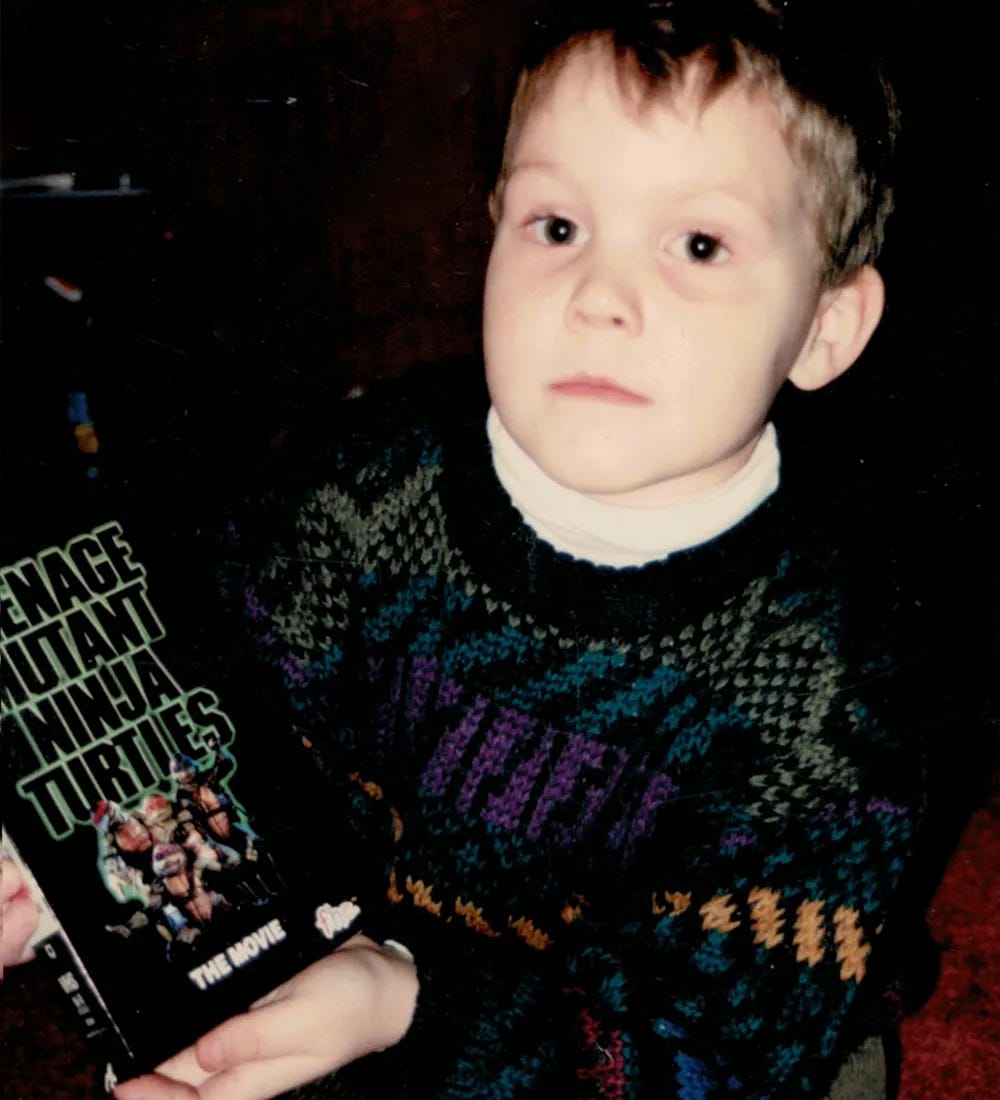
Growing up, our movie collection was mostly comprised of things my mother had taped off cable. In my recollection, Ferris Bueller’s Day Off has a JC Penney commercial right after Ed Rooney gets punched in the face. I had been to other kids’ houses and seen shelves of legitimately purchased videotapes, so I wondered if it was possible to make a copy of Pee-wee’s Big Adventure that wasn’t the NBC Sunday Night Movie sponsored by Tide.
A short trip to Radio Shack later, after describing my predicament to the more-than-patient clerk behind the counter, I had a three-pack of blank VHS tapes and all the cables needed to complete my experiment. What I needed now was the downstairs VCR.
In those first few weeks, my success knew no bounds as I amassed a growing stockpile of duplicates for a fraction of the price it would’ve cost to buy them. Little did I know my father was days away from bringing down the hammer. Before he did, though, I discovered the joy of making “video mixtapes.” I’d assemble collections of funny scenes from a variety of movies onto a single tape and pass them around to my cousins or other kids in class.
After nearly recording over a home video and almost erasing my younger brother’s entire 1992, I realized these tricks could be applied to my own movies.
Like most kids lucky enough to get their hands on a camcorder but without much grasp of production, I would write these short films and then shoot them entirely in sequence. Constantly changing camera angles, rewinding not quite far enough after blown takes, and inconsistent light, given the hours it could take to film a two-minute scene, still resulted in a masterpiece. At least in my estimation.
But now, with my new setup, I could shoot as much as I wanted and splice it all together in my room later that night. Once I realized I could run RCA cables from my stereo into the mix, I added a needle-drop soundtrack as well.
I felt like Scorsese with a lunchbox.
For the first time, I wasn’t just recording things as they happened. I was shaping them. I could sit on the floor, cross-legged in front of the TV, rewinding and replaying the same five seconds until it landed exactly the way I wanted.
Hours would disappear. I wasn’t thinking about whether it was good or who would see it. I just wanted to see if I could make it work.
Writing these projects was always the easy part. Convincing other kids to show up, remember lines, or care as much as I did was less reliable. The excitement I felt on the page didn’t always survive contact with a group. Editing gave me something steadier. A way to work that didn’t depend on momentum or buy-in from anyone else.
Even when I started performing stand-up comedy, the draw for me was less the joke writing and more an experiment in story delivery. Figuring out where something started, where it ended, and what happened when you moved a beat by half a step.
When the downstairs VCR ban was eventually introduced, no amount of pleading with Dad could get him to change his mind. Arguments about improved production value carried no weight. So, when pitch after pitch were rejected, I decided that instead of continuing to ask for permission, I would ask for forgiveness if I were ever caught.
For the sake of speed and efficiency, I drew a map in blue crayon of the cable and gear assembly, a timesaver when I might only have an hour or two to set up my rig and edit after school. My creativity was put into practice whenever I found myself alone in the house for a healthy stretch of time. Unfortunately for you, these tapes were lost as I moved around the country in my early twenties. But believe me when I tell you I made everything from bad courthouse dramas and superhero films to bad late-night talk shows and SNL clones.
My Dad never caught me.
Hopefully he’s not reading this right now or I’m liable to be grounded for the entire summer of 1997.
But I tell you that story to tell you this: had I not broken the rules, I’d have missed out on the chance to refine a way of working that’s served me well for the rest of my life.
Long before I ever attached myself to a scene or an ethos, I’d figured out how to work the only way I knew how: alone, cheaply, without permission, and with a clear sense of when something felt finished.
For a long time, though, I misunderstood what that way of working actually needed in order to grow.
I assumed there would eventually be some formal threshold, a credential, a degree, an institutional nod that would grant me permission to pursue creativity professionally. I was convinced that without an MFA from the right school, without the right introductions or affiliations, whatever I made would always exist just outside the room where real writing happened.
I carried that belief longer than I should have.
So I created in adjacent spaces. In the margins. Alternative weeklies. Punk zines. Forty-eight-hour film festivals. Dive bars disguised as comedy clubs, usually competing with a Celtics game for attention. Places that scratched the itch just enough to feel productive without ever quite satisfying it. Over time, that feeling shifted. From momentum to maintenance, from curiosity to habit.
I wasn’t blocked. I was circling.
What I didn’t recognize at first was that I’d already learned a version of the lesson I was still trying to relearn. When I eventually encountered the language of “do it yourself,” it felt familiar. Not aspirational. Just accurate.
The thing I’d been waiting for had never actually been missing. There was no final rule to break, no gate left to slip through. My work had always improved in the same way it did back in my bedroom. Privately, patiently, and without much concern for who was watching. By finishing things. By trusting my own sense of when something was done.
I don’t move VCRs anymore. I don’t draw maps in blue crayon or watch the clock to make sure everything is back where it belongs before someone gets home. But the impulse is the same.
I still believe the most useful work happens when you stop asking what’s allowed and start paying attention to what holds.
So I write. I finish things. And when something feels done, this is where it ends up.
Comments
Nothing yet. Say the first thing.
Sign in to join the conversation.