

Ireland is in an ideological rut. The traditional reliance on old school establishmentarian political tennis between Fine Gael and Fianna Fáil is out of date. Ireland faces the multipolar era and a more volatile US patron. It is in need of a new ideological vision. One such vision is offered by Ireland’s tech bros. It is Silicon Valley-style Neoliberalism.
Classical Neoliberalism is conventionally defined as “the rule of market forces,” according to historian Quinn Slobodian, who literally wrote a book on it. It can also be stated as, “global laissez-faire: self-regulating markets, shrunken states, and the reduction of all human motivation to the one-dimensional rational self-interest of Homo economicus. The [neoliberals], it was claimed, conflated free-market capitalism with democracy and fantasized about a single world market without borders.”
Slobodian offered another more heterodox definition. “The core of twentieth-century neoliberal theorizing involves what they called the meta-economic or extra-economic conditions for safeguarding capitalism at the scale of the entire world…the neoliberal project focused on designing institutions—not to liberate markets but to encase them, to inoculate capitalism against the threat of democracy, to create a framework to contain often-irrational human behavior, and to reorder the world after empire as a space of competing states in which borders fulfill a necessary function.”
Slobodian articulated the dual nature of Neoliberal lofty rhetoric and its duplicitous practice. My only change would be to substitute oligarchism for capitalism. It is the rule of oligarchy at the root not necessarily capitalism in abstract. The Neoliberals treat the state as something “for me but not for thee.” The state, for the Neoliberals, is there to secure and expand their oligarchic interests rather than the democratic interests of the national population which are often harmed to the benefit of Neoliberal oligarchic interests.
In 2025, Slobodian connected the dots between Classical Neoliberalism and an emergement Silicon Valley-style Neoliberalism. While aesthetic nuances abound, this new ideological formation in Silicon Valley is derivative of Classical Neoliberalism, if not more radical as Slobodian noted.
In my words, Silicon Valley-style Neoliberalism leverages the memetic appeal of Silicon Valley’s conventionally perceived meritocracy, innovation, and soft-spoken geeks to launder Classical Neoliberalism with radicalization exacerbated by sectoral decline and intellectual myopia.
In regards to sectoral decline, the erosion of Silicon Valley’s technological comparative advantage and proliferation of speculative vaporware leads its technology executives to pursue more fusion with the government in order to save their sinking ships. Co-Editor of The Polycrisis, at Phenomenal World, Tim Sahay called this trend “Losers picking Governments.” The precarity of their business prospects anxiously incentivizes them into more radicalized Neoliberal thinking. Ironically, the biggest carnival barkers for the free market are also the biggest parasites of the government.
In regards to intellectual myopia, many of these technology executives are narrowly specialized technicians and salesmen. The exponents of Classical Neoliberalism, for all their faults, were holistic imperial managers. There was some tether to the rules-based international order, labour-oriented domestic economics, and a liberal studies education. At very least, the realization that those aspects must be tolerated to avoid backlash. The realist Machiavellianism of Classical Neoliberalism’s prior generation is replaced with Silicon Valley’s new generation of neurotic dilettantes whose myopic ignorance increases radicalization. Without such depth and breadth, the tech bros will be more likely to further transgress G.K. Chesterton’s fence, even without knowing it, and therefore further radicalizing Neoliberalism. The ascendance of Silicon Valley-style Neoliberalism in the current Trump administration has resulted in many observers noticing those previous guardrails coming off Classical Neoliberalism across the policy spectrum.
Silicon Valley-style Neoliberalism is the wrong path for Ireland. My alternative vision is an anti-Neoliberal one. For the past 5 years, I’ve advocated for a revival of the economic perspectives of the Irish nationalist tradition which coalesced around co-operation, protectionism, and Catholic Social Teaching. These ideas were never fully and properly applied while often the target of unfair and shallow criticism. Sinn Féin founder Arthur Griffith’s economic views were precursors to those of modern development economists like Ha-Joon Chang. In these times of change, Ireland needs to embrace democratic economics sourced in its own indigenous tradition and modern scholarship across the globe.
Arthur Griffith's Economics
·
Apr 28

The economic thought of the 1916-1922 Irish revolutionary period was largely derived from Arthur Griffith. He was a prominent journalist, the founder of the Sinn Fein party, Acting President in Ireland while Eamon de Valera was away in the U.S., Minister of Home Affairs, Minister of Foreign Affairs, Anglo-Irish Treaty plenipotentiary, and the first reco…
In order to illustrate the problems of Silicon Valley-style Neoliberalism in Ireland, I will examine the most high-profile importers. My critique will focus on the Collison brothers (John and Patrick) who co-founded the digital payments startup Stripe. I will critique them because they are Silicon Valley billionaires and Irish citizens. They are tremendously professional and competent, which makes them a beacon of leadership. As a dough-faced D4 centrist dad might celebrate, “they will make Ireland run like a business…a startup business!” But most importantly, they stepped into the Irish political arena through recent political funding and activism with an anti-establishment veneer. All these qualities make them a potent force, and if you combine that with their subversive ideology, they present a significant risk to Ireland. If they steal the thunder from the real ideological changes that need to happen, then Ireland may again suffer decades of economic mismanagement.
The Collisons received some of their first startup funding from current Trump-aligned Silicon Valley billionaires such as Elon Musk, Peter Thiel, and Marc Andreessen. They have since remained close with them. In 2020, the Collisons raised funds from Thiel, Musk, and others for their Fast Grants program to fund scientific research. Their attachment indicates an ideological overlap and enmeshment in a particular network with a significantly divergent political ideology relative to conventional politics. Further, the Collisons collaborated with a particular economist on the Fast Grants — Tyler Cowen.
Cowen is a professor at George Mason University, produces the Marginal Revolution blog, and appears to be the go-to economist for the Collisons. In 2019, Patrick Collison co-wrote an article with Cowen in The Atlantic debuting their discipline of Progress Studies. Patrick Collison frequently promotes Cowen’s writing and podcasts on social media. It’s safe to say the Collisons are very influenced by Cowen’s school of thought.
In his own words in 2014, Cowen said, “I am a liberal on most but not all social issues, and I am market-oriented on economic issues.” Back in 2007, he wrote, “I would like to restructure classical liberalism, or libertarianism” in the libertarian Cato Institute’s blog. That restructuring manifested itself in his 2020 blog post debuting “State Capacity Libertarianism.”
State Capacity Libertarianism, he advocated, is a strong but non-tyrannical state that maintains and extends capitalism. Cowen also noted Peter Thiel as a major influence which brings us full circle. While dressed in a nuanced intrigue, the substance of State Capacity Libertarianism is reheated Neoliberalism. There’s nothing out of the ordinary about Cowen’s propositions from the existing Neoliberal paradigm, other than allowances for more extreme means to achieve its existing ends (i.e. the tech bro radicalization as previously stated). In fact, Cowen makes an endorsement of “Pax Americana” or in other words the conventional bipartisan position for imperial American hegemony as one of the propositions.
As America’s Neoliberal system degrades, Cowen’s solution is simply to enact a rebranded and more intense version of classical Neoliberalism to save itself from itself. In this sense, State Capacity Libertarianism, or Silicon Valley-style Neoliberalism, becomes socialism for oligarchy and capitalism for everyone else. The state must be used ever more frequently, visibly, and powerfully to maintain oligarchic dominance. Cowen is self-aware of the contradiction between rhetoric and reality which is best summed in his proverb: “keep your mouths shut.”
In 2008, Cowen wrote (my emphasis added), “I have a simple model of how some people — but by no means all — process political issues. Occasionally the real force behind a political ideology is the subconsciously held desire that a certain group of people should not be allowed to rise in relative status.”
In 2024, Cowen also wrote (my emphasis added), “I have some simple, to the point free advice for the DOGERs — the public is not always with you. Making your fight more public, and putting it more on social media, is no guarantee of victory, and indeed it often boosts the chance you will lose or be stymied…So please develop a better sense of when to keep your mouths shut and work behind the scenes.”
Put in other words, Cowen told the Silicon Valley-style Neoliberal oligarchs to hide their true intentions, lie to the public, and then usher in an unpopular agenda in the shadows.
Zooming out, Cowen is an appendage of George Mason University (GMU). GMU is a long-standing and loyal institution of Classical Neoliberalism. The most notable donors are the Koch brothers which leverage their influence to manage the school’s intellectual perspective. The Kochs are one of the richest families in America and are one of the most responsible for funding research, activism, and political campaigns during the previous era dominated by Classical Neoliberalism.
The Kochs long-standing donor ties with GMU were leveraged to select faculty that conformed or could be shaped into the Koch’s ideological framework. After calls for more transparency, released documents revealed the extent to which this relationship was controversial. So much so that GMU’s President acknowledged that the donations raised questions about outside influence and had his office conduct a review of donor agreements at the university. The faculty senate also voted to increase transparency of these donor relationships and create rules to prevent abuse.
GMU’s Mercatus Center is a think-tank that drew some of the most interest and funding from the Kochs. It’s been funded by them since the 1980s and has been an influential policy lobbyist in Washington DC. Cowen received his undergraduate degree from GMU and was taught by Mecatus’ founder and Koch affiliate Richard Fink. Cowen has been a GMU professor since 1989 and became General Director of the Mercatus Center in 1999.
Today, Cowen is the Mercatus Center’s Chairman of the board of directors where Charles Koch still sits as a member. Cowen was literally hand-picked, if not hand-sculpted, to be the salesman for Classical Neoliberalism by the Kochs. Rather than anything novel or anti-establishment, Cowen represents the status quo’s school of thought. Thus, the Collisons, as disciples of Cowen, share in this non-revolutionary school of thought. In a certain respect, the Collison brothers almost seem like a millennial reimagining of the Koch brothers. However, the comparison runs deeper than just abstract analogy.

In 2016, Patrick Collison tweeted “a great interview with 80-year-old Charles Koch.” In 2018, Charles Koch and Patrick Collison shared the stage for a chummy discussion at a Silicon Valley conference called Base Camp. A few years later, the Koch’s non-profit Stand Together partnered with Patrick Collison and Stripe for a $100 million poverty alleviation program. The Collison brothers are direct colleagues and partners of the Koch brothers. It would not be a stretch to describe the Collisons as protégés to the Kochs.
The culmination of the Koch-Collison bromance occurred at the Cato Institute’s 2025 Milton Friedman Prize dinner, in honor of Charles Koch. Patrick Collison was the keynote speaker at the event. Patrick Collison was introduced as someone “in the [same] spirit” as Charles Koch. Patrick Collison began his statements with an allusion to Marc Andreessen and the admission that “I’m a big fan of free markets, and Milton Friedman has long been an inspiration for me—I just wanted to say that here since I can’t normally say it.” He went on to criticize “wokeism” and excessive regulations.
The Irish-born entrepreneur, who seeks to seriously influence the Irish government, also said, “America is the best country in the world, and I mean that seriously…a beacon for people like me growing up in rural Ireland.” In this swirl of homages to Charles Koch and apologetics for Neoliberalism, Patrick Collison endorsed Milton Friedman’s grand myth of anarchic free markets pitted against the villainous big government. In doing so, he also idealized his adopted home of America and diminished his native nation of Ireland. The key insight here is that Patrick Collison’s ultimate vision for Ireland, a country he does not consider the best in the world, is the same as Milton Friedman’s and Charles Koch’s vision for America.
I’ve emphasized his US vs. Ireland distinction because of a qualitative not a quantitative distinction. Of course, the US has a larger population, territory, capital market, GDP, etc. My focus is on his interpretation of what qualities (as prerequisites to the quantities) make a country “best”, what particular knowledge ontologies produce his interpretation, and how those knowledge ontologies connect to his beliefs around patriotism.
In March of 2025, Patrick Collison addressed the US House Financial Services Committee on digital payments and stablecoins. He advised the US government on the future adoption of USD-backed stablecoins. He told them that USD-backed stablecoins would result in “strengthening America’s economic reach and influence.” Further, he aligned himself with US Treasury Secretary Scott Bessent, in his vision of how “stablecoins may substantially strengthen American monetary leadership.” He positively compared stablecoins “to the ‘petrodollar’ system established in the 1970s…[which] contributed to America’s leading position in the global financial system.” He also happens to massively benefit from US government policy pushing stablecoins as he has positioned Stripe to be a dominant provider of future stablecoin services.
It’s important for the Irish public to be aware of all this. Not only is there an ideological particularity to be understood, but a deep entanglement of US government affairs and Collison business interests that profit from those affairs. Is it possible for the Collisons to have the best interests of the Irish nation at heart when they are enmeshed in currying favor with a US government administration that constantly slings threats and insults towards Ireland? Is it possible for them to even understand what those best interests are given their dismissive view of “rural” Ireland in contrast to Milton Friedman’s utopia of America? Even Cowen’s subversive proverb of “keep your mouths shut” was implicit in Patrick Collison’s comment, at the Cato event, that he “can’t normally say” his authentic ideological opinions.
For sake of fairness, it should be noted that in a 2021 interview with Noah Smith, Patrick Collison said, “as an aside, this view of the role of government is an area where I find myself often disagreeing with libertarian-inclined individuals. While I consider myself strongly pro-free market and pro-freedom, I am not a libertarian, and I think this is the kind of place where a traditionally libertarian approach simply doesn’t have much that’s useful to say.” This might seem like a contradiction to the analysis made so far, but is it really that much different than Cowen’s State Capacity Libertarianism? Cowen calls Libertarianism “hollowed out” and “doesn’t seem…[to] solve or even very well address a number of major problems.”
This seems remarkably similar to Patrick Collison’s view. On the surface, they are both critical of Libertarianism but, on the substance, they are adherents to it. Where there are exceptions, it usually comes in the form of Patrick Collison’s emphasis on the “government as buyer” which means government subsidization to favored firms.
They have no problem with big government in practice so long as it funds their special interests in the private sector compounded by the incentives of sectoral decline as previously stated in the introduction. In many cases, such government buying occurs in relation to national security. Cowen’s Pax Americana and Patrick Collison’s desired collaboration in maintaining US dollar hegemony create contextual alignment with the private sector and national security.
Later on in Patrick Collison’s 2021 Noah Smith interview, he criticized anti-Neoliberal economist Mariana Mazzucato. Mazzucato is an experienced economist and her work is essential reading to solve Ireland’s problems. She emphasizes building up democratic state capacity vs. the anti-democratic state capacity ethos of Neoliberalism. Mazzucato’s books, like The Entrepreneurial State, are resources that elaborate on this.
Patrick Collison based his criticism of Mazzucato on a blog post by Jose Luis Ricón. Ricón’s blog has all the trappings of a Silicon Valley engineering personality who just follows the data, however, Ricón’s blog was funded by the Emergent Ventures grant-program which is a subsidiary of GMU’s Mercatus Center.
So, Patrick Collison leveraged a Koch-funded writer to dismiss Mazzucato, although Mazzucato would be a go-to resource for anyone who called themselves “not a libertarian” as Patrick Collison did. Instead, he then turned readers onto Simon Johnson and Jonathan Gruber as substitutes for Mazzucato.
Johnson is an economist who served in leading roles at Massachusetts Institute of Technology (MIT), the Peterson Institute, and the International Monetary Fund (IMF). He recently won a Nobel Prize for his work on institutions and their connection to development. Putting his establishment credentials aside, his work on institutions has been criticized as a defense of Neoliberalism.
Gruber served at MIT and National Bureau of Economic Research (NBER). He was also a leading architect of Obama’s Affordable Care Act (ACA), a Neoliberal subsidy to private insurance companies in this author’s view. Controversy emerged when videos surfaced that revealed Gruber to be two-faced. He said the ACA’s “lack of transparency is a huge political advantage” because of “the stupidity of the American voter.” Gruber is another example of someone who says one thing to the public and another to his inner circle, with a large degree of contempt for the public, echoing Cowen’s proverb.
Regarding their book that Patrick cited, Queen Mary University of London Professor Patrick Diamond wrote, “In Jump-Starting America, Gruber and Johnson advocate government activism and public investment…Yet their focus is…a policy mix remarkably similar to that advocated under” the establishment ideological regime of the past few decades. In similar fashion to State Capacity Libertarianism, Gruber and Johnson presented a plausible critique yet constrained the parameters of their critique to a particular and narrow set of preferred projects.
Gruber and Johnson wrote that the existing “American economic environment…is good” and only “tweaks” are needed. In 2019, Noah Smith’s review of their book remarked on the similarity to Mazzucato’s perspective. The key distinction is that Mazzucato has a more comprehensive economic framework that is holistic of other aspects of statecraft. Mazzucato’s perspective goes beyond tweaks and offers fundamental structural changes. In short, the sleight of hand in swapping Mazzucato for Gruber and Johnson presents the veneer of a Neoliberal critique but, in substance, seeks to preserve the incumbent system whereas Mazzucato’s ideas would truly challenge it.
This is not to say every individual policy that the Collisons may advertise is bad in isolation, but to point out the overall school of thought that underlies them all and the ideological gravitation that catering to them will cause. Mazzucato’s work is worthwhile on its own merits but she also has higher resonance with Ireland than one might assume.
She remarked that her University College London Institute of Innovation and Public Purpose was an “outcome…of the work” of economist Erik S. Reinert. Reiner is the unsung economist who helped foster the tremendous economic growth of Ireland’s Celtic Tiger.
“In 1980, the globe-trotting Norwegian economist worked for the consulting firm Telesis and found himself of all places sitting in the office of Ireland’s Prime Minister Charles Haughey. Reinert was tasked with advising on a future Irish industrial plan…[his] directives to the Irish government were to be more active and selective. It recommended supporting domestic firms in the productive traded activities that were strong rather than new or weak firms to build on existing success. It wasn’t a startup strategy, it was a scaleup one. The government was advised to create a variety of industrial support programs in financing, skills, labour, and more.”
The Man Who Created Ireland's Celtic Tiger
·
May 15

The secret of economic growth is to continuously direct the economy towards activities that produce increasing returns to scale. This is important because for every additional input you get more output. These activities are usually related to novel, innovative, and rare technologies because competition is very low at the start of an invention cycle and …
This advice created the greatest period of real economic growth in modern Irish history until it was gutted because Classical Neoliberalism eventually took over the Irish state’s ideological zeitgeist. Ireland would greatly benefit from returning to the school of thought of Reinert, of which, Mazzucato, in her own words, is an heir.
For further evidence of Irish congruence, Mazzucato and the Catholic Church are in intellectual collaboration. Although today’s Ireland presents as secular, there’s no getting around its deep Catholic roots and how those roots bloomed into Catholic Social Teaching informed economics and its secular offshoots. Mazzucato was appointed to the Pontifical Academy for Life by Pope Francis to support dialogue and research into fostering the economics of the common good.
Pope Francis had written that her thinking “is not ideological, which moves beyond the polarisation of free market capitalism and state socialism, and which has at its heart a concern that all of humanity have access to land, lodging, and labor.” He noted that her work, particularly The Value of Everything, prompted significant reflection on how “business successes lauded in our economic thinking as the result of individuals’ efforts or genius are in reality the fruit of massive public investment in research and education.”
In 2015, Pope Francis gave his Laudato Si’ encyclical which expanded on his perspective on how Catholicism should inform a common good economics. In it, he referenced Church teaching and past Popes’ alignment with his perspective. In a separate address in 2015, Pope Francis alluded to Pope Leo XIII’s 1891 Rerum Novarum encyclical.
Georgetown University called the 1891 encyclical “a foundation text in the history of Catholic social thought.” In the US Conference of Catholic Bishop’s Foundational Documents of [Catholic Social Teaching] CST webpage, it is listed as the first primary source document. Pope Francis positioned his common good economics as a connection between traditional Catholic Social Teaching and Mazzucato’s modern ideas.
Mazzucato’s latest book is called The Common Good Economy. She said the book “develops [the] framework” she began in collaboration with Pope Francis and “will continue” to do so with Pope Leo XIV. Therefore, such a perspective is much more coherent with Ireland’s Catholic heritage and the economic insights one derives from a Catholic worldview.

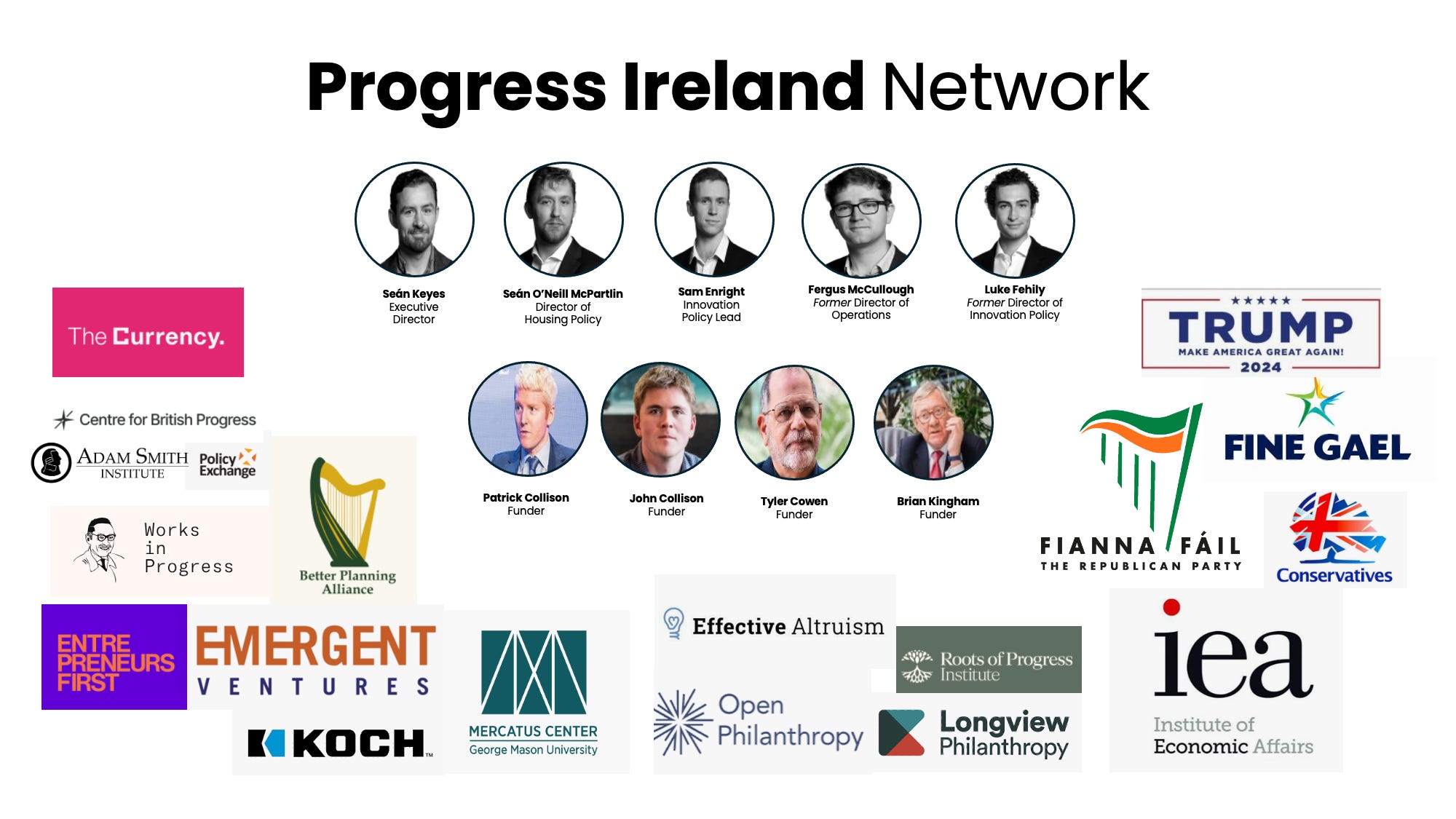
The Collisons’ most direct conduit for Irish political activity is their funding of the think-tank Progress Ireland which was launched in September of 2024. It’s published content mostly focused on housing and zoning deregulation. It is led by its Executive Director Seán Keyes, a former Finance Editor for The Currency, Managing Editor of MoneyWeek, and Editor of an equity research newsletter. His work reflected Neoliberal sympathies as seen in his 2022 appearance on RTE’s Today with Claire Byrne’s episode “Cuckoo funds outbid individual homebuyers” where Keyes defended the Cuckoo funds (foreign institutional investors).
Its Director of Housing Policy is Seán O’Neill McPartlin. He was co-founder of the YIMBY campaign Better Planning Alliance. This campaign was actually first started by the co-founder, Robert Tolan, who later brought McPartlin into the project. Tolan alleged that his project had been an appendage of Ben Southwood’s (of Stripe-owned Works in Progress, Policy Exchange, Adam Smith Institute, and Cowen’s Emergent Ventures) and John Myers’ (of Yimby Alliance in the UK and Cowen-partnered Centre for British Progress) think-tank network. Tolan indicated that Better Planning Alliance’s housing ideas, which became planks of Progress Ireland, were originally sourced from Southwood and Myers. Better Planning Alliance was also financed by Cowen’s Emergent Ventures and Collison-backed Entrepreneur First fund.
Additionally, McPartlin was the co-founder of an Irish chapter of the social movement and institutional network Effective Altruism. The larger movement and network supported humanitarian and technological causes from a Silicon Valley-inspired utilitarian philosophy. In 2020, Patrick Collison said, “I think EA [Effective Altruism] has been great and I’m sort-of delighted that they have had the progress they’ve had.”
Effective Altruism became infamous when one of its largest funders cryptocurrency executive Sam Bankman-Fried was arrested in 2022 and is now serving 25 years in prison for multiple types fraud, money laundering, and campaign finance violations. The former and other scandals have sullied the reputation of the movement and network. In 2024, Wired Magazine ran a story on Effective Altruism’s demise.
Some of its legacy institutions and influencers persist after distancing from the old brand. Much of them seemed to merge into Patrick Collison’s and Cowen’s Progress Studies movement as well as Ezra Klein’s and Derek Thompson’s Abundance movement.
According to Jason Crawford of The Roots of Progress think-tank (also funded by Cowen’s Emergent Ventures, Effective Altruism’s Open Philanthropy, and the Collison brothers), Progress Studies and Abundance “overlap 80–90%, and if you’re outside both of them you should probably think of them as variations on the same thing. If you look at the Abundance conference and the Progress Conference, for example, there’s a good amount of overlap in the speakers, attendees, and topics.”
Progress Ireland’s other staff members included Innovation Policy Lead Sam Enright. He doesn’t appear to have any prior work experience besides a blog called The Fitzwilliam and roles related to his university education. He claimed financial support from Cowen’s Emergent Ventures, Effective Altruism’s Longview Philanthropy, and Roots of Progress. He also previously appeared on Tyler Cowen’s podcast.
Fergus McCullough was the former Director of Operations and co-founder who recently left this past June, according to his LinkedIn. He previously worked in “Special Projects” for Fuse, a renewable energy startup. He became a fellow of Civic Future in 2023. He also co-founded Enright’s Fitzwilliam blog, received financial support from Cowen’s Emergent Ventures, and appeared on the same Cowen podcast episode as Enright.
Luke Fehily was the former Director of Innovation Policy and another co-founder who left in May 2025. His prior work experience was as an engineer for Johnson & Johnson MedTech. He currently provides independent consulting, produces a public policy themed podcast called Memo to File with civil servants as guests, and is a member of the Research & Innovation Policy Advisory Forum for the Irish government Department of Further and Higher Education, Research, Innovation and Science.
Three of the five critical staff members were already enmeshed and financed by the Cowen and Collison networks before Progress Ireland was founded. It was also revealed that their core policy planks were provided to them from this Neoliberal network rather than originating in their own independent research and analysis.
Progress Ireland lists its donors that have provided €5,000 or more, however it did not provide the exact amounts. Of course, the Collison brothers appear but also Cowen’s Emergent Ventures and Effective Altruism’s Open Philanthropy. Large multinational corporations like Meta and Amazon featured too. Irish startups and their founders such as Intercom and Manna also provided funded. Intercom’s Eoghan McCabe is a large donor to US President Donald Trump and has become a vocal right-wing commentator. Manna’s Bobby Healy made waves this past June when he had a hysterical breakdown over his inability to comply with local councils’ requirements for his controversial drone delivery service and shut down all operations in Ireland. Healy also idealizes Elon Musk and supported Trump in social media posts.

One of the more interesting names is Reliance Security Group executive Brian Kingham, who is an Irish national with extensive business interests in the United Kingdom (UK). In 2017, The Times reported that he sought to commit up to €2 million to the establishment of an academy of entrepreneurship at the Irish Management Institute (IMI) that never panned out. The article concluded with Kingham considering other options to fund. It would appear that Kingham found one such option in Progress Ireland, although, it is unclear if his contribution over €5,000 nears his previous €2 million intention.
Regarding Kingham’s background, he’s not the typical Irishman. In 2024, he was awarded the honor of Ordinary Commander of the Civil Division of the British Empire (a rank just below knighthood) by King Charles. He is a large donor to the UK’s Conservative Party. He gave a speech at the Neoliberal think-tank Institute of Economic Affairs’ (IEA) 2025 Ralph Harris Centenary Lecture. He described Harris as a “formative influence” on himself and that he found a “great deal in common” with his ideas.
Ralph Harris was an economist who was the head of IEA from 1957 to 1988. He also served as the President of the Mont Pelerin Society (a Neoliberal conference founded by Friedrich Hayek) from 1982 to 1984. Later, he led the anti-European Union Bruges Group and Rupert Murdoch’s Times Newspapers. The Guardian described his political views as follows:
“Harris…described himself as a ‘radical reactionary’. He was the high priest of the libertarian right, whose creed included full-blooded monetarism, the unleashing of market forces, sharp tax cuts, unrestricted Sunday trading, the castration of trade unions and the abolition of minimum wages, nationalised industries and inflation-proof pensions. In 1979 Margaret Thatcher made him her first peer…‘I am very critical of democracy,’ Harris said on his 70th birthday. ‘Politics has meant unlimited democracy and unlimited claims on the national income.’ In 1985 he founded the No Turning Back group of Thatcher zealots, and rather than reform the Lords, in 1999 he proposed culling about half the House of Commons…Their series of easy-to-read pamphlets with snappy titles like Down With the Poor (1971) and The Challenge of the Radical Reactionary (1981), which helped…create the intellectual climate for the emergence of Thatcher.”
In his 2025 IEA speech, Kingham suggested that Thatcher was supported by the “magic of [Harris] and his followers. These dangerous radicals had created something crucially important.” He alluded to Harris providing the intellectual arguments and community to bolster Thatcher’s confidence in her Neoliberal agenda. Kingham concluded, “that I could call [Harris] a friend gives me no greater pleasure…I take his memory as a divine inspiration.”
The analysis of Progress Ireland’s staff and financiers revealed clear connections to the newer Silicon Valley-style Neoliberalism and the older Classical Neoliberalism of the Kochs and Thatcher. There were even glimmers of the more crude associations with post-2024 Trumpism, however the prior ideologies also had their share of ugliness. Finally, the lack of originality to Progress Ireland’s research is surprising. The evidence points to Progress Ireland being an Irish facade pushing ideas sourced from English and American entities. These ideas now appear rather hollow and in bad faith sowing doubt if its staff even comprehends (or cares to) the ideas they mouth. Although, it is still worthwhile to analyze those ideas.
Progress Ireland’s “founding essay”, which articulated their general philosophy, showcased problematic ideological roots. Progress Ireland doesn’t fundamentally disagree with any of the orthodox Neoliberal narrative on Ireland. It claimed economist T.K. Whitaker was the positive and driving force that shaped the successes of the modern Irish economy, rather than anyone else like Reinert. “We consciously opened up to foreign ideas, technologies, management techniques and capital. The strategy worked perfectly.” It claimed the source of Ireland’s problems was that, ultimately, “Ireland was a backwater” and its native population couldn’t meet the standards of other nations.
Not only does this reveal the chauvinistic west Brit (or East Yank) attitude of the Progress Ireland staff but also sheds light on Patrick Collison’s connotation of “rural Ireland” when he spoke on why “America is the best country in the world” at the Cato-Koch event. It would seem what Patrick Collison means by “rural” is “backwater.”
Putting aside the disrespectful backwater line, this narrative neglected to mention that Whitaker’s legacy, which shifted Ireland out of national protectionism towards foreign financialization, led directly to Ireland’s financial woes of the 1970s to 1980s. It was only after Ireland embraced Reinert’s development economics that emphasized a more scientific national industrial policy that the Celtic Tiger was born. Whitaker imported alien ideas supported by the IMF and World Bank, while the Celtic Tiger returned to the essence of the economics championed by pre-1922 Irish republicans and today’s modern development economists.
Another, central expression of Progress Ireland’s vision was John Collison’s October 2025 op-ed piece in The Irish Times. He opined that Ireland’s biggest failure is that it doesn’t build enough. The blame? NIMBYs and a variety of unaccountable government agencies. Despite the fact that “80% of planning applications in Ireland last year were approved” as journalist Theo McDonald pointed out in his rebuttal to the op-ed, John Collison believes that “Ireland has ended up a vetocracy.” John Collison’s Irish reimagining of this argument’s form doesn’t change the fact that this view is no different in substance to the typical big government paranoia found in the American Koch-sphere.
A variety of commentators reacted to John Collison’s shot across the bow. Michael Byrne, a lecturer in political economy in University College Dublin, criticized the op-ed’s myopia in ignoring “the main cause of weakened state capacity across advanced economies is ‘not unaccountable agencies, but decades of neoliberalism.’” Irish Times columnist, businesswoman, and economist Sinéad O’Sullivan echoed this sentiment when she wrote, “the Collison worldview treats the state as an obstacle to be routed around…[but] in Ireland, the state’s absence is the obstacle, and routing around it is exactly how…[it] gets worse.”
Andrew Jackson, an environmental and planning lawyer as well as lecturer at University College Dublin, provided a systematic breakdown of each example John Collison listed and how those examples were not slam dunk cases of runaway “vetocracy.” Jackson demonstrated the lack of detailed understanding that John Collison’s pontificating big picture op-ed contained. Jackson found that the examples were not actually getting bottlenecked by NIMBYs or government agencies but in some cases financial speculation. There was often much more democratic accountability in the processes and majority support for the government agencies than given credit for by John Collison.
The Village Editor Michael Smith summarized things this way:
“What you get from Collison is a story whose villains are almost entirely regulators, agencies and environmental groups. It is an appealing narrative tailored to Ireland’s ubiquitous visionless who finish their evenings reflexively whining that Ireland’s problem is ‘too much regulation’…The abundance verse [i.e. the Collison worlview] treats infrastructural constraint as proof of overregulation rather than as evidence of state neglect…Koch strategy documents explicitly prioritised media-friendly intellectuals, lifestyle publications, and ‘centrist’ outlets to normalise deregulation after grassroots libertarianism failed. Works in Progress (which is Stripe-owned) mirrors this approach: staffed by former Adam Smith Institute and Tufton Street figures, omitting their libertarian pasts, and publishing ‘neutral’ long-form essays that shape elite opinion without democratic contest…Ireland does not lack abundance. It lacks political courage. It lacks the willingness to confront vested interests, to discipline landowners, to invest directly, and to govern for the people who live here rather than those who speculate on it or who techbro factlessly on it. (If techbros claim solution, architect, sandbox etc as verbs, Village will claim techbro as a verb.) Ireland’s political class (not you of course) continues to flirt with facile technocratic narratives precisely because they obscure responsibility. The abundance/progress-verse thrives in this haze: a politics of permanent deferral, where everything is blamed on caution and nothing on power and money. Ireland needs and deserves a future that belongs to its people, not to the counterfactual agendas of its wealthiest and least-informed deregulatorists.”
One particular policy proposal of Progress Ireland is to deregulate the planning permission required for homeowners to build more seomraí or “ancillary dwelling [units or ADUs] in the garden of an existing property which may be used as a separate secondary dwelling from the main house.” Progress Ireland successfully lobbied the Irish government on this idea. In just the past month, The Journal reported that “new rules surrounding planning for garden cabins…have come into force…The new Exempted Development Regulations for Residential Dwellings has lifted and expanded various planning regulations around additions at people’s homes. The most high-profile of these is the exemption of the requirement to acquire planning permission for homeowners who wish to build modular units up to 45 square metres in their back garden.” Keyes gloated about playing a part in this policy’s finalization.
There are a few problems with this idea. One, it was motivated by the claim that it could introduce “350,000” extra housing units to the market. However, that figure is a gross exaggeration that assumed “anyone who has the space, and could viably develop it.” Tolan, the original founder of Better Planning Alliance who first developed these estimates for the Irish version of this policy, cautioned against such a high figure. In Better Planning Alliance’s original paper on this idea, it instead offered a much lower “6,700 new homes” as an estimate. 20,000 new homes was given as an optimistic estimate. Progress Ireland claimed an estimate 17 to 52 times the original paper’s findings.
Two, Progress Ireland suggested that policies like these “will alleviate rent pressure.” However, these units are more expensive to individual renters. University of California Los Angeles (UCLA) researcher Rebecca E. Crane found that “on the whole, rents for ADUs are higher than the nearby rental prices for a one-bedroom unit…The median rent for ADUs with non-related tenants is higher than the median rental price for the whole of Los Angeles, and this is truer after factoring in the size of the unit…After factoring in the tenant-homeowner relationship and the size of the unit, ADUs do not appear to be a low-cost alternative to other types of rental units nearby.”
Three, the policy fails to consider the unintended consequences. In other cities where ADUs have proliferated, it has been found that a substantial amount of them are used as short-term rentals for transient guests on sites like AirBnB rather than supply for long-term renters.
Further, these types of deregulated backyard housing units can be abused to form slums, as shown in the UK. The BBC reported, “a series of modern day British slums have been described as ‘sheds with beds’. The illegal structures, some dangerous and cramped, are offered by landlords - often to Britain’s illegal immigrants.” The landlords don’t take care of these units and often exort the illegal immigrants for exploitative rents or else they report them to the authorities to be deported. The Independent reported, “it does feel like you are going back to the Dark Ages sometimes when you visit these places. One of the dwellings you could have literally pushed over.” Business Insider reported one landlord put up to 40 tenants into 4 bedrooms. Ireland is not immune to this. The Irish Independent just reported that “inspectors [found] 34 beds crammed into south Dublin bungalow.”
Quartz reviewed this British trend and summarized, “packing extra renters – often recent immigrants – into shoddily built extensions in these cramped neighborhoods doesn’t represent a total relaxation of zoning laws, it’s just a small exploitative niche within the current system, flourishing and festering while city-wide rents still rise…If these conditions sound Dickensian, that’s because they are.”
There’s little doubt that Progress Ireland’s ADU policy will lead to more instances like this, exploit the growing immigrant community of Ireland, and enrich slumlords that profit off of increased numbers of low-wage immigrants into Ireland. Finally, the chaotic nature of these ADUs also creates problems that arise from the increased pressure on communal infrastructure from the messy introduction of new units that the local areas didn’t account for in their infrastructure plans.
This one policy is ultimately derivative of Progress Ireland’s big picture perspective on housing. Namely, that simply adding more of any housing supply lowers housing prices across the entire market. Keyes said, “the relationship between housing supply and house prices is a bit complicated…but it’s not totally illegible. It still conforms broadly to a supply and demand framework.” But, some prominent economic literature disagrees with Keyes.
The Federal Reserve Bank of San Francisco published a working paper entitled, Supply Constraints Do Not Explain House Price and Quantity Growth Across U.S. Cities. It explained:
“The standard view of housing markets is that differences in the flexibility of local housing supply—shaped by factors like geography and regulation—explain differences in how house prices and quantities respond to rising demand across U.S. cities. However, from 2000 to 2020, we find that higher income growth predicts the same growth in house prices, housing quantities, and population regardless of the estimated housing supply elasticity. We find the same results when we examine rents, expand the sample to 1980, use different elasticity measures, use per capita income or population instead of total income growth, and when using plausibly exogenous variation in housing demand. Using a general demand-and supply framework, we show that these results imply that measured housing supply constraints do not explain differences in housing dynamics across U.S. cities. We suggest that allowing for multiple margins of adjustment in housing—quantity and quality—and differential shifts in the demand along these margins helps explain the data. Our conclusions challenge the prevailing view of housing markets and suggest that relaxing regulatory housing supply constraints may not affect housing affordability.”
Along a similar theme, the Bank of England published an essay that challenged the prevailing supply-constraint view:
“Housing is an asset, whose value should be determined by the expected future value of rents, rather than a textbook demand and supply for physical dwellings. In this post we develop a simple asset-pricing model, and combine it with data for England and Wales. We find that the rise in real house prices since 2000 can be explained almost entirely by lower interest rates. Increasing scarcity of housing, evidenced by real rental prices and their expected growth, has played a negligible role at the national level.”
With respect to the Irish housing crisis in particular, I’ve long highlighted the relationship between Irish bank lending and Irish housing construction. Due to the housing bubble of the early 2000s and its eventual bust, Irish banks have subsequently under-lent to Irish housing construction as well as the overall domestic economy. This is due to regulations and risk models used by Irish banks that over-penalize the Irish construction sector in lending decisions. This is compounded when the problems of the bubble era are largely gone and have little relevance to the present lower risks and higher construction needs of the Irish housing market.
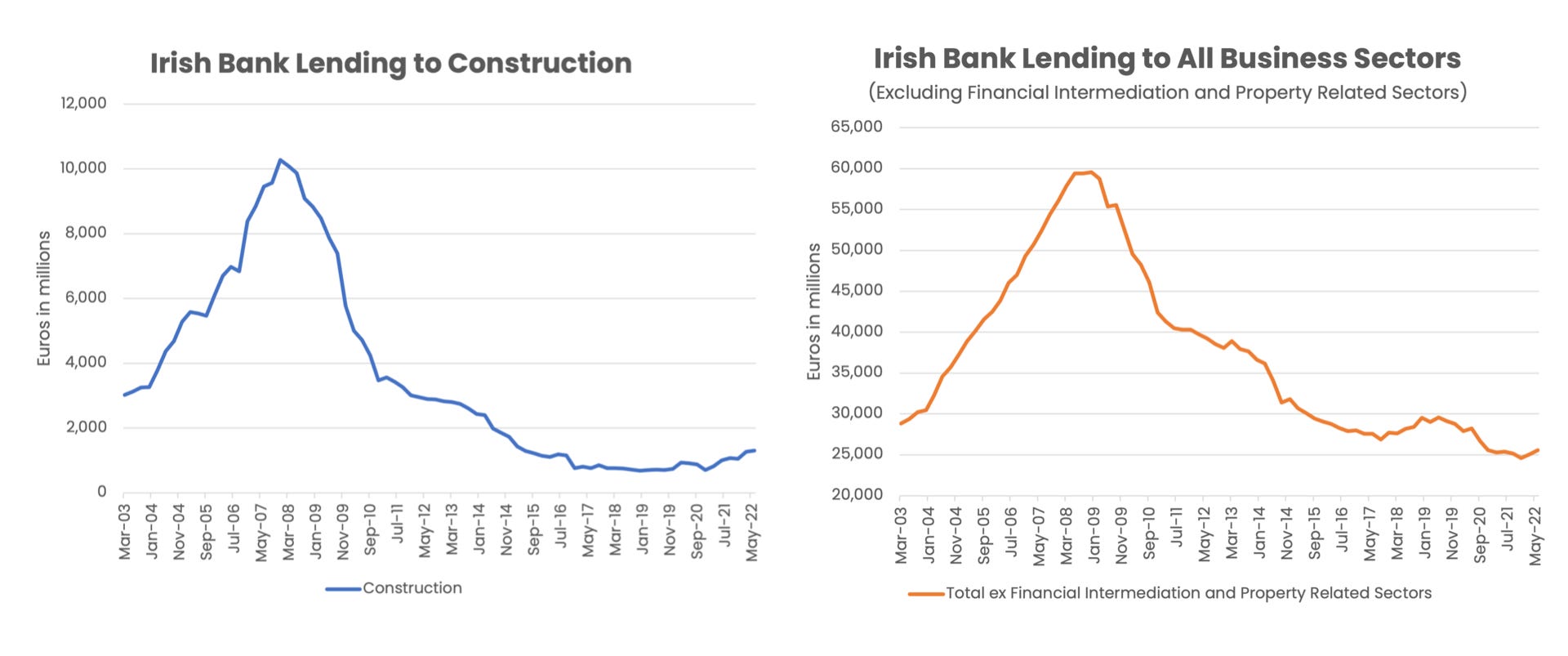
Economic and Social Research Institute (ESRI) Research Professor and Michael Martin’s economic advisor Kieran McQuinn echoed my sentiments in his March of 2025 ESRI Quarterly Economic Commentary. He wrote:
“One of the many impacts of the global financial crisis on the Irish financial system was an increase in regulation both at a European Union (EU) and Irish level…Bank lending standards across the EU became significantly stricter as regulators and financial institutions sought to mitigate risk and strengthen the stability of the banking sector. In the Irish case, the significant distress experienced by domestic financial institutions required them to maintain higher capital levels compared to those in other euro area nations. As a result, these institutions face relatively higher funding costs, limiting their ability to transmit reductions in the euro area policy rate…Therefore, lending levels into the domestic economy have been much more modest in recent years…since the global financial crisis, the total stock of lending has fallen sharply and from 2016 onwards, total deposits now significantly exceed the amount of credit extended to Irish households. At present the gap is in the order of €43.5bn…The financing of an additional 20,000 housing units solely through the domestic financial system would require existing levels of credit to more than double…It is clear that in the traditional domestic financial sector the current level of credit being extended to the Irish residential market is at present significantly lower than that required to meet the level of both the structural demand for housing and the unmet demand. Bridging this gap will clearly require additional funding from a number of sources, potentially increased funding by the State, [and] increased lending from the traditional banking sector.”
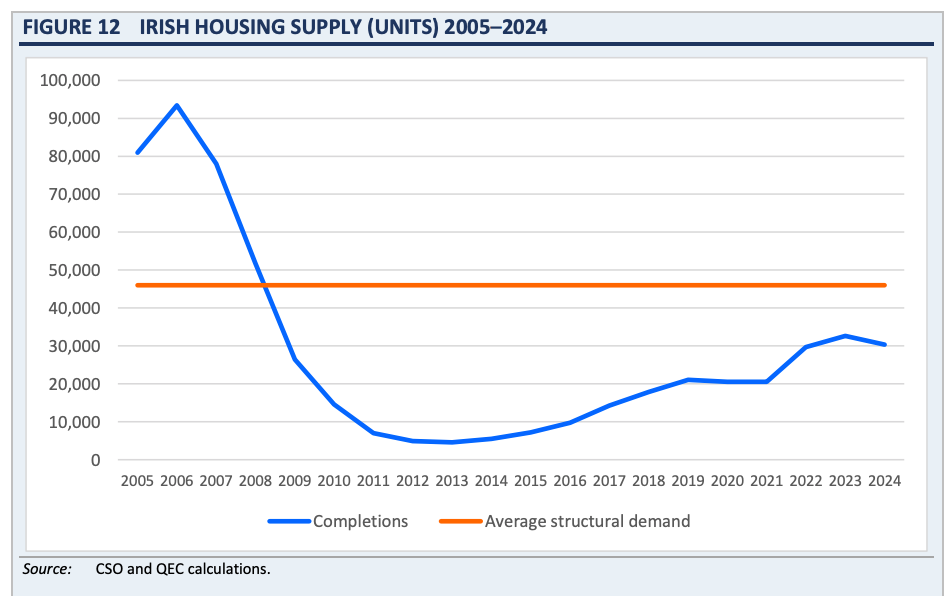
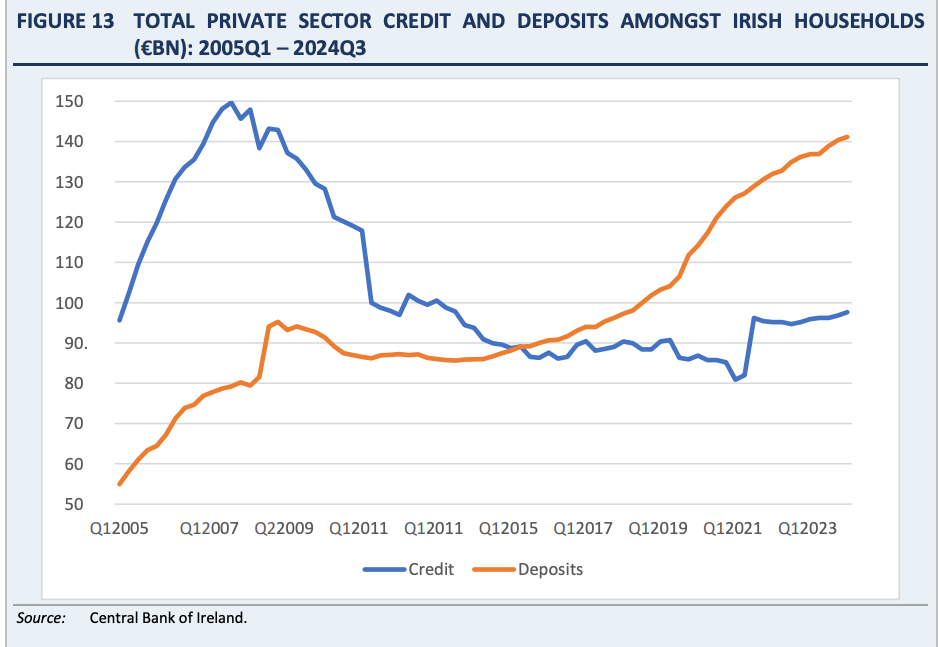
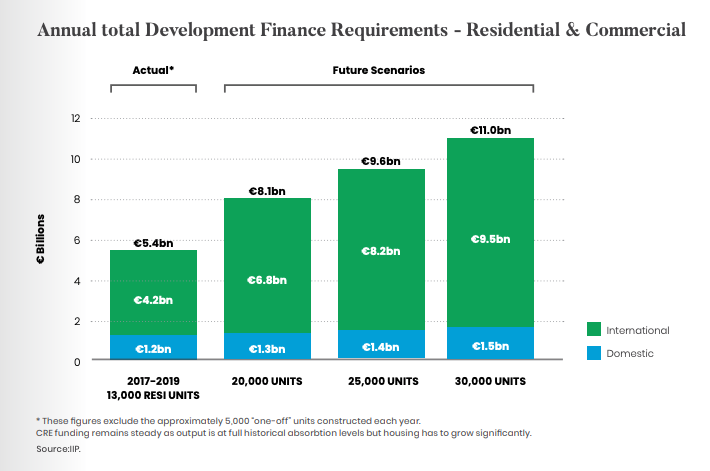
McQuinn explained that Ireland’s housing crisis is really an Irish banking crisis. The fact is that Irish banks don’t lend money for construction. This led to a big gap between the relative demand and the supply of lending. International financiers attempted to fill that gap. In 2021, The Currency reported that “78 per cent of Irish property funding this year came from overseas. Ireland’s property market has evolved to be almost totally dependent on foreign funding.” In 2021, Irish Institutional Property (IIP), a group of institutionally financed investors and real estate providers in the Irish real estate market, found that international investors represented 72 percent of total expenditure on Irish real estate in 2019. Property services company Hooke & MacDonald reported 78 percent of actual total development finance for residential and commercial real estate came from international investors across 2017 to 2019.
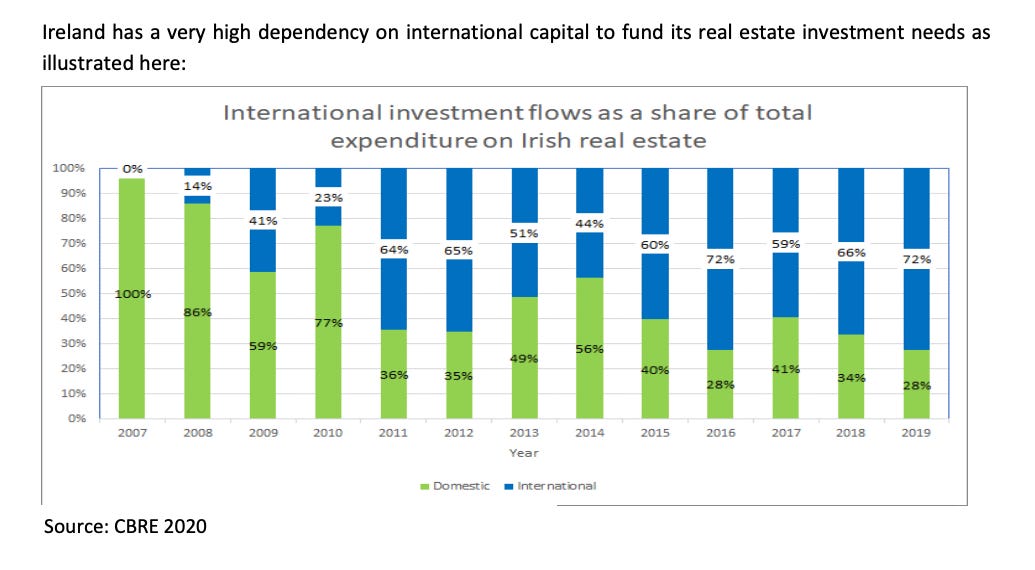
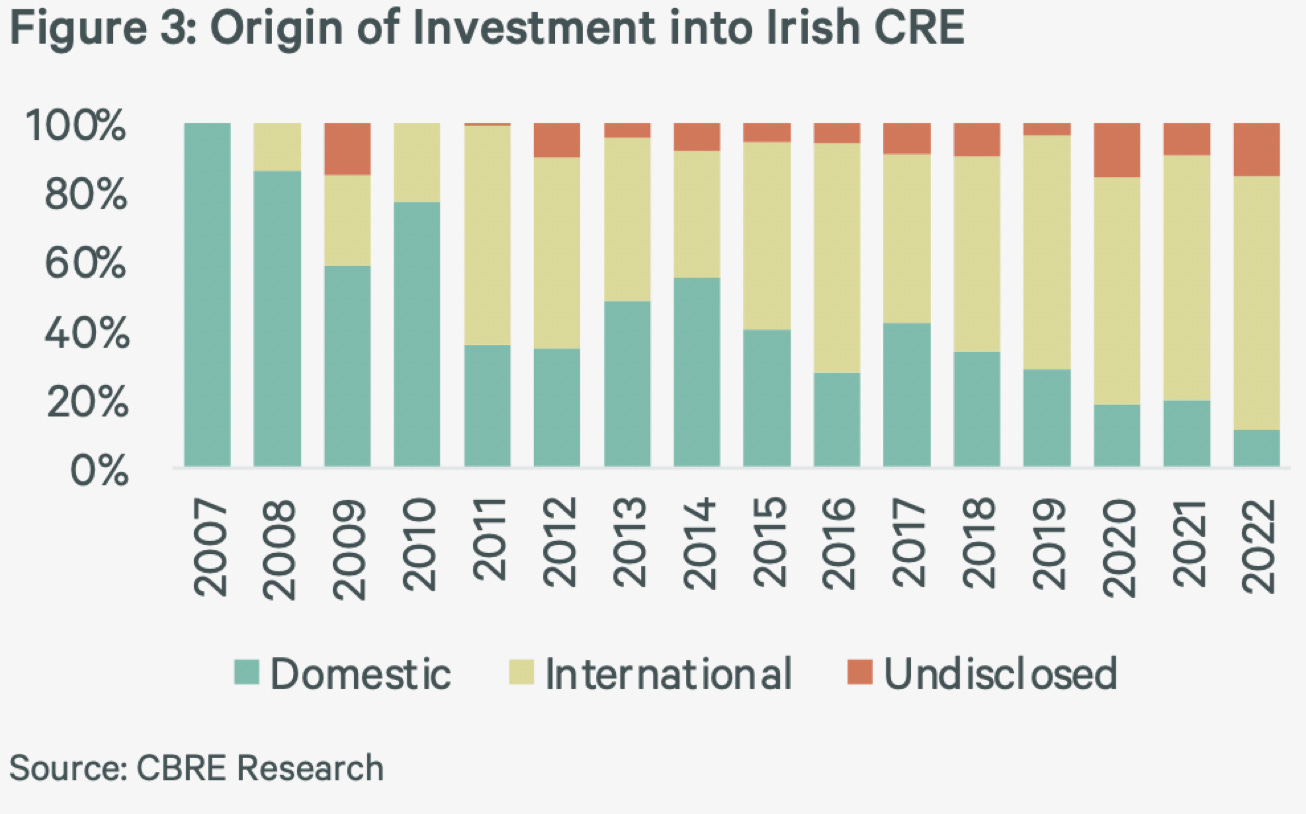
In January of 2023, the same reporter for The Currency, revealed this trend extending into 2022, with domestic investment into Irish commercial real estate almost non-existent in relative terms. This reporter defended foreign investors dominating the Irish property market and criticized any contention that domestic banks should do more. He wrote, “we don’t want our banks to take the lead…We know what happened last time…Big foreign investors have deep pockets, an appetite for risk, a long-term outlook, and experience with big projects. We’re mad to turn them away.” That Currency reporter who defended the present inadequate banking status quo and showed a severe lack of depth was Sean Keyes before he worked at Progress Ireland.
On one of the most pressing aspects of Ireland’s housing crisis, Progress Ireland’s chief tank thinker got it incredibly wrong. Although, wrong would suggest some grappling with the facts of the issue. Keyes showed an impressive lack of interest and understanding of those facts. He simply ignored and glided over them in order to run propaganda in support of foreign institutional investors. Perhaps, his apt ability at slinging propaganda for foreign oligarchs is what made him such a shoe-in for leading Progress Ireland.
If Ireland were to craft policy to address these domestic bank challenges, both at the national and European levels, then real progress could be made to build needed supply. In quantitative terms, foreign investors can’t supply the necessary funding to meet Ireland’s housing needs compared to the additional funding provided by domestic banks firing on all cylinders. In qualitative terms, domestic banks also make different lending decisions than foreign investors. A reinvigorated Irish banking sector would enable more small to medium sized construction firms to build rather than large firms (favored by foreign institutional investors); more single family units rather than single occupant apartment blocks (favored by foreign institutional investors), and more distributed housing rather than concentrated housing in Dublin and its urban sprawl (favored by foreign institutional investors).
The Irish housing crisis is a byproduct of the different decisions foreign institutional investors make in regards to housing types, locations, and stock. The combination of more local decision-making through domestic banks, empowerment to small to medium sized construction firms, and sophisticated Irish government policy would better shape housing construction outcomes and limit investor asset speculation relative to the status quo. This combination would also mitigate some of the effects raised by the San Francisco Fed and Bank of England papers. It would be a housing solution for the entire Irish democracy, not just a foreign oligarchy.
It should also not be neglected, as UCD’s Byrne noted, that “the State reduced social housing output by 90%” since the housing market crashed. This is an aspect of the shortage but the collaboration between domestic banks and the government will provide more funds for future social housing. The advocates for more social housing should broaden their vision. Why not also social banking? As that is the ultimate springboard for future housing growth and many more economic concerns.
Rather than Progress Ireland’s outward-looking Neoliberal conclusion which calls for a “new Jerusalem”, Ireland needs an inward-looking anti-Neoliberal resurrection of Ireland.
Progress Ireland’s vision is a fundamental divergence from an indigenously Irish and anti-Neoliberal perspective. Why wouldn’t a think-tank funded by the Neoliberal Collisons echo their views? GMU’s Mercatus Center certainly echoes the views of the Kochs. If this is the case in their general philosophy, it is only logical to conclude that this divergence would manifest in future policy advocacy. Each individual proposal creates and cements a political culture of Silicon Valley-style Neoliberalism that will spill over to impact more and more policy decisions.
Regarding other issues, the Collisons are fixated on unrestricted mass immigration, specifically GMU and Cato economist Bryan Caplan’s extreme Neoliberal conception of it as open borders. I’ve previously explained how America’s Neoliberal immigration system really works and how it conforms to oligarchic interests. In a coincidental 2015 interview with Abundance movement co-founder Ezra Klein, US politician Bernie Sanders famously said (my emphasis added):
“Open borders? No, that’s a Koch brothers proposal…That’s a right-wing proposal, which says essentially there is no United States…It would make everybody in America poorer—you’re doing away with the concept of a nation state, and I don’t think there’s any country in the world that believes in that. If you believe in a nation state or in a country called the United States or UK or Denmark or any other country, you have an obligation in my view to do everything we can to help poor people. What right-wing people in this country would love is an open-border policy. Bring in all kinds of people, work for $2 or $3 an hour, that would be great for them. I don’t believe in that. I think we have to raise wages in this country, I think we have to do everything we can to create millions of jobs. You know what youth unemployment is in the United States of America today? If you’re a white high school graduate, it’s 33 percent, Hispanic 36 percent, African American 51 percent. You think we should open the borders and bring in a lot of low-wage workers, or do you think maybe we should try to get jobs for those kids? I think from a moral responsibility we’ve got to work with the rest of the industrialized world to address the problems of international poverty, but you don’t do that by making people in this country even poorer.”
A more Collison-inspired Irish political zeitgeist would induce such a Koch-inspired open borders agenda pitting them against the opinions of most Irish people. At present, 75 percent of Irish people believe there’s been too much immigration into Ireland and that it’s placing increasing “pressure on housing supply, on health services, on schools, on the tourism sector, on policing, and on other public services.” The Irish Fiscal Advisory Council detailed Ireland’s infrastructure shortfalls and the impact of increased demand from population growth.
The Collisons also support cryptocurrency and stablecoins that are in conflict with sound financial regulations to suppress fraud and speculation as well as threats to European and Irish monetary sovereignty. The Collisons promote Mario Draghi’s Neoliberal vision for Europe. The Collisons publicize pro-Israeli and anti-Chinese views (the cognitive dissonance being quite deafening) which conflicts with the practical need for Ireland to decouple from the Israeli economy and expand trade with China.
Should China and Ireland Trade More?
·
September 17, 2024

In 2015, China opened the National Exhibition and Convention Center. It is the largest convention complex of its kind in the world. It hosts China’s International Import Expo which seeks to encourage foreign countries to export more to China. Most interestingly, t…
This has not been a criticism of the Collisons’ intelligence, business competency, or even some of their ideas in isolation. This is a criticism of their overall ideology and their Silicon Valley network. I am warning, not against a single aspect, but of epistemic pollution. If Ireland adopts this ideology, it may accrue superficial gains at the expense of conceding substantive losses and its core values.
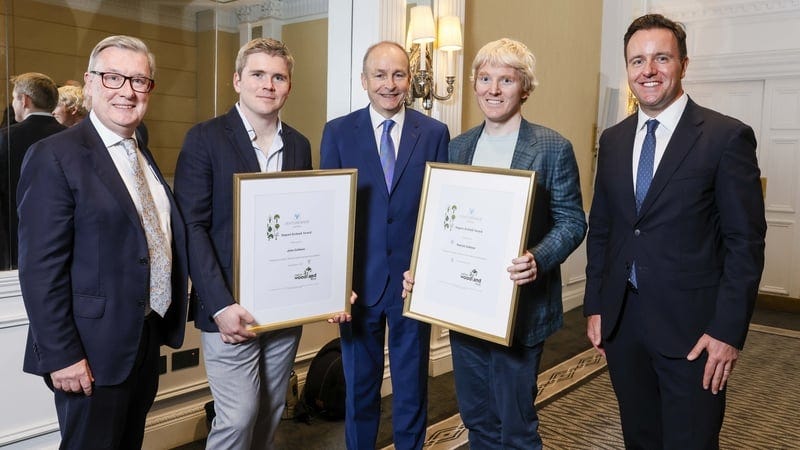
The Collisons and Progress Ireland have already penetrated the Irish establishment. Fine Gael Tánaiste and Minister for Finance Simon Harris described John Collison’s op-ed as a “thoughtful and thought-provoking piece. Too many layers, too many structures, processes that take too long. Time for the pendulum to swing back. This will be a big part of my work and focus with colleagues in the months ahead.” Progress Ireland has been meeting with top Irish government officials. It goes without saying that Ireland’s premier tech whizkid billionaires are able to open many doors and rub shoulders with many Irish political elites. In 2025, Taoiseach Micheál Martin presented both Collison brothers with the Impact Ireland Award.
Deputy leader of Fianna Fáil and Minister for Public Expenditure, Infrastructure, Reform & Digitalisation Jack Chambers has also echoed Progress Ireland’s rhetoric more and more. Chambers described Ireland as overregulated. He said, “the cumulative impact of all of these has been excessive, has produced time delays, and that’s why we need reform. We need to have a constant focus and look back at regulation in the economy.” More recently, Chambers declared “the era of ‘endless recruitment everywhere’ in the public service is over” as part of his emerging brand of overt Neoliberalism.
Three months ago in San Francisco, Chambers met with John Collison “to discuss the Governments infrastructure reforms to deliver abundance and growth in the Irish economy.” In 2024 in Washington DC, Chambers met with John Collison to discuss the Irish economy. It’s safe to say Chambers is nested within the wider network of the Collisons and Progress Ireland. Therefore, Chambers has a keen ear to their ideas. In December of 2025, The Irish Independent’s Colin Murphy also noticed this ideological overlap between the Collisons, Progress Ireland, and Chambers.
Ireland should beware of tech bros bearing grifts. Ireland should choose both contemporary and historical critics of Neoliberalism and its antecedents. It should absorb the lessons from Chang and Mazzucato. It should cherish the legacy of Irish republicans from 1922 and before who laid down the proper indigenous ideology to follow. Those Irish republicans warned of the “dangers of American finance”, as said by Joseph Connolly, and that “investors and exploiters from outside will come in to reap the rich profits which are to be made. And, what is worse still, they will bring with them all the evils that we want to avoid in the new Ireland,” as said by Michael Collins. Present-day Irish citizens should heed those words and see tech bros and their Silicon Valley-style Neoliberalism as the modern manifestations of what was warned against back then.
The Irish tech bros talk up their connections to Silicon Valley wealth. Despite whatever gloss they may shine on their ideas, Ireland cannot justify any dubious means for any speculative ends. The economic interests of the few cannot be the only consideration of the state. It is the common good which should always be sought. A common good where economic and political sovereignty are democratically distributed. A common good that centers on the holistic well-being of Irish families and not Silicon Valley oligarchs.

This was part 2 in a series about the intersection of tech and politics in Ireland. Read Part 1’s big picture analysis of Ireland’s Tech Fork in the Road, and keep an eye out for Part 3’s deep-dive into a particular business case study.
Ireland's Tech Fork in the Road
·
Jun 19

Ireland stands at a tech fork in the road: double down on its reliance on American tech giants, or begin the difficult shift towards European tech sovereignty. One well-trodden path leads to dependence and distortion. The other calls for radical change but points towards independence and development. Ireland’s choice will determine the success or failur…
Irish Anti-Imperialist and Nationalist Economics
·
August 6, 2021

After a year of deep research, I’m proud to present my M.A. dissertation on Irish economic history. This compiles and expands on thoughts I’ve written about previously. I hope you better understand imperialism, nationalism, and economics after reading this. If you like this content, I hope you will support my pursuits to turn it into a larger book. The …
American vs. European GDP Per Capita
·
August 28, 2025

American economic well-being is suggested to be much greater than European economic well-being, but closer examination revealed more nuance that inverted that suggestion. Sam Bowman’s Reason Magazine article compared America and Europe to make the pro-American and anti-European case. His argument was most reliant on GDP per capita comparisons. He wrote, “In Western Europe, GDP per capita—the average economic output per person—is about $63,000 per year, adjusted for the cost of living. In the United States, it is $86,000.” Without this comparison, the rest of Bowman’s essay is much less compelling. This difference is the necessary conceit to justify lauding the American economic model over that of Europe.
What’s Driving the US Stock Market Growth (or Bloat)?
·
July 15, 2025
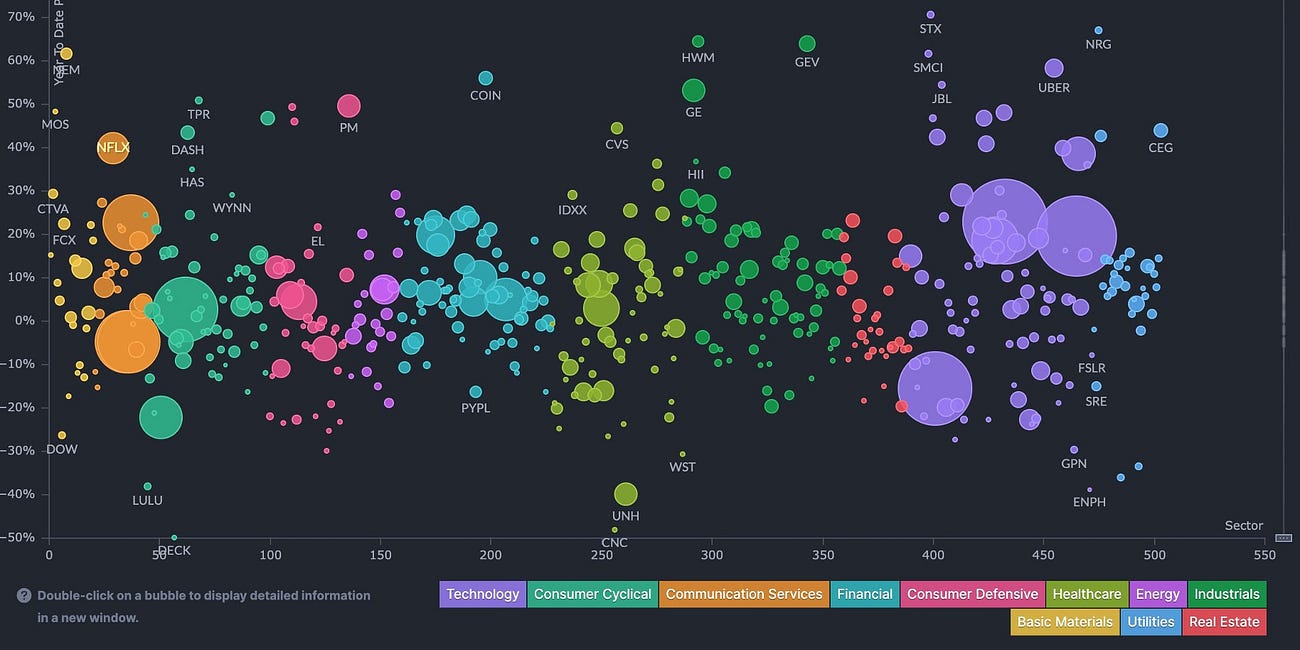
The growth of the US stock market is supposed to signal a healthy economy but, after deconstructing its individual components, its “growth” looks more like the bloat of a rotting corpse. Since the start of the year to 11 July 2025 (YTD), the S&P 500 grew by 5.37 percent on average. It had a median growth of 4.45 percent, a minimum of negative 50.26 percent, and a maximum of 88.99 percent. What drove this “growth”? Artificial Intelligence (AI) speculation, defense department welfare, and companies that profit from the impoverished.
No posts
Comments
Nothing yet. Say the first thing.
Sign in to join the conversation.