
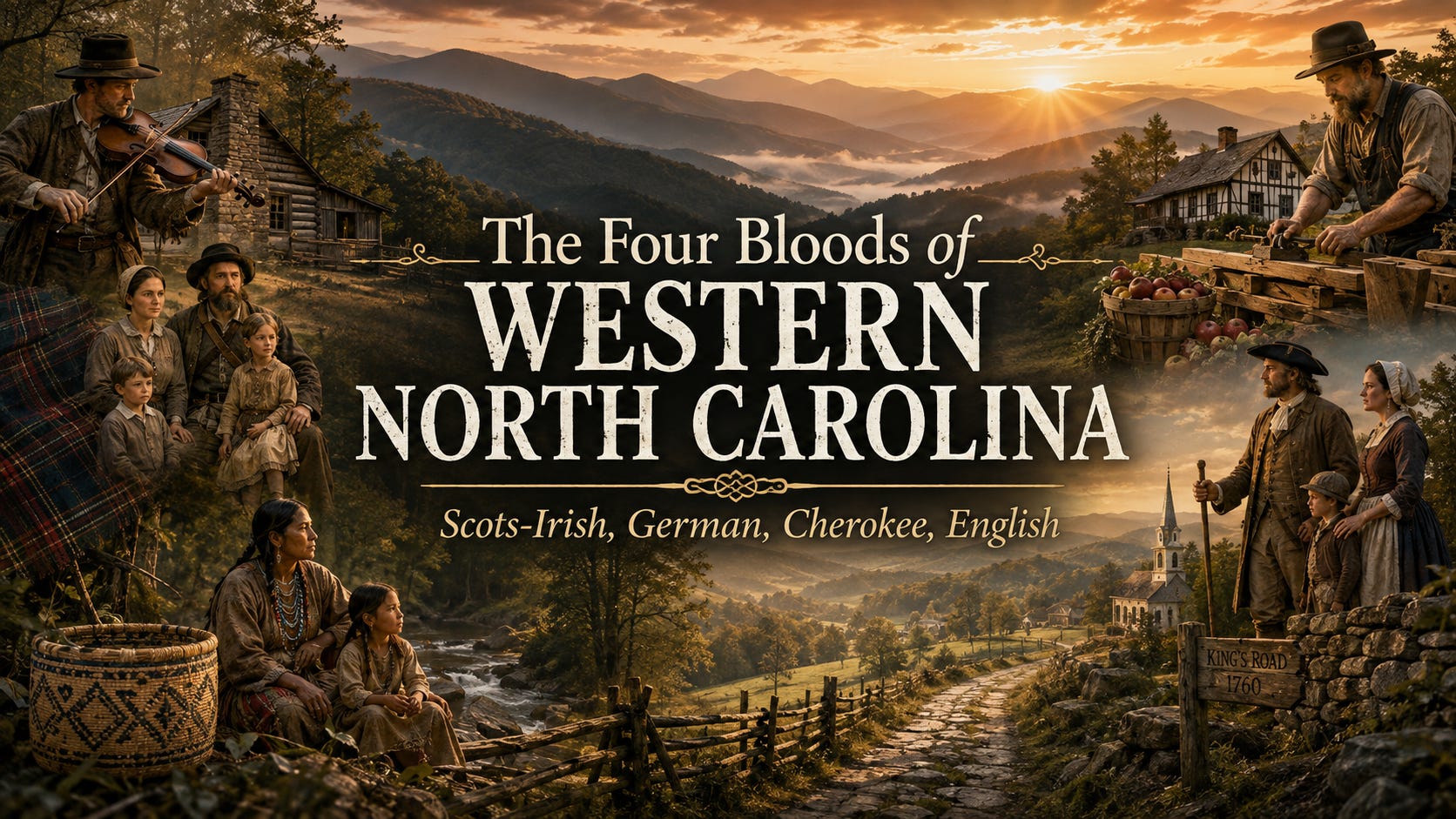
Nobody is simply “from the mountains.”
Not really.
When someone says their people are from Western North Carolina, that is only the beginning of the story. The deeper truth is tied to place: the county they came from, the creek they settled on, the ridge they crossed, the churchyard where their people are buried, the old road that brought them in, and the people who were here before their family ever arrived.
Those questions tell more than a DNA percentage ever could.
Western North Carolina bloodlines are layered. Cherokee homeland, Scots-Irish settlement, German endurance, English law, African survival, hidden ancestry, changed names, family stories, courthouse records, and old graves on hillsides most people drive past without noticing.
The mountains did not create a pure people.
They created a braided one.
The first strand is Cherokee.
Long before Buncombe, Madison, Haywood, Yancey, Mitchell, McDowell, Macon, Jackson, Swain, Henderson, Transylvania, or Avery had their modern names, the Cherokee already knew these mountains. They had towns along the rivers, trails through the gaps, names for places before those names were ever written in English, and a world that Europeans entered late and understood poorly.
They farmed the valleys, hunted the ridges, traded across distance, governed their towns, and lived inside a mountain homeland that had memory long before it had county lines.
Western North Carolina still speaks Cherokee, even when we forget to listen.
Cullowhee, Tuckasegee, Nantahala, Oconaluftee, Cullasaja, Tusquittee, Junaluska.
Those names are not decoration. They are reminders that this place was never empty.
The tragedy of removal sits inside that same story. The Trail of Tears was not some distant national event with no connection to these ridges. It came out of this land. It came out of a government decision to take a homeland from a people who had already built farms, courts, schools, laws, and a written language through the work of Sequoyah.
The Cherokee did what the United States claimed it wanted Native nations to do.
Then the United States took the land anyway.
Still, not all left. Some hid in the mountains. Some remained through legal arrangements. Some stayed because homeland is not just property. Their descendants remain here today as the Eastern Band of Cherokee Indians on the Qualla Boundary.
That is not a side note to Western North Carolina history.
That is where the story begins.
The Scots-Irish came later, and if one European stream gave Southern Appalachia its loudest cultural reputation, it was probably them.
Their story is often misunderstood. They were not simply Irish in the Boston or New York sense. Many came out of the borderlands between Scotland and England, moved into Ulster in Northern Ireland, crossed the Atlantic, and then followed the Great Wagon Road down through Pennsylvania, Virginia, the Carolinas, Tennessee, and Georgia.
By the time they reached the mountains, they had already been moved, squeezed, taxed, restricted, and pushed around by landlords, churches, kings, and governments. They knew what distant power felt like, and they did not trust it.
That old suspicion came with them.
So did the music, the ballads, the fiddle, the hard religion, the whiskey, the family pride, the quick temper toward outside control, the need for land, and the habit of making do.
Lees-McRae College, in its article on Scots-Irish heritage in Appalachia, makes a strong point: the Scots-Irish gave much of Appalachian culture its distinct shape, especially in language, music, religion, agriculture, and daily life.
You can see that across Western North Carolina in the surnames, the old Presbyterian influence, the mountain music, the way people talk about freedom, the moonshine traditions, the quilting, the buttermilk and potatoes, and the older speech patterns that survived in coves and hollows long after they faded elsewhere.
The Wildberry Lodge article on Asheville and Western North Carolina’s Scots-Irish history adds another layer. These families did not arrive empty-handed. They brought folklore, songs, ballads, farming methods, building practices, and architectural habits that became part of the Southern Appalachian world.
That is the thing about ancestry. It is not only blood.
It is what people carry.
A song can travel through a family. So can a recipe, a superstition, a distrust of authority, a way of building, a way of praying, or a story about where the family came from, even when the details get blurred.
WLOS recently spotlighted Scottish heritage in Western North Carolina through the Scottish Tartans Museum and Heritage Center in Franklin. That museum preserves tartans, Highland dress, clan history, and the larger story of Scottish and Scots-Irish immigration into North Carolina.
That gives this history a living anchor.
It is not just locked away in deed books. It is still visible at the Grandfather Mountain Highland Games, still heard in pipes, still seen in tartans, and still found in names like McDowell, Rutherford, MacRae, Highlands, MacRae Meadows, and countless family lines scattered across the region.
Old pride has a long memory.
For many Western North Carolina families, the Scots-Irish story is not abstract. It runs through names like Phillips and Murray, along with Campbell, Ramsey, Buchanan, Graham, Armstrong, Elliott, Johnston, McDowell, and many others that appear across old deeds, militia rolls, church books, family Bibles, cemeteries, land grants, and courthouse records.
Those names are not just names. They are road maps.
Some came down the Great Wagon Road. Some passed through Virginia. Some came through East Tennessee. Some settled in creek bottoms and mountain coves in what became Madison, Buncombe, Haywood, Yancey, Mitchell, McDowell, Macon, and the surrounding counties.
By the time those families were rooted here, their names had become part of the landscape itself.
But pride should never make the story too clean.
Many Scots-Irish families came here looking for freedom, land, and a life beyond the reach of people who had ruled over them. Yet the land they entered was not empty. It was Cherokee land.
That is the hard truth in the middle of the mountain story.
Some ancestors came wounded, then later helped wound others.
Both can be true.
Western North Carolina history requires that kind of honesty.
The Germans brought a quieter inheritance, but quiet does not mean small.
German-speaking settlers came into the American backcountry in large numbers through Pennsylvania. Many came from the Palatinate and nearby regions. They were farmers, craftsmen, Lutherans, Mennonites, Moravians, and people looking for stable ground after Europe had worn them down through war, religious struggle, poverty, and uncertainty.
Some moved down the same wagon roads. Some settled in the Shenandoah Valley. Some pushed into North Carolina.
They brought farms, barns, churches, orchards, records, trades, soil sense, and a patient relationship with land.
The Scots-Irish often pushed toward open ground when things got crowded. The Germans tended to stay, improve, build, and leave a strong paper trail.
You still see them in Western North Carolina family names such as Reinhardt, Kiser, Kuykendall, Hildebrand, Huffman, Shuford, Propst, Setzer, and others.
You also see them in names that changed shape over time. Schmidt became Smith. Zimmerman became Carpenter. Other names softened just enough to pass through English-speaking mouths without disappearing completely.
The German contribution to mountain culture does not always get romanticized. It does not come with the same mythic sound as the Scots-Irish frontier. But it sits deep in the region’s bones: work, land, church, craft, farm, orchard, records, and staying power.
Then there were the English, who can be easy to overlook because English language, English law, and English customs became the background structure of colonial America.
But background is still power.
The English brought courts, land grants, tax lists, county lines, deed books, political offices, and the legal framework everyone else had to navigate.
Some English families came as land speculators and men of ambition. Others came poor, landless, or nearly so: former indentured servants, tenant farmers, younger sons, and families with little chance of owning good land along the coast.
So they moved inland.
In Western North Carolina, English bloodlines run through old county records, Quaker records, Anglican records, land grants, wills, marriages, and courthouse minutes.
Shelton belongs in that English mountain stream, along with Allen, Roberts, Hensley, Edwards, Wilson, Davis, Rice, Buckner, Holcombe, and many other family names that moved through Virginia, the Carolinas, and into the backcountry.
Some of those lines came early. Some moved slowly, generation by generation, until the mountains became the family’s known world.
After a while, the lines blurred.
A German family married into a Scots-Irish one. An English surname appeared in a Cherokee story. A Scots-Irish line became almost impossible to separate from an English one. A family said “Irish” when the records suggested Ulster Scots. A family claimed Cherokee ancestry without documentation, while another carried Cherokee ancestry and never spoke of it. Another had African ancestry hidden because silence was safer than truth.
That is the real Western North Carolina story.
Not purity.
Mixture.
Survival.
Adaptation.
People becoming kin across lines that history books try to keep separate.
That is why bloodline stories here need care. DNA can offer hints, but it cannot do the whole job. You need land records, church registers, census pages, military rolls, court files, tribal rolls, cemetery stones, old maps, family Bibles, and oral history.
Even then, humility is necessary.
Records were kept by people, and people made mistakes. They spelled names wrong. They erased things. They hid things. They simplified what was complicated. Families moved across county lines. Children were raised by relatives. Stories changed in the telling.
A name can open a door, but it cannot tell the whole story by itself.
That is what makes Western North Carolina so fascinating. History here is not only something you read. You can drive through it.
You can walk into Franklin and see Scottish heritage preserved in tartans and Highland dress. You can stand at Grandfather Mountain and hear bagpipes rise against the ridges. You can walk Cherokee ground and know the story began long before the county was named. You can open deed books in Madison, Buncombe, Haywood, Yancey, Mitchell, McDowell, Macon, or Jackson County and watch families move creek by creek, ridge by ridge, generation by generation.
A surname can make you wonder what road carried it here.
So can a river.
So can a cove.
So can a churchyard.
So can an old grave with a name nearly worn away.
Western North Carolina remembers, but not always plainly. Some memories are celebrated. Some are buried. Some are carved in stone. Some are hidden in courthouse basements. Some live only in the way an old person says, “Our people came from over the mountain.”
The Cherokee are still here.
So are the Scots-Irish, German, English, African, and mixed lines.
Some are documented. Some are whispered. Some were renamed. Some were nearly lost.
All of them helped make this region what it is.
That is the deeper story of Western North Carolina blood. It is not one inheritance, but many inheritances braided into one mountain place.
Sometimes that braid is beautiful.
Sometimes it is painful.
Most of the time, it is both.
The mountains were not empty. The settlers were not simple. The bloodlines were not pure. The stories were not clean.
But they were real.
And they still shape us.
Every time someone says they are from these mountains, they are carrying more than they know: old migrations, old removals, old farms, old churches, old roads, old songs, old names, old grief, old pride, and old contradictions.
There is no such thing as just Western North Carolina blood.
There is Cherokee homeland, Scots-Irish defiance, German endurance, English law, African survival, hidden mixture, family memory, and beneath all of it, the land holding the story longer than any of us.
So do not stop at a DNA percentage.
Go to the courthouse. Walk the cemetery. Read the names. Study the creeks. Find the old road. Ask what church they attended. Ask where the family lived before they came here. Ask whose land it was before that. Ask what was remembered, what was forgotten, and what had to be hidden.
Blood alone will never tell the whole story.
Place will get you closer.
And Western North Carolina has been telling that story for a very long time.
As always, if you are looking to buy or sell in the Asheville area, I am always available to talk. Take a look at todays inventory.
No posts
Comments
Nothing yet. Say the first thing.
Sign in to join the conversation.