
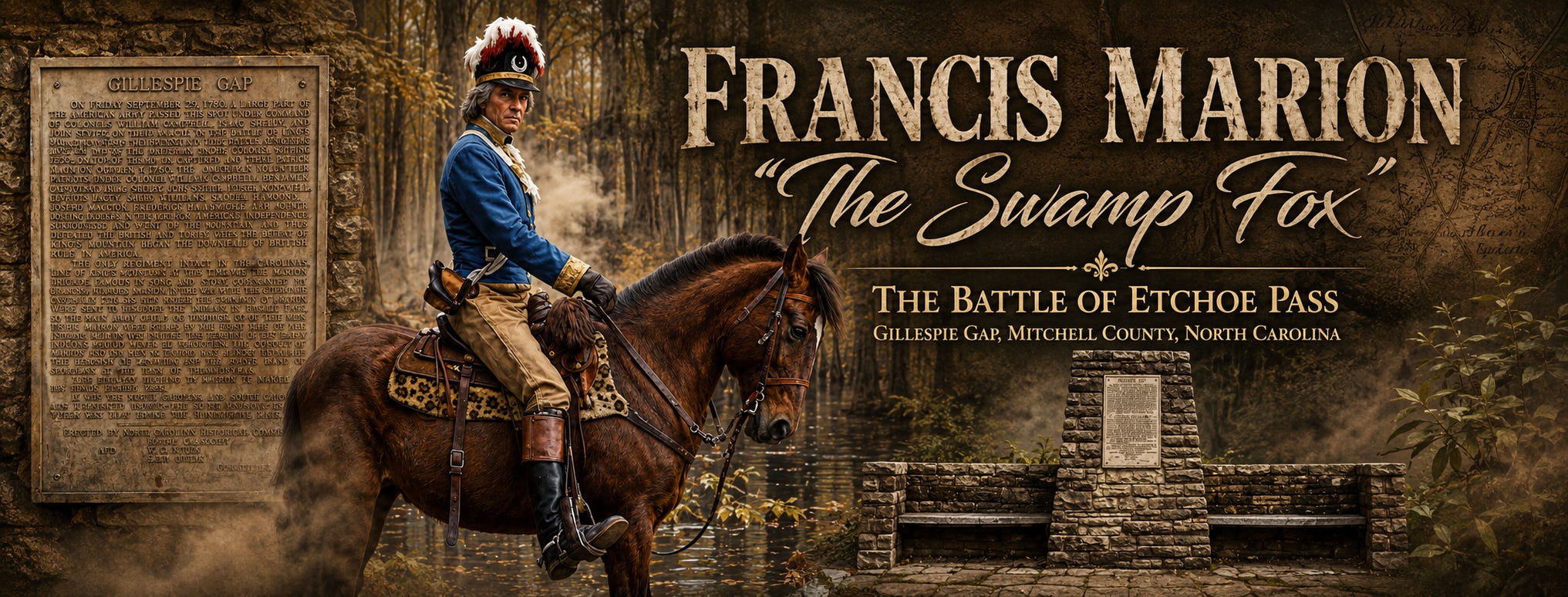
There are places in the mountains where the marker tells one story, but the deeper story is hidden in the wording.
Gillespie Gap is one of those places.
Today, most people pass through it without thinking too much about the name. It sits along the Blue Ridge near Spruce Pine, close to the Museum of North Carolina Minerals, where the Blue Ridge Parkway crosses this old mountain passage. NC 226 comes up from Marion and continues toward Spruce Pine. NC 226A turns toward Little Switzerland. The gap sits near the McDowell and Mitchell County line, and the Eastern Continental Divide runs along this high country.
It is a beautiful place.
But it is also a confusing place.
And that confusion may reach all the way back to the naming of Marion, North Carolina in 1845.
Marion was named for Francis Marion, the famous Swamp Fox of the American Revolution. That much is known.
But here is the question that makes Gillespie Gap so interesting:
Why would a town in the mountains of western North Carolina be named for Francis Marion?
Marion’s most famous Revolutionary War service was in the South Carolina lowcountry. That is where the Swamp Fox legend was made.
So why Marion, North Carolina?
The answer appears to be tied to an old geographical mistake.
For many years, local memory seems to have connected Francis Marion with a battle believed to have happened at Gillespie Gap, just above the road leading into Marion.
That battle was Etchoe Pass.
The problem is that Etchoe Pass was not Gillespie Gap.
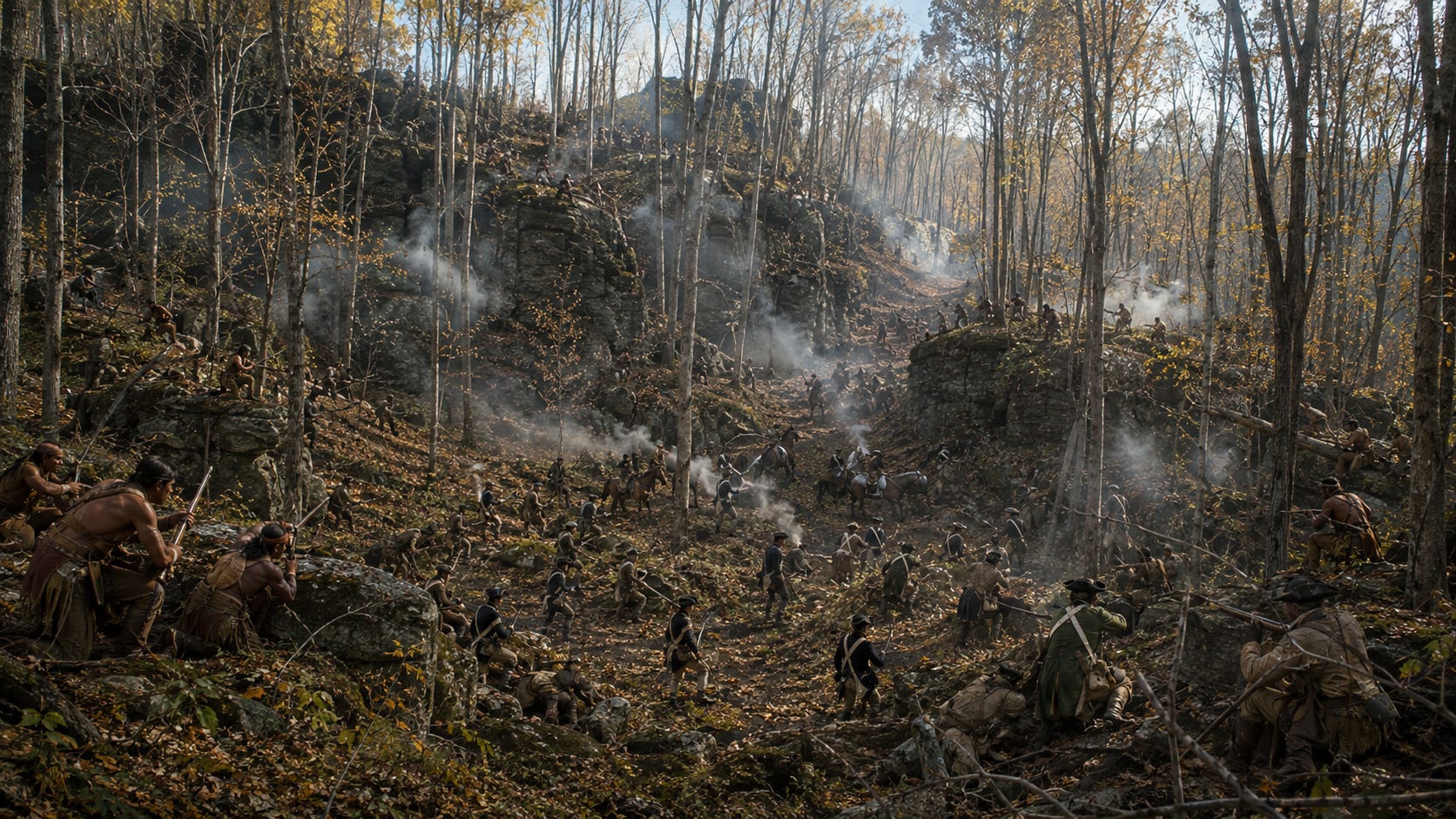
The Battle of Etchoe Pass took place much farther southwest, during the Cherokee War of 1760 and 1761, near the Cherokee Middle Towns in what is now Macon County, around present-day Otto and Franklin, close to the Georgia border.
But the people who named Marion in 1845 seem to have believed differently.
They appear to have believed that Etchoe Pass was Gillespie Gap, or at least that Francis Marion’s action at Etchoe Pass belonged to this same mountain passage above Marion.
That makes the town name much more than a general patriotic tribute.
It means the naming of Marion was likely a direct reflection of a local belief that Francis Marion’s courage at Etchoe Pass had happened nearby, just above the town, in the mountain gap that later generations would know as Gillespie Gap.
In other words, the people naming Marion were not simply reaching out to a distant Revolutionary hero.
They believed they were honoring a man whose heroism had touched their own mountains.
Their own road.
Their own pass.
Their own story.
And now, the road history makes that argument even stronger.
Long before the 1927 monument was erected, the road itself carried the name Etchoe Pass Road.
The old route through Little Switzerland was authorized in 1913 as a toll road. It ran from Gillespie Gap to Little Switzerland along the ridgeline. It was called Etchoe Pass Road.
That matters.
Because it shows the Etchoe name was not casually added to the monument in 1927.
It was already attached to the mountain road.
It was already part of the local geography.
It was already being used for the route connected to Gillespie Gap.
By 1921, that road had become part of NC 19. In 1934, NC 19 was replaced in that area by NC 26. Later, when a more direct Cox Creek route became the main road, the old Etchoe Pass Road became NC 26A. In 1961, it was renumbered again as NC 226A.
So the road we now know as NC 226A carries the remains of an older name.
Etchoe Pass Road.
That is the missing piece.
The confusion did not begin with a plaque.
It was already on the road.
It was already in the way people described the landscape.
The 1927 Gillespie Gap monument simply preserved that belief in bronze.
And once you know that, the marker reads differently.
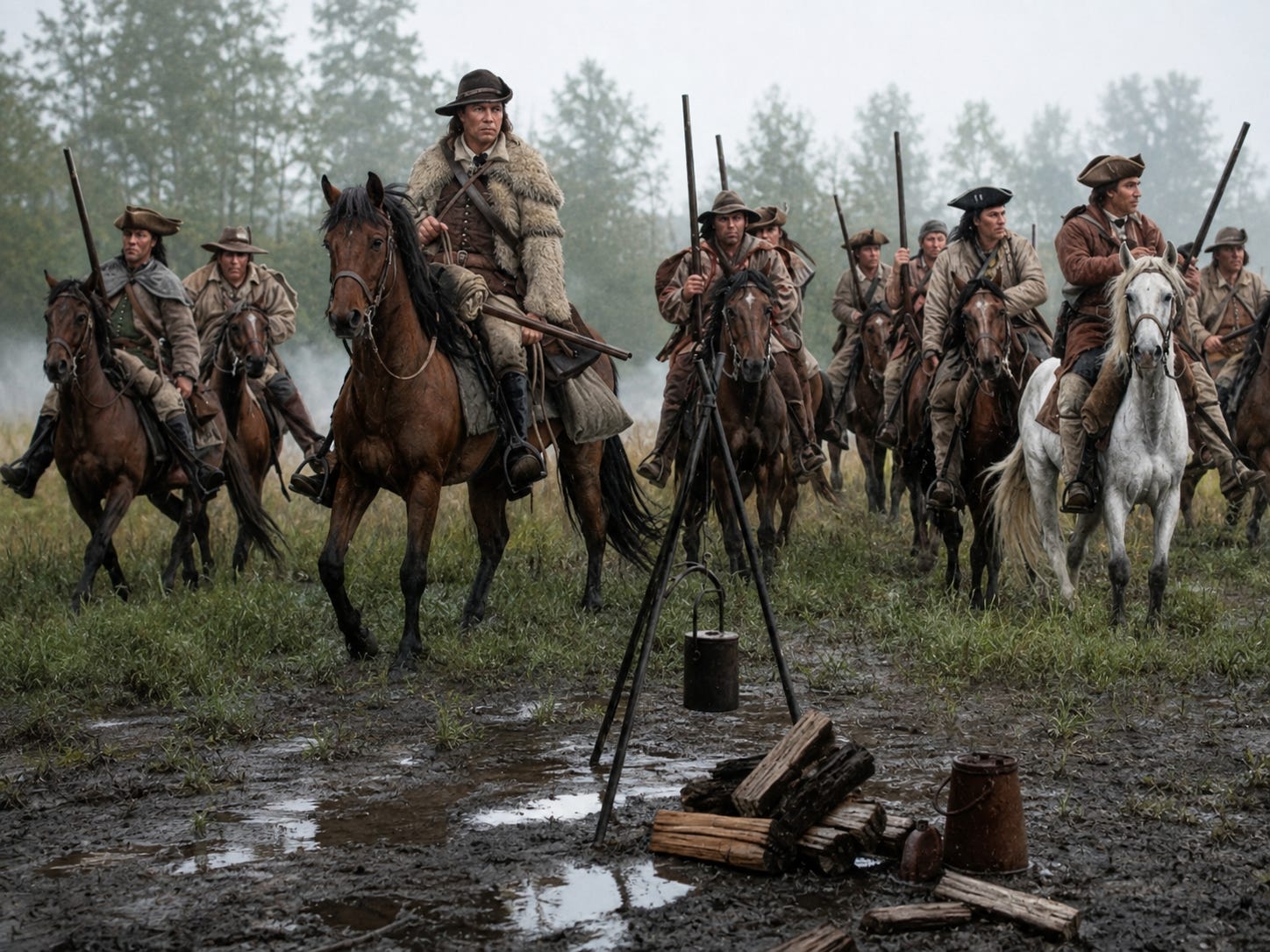
The monument honored the Overmountain Men who passed through Gillespie Gap in 1780 on their way to Kings Mountain. That part belongs here. The Overmountain Men were moving east across the mountains, and Gillespie Gap was part of that great march toward one of the turning points of the American Revolution.
But the marker does something else too.
It also mentions Francis Marion and the Battle of Etchoe Pass.
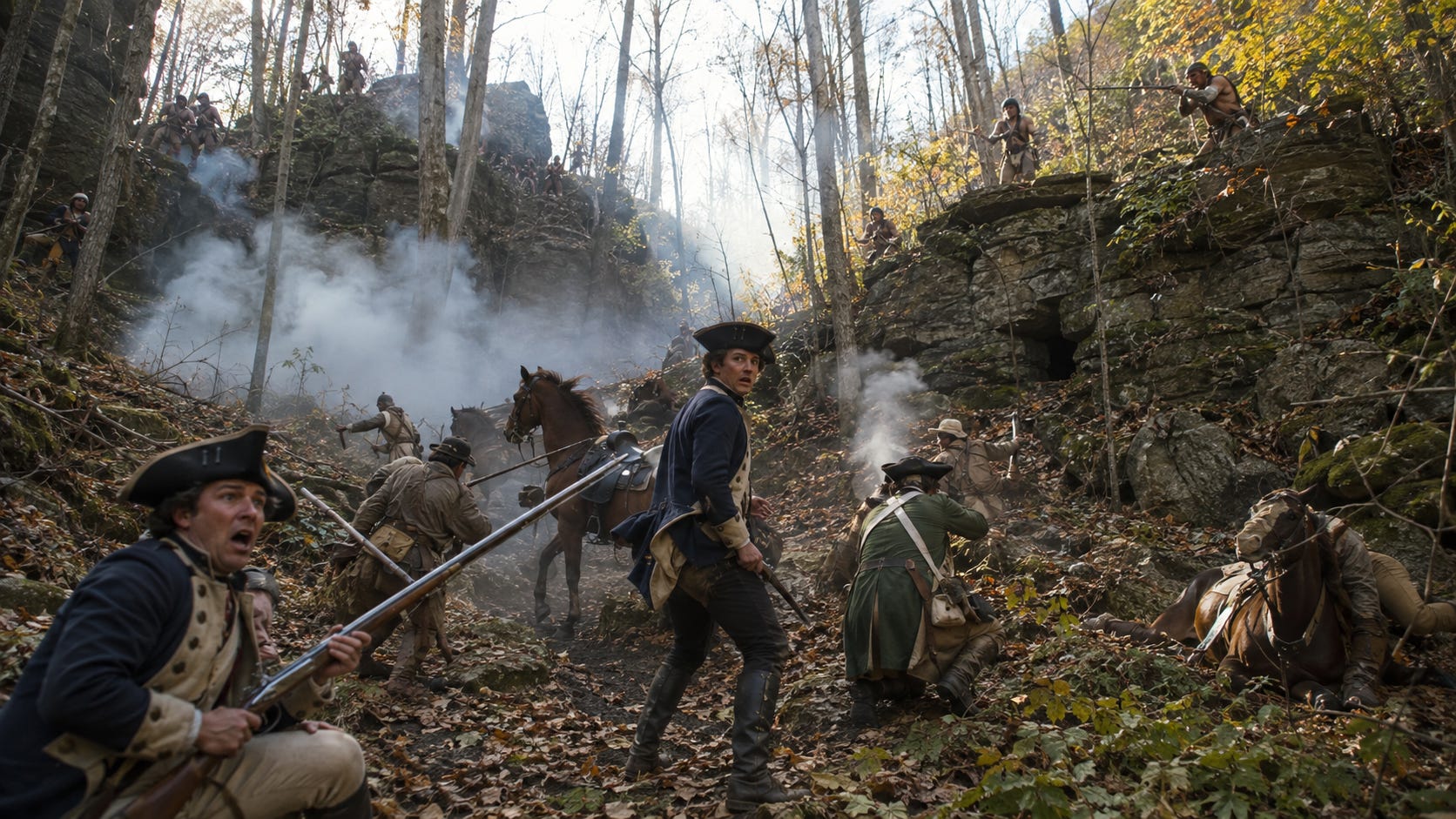
The inscription says that thirty men under Marion were sent to dislodge Cherokee warriors at Etchoe Pass. Twenty-one of those men were killed by the first fire. Marion survived. Then the inscription compares the bravery of Marion and his men to Leonidas and the Spartans at Thermopylae.
Then comes the line that matters most:
“This highway leading to Marion is named in his honor Etchoe Pass.”
That sentence is the key.
It links Francis Marion, Etchoe Pass, Gillespie Gap, and the highway leading into Marion all in one thought.
And now we know there really was an Etchoe Pass Road running from Gillespie Gap toward Little Switzerland.
That makes the wording even more important.
It was not random.
It was not accidental.
It reflects a local belief that this road and this gap were tied directly to Francis Marion’s heroism.
By 1927, that belief was strong enough to be cast in bronze.
But by 1913, it was already strong enough to be written into the road name.
That pushes the story back before the monument.
And if the road name was already established by 1913, it becomes easier to believe that the same local tradition reached back much earlier, perhaps even to the naming of Marion in 1845.
That is the heart of the article.
The naming of Marion appears to have been rooted not merely in admiration for Francis Marion as a distant American hero, but in a local belief that his famous Etchoe Pass action had happened near Gillespie Gap.
If true, then Marion’s name was not only patriotic.
It was geographical.
It was local.
It was tied to a mistaken map of memory.
The town name, the mountain road, the gap, and the battle had all become tangled together.
The problem, again, is that the geography was wrong.
Gillespie Gap belongs to the Overmountain Men story.
Etchoe Pass belongs to a different story, farther southwest, tied to Cherokee resistance, colonial expansion, and the violence of the Cherokee War.
Those two places should not be folded into one.
But they were.
At least in public memory.
That is why Gillespie Gap matters.
It does not only tell us about what happened in 1780.
It tells us how people remembered the past in 1845, how that memory appeared in a road name by 1913, and how it was carved into public commemoration in 1927.
It shows how a mistaken belief can become part of a town’s identity.
A name gets attached to a hero.
A hero gets attached to a battle.
A battle gets attached to a pass.
A pass gets attached to a road.
A road leads to a town.
And the town carries the name forward.
That is how memory works sometimes.
Not cleanly.
Not perfectly.
Not always accurately.
But powerfully.
By the time the Gillespie Gap monument was dedicated on July 4, 1927, thousands reportedly attended the ceremony. Former Governor Cameron Morrison spoke. The North Carolina Historical Commission was involved. The monument honored the Overmountain Men, Francis Marion, and the 30th Division of World War I.
That tells us something about the era.
The people who built this monument were creating a patriotic landscape.
Kings Mountain.
Francis Marion.
The Cherokee War.
World War I.
The Hindenburg Line.
All of it was placed together on one mountain marker in the Blue Ridge.
To modern eyes, that feels crowded.
But to the people of 1927, it may have felt like one continuous story of courage.
Mountain courage.
Revolutionary courage.
Frontier courage.
World War courage.
One generation honoring another.
Still, history needs more than emotion.
It needs geography.
And geography is where this story begins to unravel.
The Battle of Etchoe Pass was real.
Francis Marion’s involvement was real.
The Overmountain Men’s passage through Gillespie Gap was real.
The old Etchoe Pass Road was real.
The naming of Marion for Francis Marion was real.
But the belief that Etchoe Pass was Gillespie Gap was wrong.
That is the strange and fascinating part.
A real town may have been named from a real admiration for a real man, connected through a mistaken belief about a real battle in the wrong place.
That is the kind of history the mountains hold.
Not simple.
Not clean.
But deeply human.
People in 1845 seem to have believed that Marion’s story belonged to their own mountain landscape. By 1913, that belief appears in the name Etchoe Pass Road. By 1927, it was still visible on the Gillespie Gap marker.
They must have believed Etchoe Pass was here.
Or close enough to here.
They must have believed Francis Marion’s courage had been displayed near the road leading into town.
That belief helps explain why the monument reads the way it does.
It helps explain why the road carried the Etchoe name.
And it helps explain why the name Marion may have felt so appropriate to the people who chose it.
They were not simply honoring a hero from somewhere else.
They believed they were honoring a hero tied to their own mountains.
Their own pass.
Their own road.
Their own sense of place.
But time has a way of correcting memory.
The more carefully historians looked, the clearer it became that Etchoe Pass was not Gillespie Gap. The true location belonged farther southwest, near the Georgia border.
So the marker at Gillespie Gap became something more than a memorial.
It became evidence.
Evidence of how history was understood in 1927.
Evidence of how Francis Marion’s name had been localized in the mountains.
Evidence of how a mistaken location could shape public memory for generations.
And perhaps, evidence of why Marion, North Carolina was named as it was in 1845.
That does not make the town name meaningless.
If anything, it makes it more interesting.
Because now the name Marion carries two stories.
One is the intended story: honoring Francis Marion, the Swamp Fox.
The other is the hidden story: the belief that his heroism at Etchoe Pass had happened close enough to give the name local weight.
One story is patriotic.
The other is geographical.
And between them is a mistake.
But mistakes matter.
Especially old ones.
They show us what people believed.
They show us how communities saw themselves.
They show us how places built identity from memory, pride, fragments, and assumptions.
The people who named Marion, named Etchoe Pass Road, and later marked Gillespie Gap were not trying to deceive anyone.
They were trying to honor the past.
But they were working from the history they believed to be true.
That is why this story should be told carefully.
Not to embarrass the past.
Not to tear down a marker.
Not to strip meaning from a town name.
But to understand how memory is made.
Gillespie Gap still deserves its place in history.
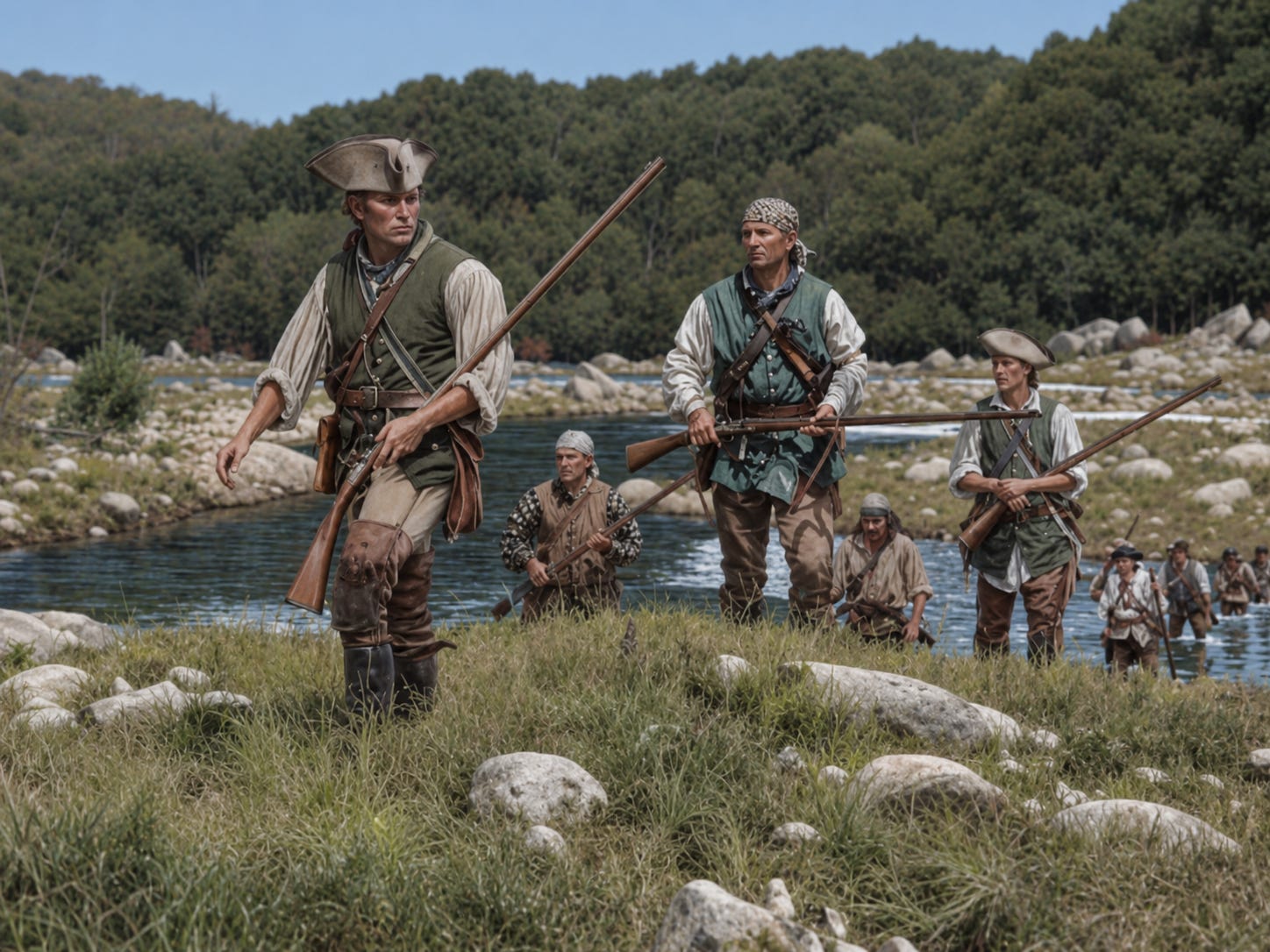
The Overmountain Men passed through this mountain country on their way to Kings Mountain. That march helped shape the outcome of the American Revolution.
That story belongs here.
But Etchoe Pass does not.
And Francis Marion’s connection to Gillespie Gap appears to be the result of a mistaken belief that became powerful enough to shape local memory, the name of a road, and perhaps even the naming of Marion itself.
That is what makes this story so compelling.
A mountain gap becomes more than a gap.
A road becomes more than a road.
A town name becomes more than a town name.
And a monument, meant to settle memory, opens a question nearly a century later.
What did the people of Marion believe about their own name?
What did they think happened at Gillespie Gap?
How long did they believe Etchoe Pass was there?
How much of that belief shaped the way this region remembered Francis Marion?
And how much history is still hiding in the old names of our mountain roads?
Those are the questions worth asking.
Because the mountains remember a lot.
But people have to remember carefully.
And sometimes, the most interesting history begins with a mistake written on a map, carried by a road, and finally cast in bronze.
No posts
Comments
Nothing yet. Say the first thing.
Sign in to join the conversation.