
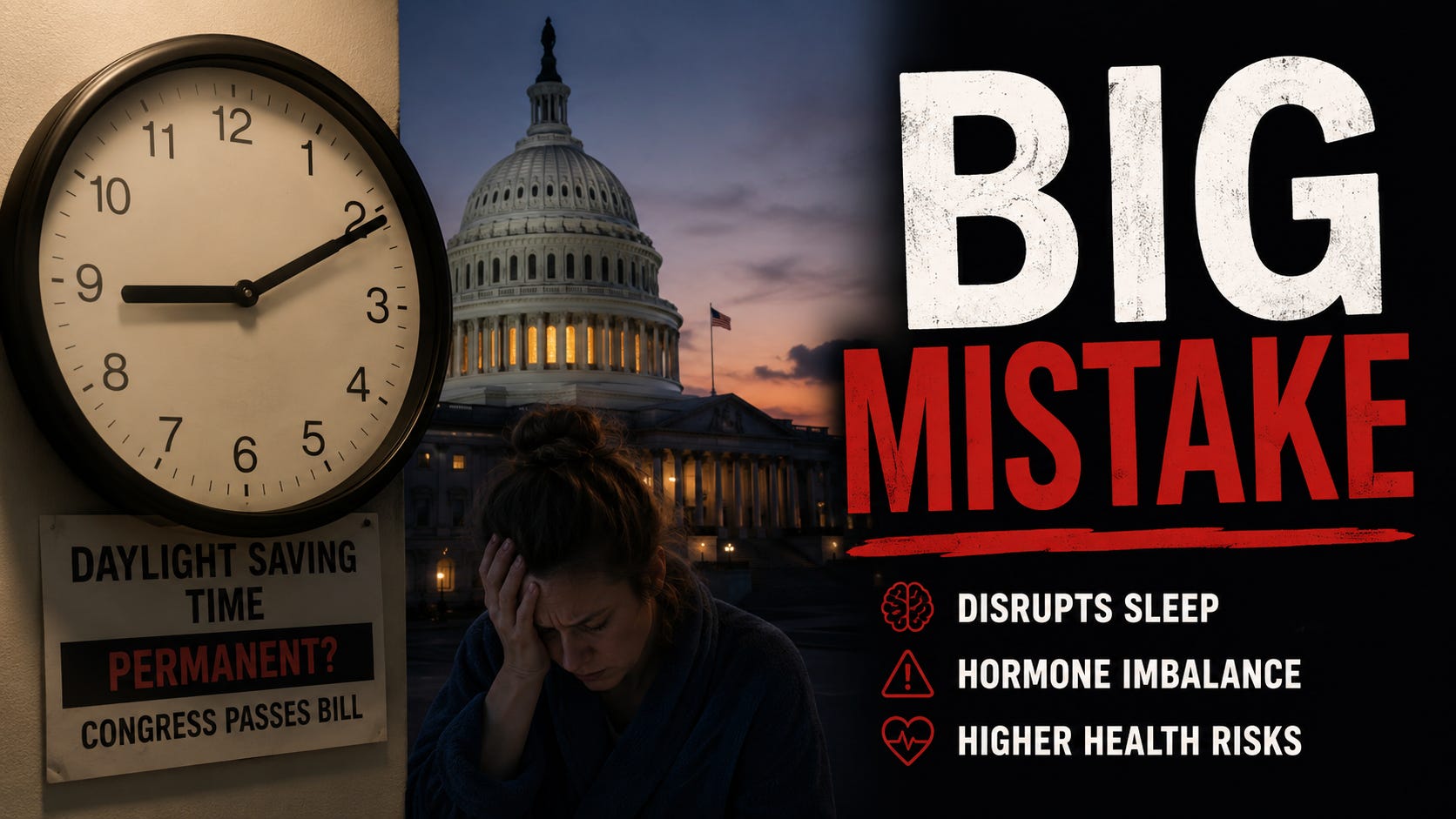
On a July morning in 2026, a congressman on the House floor pulled out his phone and played “Here Comes the Sun.”
He was celebrating. The House had just voted 308 to 117 to lock the clocks on daylight saving time forever. The bill is called the Sunshine Protection Act. It sounds warm. It sounds healthy. It sounds like a gift.
It is none of those things. Because the one thing permanent daylight saving time does not protect is your sunshine. It hides your morning sun and hands the evening a little extra. And your body clock, the ancient timekeeper running every cell you own, does not care about your evening plans. It cares about the sunrise. This bill takes the sunrise away.
The House passed permanent daylight saving time. It now goes to the Senate.
Permanent daylight saving time pushes your clock an hour off the sun all year. Dark mornings, bright late evenings.
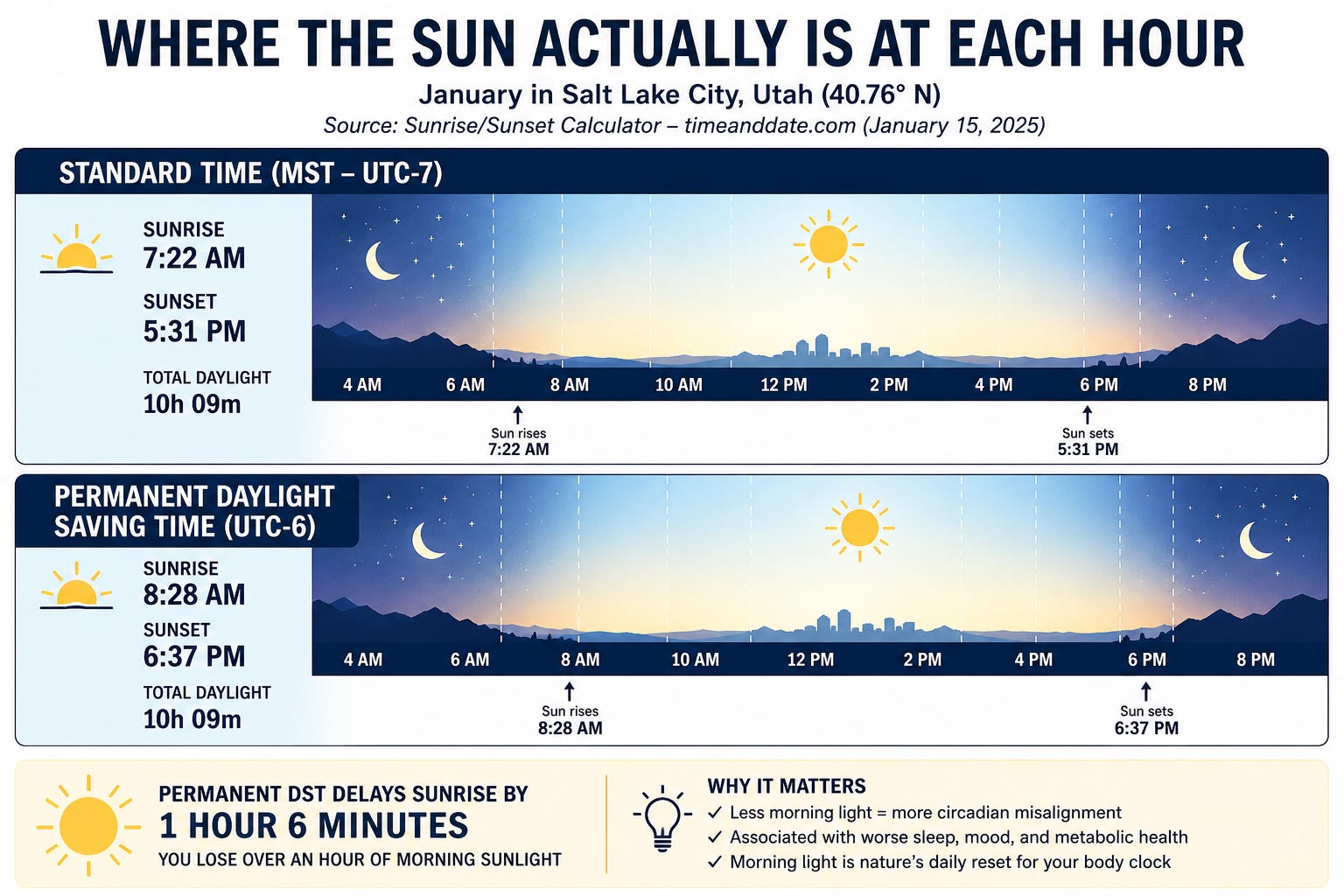
Your master clock sets itself with morning light. Take away morning light and the whole system drifts late.
Every sleep and circadian science group backs the opposite fix: permanent standard time.
The “spring forward” jump is a yearly experiment. Heart attacks, strokes, and crashes spike right after it.
Permanent daylight saving time is closer to a permanent “spring forward” than most people realize.
The real driver behind the bill is money, not health. Evening daylight sells more gas, food, and rounds of golf.
You can protect your own clock no matter what Congress does. The protocol is at the bottom.
Before we go deeper. Starting soon I am opening more of this Substack to paying subscribers only. That includes expert interviews on blood work, supplements, light, and nervous system repair. If this work helps you, support it for $9.99/month or $80/year.
You have a master clock. It sits behind your eyes in a tiny patch of brain called the suprachiasmatic nucleus, or SCN. I covered this in full in my Circadian Biology 101 breakdown, so here is the short version.
Special cells in your eyes catch light and send a wire straight to that clock. The clock then tells every organ what time it is. It fires cortisol to wake you up. It holds melatonin back until dark. It sets your body temperature, your blood pressure, your hunger, and your repair crews on a 24 hour loop.
Here is the catch. Your inner clock does not run at exactly 24 hours. It runs a little long. So every single day it needs a reset, or it drifts. That reset button is morning light. Bright light in the first hours after you wake tells the clock, “This is the start of the day. Sync to now.”
Think of it like a wind up watch that loses a few minutes each day. Morning sun is the daily wind. Miss the wind and the watch falls behind. Miss it for weeks and you are living in the wrong time entirely.
This is why sunrise light matters more than any other light you get. It is not a nice to have. It is the anchor.
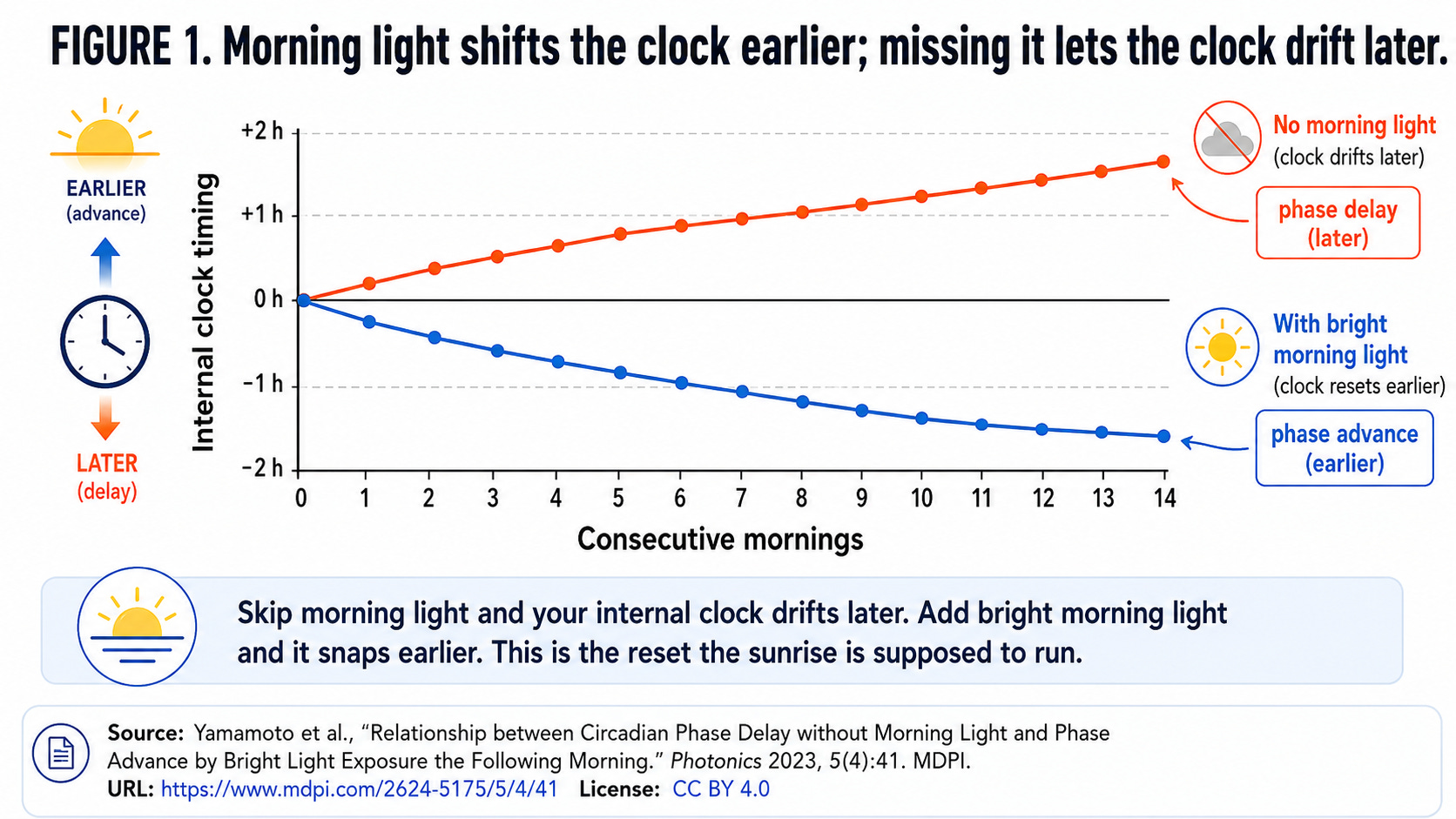
Now picture the bill in action. Permanent daylight saving time keeps the clocks pushed one hour ahead of the sun, all year, forever.
In winter, that is brutal. In much of the country the sun would not clear the horizon until 8 or even 9 in the morning. You would wake in the dark. You would drive to work in the dark. Kids would wait for the school bus in the dark.
So the exact moment your clock is begging for its reset, the light is gone. You give it a phone screen and a kitchen bulb instead. Those are far too dim and far too blue to do the job. The clock stays unanchored and drifts late.
We already ran this experiment. In 1974 the country tried permanent daylight saving time. Within weeks people hated it. Children were walking to school in pitch black winter mornings. Parents revolted. Congress reversed the law in under a year.
The bill that just passed the House forgets that lesson on purpose. Its backers talk about bright evenings and never mention the dark mornings that come with them. You cannot add light to the evening without taking it from the morning. The sun does not make more daylight because Congress moved a number.
Your clock will feel that trade every winter morning. And a clock that never gets its anchor is a clock that runs your body on the wrong schedule.
You do not have to guess what happens when you steal morning light. We do it once a year, every spring, and the damage shows up in hospitals.
When the clocks jump forward, you lose an hour of sleep and your clock lands an hour off the sun overnight. That is a tiny shift. Your body treats it like a punch.
In the days right after the spring change, heart attacks go up. A landmark study in the New England Journal of Medicine found the risk of heart attack rose in the first three weekdays after springing forward. Later reviews pooled data from many countries and confirmed it. One meta analysis of over 100,000 people found heart attack risk climbed about 5 percent in the week after the spring shift.
It is not just hearts. Strokes tick up. Fatal car crashes tick up. Workplace injuries tick up. Even mood takes a hit, with more reports of low mood in the weeks after the change.
Now connect the dots. Permanent daylight saving time is not a one day jump. It is closer to holding your body in that spring forward state for months on end, every winter, because the sun stays an hour behind your clock the whole season.
The yearly spike is your body screaming at a single one hour mismatch. This bill would make a version of that mismatch your new normal for the darkest part of the year.
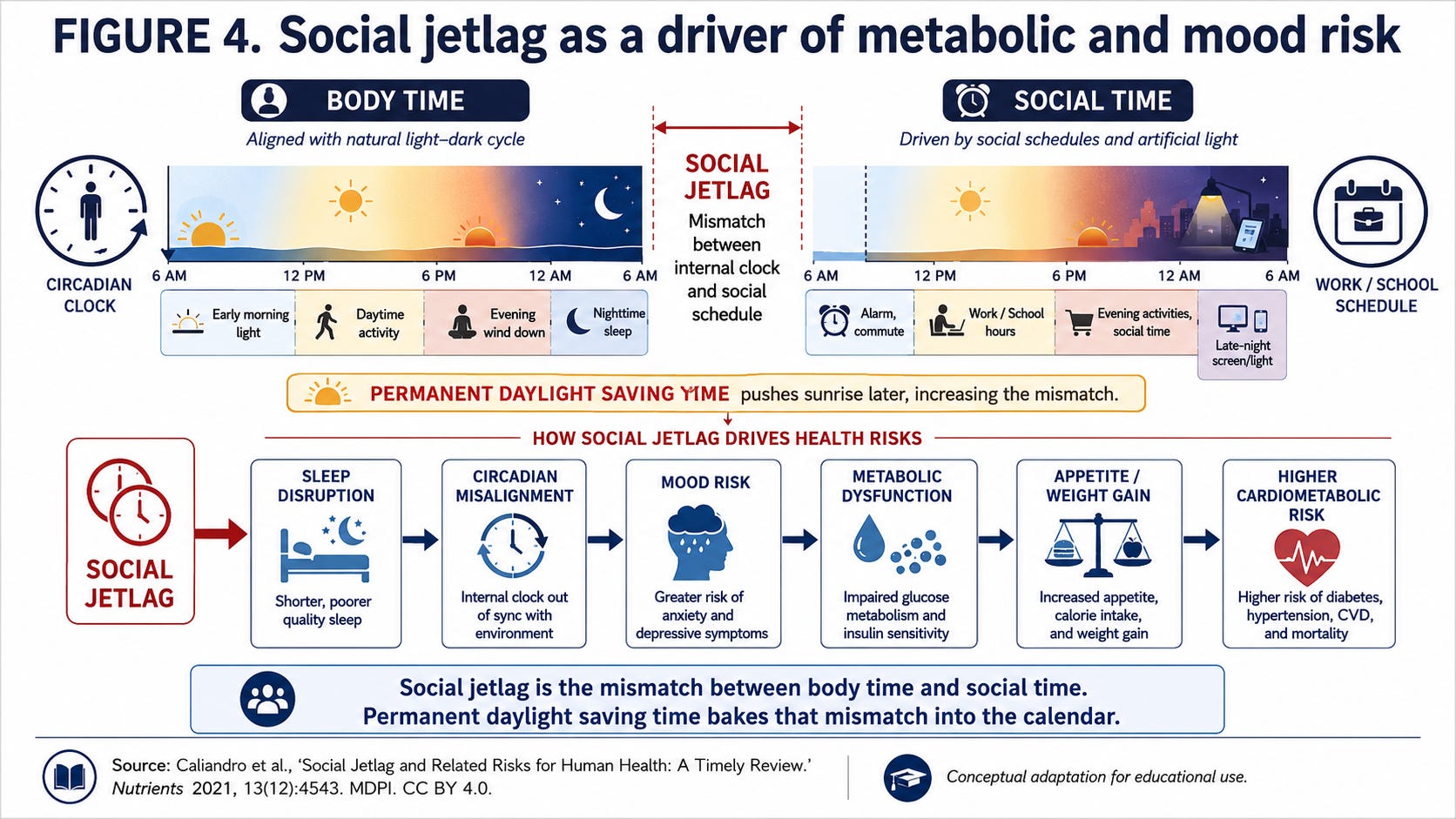
There is a name for what happens when your inner clock and your outer schedule stop matching. Scientists call it circadian misalignment. In everyday life the milder version is called social jetlag.
Social jetlag is the jet lag you get without a plane. Your body wants one schedule. Your alarm, your job, and your light exposure force another. The gap between them wears you down.
Here is why this matters for the bill. Permanent daylight saving time is a form of built in social jetlag for the whole country. It sets the official clock an hour ahead of your biological clock and locks it there. You are not flying anywhere, but your body spends every winter feeling like it moved a time zone east and never adjusted.
That gap is not harmless. Research links chronic circadian misalignment and social jetlag to higher rates of obesity, type 2 diabetes, heart disease, and depression. When your clock and your world disagree, your metabolism, your hormones, and your mood pay the tab.
Standard time shrinks that gap. It keeps clock noon close to sun noon, which is exactly what your body evolved to expect. Permanent daylight saving time widens the gap and calls it a benefit.
You would not choose to feel jet lagged all winter. This bill chooses it for you.
If you are fighting a chronic condition and you feel like you are guessing, you do not have to do this alone. My team at Shield of Health works one on one to rebuild your terrain from the ground up and not chasing symptoms
Reach out to us by filling out this short questionnaire HERE
If daylight saving time is the wrong setting, what is the right one?
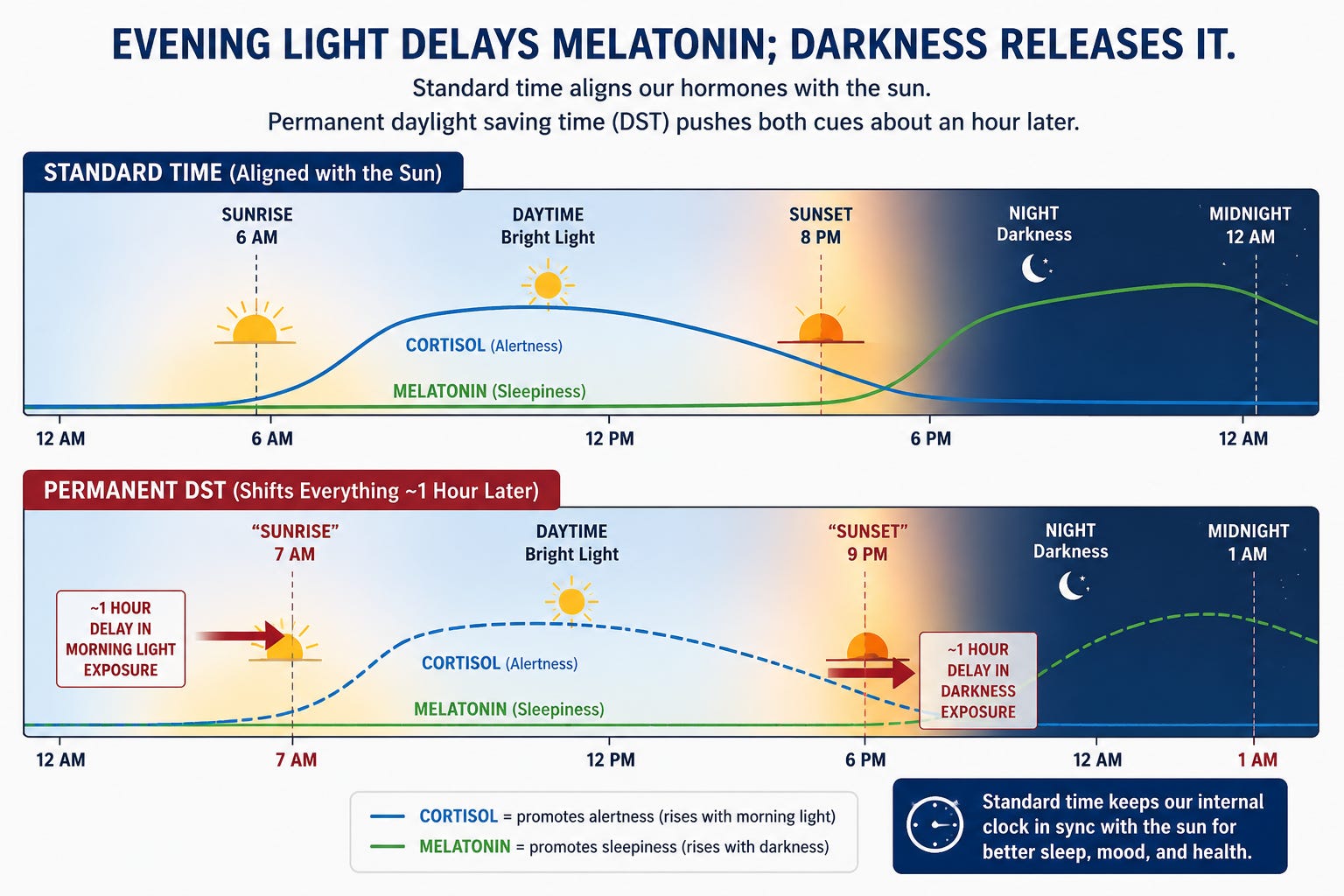
Standard time. It is the setting where clock noon sits closest to the moment the sun is highest in the sky. That is not a random choice. It is the arrangement your biology was built around across every generation before the light switch existed.
Under standard time, light comes early. Your clock gets its morning anchor near the time you naturally wake. Cortisol rises with the sun the way it is supposed to. The whole day starts on time.
Just as important, standard time lets the evening go dark on schedule. Darkness is the cue that releases melatonin, the hormone that runs your deep repair overnight. Bright evening light delays that release and shortens your window for real recovery.
Permanent daylight saving time does the opposite on both ends. It hides the morning light you need and stretches the evening light that keeps melatonin locked up. Late light in, late melatonin out, later and worse sleep. (The claim that this evening light shift meaningfully worsens long term health outcomes for the whole population is supported by circadian theory and the misalignment data, though direct multi decade trials on permanent daylight saving time do not exist. I am labeling that as a strong hypothesis, not settled fact.)
This is why the American Academy of Sleep Medicine, the Sleep Research Society, and every major circadian science group land in the same place. They do not want the clock changing twice a year either. But when forced to pick one setting to keep forever, they pick standard time, because it aligns best with human biology.
So if the science points to standard time, why did the House vote the other way?
Follow the evening light. That extra hour of daylight after work is not really for your health. It is for your wallet, or more honestly, for someone else’s cash register.
When it is bright after work, people go out. They shop. They fill the gas tank for one more errand. They hit the driving range, the patio, the ballpark, the store. That is why the loudest historical support for daylight saving time has come from retail, recreation, and the chamber of commerce, not from doctors.
The lawmakers pushing this bill said the quiet part out loud. They framed it around the modern economy, around consistency for business, around more usable evening daylight for spending. Health was the wrapper. Commerce was the gift inside.
The old excuse was that daylight saving time saves energy. That myth is dead. When Indiana rolled daylight saving time out statewide, researchers found home electricity use went up, not down, because people ran more air conditioning and heat in those extra bright evening hours. (I am flagging this specific study for you to re verify, but the direction of the finding is well established.)
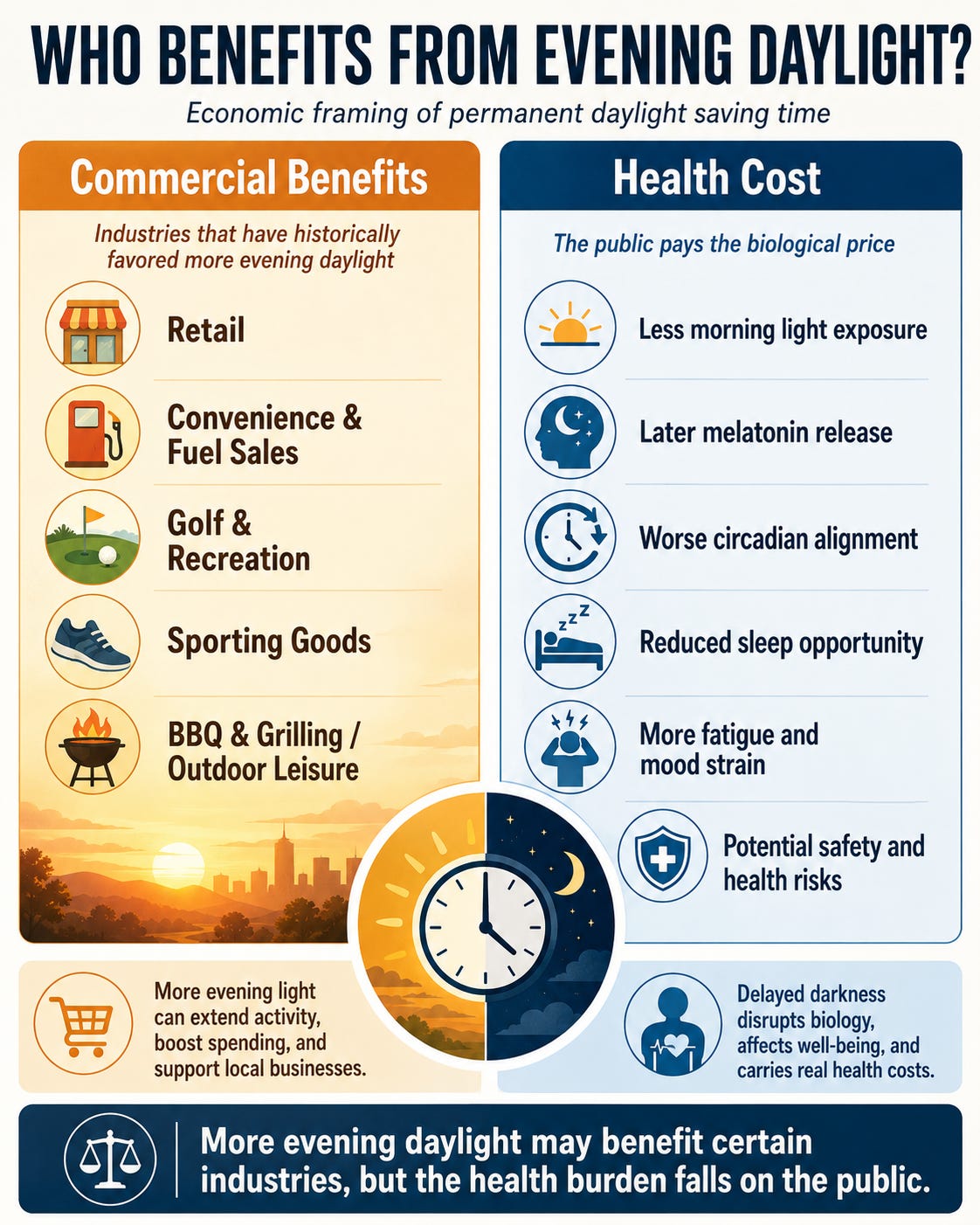
So here is the trade the bill offers you. Give up your morning sun, the one input your body cannot function without, so the evening economy gets a boost. Your heart, your sleep, and your metabolism cover the cost. The register rings.
That is not sunshine protection. That is sunshine relocation, moved to the hour that sells the most stuff.
You do not control the Senate. You control your light. Here is how to defend your morning anchor even if permanent daylight saving time becomes law.
Get outside within 30 to 60 minutes of waking. No sunglasses. No window glass in the way. Even on a gray day, outdoor light is many times brighter than your kitchen. Aim for 5 to 10 minutes on a bright morning, 15 to 20 on an overcast one.
Wake at the same time every day. Weekends included. A steady wake time is the second half of the anchor. This alone shrinks your social jetlag.
If your winter sunrise comes late, bridge the gap. Use a bright light source or a red light panel to start your day, then get real sun the moment it is available. My free Sun Prep timing tool at RedLightTimer.com helps you sequence panel time before sun exposure.
Kill the evening light. Dim the house after sunset. Cut screens or switch them to warm, low settings. Candles or a red bulb in your main rooms tell your body that night has come. I keep a red bulb in every main room for exactly this.
Anchor your meals to the sun, not the clock on the wall. Eat your biggest meal earlier in the day. Stop eating well before bed. Late food is another signal that drags your clock off track.
Protect the dark. Blackout the bedroom. Your overnight repair crews need true darkness to run.
“I get morning light and still feel wrecked.” Check your evening. Bright light after dark can cancel out a good morning. Fix the night first.
“I cannot get outside before work in winter.” Use bright indoor light or a panel as a bridge, then step outside at your first real chance, even at lunch. Some morning anchor beats none.
“How do I know if I am misaligned?” Ask yourself: Do you feel wired at night and dead in the morning? Do weekends look completely different from weekdays? Do you dread dark commutes? Those are social jetlag flags.
“Does one hour really matter?” The spring forward data says yes. A single hour of mismatch moves heart attack and crash numbers across whole populations. Your body is more sensitive to this than you think.
The congressman who played “Here Comes the Sun” had it backwards. You cannot make the sun come sooner by voting. You can only decide whether your clock gets to meet it.
Permanent daylight saving time tells your body the sun is late all winter, then asks your heart and your sleep to absorb the difference so the evening economy can grow. Standard time does the humble thing. It keeps your clock close to the sky and lets your morning light land where your biology expects it.
The Senate has not voted yet. But whatever they decide, the sunrise is still the most powerful health tool you own, and it is free. Go meet it tomorrow. Your clock is waiting for the wind.
Sincerely your friendly neighborhood health nerd, Ryan

U.S. House of Representatives. H.R. 139, the Sunshine Protection Act. Passed 308 to 117, July 14, 2026.
Rishi MA, Cheng JY, Strang AR, et al. Permanent standard time is the optimal choice for health and safety: an American Academy of Sleep Medicine position statement. J Clin Sleep Med. 2024. DOI 10.5664/jcsm.10898.
Janszky I, Ljung R. Shifts to and from daylight saving time and incidence of myocardial infarction. N Engl J Med. 2008;359(18):1966-1968. DOI 10.1056/NEJMc0807104.
Manfredini R, et al. Daylight Saving Time and Acute Myocardial Infarction: A Meta-Analysis. J Clin Med. 2019. PMC6463000.
Rishi MA, et al. (review) Acute Myocardial Infarction and Daylight Saving Time Transitions: Is There a Risk? Clocks & Sleep. 2021. PMC8628759.
Caliandro R, et al. Social Jetlag and Related Risks for Human Health: A Timely Review. Nutrients. 2021;13(12):4543.
Yamamoto et al. Relationship between Circadian Phase Delay without Morning Light and Phase Advance by Bright Light Exposure the Following Morning. Photonics. 2023;5(4):41. MDPI.
Kotchen MJ, Grant LE. Does Daylight Saving Time Save Energy? Evidence from a Natural Experiment in Indiana.
Meta-analysis of DST transitions and heart attack risk. Dtsch Arztebl Int. 2024. PMC11526362.
No posts
Comments
Nothing yet. Say the first thing.
Sign in to join the conversation.