
Wherever humans are gathered and with great seriousness try to think through the predicament of being human, wisdom emerges. -Teju Cole
David Woods, Professor of Cognitive Systems Engineering at Ohio State, has spent forty years studying the safety of complex systems. His key insight: systems fail when they get stuck, when they fail to reframe and revitalize.
His Theory of Graceful Extensibility reveals that adaptive systems—whether that is a human body, a civilization, a planetary ecosystem—must change themselves to meet changing challenges, and that they must move smoothly from the system's current state. Complex systems fail when they cannot reframe.
It would be hard not to read these lessons into the classroom of this moment. Except I'm not much for 'especially now' talk, and it is precisely the terrible timelessness of these ideas that lead me to this essay. We live in a moment in which our relationality, who we are with and for each other, is a crisis discipline, and the particular tenor of conditions in the United States (where I happen to have been born and live) have incited omni-directional calls towards community. These calls have been covered the spectrum: inspirational to stultifying, substantive to superficial. We risk exhausting the word precisely at at time when we most need to understand and cultivate what it can mean; a crisis indeed.
So, I want to do two things here: first, to share how the Flourishing Salons community is thinking of reframing and revitalization in a changed and changing world; second, to offer that experience as meaningful guidance on how dialectic as reframing, collectives as the substance, and breathing and feedback as the dynamics can illuminate what flourishing means today.
The Flourishing Salons are human-scale interaction rooted in liberated thought, intellectual friendship, and the shared inquiry into flourishing. Each 90-minute conversation is both an interaction and an emergence, the long work of small threading into a larger tapestry that becomes visible when we pause to see the scale beyond ourselves.
Émile Durkheim described 'collective effervescence' as the sense of energy and harmony people feel when they come together in a group around a shared purpose. The Salons are a quiet resistance over and against the easy story that we are too busy for this kind of thinking, a ritual of being in each other’s company with attention and care. That is counter-cultural, and that matters.
But our forms of gathering must remain attune to the world, to the lives that they serve and participate in forming. We all need to respond in our ways of being with one another, about dynamics affecting who we are to and for each other and widening the possibility space in which we can act. An idea that has influenced me a great deal over the past five years is the 'adjacent possible': The places we can reach from where we currently are and what we currently know and can imagine. Again reading it into the theater of 2025, the adjacent possible could mean for the Salons (and our reasons for gathering across the spectrum) what worlds we might be able to reach from our present configuration of society. The measure of these gatherings, which has always meant the community they represent and support, may be how they affect the adjacent possible, altering the shape, texture, and risk of the possible.

The most exciting movement in nature is not progress, advance, but expansion and contradiction, the opening and shutting of the eye, the hand, the heart, the mind. We throw our arms wide with a gesture of religion to the universe; we close them around a person. We explore and adventure for a while and then we draw in to consolidate our gains. The breathless swing is between subject matter and form -Robert Frost
We are lives, to and for each other, and lives flourish or languish. Flourishing is about life, but not exclusively for ourselves. We live in ecologies of interdependence. Simone de Beauvoir wrote to will oneself free is also to will others free; one's freedom can be achieved only through the freedom of others.
...the vision of life lived outside of triumph or defeat, in continual triumph and defeat, in the present, alive. -Muriel Rukeyser
I feel at once a rush, an urgency, and a stillness. In every conversation there is both an imperative (oughts and shoulds) and a sort of muscular silence (not an absence, but a presence; not a lack of movement, but movement on unknown planes). It is a consciousness both for what is jolting us awake and for qarrtsiluni—an Inupiaq word meaning 'sitting together in darkness waiting for something to happen,' that is to think: what are we in the anteroom for now? There is a quality of attention to both that is revelatory of what our work is to do now.
At the root of this is dialectic—a rich and freighted notion, to be sure—but for our purposes is nothing more nor less than a putting together of two things thought to be opposite, in contradiction, irresolvable. Dialectic is the practice of reframing, one that keeps systems alive, vital.

The light in Vermeer's masterpiece demarcates a boundary. On one side is light and the other shadow. How easy it is to fall into discourse about the light vs. the dark, to draw all meaning into the painting by what is illuminated and what is not. Yet the full extent of what can be apprehended in the work is only revealed when attention is given to the line itself. A space opens there, something of substance and width rather than a mere line.
To realize there is a world in your line is a life-shaking experience, and in the vibration how much emanates into the possible and the considerable, the thinkable and the thought. Dialectic is the art of drawing attention to the between, opening interaction where boundaries once seemed fixed. It reminds us that the essential question is not "what" but "when," and with that comes the realization that our beliefs and positions are dynamic.
Dialectic is a support for resisting the tendency for our beliefs to harden, a social and political pull. If we think of ideology as a very fixed doctrine that is quite absolutist and very resistant to evidence, dialectic is the resistance to the hardening of ideology. There are cognitive dynamics and poetics of dialectic that are somehow an antidote to that troubling and troublesome hardening of mind and belief. Ideologies become stuck systems, unable to reframe or revitalize, unable to adapt to changing conditions. Dialectic keeps systems alive.
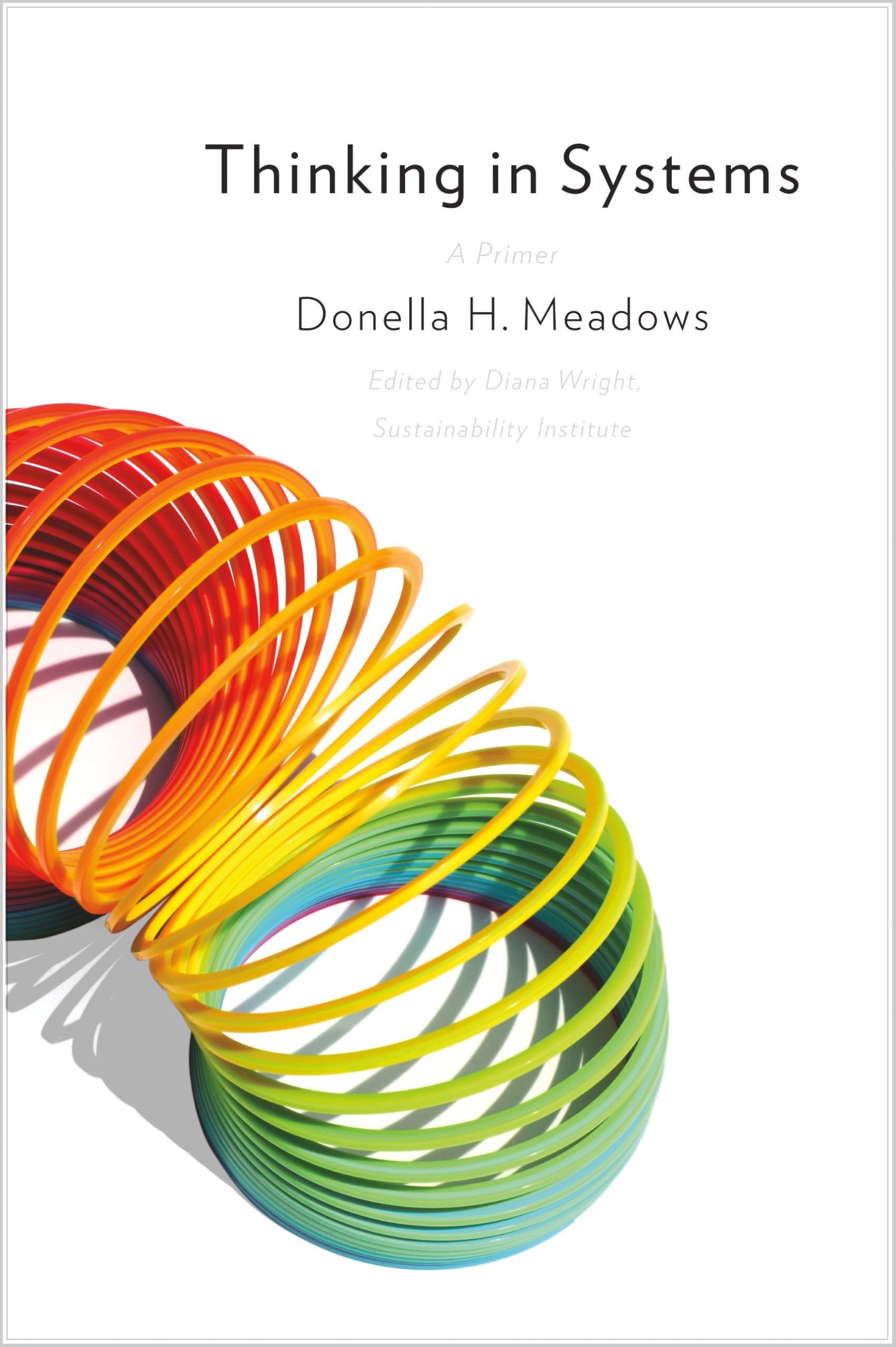
Donella Meadows taught that the basic operating unit of a system is the feedback loop. So elemental is the concept that systems thinkers understand the world as a collection of feedback processes. Discovering the notion of feedbacks is a momentous event in a person's life and I'm always delighted to be present to it.
So it is with bewilderment that I read and interact with so many 'theories of change' that make no mention of feedback. In order for change to occur and remain, one must alter the feedbacks, must create dynamics. If I think about the problem that The Flourishing Salons are trying to solve—that of creating a self-organizing, flourishing community that is active socially and academically; is supportive of flourishing individuals and network-forming of flourishing collectives—their theory of change is based on nourishing feedback loops. How do we create these feedbacks, ones that overcome the single-minded narratives of brokenness that permeate and persecute our cultures?
We seem to have been disempowered from making a difference. Buddhist philosophy is clear that compassion is defined in two parts: feeling with the suffering of the other and the intent to act to alleviate the deep causes of suffering. To lose the action part is to change it entirely. It is counter-cultural to suggest that what we tell people become positive and nourishing. Somehow we allowed the perception to take hold that the loudest voices and the most outraged—however inactive, complacent, and complicit—to be thought of as the most knowledgeable and engaged. As if if you yelled louder, you must care and you must know. Yet, it is this nourishing feedback that forms a flourishing system, and it is the nature and kinds of this feedback we must be interested in.
For all that has been and is made of the 'digital transformation,' there remains an almost indisputable difference between virtual and in-person gathering. The beginning of 2023 was an unspoken turning point, thereafter the willingness or even expectation of virtual gathering that thrived out of necessity in the height of the pandemic years collapsed, and with it the virtually-maintained rich webs of social connection, and the norms of trust and reciprocity that arise from them. I feel the same hunger: the nuance and inefficiency and happenstance that more naturally arises from being in a room physically with others, generously and generatively. Until December 2024, five years of The Flourishing Salons had never had an in-person gathering.
We are called to move out into the world now, exploring the space between virtual and physical gatherings with humility and openness to discover new literacies of connection1.
We need to reframe the notion of community.
The term community has been overworked and overcharged, so commonplace it has lost its vitality and affect. Sometimes new language can complicate a concept long enough that new thinking can surround and suffuse it.
To revive its meaning, we can turn to the idea of collectives.
A collective is not just a group, but a group that reflexively stewards an idea for a time in a way that generates new intelligence, capacity, and meaning. There are numerous elements and it is worth briefly commenting further on each:
'group': collection, somehow interacting
'reflexively': in conversation; self-referentiality and a conversation among
'stewards': active, ongoing
'idea': capaciously conceived, an orientation (acknowledges the centrality of the idea; displaces the individual from the center)
'for a time': transient and ongoing
'in a way that generates new intelligence/capacity/meaning': a strong bridge to what we are learning from the field of complexity science, and what is perhaps a burgeoning sub-discipline of 'collective intelligence,' for how we organize and govern ourselves and relate to one another.
What I want to do with introducing collectives as new language is support the emergence of new wisdom (or rather re-members wisdom long held) to the notion that we can act on in relating and being with one another.
These elements of a collective establish a connection with flourishing. Collectives are living systems that generate new capacities and meaning, emerging and reconfiguring with context. They resist the hardening of ideology and embrace the dynamics of feedback and reframing, aligning with flourishing as an ongoing and remarkably active process of seeking balance rather than a fixed state. Where ideology becomes insensitive to changing conditions, flourishing is attunement to feedbacks. Ideology sacrifices plurality, collapses of dialectic, loses conversation; flourishing reveres plurality, works through dialectic, is a conversation. Ideology becomes fixed, flourishing is ongoing.
Collective understands dialectic to be a key dynamic of flourishing. Collective draws in a frame for understanding flourishing from complex adaptive systems. Collective reveals community to be a creative act. Collective leads us to the essential insight that kindness is an intelligence of its own. Computer science philosopher Jaron Lanier writes that kindness requires genius, to be effectively kind is hard and takes difficult lessons. Collective requires nourishing feedback loops.
How do we live the insights of these dynamics?
The Flourishing Summits will be series of activities where we bring together a singular group, almost certain not to be otherwise brought into conversation and collaboration, to explore the notion of flourishing in science and society and to create research structures that substantiate the study of flourishing and social structures that allow wider participation in the conversation of flourishing. They will have two goals: to create a network of flourishing scientists and thinkers, and to author a book that outlines a new philosophy of flourishing and a corresponding research program which will establish the new field of Flourishing Studies.
Our first summit with the Aspen Institute in May 2025 explored conceptualizing and actualizing flourishing. Goethe was given the final word at the event, "Now that we are miraculously met, let us not lead trivial lives." This essay, as each Flourishing Salon, is an invitation to participate in the great conversation that is emerging across scale, across division, and across time about flourishing that emphasizes dialectical engagement, ongoingness, and the pursuit of "great questions."
Precisely at a moment like this, of vast aching open questions and very few answers we can agree on, our questions themselves become powerful tools for living and growing. -Krista Tippett
We need to conceptualize in order to measure and study and only then we can begin to think about tradeoffs in designing social and political systems responsive to a more robust conception of well-being. And we need to make this field of research real.
To build a field of Flourishing Studies, we will need a robust conception and a concomitant scientific research program.
Establishing a new fully recognized field of research and practice requires structural elements (both social and technical), including educational and training pathways, dedicated funding, supportive public sector and private sector policies, effective leadership, well-crafted communications strategies, and infrastructure capacity.
What we need now is evidence that makes Flourishing Studies real. This discipline, along with the research structures that will be required for them, will be developed in future essays. What we ought to do now is (collectively) author an ‘anthology’ of flourishing that establishes a framework for flourishing and substantiates it in the landmark studies.

We have partnered with Leonardo Journal (MIT Press) to open a Focus Section:
"Flourishing as Ongoingness and Collectivity in Form and Process: A Dialectical Encounter"
Leonardo Focus Section on Flourishing
Dedicated to exploring flourishing as a dynamic, relational process rooted in ecology, anthropology, and shared inquiry, we invite scholars, artists, scientists, philosophers, and cultural practitioners to contribute. In this Focus Section we ask how flourishing can be embedded into the very form and process of our work and lives (represented, felt, shared, and enacted). This will contribute to an anthology of flourishing.
Finally, the Origins Podcast has always been a site of my working out my thinking about flourishing in public, predominantly through the art of asking and drawing out. Origins remains a site for public reflection on flourishing, drawing out the complexity of guests’ lives with reverence and curiosity. Drawing out is the form of interacting that emerges from a recognition of and reverence for a dignity; our questions are our signals of what we hold to be dignified. Each episode is a reverencing of the guest, their life, an attempt to hold more of their complexity and to invite others to work on that art as well. Generous, generative asking is itself an act of flourishing. Season Eight is going on now, find them wherever you get your podcasts or go through the website.
The ability to ask beautiful questions—often in very un-beautiful moments—is one of the greatest disciplines of a human life. And a beautiful question starts to shape your identity as much by asking it as it does by having it answered. -David Whyte
A big point here is about not attempting to claim to be the only. Flourishing requires sturdy and broad coalitions—selfless connections, care, collective intelligence, and ongoing encounters with flourishing.
What we need are sturdy coalitions. And I think labor unions—when the labor movement was much larger, there was a way that people of different colors and classes got together. When you had a compulsory draft, people of different colors and classes got together in a natural way. Public schools have done this. But we’re down on those crossover, connective institutions. I think we need to build another one. - Arlie Hochschild
Anything worthwhile is worth holding in many hands. And we are seeking real, muscular coalitions now. We are called to be alongside, to be part of collectives precisely as we are cultivating a collective of our own. What we do now will be oriented toward creating belonging, solidarity, and, as always, encounters with flourishing; towards true collectives.
This coalition is a conversation that exists across space and time. Among those conversation is abundant guidance - live human signposts, as civil rights activist Vincent Harding said. At the bottom of this essay is a set of resources that we have found inspiration and nourishment in and a couple of notes to guide you with them.
Systems change is deeply personal—only through changing my own internal system can I develop the capacity, the understanding, the space, the compassion to be able to go out and affect change. -Christiana Figueres
Each salon, each essay, each conversation is an encounter with flourishing, an invitation to live into the dynamics of reframing, feedback, and collective life. Through these ongoing practices and experiences, we begin the work of systems change within and around us.
Facilitation, governance, conflict transformation
Pádraig Ó Tuama: poet, theologian, conflict mediator; endless wisdom
Karen Murphy and Facing History & Ourselves: a global non-profit organization that uses lessons of history to challenge teachers and their students to stand up to bigotry and hate.
Great asking and active listening
Strangers in Their Own Land by Arlie Hochschild
The Better Conversations Guide by The On Being Project
"Political Polarization, the Classroom, and the Future of Civil Discourse" lecture by John Rose: how to widen a group's Overton Window
Democracy May Not Exist, but We'll Miss It When It's Gone by Astra Taylor: A masterpiece of representing dialectic on the page and holding multiple truths together generatively. "As we shall see, for democracy to continue and transform, the two poles represented by the paradoxes explored in these pages must be held in thoughtful, delicate tension."
If you want to listen to the plans for the reframings of the salons, check out the April event.
No posts
Comments
Nothing yet. Say the first thing.
Sign in to join the conversation.