
When the 2025 Kent County Housing Needs Assessment came out last spring, one of the first things we had to explain to every reporter who called was that a shrinking gap is not the same as a closed gap. The headline was real. The projected shortfall between now and 2030 had narrowed by 2.3 percent. Permits were up. Rental vacancy in Grand Rapids had ticked up enough that a few Class C landlords were quietly offering concessions again. After a decade of one-way pressure, the arrow had begun, to move in a healthier direction for the community.
Then came the question we get from every reporter. For whom?
That’s the question this series is built around.
We’ve mostly gotten past the argument about whether building more housing helps. It absolutely does. The harder question — the one I get asked every time a housing study comes out — is who it actually reaches.
The 2025 Pew analysis is the cleanest statement of the supply case: “Building more housing—both throughout a metropolitan area and in a particular neighborhood—keeps rent growth lower overall, but it takes the most pressure off of older, less-expensive housing, essentially mitigating the competitive process”.
Evan Mast’s migration-chain research, which we’ve cited often, shows that a hundred new market-rate units at the top of the market free up roughly seventy units in below-median neighborhoods within five years.
In Austin, where developers actually built what the demand curves asked for, Class C rents — the rents most often paid by lower-income households — fell by more than eleven percent. Where supply shows up, rents soften. The evidence is really hard to argue with.
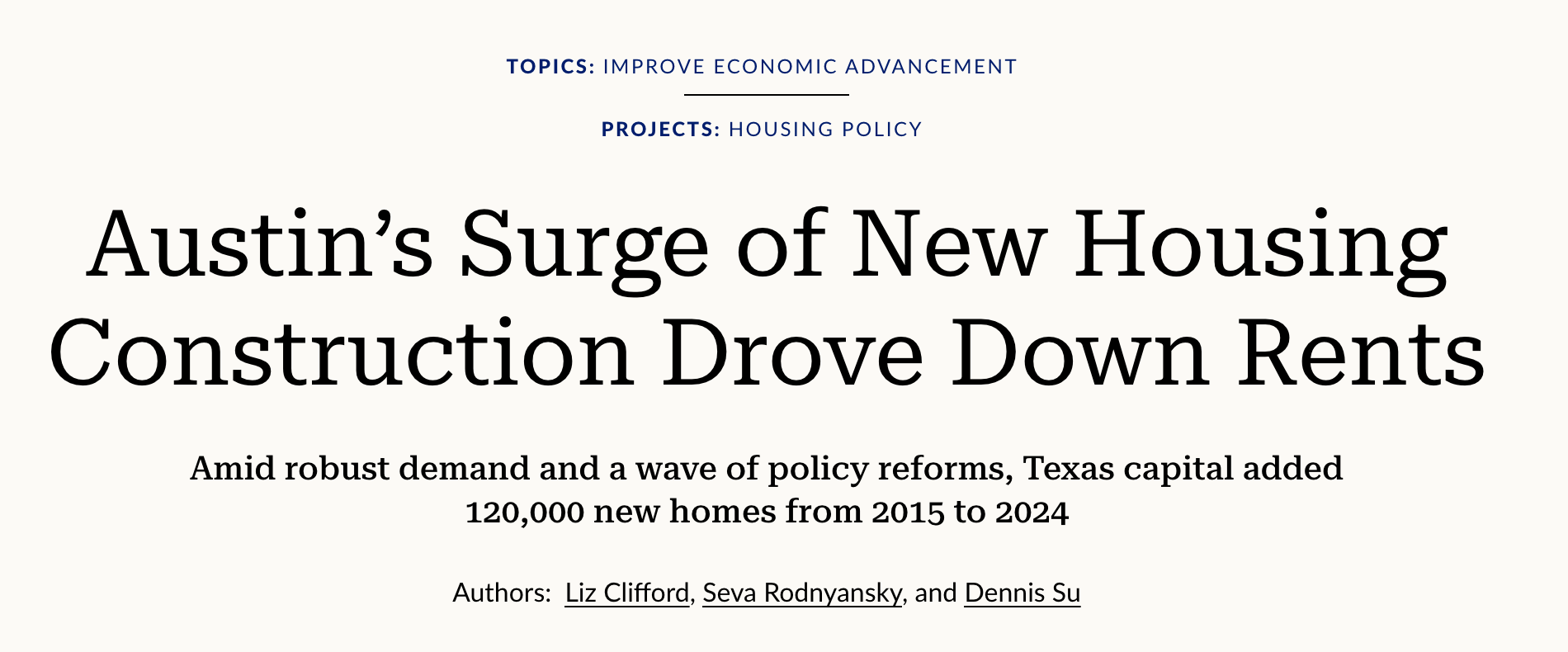
The evidence doesn’t say anything about whether that rent drop reached your neighbors. “Rents softened” and “my people can now afford a place” are two very different statements. If you’re sitting on a city council or running a nonprofit, that gap is where your actions and statements are most important.
Enough diversity and abundance of supply can work for everyone over time. But more supply isn’t enough on its own for the households that need the most help today.
To be abundantly clear on this point - If we are not creating enough supply for every household to have a decent option, then prices are going to continue to rise further and further out of reach. AND - creating more supply without paired subsidies does not meet the needs of our lowest income households.
If you fail to acknowledge that both of these things are true, your community will continue to serve only a fraction of the population with adequate housing.
The National Low Income Housing Coalition’s 2025 Gap report counted 7.1 million rental homes missing from the market for households at or below 30% AMI — in Kent County, that would be a family of four earning $26,500 or less. For every 100 of those households, there are only 35 homes they can actually afford and get into. Most are spending more than half their income on rent. Which means a car repair can quickly escalate to an eviction.
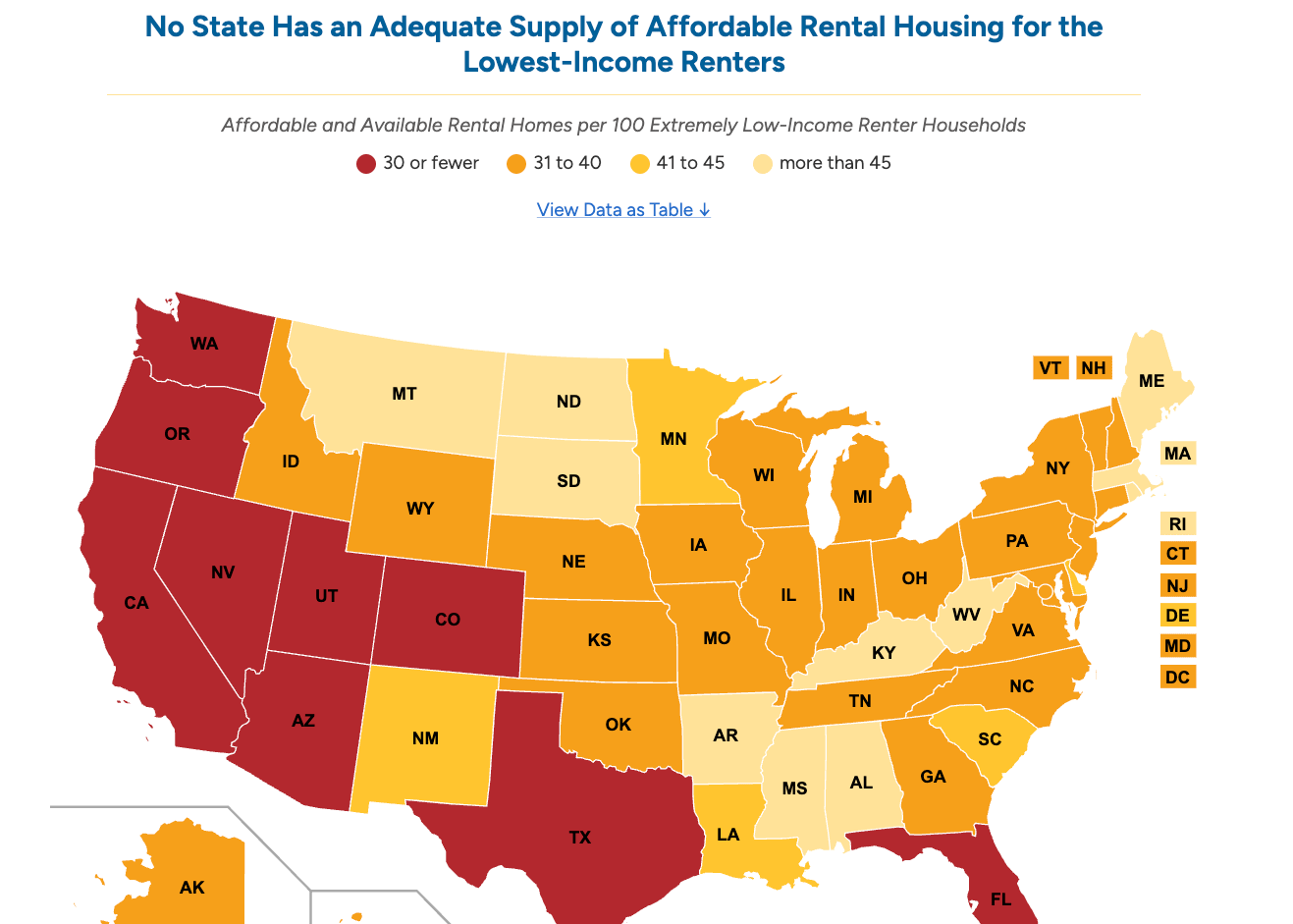
Compare this to Mast’s numbers. A hundred new market-rate units that seem very expensive today will quickly free up around seventy units below the median rent. That’s real — it’s why we keep pushing for more permits and broader zoning. But “quickly” means three to five years. And “below the median” doesn’t mean it’s affordable to the lowest income households.
Again - more housing supply is the simplest, most cost effective way to address the widespread pain of housing unaffordability. It’s just not a silver bullet for low income families who need help today. If your community is struggling to figure out what to do with limited resources, the simplest answer is to make building more options more quickly as easy as possible. Just know that this will only directly benefit middle-income households, and it will indirectly benefit low and moderate income households over the following years. Then, if the community does have some resources to support subsidies, those subsidies can be targeted primarily for very low income households.
There are a lot of folks in our communities who are earning enough money every month that it should be easy for them to find a house or apartment they can afford. Ten years ago, they could have. A registered nurse a couple of years out of school. An electrician. A young project manager at one of the medical device firms on the Medical Mile. They’re all earning $60,000 to $75,000 a year. They’re not poor. HUD calls them “workforce.” But they probably can’t afford to buy a starter home.
These households don’t need a housing voucher or a tax credit. They need a housing option the market hasn’t been allowed to build for forty years. They need a small home on a small lot. A townhouse. A two-bedroom condo or flat within walking distance of work or local amenities.
So, let’s just make sure we’re all on the same page…
We have one group of households that will accept just about any option as long as it costs them less than 40% of their monthly earnings. These families are not served by new supply alone. They need subsidies.
But these families are competing with higher income households for the scarce housing options that are available. Those higher income households would generally prefer something a little nicer, a little newer, and a little closer to the things they care about.
And if those newer options are few and far between, they’ll buy or rent the older and less expensive options — removing them from the grasp of those who need them most.
Different families, different constraints, different fixes. Yet all of it is interrelated.
The Low Income Housing Tax Credit program is another great example. A 9% tax credit deal can produce a sixty-unit apartment building where every unit is capped at rents that are affordable to households earning 60% of the median income or below (serving mostly households earning $35,000 to $55,000 per year). It’s a beautiful outcome. But it doesn’t house the nurse who earns $65,000 per year, and on its own it doesn’t house a single mom earning minimum wage either — that family needs a voucher or a project-based subsidy layered on top of the tax credits.
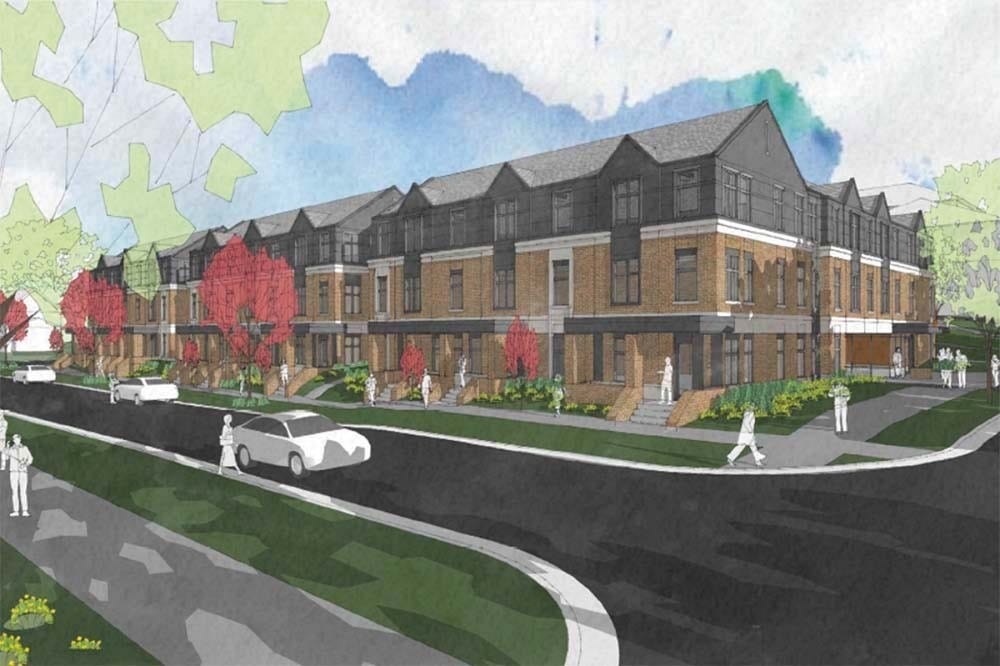
Image credit: 9% LIHTC development designed by Integrated Architecture
Most communities could still use a whole lot more housing like this. It’s just not enough. It’s a single arrow in the quiver.
Now let’s use zoning reform as another example. Allowing duplexes and cottage courts on lots that used to permit only large single-family homes will, over time, put a lot of workforce units on the ground and, through filtering, ease pressure a few rungs down the market. What it won’t do this year is place a family of four in a home they can afford on $20 an hour.
Each tool fits some households. None of them fits every household. A local official’s job — and their staff — is to know the landscape of resources well enough to use the right tool at the right time and for the right household type. Defending a favorite isn’t a housing policy.
That’s what the rest of this series is for.
The next post digs into workforce housing — the 80–120% AMI tier where zoning reform and modest gap financing do most of the heavy lifting, and where local employers have the most at stake.
After that, we’ll explore the missing middle and the starter-home gap, which is where the long-run supply story actually plays out (mostly by removing prohibitions, not by layering subsidy).
The last post will take the hardest tier seriously: extremely low-income households, where no amount of private production balances the math without public investment. The honest question we have to ask is not whether to subsidize. It’s how deep to go, and where the funding will come from.
The Kent County study narrowed its projected gap by 2.3 percent. Real progress, earned by a lot of quiet permitting and zoning and bridge-financing work on real projects. But the 2.3 percent didn’t fall evenly. Some households felt their rents ease. Some didn’t. The ones who didn’t are still our neighbors.
We can’t afford to continue having arguments about whether to build more housing supply or to provide more financial subsidy to those who need it most. The answer is yes to both. But we have to get better at talking about which households we’re trying to prioritize with which tools, and learn how to use all of the tools effectively at-scale. That’s the work.
No posts
Comments
Nothing yet. Say the first thing.
Sign in to join the conversation.