
There’s a question that comes up in every community conversation about housing, and it almost always lands the same way.
“Where would we put it?”
When the discussion turns to building more homes — more affordable homes, more workforce homes, more of the missing middle housing that young families and aging seniors both desperately need — that question tends to stop the room. People look at each other. Someone mentions a parcel on the edge of town. Someone else says that land is too expensive. A third person suggests the old factory site, and a fourth reminds the room it’s contaminated.
The conversation circles. And eventually, most groups arrive at the same conclusion: we want more housing, but we’re not sure there’s anywhere to put it.
When our team is in the room, we do a pretty good job of challenges underlying assumptions and supporting groups through the process of identifying far more opportunities than they ever thought could be realistic. But we’re only able to take on a small handful of clients at a time, and this same issue repeats itself everywhere we go. So, we made a map.
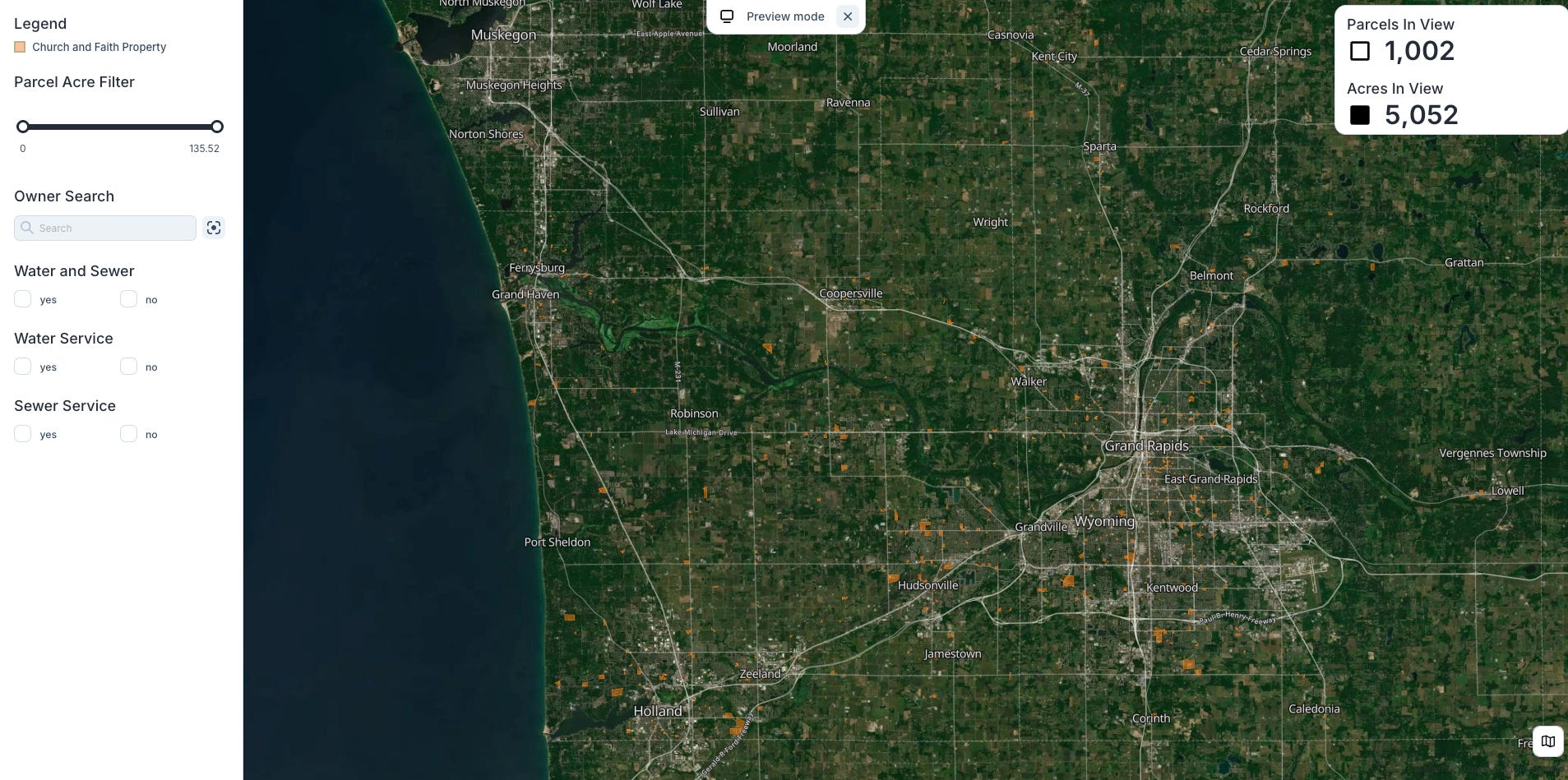
This is a basic mapping tool for West Michigan. The goal was simple: identify tax-exempt properties — particularly those owned by faith communities — and understand their distribution, size, and relationship to existing infrastructure.
What we found was striking.
Across the region, there are more than 1,000 properties owned by churches, synagogues, mosques, and other faith-based organizations. Together, they encompass more than 5,000 acres of land — much of it well-located, well-served by existing water and sewer, and sitting at the edges of established neighborhoods where new housing could integrate naturally rather than disrupt.
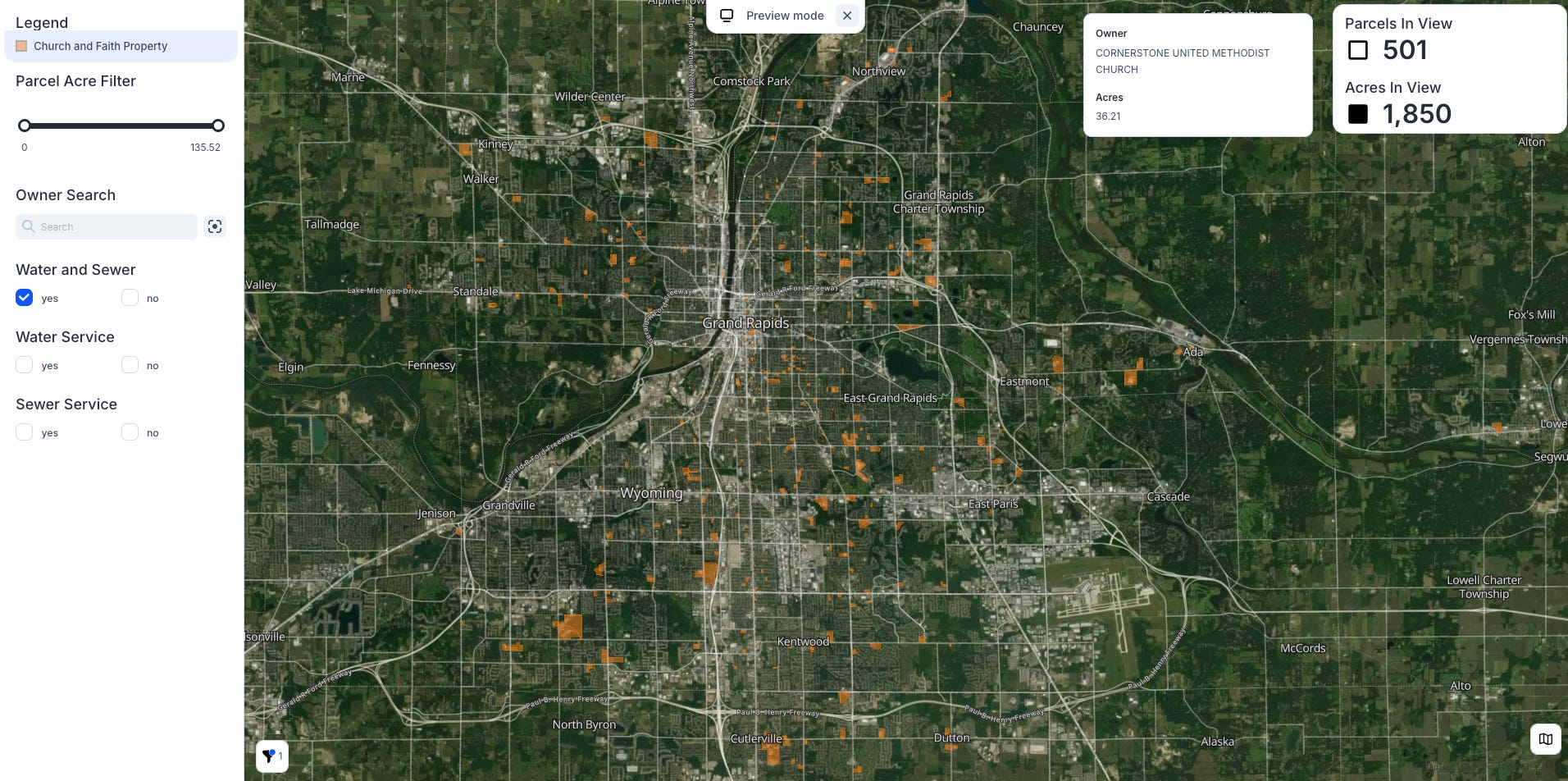
This is a tighter view that illustrates only properties with direct access to municipal sewer and water service in part of the region (1,850 acres in this image).
This is not unusual. Religious institutions have always been anchors of community life, and historically, that meant owning land — lots of it. What has changed is the math. Attendance at congregations across every tradition has declined. Buildings that once served overflowing Sunday schools now sit empty through the week. Parking lots sized for a congregation of five hundred host a congregation of a hundred and fifty.
The land remains. The mission remains. What’s shifting — slowly, but genuinely — is the question those institutions are asking about the relationship between the two.
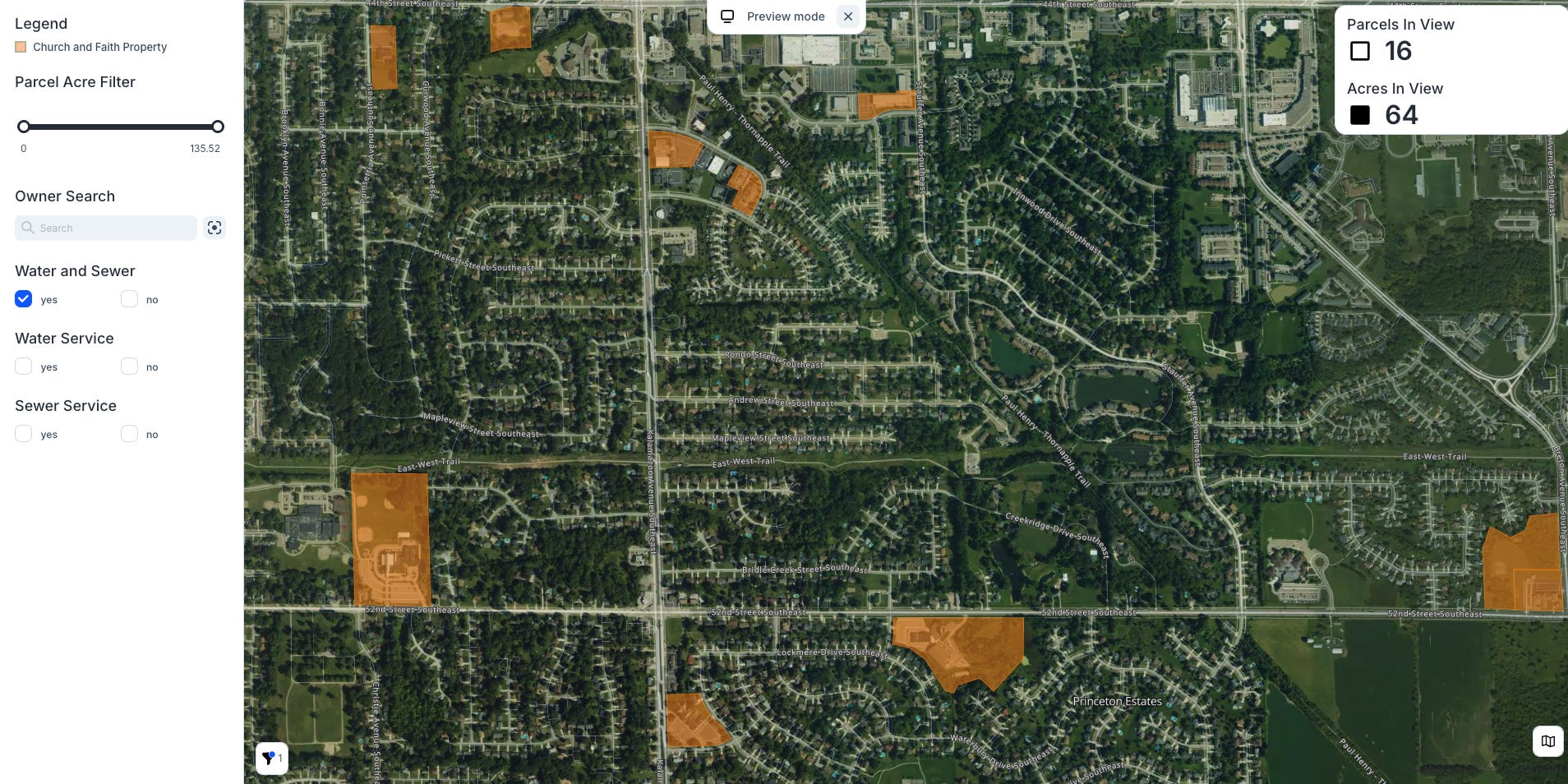
This is the neighborhood where I grew up. 64 acres of church-owned land in less than a square mile.
Here’s the thought experiment I keep returning to:
What if just 10% of those faith communities chose to use a portion of their land to support housing?
Not all of it. Not even most of it. A corner of an oversized parking lot. A vacant lot adjacent to the sanctuary. A wing of an underutilized building converted to transitional housing or affordable apartments.
Ten percent of 1,000 properties is 100 sites. A hundred sites, thoughtfully developed, could house thousands of families. And because these sites are scattered across the region — anchored in neighborhoods, connected to community, already carrying the goodwill of institutions that have served those places for decades — the housing they generate would be exactly the kind communities say they want: distributed, human-scaled, rooted.
The land isn’t the obstacle. It’s already there.
Of course, a map is not a development plan. And identifying 5,000 acres of potential is very different from unlocking even a fraction of it.
What actually moves faith communities toward action isn’t data — it’s discernment. It’s the slow, sometimes difficult institutional work of asking whether a congregation’s relationship to its property is aligned with its stated values. It’s the conversation between a board of trustees and a pastor about whether stewardship of land means preserving it exactly as-is, or whether it means putting it to work for the community you’ve pledged to serve.
Those conversations are hard. They involve real estate realities, denominational governance structures, financing complexity, and neighborhood relationships. They also involve something more tender: a congregation’s sense of its own identity, its history, and its future.
That’s why we’ve developed a Faith-Based Discernment Guide (Sacred Ground, Shared Purpose) specifically for church leaders navigating this process. The guide walks leadership teams through the key questions: What is your community’s mission, and how does this property serve it? What are the realistic development options given your site’s size, zoning, and location? Who are the right partners — developers, nonprofits, housing authorities — and how do you evaluate them? What does a faithful “yes” look like, and what does a wise “not yet” look like?
The goal isn’t to pressure congregations toward a particular outcome. It’s to give leaders the framework to make a genuinely informed decision — one they can stand behind, explain to their congregation, and implement with confidence.
We’ve written before about corridor strategy as a politically durable path to housing growth — concentrating development along underutilized commercial corridors where infrastructure already exists and neighborhood opposition is lower. Faith-based land is a natural complement to that approach.
Many of the region’s largest church campuses sit precisely at the intersections of those corridors: on arterial roads, at the edges of residential neighborhoods, in locations where modest density feels contextual rather than jarring. They already have the setbacks, the parking, and in many cases the organizational relationships to be good partners in community-scale development.
What they often lack is a roadmap. That’s what we’re trying to provide.
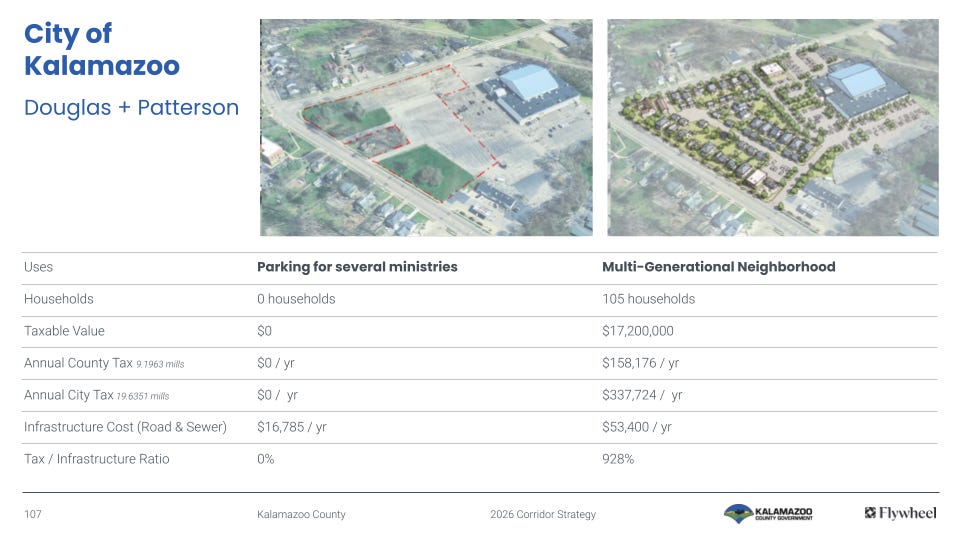
This is an excerpt from a recent report we completed for the City and County of Kalamazoo. Their local team’s identified several properties that were well served by infrastructure where new neighborhoods could be created, or existing neighborhoods could be enhanced. As you can see from the table below the images, these opportunities not only generate abundant housing, but also create much more local revenue to fund services and infrastructure.
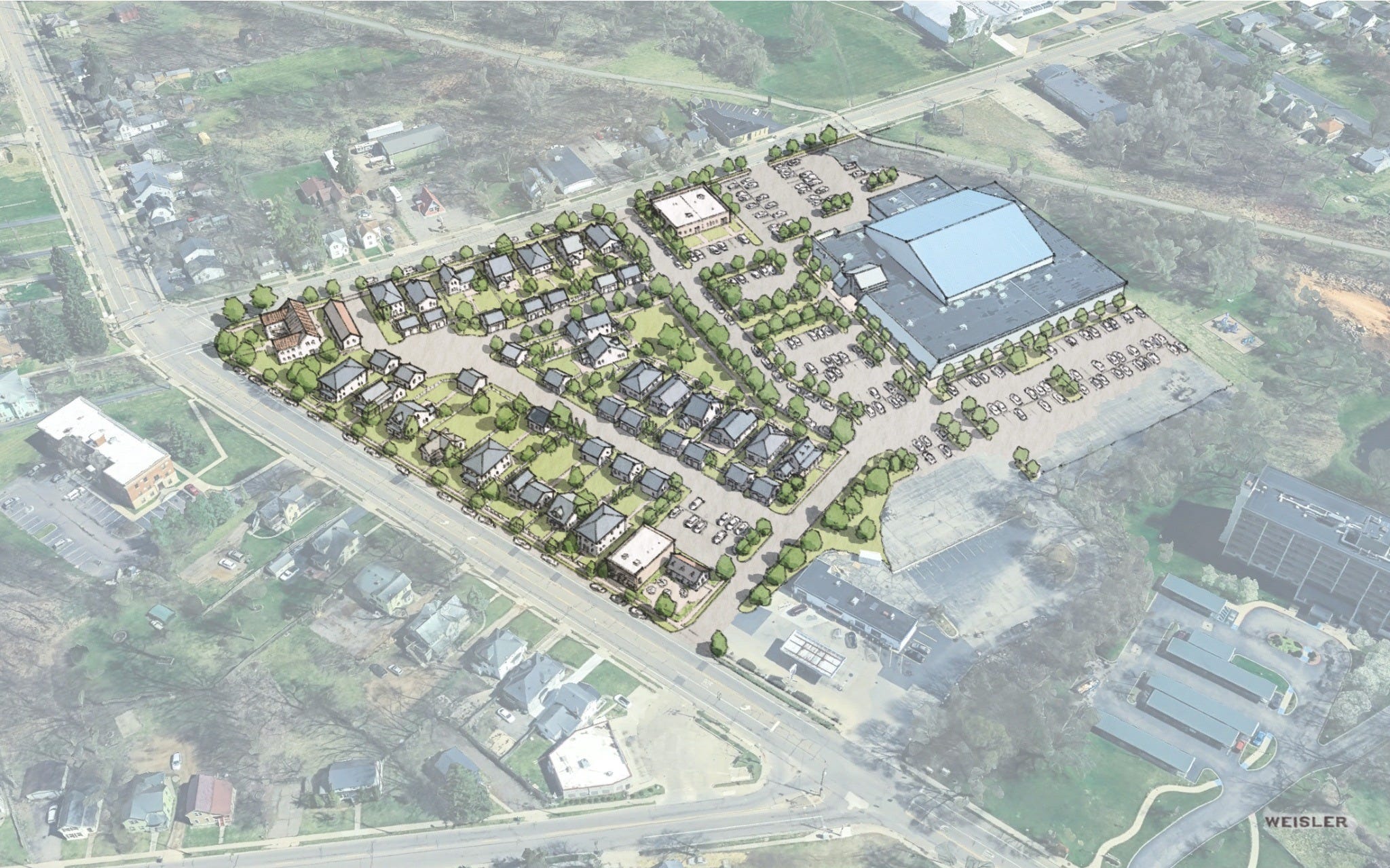
Illustration by Sam Weisler.
Here’s the thing about the housing shortage that doesn’t get said often enough: it is not, primarily, a land problem.
Most communities — including ours — have abundant opportunity to build the housing they need. The land exists. The infrastructure exists. The demand certainly exists.
What’s harder to come by is the combination of three things: a vision for what’s possible, a plan specific enough to act on, and someone dedicated to seeing both through.
Faith communities have always understood this dynamic. They know that building something lasting — a congregation, a school, a community institution — requires sustained commitment over time, through seasons of enthusiasm and seasons of doubt. The work of housing development isn’t so different.
The map shows us the opportunity. The discernment guide helps communities decide whether to step into it. The harder work — and the more rewarding work — is what comes next: the partnerships built, the plans drawn, the ground broken, the families housed.
It starts with believing the land is already there and that land could be serving a higher purpose.
Want to explore the mapping tool or request a copy of the Faith-Based Discernment Guide for your community or congregation? [Reach out to the Flywheel Momentum team - hello@flywheelmomentum.com] We’d love to talk.
Thanks for reading Momentum to Build Community! This post is public so feel free to share it.
No posts
Comments
Nothing yet. Say the first thing.
Sign in to join the conversation.