
Every year, the Sun expels over 40,000,000,000,000 metric tons of plasma out into the solar system. Most of this plasma travels in the form of the solar wind, a constant stream of particles emanating outwards from the Sun’s atmosphere. Around 10% of this mass loss (although the exact number varies year to year), comes from a more violent process – the eruption of mountain-sized masses of plasma called coronal mass ejections (CMEs). Losing 40,000,000,000,000 metric tons a year certainly seems like a lot (and it is), but is several times less than the mass lost inside the Sun’s core; as the Sun’s nuclear engine continuously converts hydrogen into helium to power the Sun, losing mass in the process. Across the Sun’s lifetime to date, the solar wind, coronal mass ejections and nuclear fusion have caused only a 0.1% drop from the Sun’s original mass (equivalent to around 500 Earths).
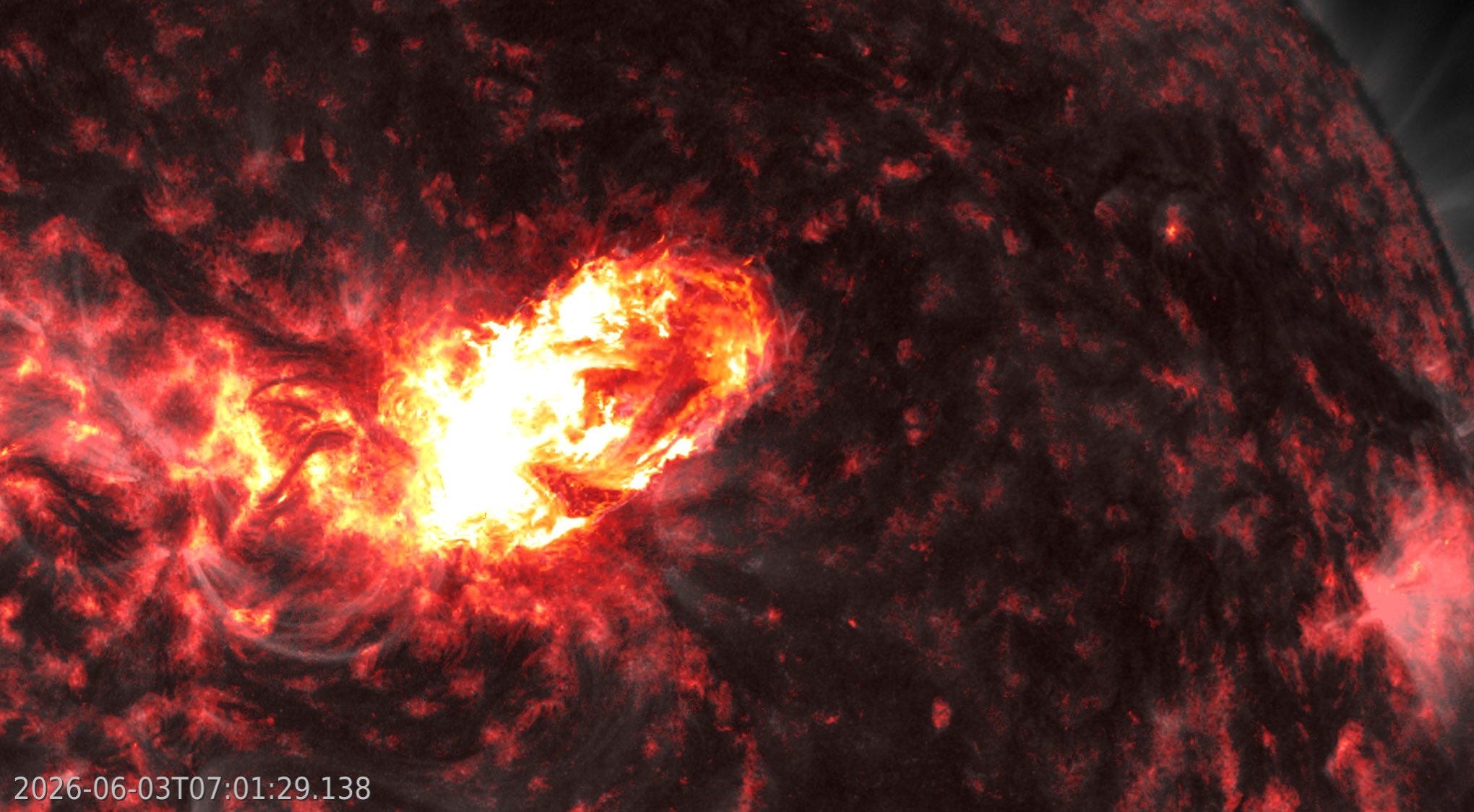
After a quiet few weeks on the Sun, solar activity picked up at the start of June. The Sun produced two X-class solar flares (the largest category), alongside many moderate-sized flares too. Solar flares themselves are just the emission of light and heat, but in many cases also trigger the eruption of coronal mass ejections (CMEs). It are these CMEs, when heading towards Earth, that can produce enhanced aurora and possible technological disruptions (in the largest cases). What made early June’s events particularly interesting, is that they occurred whilst close to the Sun’s centre – pointing right at Earth!
Although many of the solar flares occurring throughout this period did not trigger any CME eruptions, three of the larger solar flares did – three CMEs were heading towards Earth… or were they?
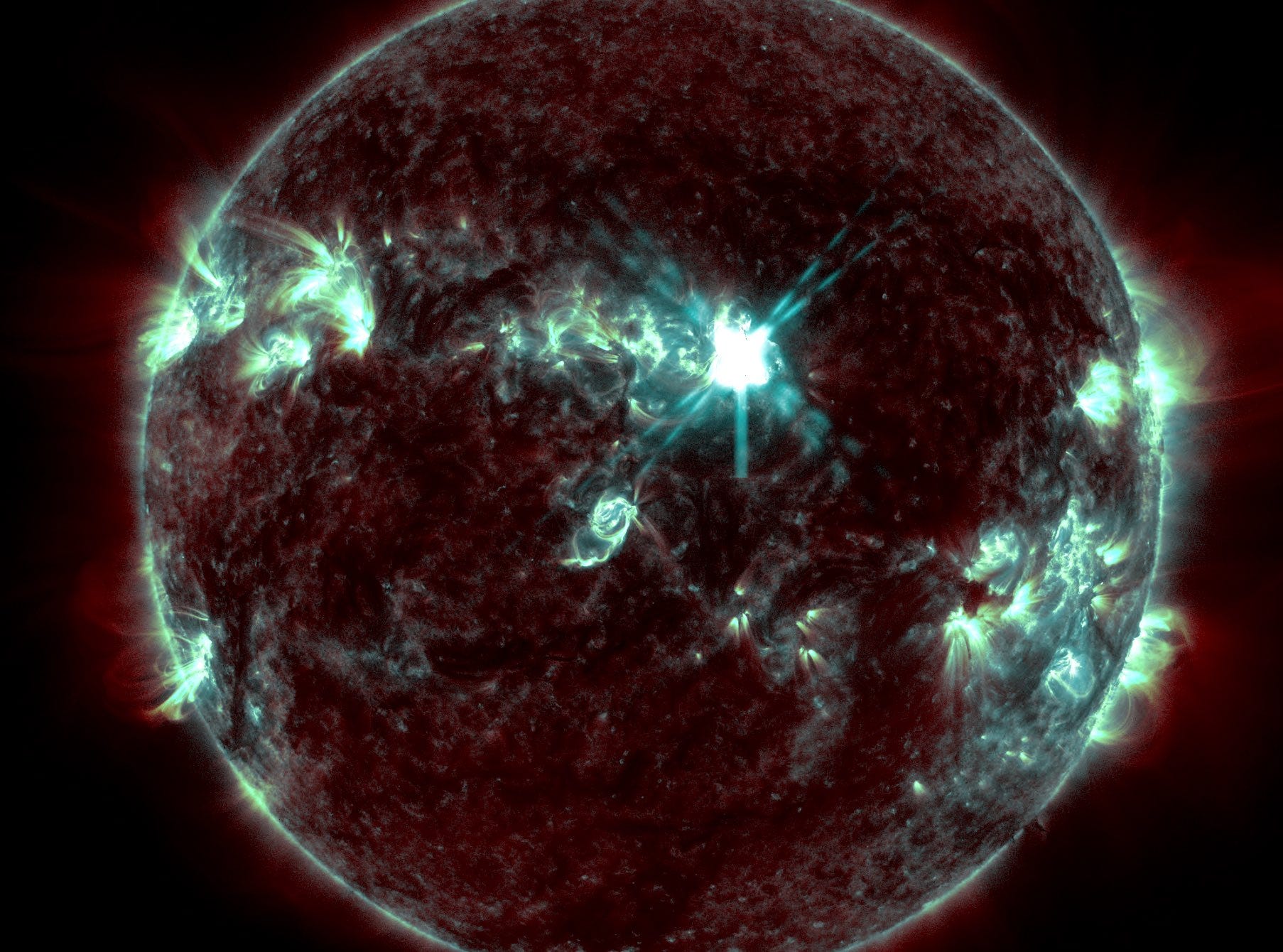
Following the series of eruptions from the Sun, the National Oceanic and Atmospheric Administration’s Space Weather Prediction Center issued a prediction for a strong (G3 level) geomagnetic storm (on a scale of G1-G5). Geomagnetic storms happen as CMEs slam into Earth’s magnetic field, causing it to wobble. This process introduces high energy particles into Earth’s magnetic environment, which spiral down towards the atmosphere where they collide with the air above us – causing the aurora (northern & southern lights) as air molecules start to glow. A G3 geomagnetic storm would be a decently-sized event, bringing enhanced aurora to millions at mid-latitudes.
However… the predicted geomagnetic storm never came. To make matters worse, neither did a second strong geomagnetic storm expected to arrive a few days later. So what happened?
Predicting when Earth-directed CMEs will arrive at Earth is very challenging. As we learnt with the recent multiple missed CMEs that were expected to hit Earth, there are large uncertainties involved. These errors are not a result of us misunderstanding the Sun, but comes down to a lack of data… bear with me!
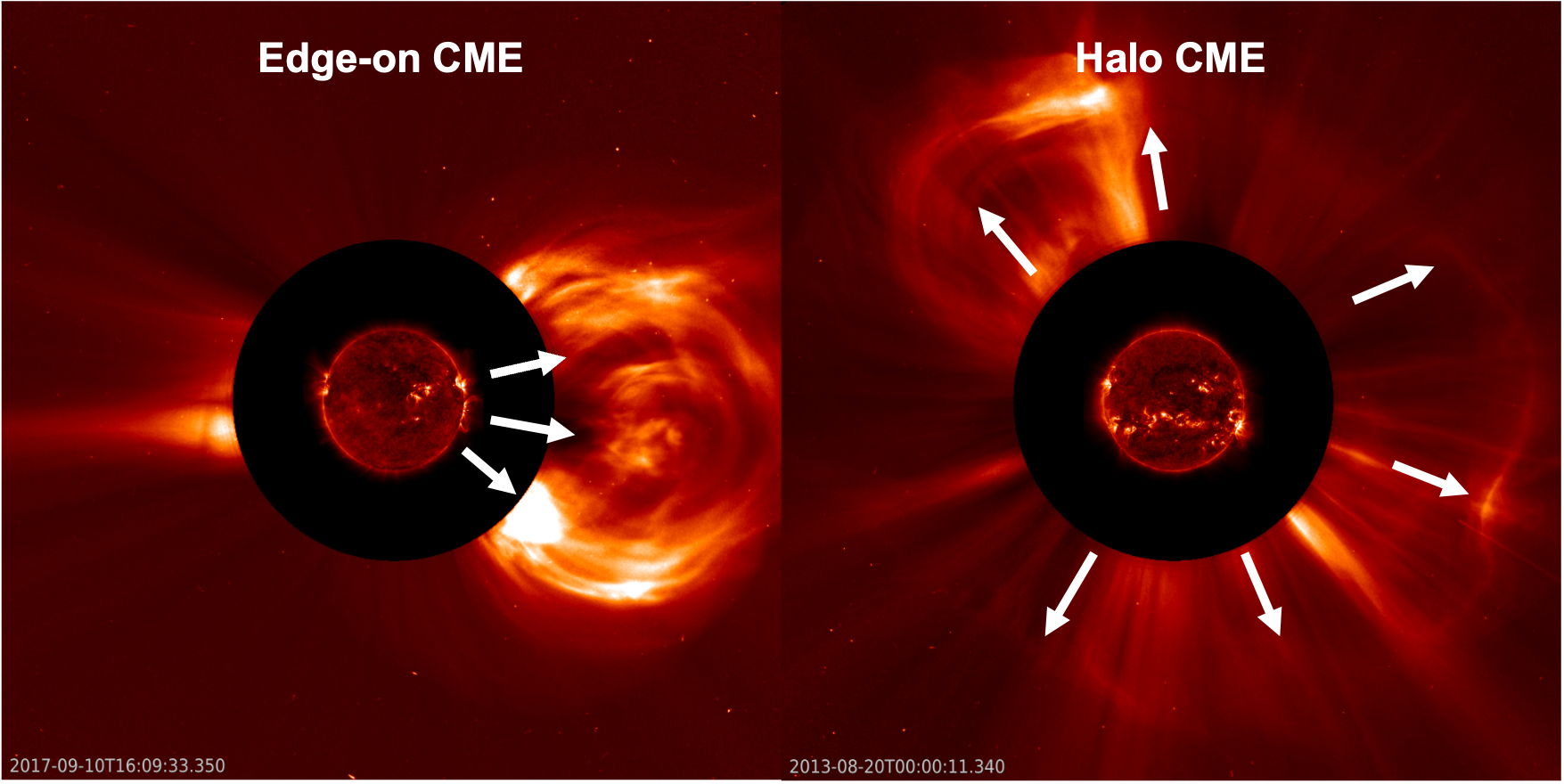
If we are staring at the Sun as a CME lifts off, our exact view depends on the relative angle between us and the eruption. In the example where a CME erupts from the edge of the Sun, we receive a clear view of the large plasma structure erupting into space. This would be an edge-on or limb CME, with a historic example shown in the left frame of the above image. For events like this, the plane-of-sky positioning of the CME makes it easy to measure its speed and track its direction.
However, for CMEs heading towards Earth, its a different story. Instead of seeing a nice neat CME structure, we instead see a halo around the Sun, as the CME heads towards us (right panel of the image above). These events are aptly named halo CMEs – and look near identical for CMEs heading both directly towards or directly away from us. Because most of our permanently-positioned assets in space observe the Sun from the Sun-Earth line, halo CMEs offer little to go off on when attempting to predict their exact speed or position. Instead of a neatly travelling structure of plasma, we just see as expanding ring around the Sun.
This observational limitation is the primary challenge when predicting the impact time and speed of CMEs at Earth. Our computer simulations that predict these events utilize strong physical understandings, yet the data available to us to plug into these simulations are limited (much of the time) to a single data view angle. An analogy to this would be to try predict weather on the ground with data from a single weather balloon (instead of using the vast array of weather stations and satellites currently available to us). This is what happened with June’s incorrect forecasts – we simply lacked the data to make a more accurate prediction.
In 2031, the European Space Agency is planning the launch of the Vigil satellite, a series of telescopes that will be offset from the Sun-Earth line by 60˚. Later that decade, the Korea AeroSpace Administration is planning a similarly placed mission on the opposite side of the Sun. Together, these multiple vantage points of the Sun will significantly improve our ability to accurately predict the arrival and impact consequences of Earth-directed CMEs from the Sun!
Even if CMEs arrive as predicted, there is another factor involved in making it tricky to predict their impact strength upon arrival – the magnetic orientation of the CME. This is a complex enough topic to warrant its own post, so subscribe to hear about this (and other Sun-related topics) in the future!
No posts
Comments
Nothing yet. Say the first thing.
Sign in to join the conversation.