
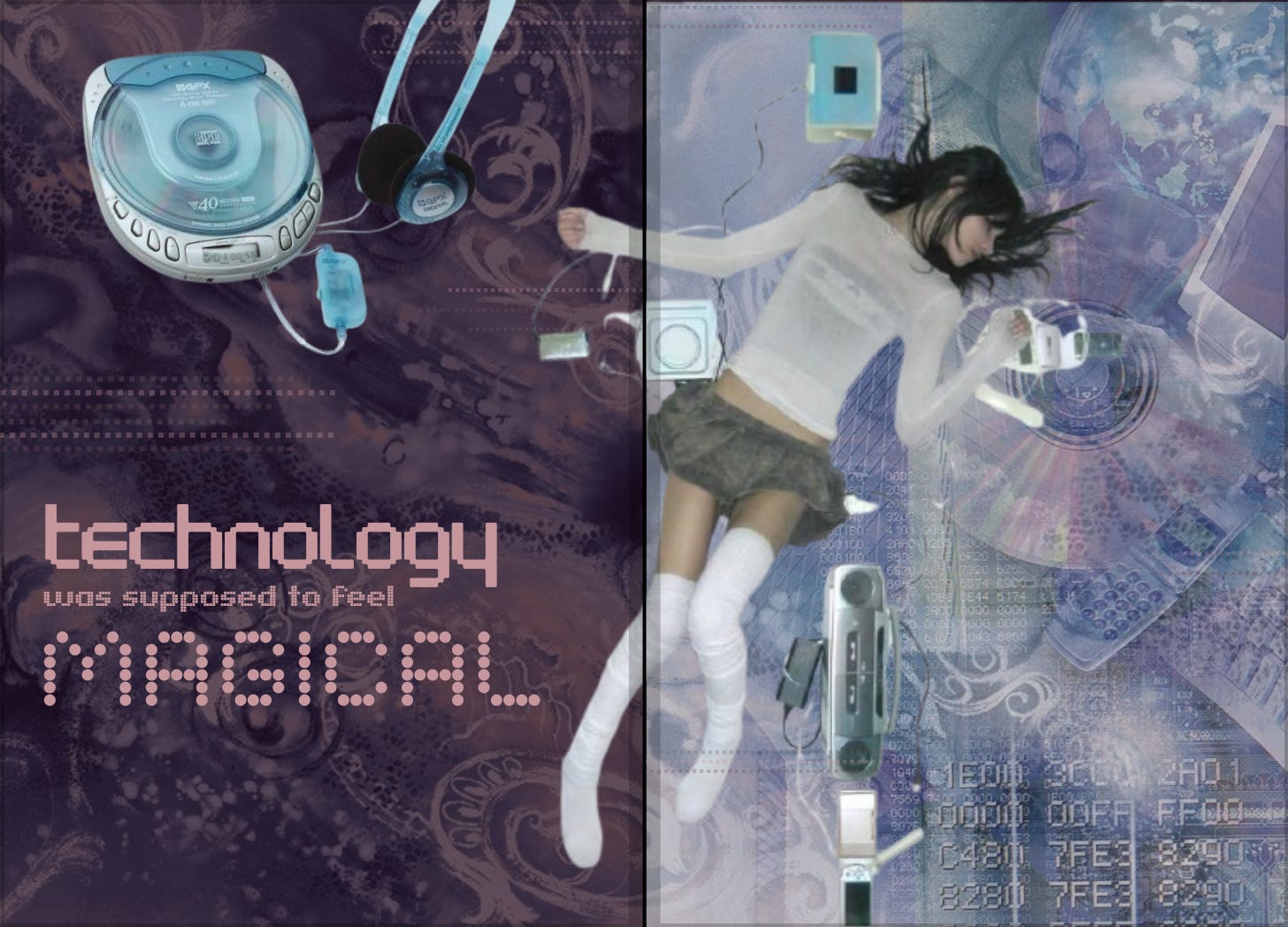
Once upon a time, the internet felt like a physical place to visit.
Many of my childhood after-school afternoons were spent at the family desktop computer for an allotted time to play games or watch videos. The internet was a destination—a world the computer could teleport you to. Of course, I didn’t want to live there. I logged in to this magical escape, then logged off.
Part of what made the internet fun was how temporary the activities there felt. The characters in my favorite online games would greet me when the game started and say “See you next time!” at the end. I’d watch YouTube videos by DIYers to learn how to make something (probably a friendship bracelet or a craft for my dollhouse), then I’d leave the computer to go create it myself—a portal back to real life.
It’s easy to romanticize the internet of my childhood, because it fueled my creativity and inspired me over and over again. Despite all of its downfalls, I think the “old internet” still had a sense of place that grounded it and made it somewhere that felt edifying and deeply optimistic.
The internet of the 2000s/early 2010s felt enchanted. That place doesn’t exist anymore…what happened?
As a 2004 baby, I can’t remember the early 2000s, but traces of the Y2K era’s hope lingered in all of the technology I recall from my childhood in the late 2000s and early 2010s. Devices tended to be bright, colorful, uniquely shaped, a little over-the-top, and they usually had a single-purpose.
Phones were for calling and texting. If you wanted to take pictures, you’d bring your camera. If you were in the mood to play a game, you’d get your Gameboy or DS. To listen to music, you’d plug your earbuds into a CD player or iPod. And to visit the internet, you’d get on the computer.
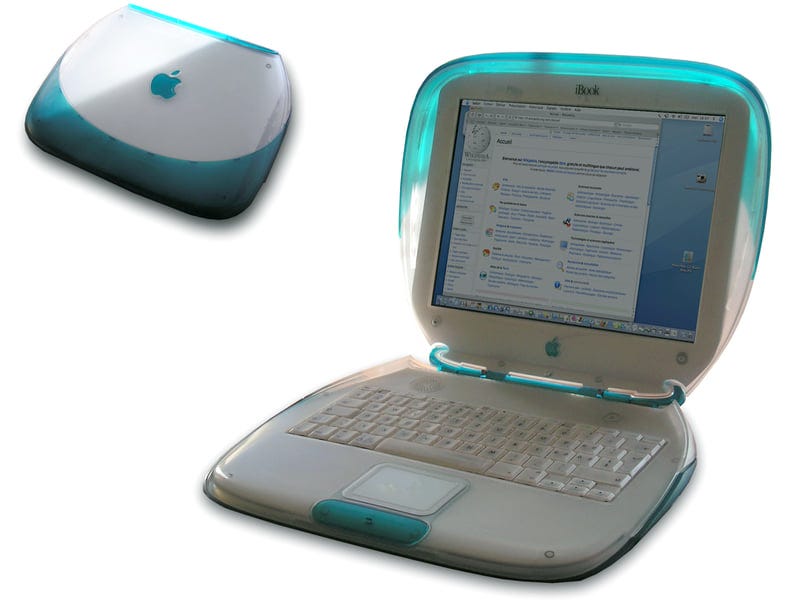
The World Wide Web itself mirrored the bright, quirky designs of the devices. Through an aesthetic we now call Frutiger Aero, the net was filled with “techno-utopian” visuals—gloss, translucency, and elements from nature like bubbles, the aurora borealis, grassy fields, or the ocean—that showed human-centric technology in harmony with nature.
Yes, it was just a corporate art design era for marketing products, but it reflected a cultural mindset, too. It felt hopeful. Magical, but an earthy magic we could reach. Like the possibilities were endless ahead of us, with the internet.
But the internet isn’t a place anymore—it surrounds us. It follows us and listens to us. It feels like a pervasive, omnipresent force that has slowly seeped into everything we’ve touched, and AI has only blackened the ruins of the old internet.
The internet used to promise us things like inspiration and knowledge. Now, AI promises us the same things but through automation, shutting out human participation in the process.
I think AI is a dark, twisted form of the magic the internet of the 2000s promised us.
Frutiger Aero is highly trending on TikTok and Instagram. You’ll find old devices (“Phones used to be so f*****g cool,” a commenter on a video of an adorably quirky old Nokia flip phone says, “Can one of the major carriers please bring back this magic?”), Windows XP screensavers, aquatic-themed audios or nature sounds, and everything blue and green.
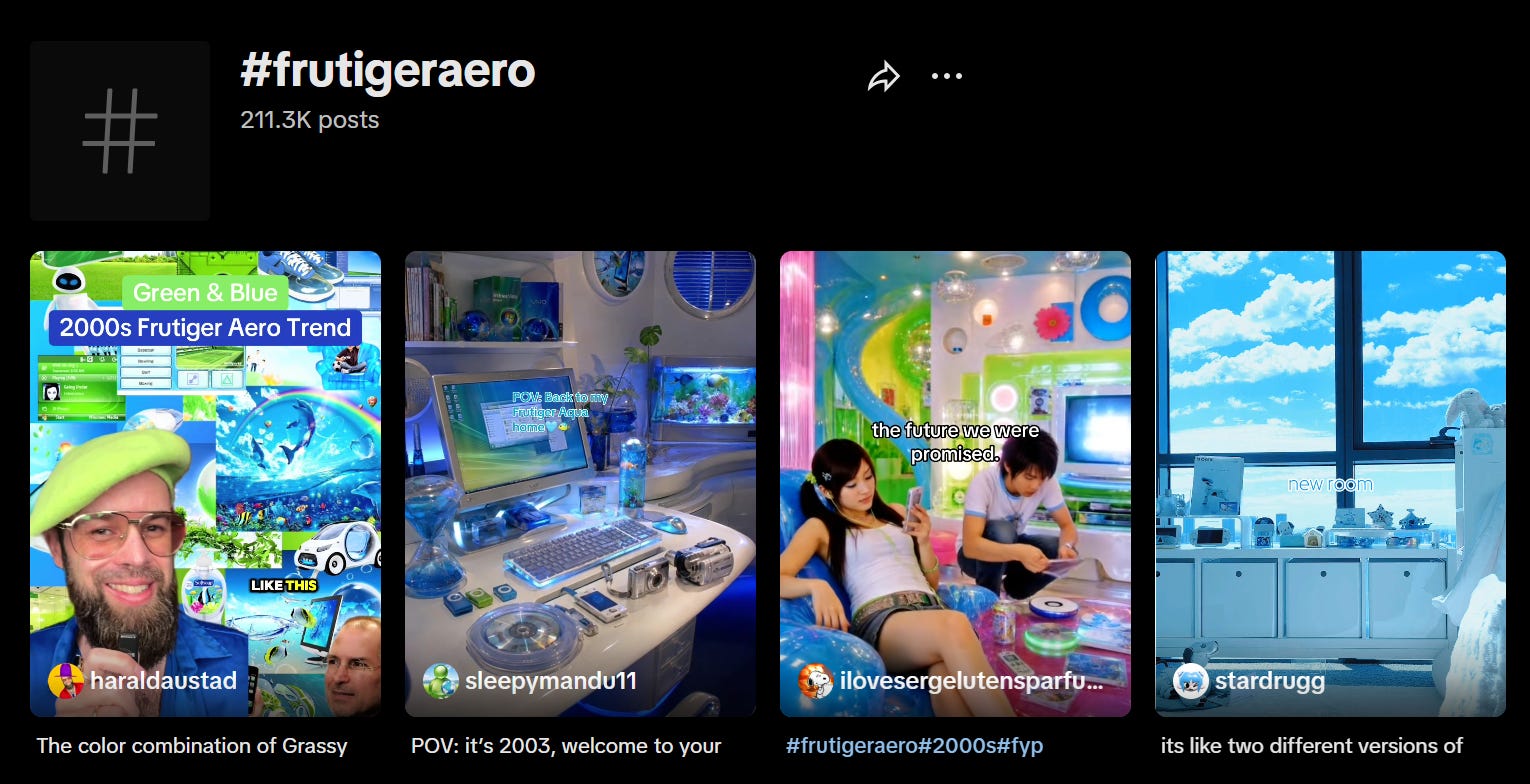
This kind of nostalgia is the epitome of bittersweetness for me, and I know I’m not alone in that feeling. It feels like revisiting and grieving a future we were promised in childhood but never got. It’s a reminder of a reality we could’ve had, one we dreamed of before things went so wrong.
We’re living the polar opposite of what we imagined through Frutiger Aero. Big Tech is notoriously evil. AI data centers are destroying the environment. At the same time, technology is still consuming our lives, and there’s next to nothing we can do about it…we’re burnt out.
We have the right to be bitter about this, but reminding ourselves of Frutiger Aero itself is, oddly enough, both comforting and inspiring.
So inspiring, in fact, there’s a quiet rebellion on the rise against big tech companies and generative AI. For example, a group of tech savvy Gen Z creators are building cyberdecks—small, customized computers built for the sake of digital independence.
I’ve seen cyberdecks built for all kinds of purposes (both practical and for fun), but that’s not the point—they’re essentially homemade laptops. The point is total control over your tech. They offer an alternative to tech with algorithms, surveillance, and data harvesting.
The cyberdecks are cool. They’re bright, fun, futuristic…this is just about as close as it gets to what it was like in the 2000s. We’re taking a step back in order to see the future again.
I want to believe that this is a sign that there’s a renaissance coming, now that we’ve realized how AI has eaten away at our culture—a renaissance where art and technology are human-centric once more.
The old internet might be gone forever, but we won’t ever forget the magic it sparked in us. We want to wonder again, we want to hope again.
We want technology to feel magical again—not because we want to return to the past, but because we’re ready for a future worth imagining.

Comments
Nothing yet. Say the first thing.
Sign in to join the conversation.