
Ever wake up and see some news that you skip over because you think it’s a bad joke? Well, for Democrats in Montana this week, pictures of union leaders happily endorsing MAGA Republican Aaron Flint for Congress was one of those moments.
Across the country, similar shocks have emerged for Democrats, all revolving around the same topic. Maybe, just maybe, this is the jolt of reality needed to spur Democrats into seizing an opportunity to fix some of what’s been ailing the party.

I’ll get to this topic of Unions endorsing Republicans, but let’s step back for a moment and focus on the opportunity this moment represents.
What if, after years of trying, there was a way for Democrats to bring vast majorities of working-class people back into the fold? No, it’s not difficult. Seizing it requires no embarrassing contortion or compromise and no expensive rebranding; in fact, it’s smack in the middle of what the party claims as its wheelhouse. It’s rooted in legitimate fear about job loss, skyrocketing electricity rates, worsening water quality, and the unregulated industrialization of the places we live.
It’s coming from people who endure “thousand-year climate events” every few days. Droughts, fires, and floods that disproportionately impact working people and destroy small businesses. It’s coming from people who are pissed at the tech bros and VC firms in lofty office buildings and private jets who only demand more tax breaks and environmental deregulation so they can profit more, build faster, and consume unthinkable amounts of electricity, further thickening the earth’s stifling CO2 blanket.
It’s bubbling up from a broad majority of Americans who are crying out for help in the fight against a broken economy that disproportionately rewards the investor class and tech bros. These are the same people who don’t even pretend that their feverish rush to deploy AI is anything but a project to replace millions of working Americans with dark-factory robots, self-driving trucks, chatbots, and simulated service agents.
Voters of both parties feel the rumbling of the oncoming earthquake and are grasping for a way, any way, to exert some control; some way to slow and protect against these breakneck changes being forced upon us. It comes from people who know the fight is stacked against them, but who also know that in a bare-knuckle brawl, you use every bit of leverage you’ve got. And this is the last leverage point left—where working people reach up from the mat, grab a body part, and twist until the tech bros and lobbyists start screaming.
Yup, you got it right. It’s the data centers, stupid!
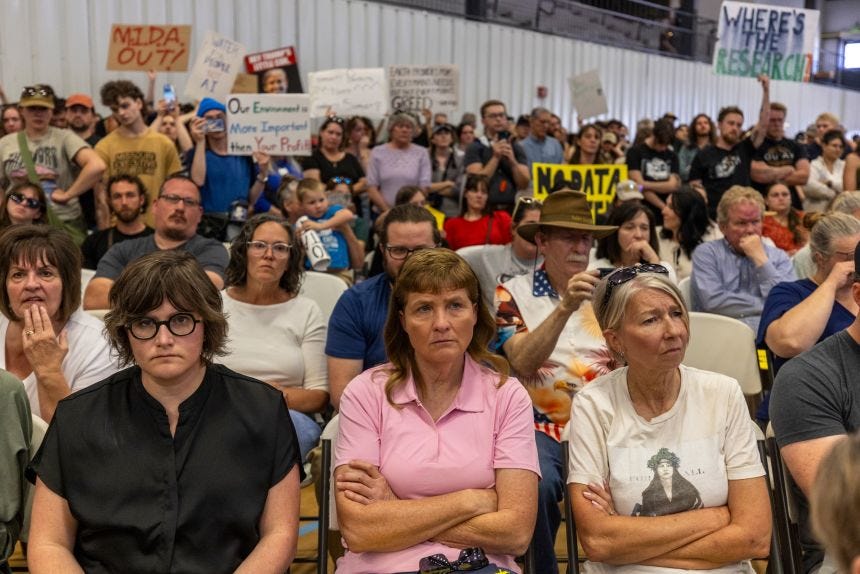
How we got here:
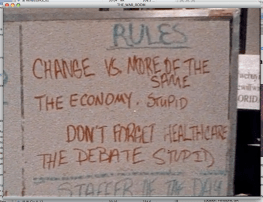
There is no small amount of irony in the fact that Democratic strategist James Carville coined the prescient and iconic 1992 campaign theme “it’s the economy, stupid” for the exact same Clinton administration that just months later rammed the North American Free Trade Agreement, or NAFTA, through Congress.1
Granted, there is no single source for what followed, but the Democratic Party’s dramatic loss of working-class voters over the three decades was partially precipitated by the “giant sucking sound” of jobs being outsourced from American factories to foreign countries. Working Americans felt betrayed, a fact that became very painfully obvious to Democrats when Hillary Clinton lost in 2016, at least in part because of her focus on corporate Wall Street connections and her inability to distance from Bill’s signature trade deal. Hillary, as the saying goes, “was just another corporate Democrat.”2
Democrats have at least pretended to take the resulting lessons very seriously. For the last decade, the party has spent hundreds of millions on consultants, autopsies, ad campaigns, focus groups and candidate recruitment in a desperate attempt to win back those working-class voters.
How’s that going? Not so great. Kamala Harris’s 2024 working-class woes are well documented, and echoes of her loss permeated through other races across the nation. Here in Montana, I lost a race for Governor to an outsourcing tech billionaire, and in the same cycle the desperate fight to keep working farmer Jon Tester in the Senate also failed. Jon lost by 7% despite a genuinely grease-stained Carhartt jacket and an insane level of campaign spending totaling more than $300 million, or more than $400 per registered voter, a sum that made it the most expensive per capita election in the nation’s history.
Some Dems Are Getting It, But It’s Scattershot and That Ain’t Cutting It:
Given all this decade-long expensive Democratic hand-wringing, you’d think that when a powerful, realigning issue like this comes along, one that bundles income disparity, environment, job loss, tax policy, and quality of life, an issue that energizes more and more voters (current polling is at 71% oppose and its growing), including large numbers of working-class Republicans, Dems would jump on it like a chicken on a June bug.3
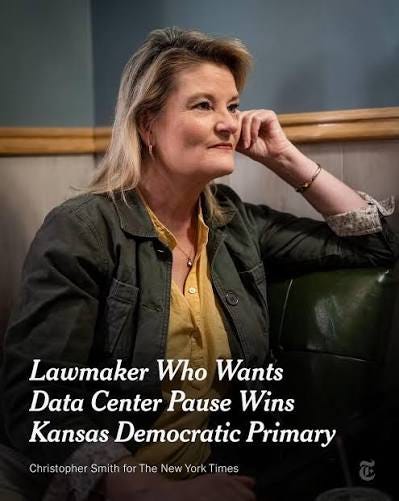
Some Dems have pounced. Cindy Holscher, the Democratic candidate for governor in Kansas, just won her primary, coming from behind, defying the polls, and without the endorsement of sitting Governor Laura Kelly. When I asked how she did it, she had two words: “Data Centers.”4 Holscher, previously voted for a bill in the state legislature that cut taxes for large tech projects. But after being on the trail with voters, she quickly realized she needed the courage to change her mind publicly and forcefully. She did it, ran on it, and won the primary.
Why aren’t the party and candidates who want to win adopting the same kind of forceful stance across the board so that voters know exactly which party stands against data centers? Well, that can be explained by what’s going on in Montana.
How Data Centers Are Playing Out In Montana:
The battle here in Montana is emblematic of this issue for Dems across the nation. Despite loud public outcry and bipartisan opposition to planned data centers near Billings, Butte, and Missoula, Republicans remain firmly behind full-speed data center development. At least 14 others are planned for the state because we have almost no regulations; we have cheap power, and at least today, we still have water.
Our GOP governor pals around with data center lobbyists and appoints their champions to commissions. Aaron Flint, the Republican nominee for the MT01 House seat, is likewise bought and paid for by data-center tech bros and relied on nearly $1mil of AI lobbying money to win his primary.
Given these obvious GOP stances, it shouldn’t be hard for Dems to draw a clear distinction. Former Governor Brian Schweitzer made this clear a few weeks ago when he spoke to a statewide democratic group;
“Nationwide data centers have a 30% approval rating. In Montana, they have a 22% approval rating. That’s lower than almost everything, anything that you can look at. I think every issue that I have looked at, no matter what it has to do with, education or health care, I can’t find any as low as 22%. So the public is already on our side.”5
Some Dem grassroots leaders are reading Schweitzer’s mail and pushing a more aggressive stance, as witnessed by the results of the recent Montana Democratic Party convention, where the party narrowly adopted a hard-fought plank calling for a two-year moratorium on data center construction.6
But here is where political difficulty starts for Dems. This plank passed despite strong opposition from organized labor reps in attendance, who pressured the party to avoid the data center fight.
In a sign of the tug of war inside Dem politics, Former Senator Tester, who now serves on an advisory board for Anthropic AI, recently publicly chastised Democrats who oppose data center construction and suggested that focusing on future regulation would be a better approach.7
The problem with Jon’s suggested, measured approach is that, unlike past industrial building projects, AI corporations like Anthropic have unlimited money and are moving so fast that there is no time to debate careful, complex regulations, especially given the dysfunction of D.C. These companies want to slow things down so that debate grinds to a halt in the legislative back-and-forth.
I remember being very excited by Jon’s 2005/06 Senate run. (Full disclosure - I was a strong and active supporter of Jon in all of his races.) He was a straight-talking populist with a keen nose for smart politics. Maybe I’m just nostalgic for the good ol days, but it’s hard for me to believe the 2005 Jon Tester would have failed to jump on Data Center opposition as both good policy and good politics.
This is not the slow-rolling industrial buildout of the past. Given the stakes, we need fast action that demands NOTHING be built until strict regulations are in place, including rules that guard against AI displacing workers.
We need a moratorium on any new construction; Dems need to run on it, loud and proud, and if we win back the House and Senate, Democrats need to make sure it happens fast.
Data center proponents aren’t waiting around or twiddling their thumbs. They are doing all they can to stop the party from taking clear action or issuing clear messages. In a December 2025 move that surprised many, the Montana AFL-CIO instructed the Montana Democratic Party to lay off any criticism of data centers, and they did it with an official letter that read in part;
“While we understand that this is a complex policy matter, I feel it is important that we remind you that the Building Trades and union members who work in the construction industry have been very supportive of conversations about the potential for data centers in Montana.”8
In June, Jason Smalls, the Republican who is also President of Montana AFL-CIO, made a show of laughing it up with Flint and also said that the Data Center issue was no big deal and that concerned voters were just “controlling people through manipulation and fear.”

And then, last week, the Carpenter’s Union in Butte officially endorsed MAGA Flint for Congress, an unprecedented and shocking move given the very clear anti-union sentiments, history, and policies of the MAGA coalition. Ironworker leaders also filmed videos laughing it up with Flint. Apparently, union rights, prevailing wage, and fighting right-to-work aren’t important after all. Data centers are all that matter even if they jack up electricity rates and take jobs from tens of thousands of union member teachers, nurses, and police officers.
I gotta think that somewhere there must is a smoke-filled bar full of MAGA CEOs, Republican operatives, anti-union lobbyists, and wealthy investors toasting this inside job victory. And who can blame them? It’s very hard not to interpret this long, documented string of events from labor leaders as anything but a clear pro-data-center stance from an entity that purports to be inside the Democratic Party tent.
I was honored to receive the AFL-CIO endorsement in our Gubernatorial run, but that does not mean that I have to look away from what they are attempting now. The real perplexing part is that some Democrats fail to recognize the political malpractice and destructiveness of what’s happening.
A political party’s sole purpose is supposed to be to win elections. In other words, only a party that wished to lose elections would take orders directly contrary to the growing calls of almost all Democrats and a rapidly growing number of Republican voters.
Perhaps this is the sort of moment that political scientists call a “realignment opportunity.” The precipice moment where a successful political party musters up enough courage to stand up to destructive demands from its own “groups” so that it can grab voters back from the opposition party. These opportunities require courage, boldness, and a willingness to care about winning.
For the sake of our state and country, and especially the working people most impacted by data centers and AI, let’s hope Democrats find the courage to make it happen.
https://www.politico.com/story/2018/12/08/clinton-signs-nafta-into-law-dec-8-1993-1040789
https://www.theguardian.com/us-news/2016/nov/09/hillary-clinton-election-president-loss
https://www.cnn.com/2026/08/06/business/ai-data-center-construction
https://www.politico.com/news/2026/08/02/kansas-data-center-fight-governor-race-01021247
https://montanafreepress.org/2026/06/25/data-centers-in-the-democratic-hot-seat/
https://www.ypradio.org/regional-news/2026-06-23/montana-democratic-party-gathers-to-vote-on-party-platforms
https://montanafreepress.org/2026/06/25/data-centers-in-the-democratic-hot-seat/
https://www.bozemandailychronicle.com/news/email-unions-urged-montana-democrats-to-back-off-negative-messaging-on-data-centers/article_d480bbe0-a989-5ff1-966a-00a77c842d8e.html
Comments
Nothing yet. Say the first thing.
Sign in to join the conversation.