
Readers: my new book will officially be out on April 21st, or one week from today. I’m excited. People ask me: “Ryan, what’s your book about?” I’m always tempted to say that it’s about everything. It is, but that’s not a helpful answer. Instead, I usually say something like: the central theme of the book is that our species’ capacity for faith is its defining and most important attribute. And that’s true and interesting enough but doesn’t really tell someone much about what I mean by that or why it matters.
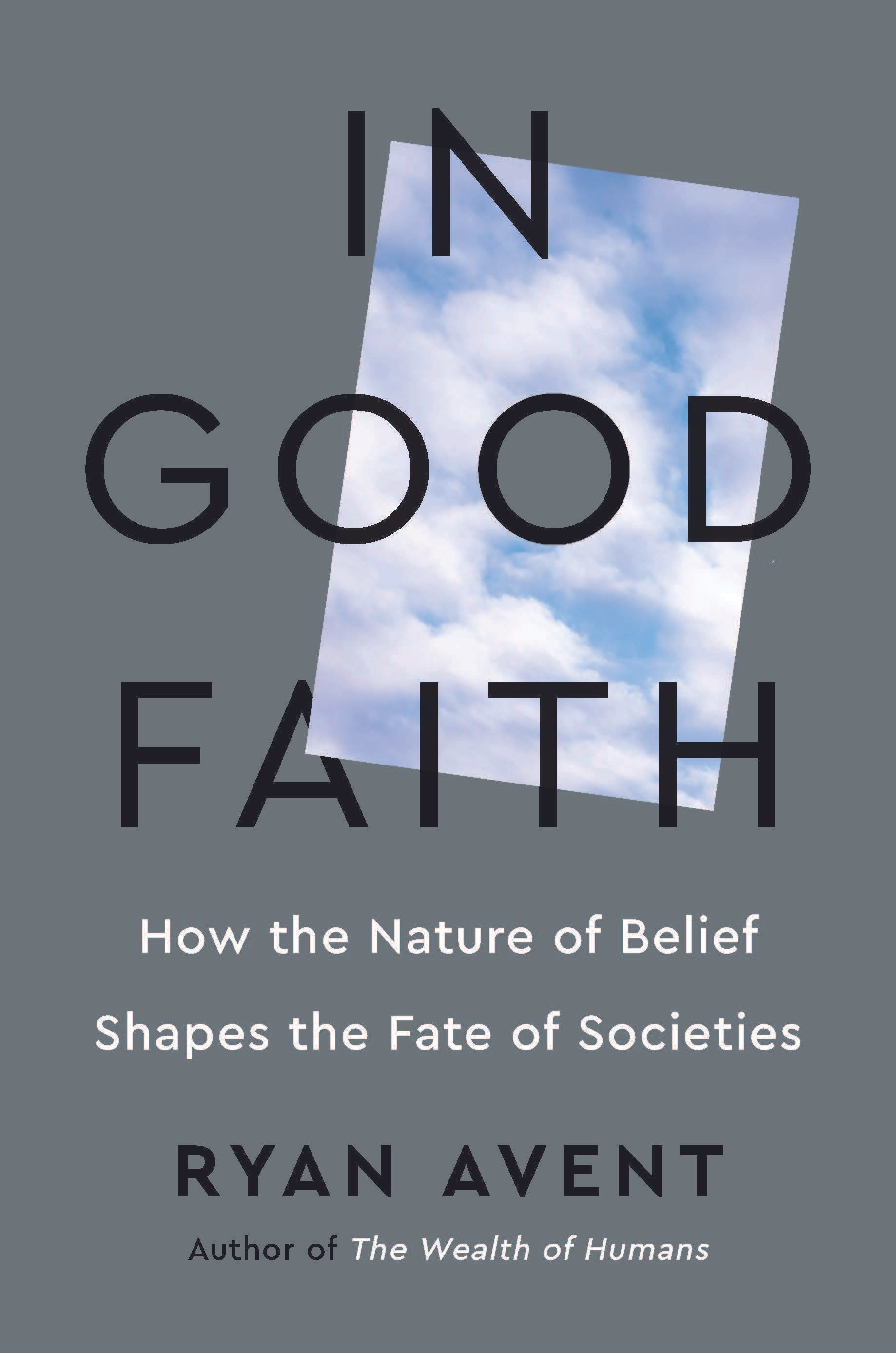
In fact, it’s incredibly hard to explain all that stuff in a few sentences—for me at least, which is why I wrote a 300-page book. But I’m incredibly proud of what’s in those 300 pages, and I really want you all to explore that, so I need to share with you a little more detail about what to expect.
When I say that faith is our defining characteristic, I mean, in the first instance, that its emergence laid the groundwork for greater social cooperation and became a driving force of human evolution. Sharing beliefs with others without necessarily understanding the basis of those beliefs helps to preserve cultural information (which is itself subject to evolutionary pressure) and facilitates action with a collective purpose. It transforms us from a species like others, whose capacity for social cooperation is largely constrained by the mathematics of (genetic) self-interest, into something quite different.
An important component of this idea is the notion that beliefs are behaviorally relevant, at both the individual and societal level. This little nugget was actually the initial spark for the book. My last book, The Wealth of Humans, included a chapter on the importance of “social capital” to the operation of businesses and other institutions. Shared culture, I argued, was like an invisible code that guided and motivated individuals in a way that yielded particular collective outcomes. I kept following that thought and it ultimately led to this book. Yes, we are individually concerned with our own self-interest, but that is not the fundamental human motivation, on which all of history is built. Rather, we are fundamentally cultural, and our shared beliefs determine the extent to which we allow ourselves to indulge in self-interested behavior.
Now, a significant implication of the ideas above is that a society’s collective capabilities are determined by the nature and distribution of belief: who shares what understandings about the world with what intensity. A society in which no one feels an intrinsic motivation to behave in pro-social ways is capable of much less than one in which many people hold beliefs which encourage some self-restraint on behalf of others. It is thus appropriate to see the emergence of new beliefs and their dispersion and evolution as a driving force of long-run social, technological, and economic progress. Over time we land on new ways of thinking, which unlock new forms of cooperation, which grant us new capabilities.
With that framework in hand, the book explores a new way of understanding how we got to modernity as a species, how societies occasionally run into trouble (as we are running into trouble now), and how we should think about the work of managing serious social problems and building better futures. You’ll have to read to see exactly what the book does with all this, but I think it’s worth the trouble, even though many of you will find many things with which to quibble.
There are a few other threads which run the length of the book: helping to hold it together, providing context, and serving other important purposes. One is autobiographical, you might be interested or annoyed to learn. There is a good reason for this, as you will (hopefully) see. Another is cosmological. A book about faith has to grapple with the Very Big Questions, as well with what faith means to people. The third relates to how we conceive of the structure and operation of nature and what this conception leaves out. This third thread feels to me like the “social capital” of this book: the thing I can’t let go of, the kernel of some bigger thing to come. But we’ll see about that.
What else should you expect? I mean, the book is weird. You should know that going in. It’s also hopeful; my intention is for people to finish the book feeling optimistic about the future. I think it’s the best thing I’ve ever written, although that isn’t necessarily saying very much. I don’t think you’ll regret reading it, even if you violently disagree with it or find some parts utterly baffling.
In conclusion, I really hope you’ll give it a shot. If I’ve persuaded you, it is currently available for pre-order at most online booksellers. Order today, and one week from now you’ll have a crazy little book sitting on your doorstep. If I haven’t, well, I would just humbly encourage you to take a leap of faith. Or wait until it is available for check-out from the public library. Either way.
No posts
Comments
Nothing yet. Say the first thing.
Sign in to join the conversation.