
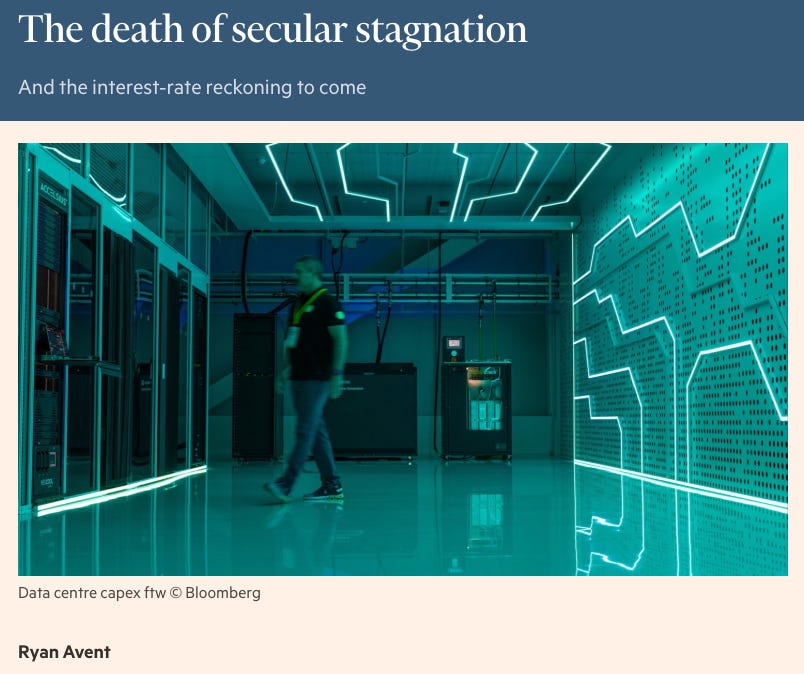
I have a new piece up at Alphaville today, examining an underappreciated macroeconomic dynamic: namely, a sharp and likely sustained rise in investment demand across the economy. In the 2010s, many people came to believe that we had become firmly stuck in a low-interest-rate world, because aging populations wanted to save a lot while mediocre growth prospects meant that private-sector investment demand was chronically weak. This was secular stagnation, and the only way to sustain a full-employment economy under such circumstances was through persistent government borrowing, which many governments ultimately signed on for.
Today, though, prospects for productivity growth and investment demand look much different than they did before the pandemic. The AI complex is sucking up a huge amount of capital, and will probably continue to do so for years, but we also face other large capital-intense investment needs: in renewable energy, grid upgrades, and preparation for climate change; in deployment of autonomous vehicles and drones; and in deployment of ever-more-capable robots; just to take a few examples. This investment all needs to be funded, but governments have large debts and deficits to finance. These competing demands seem sure to wreak some havoc on bond markets.
I’m thrilled by this new review of the book, published by The Gospel Coalition. A snippet for you:
Avent’s In Good Faith achieves something genuinely difficult: a synthetic account of human belief, cultural evolution, and social meaning that takes religion seriously without being religious. He writes candidly about his own losses and uncertainty, giving the book an unusual intellectual honesty.
Jonathan Rauch also published an interesting critique of the book this week, at The UnPopulist. Rauch notes that defenders of liberalism are divided over how to respond to right-wing post-liberalism, and he identifies three different liberal camps:
Classical liberalism argues—with Locke, Mill, and modern libertarians—that providing meaning is not liberalism’s job. Rather, liberalism’s founding principle and distinguishing strength is precisely that it sidesteps questions about life’s purpose and the nature of the good, allowing a multiplicity of moral visions to coexist and thrive…
Values liberalism agrees that liberals embrace no single vision of the good, but it rejects the notion that liberalism is value-neutral. To the contrary, liberalism presupposes and promulgates a hefty bundle of values, such as empathy, reciprocity, fairness, equality, lawfulness, truthfulness, forbearance, and (of course) freedom…
Deficiency liberalism accepts many premises of the other two schools, at least in theory; but it argues that neither classical liberalism nor values liberalism has, in practice, risen to today’s real-world challenge. In fact, they have objectively fallen short, which is why we’re in a crisis. If liberalism does not find a meaningful story to tell about itself, and if it cannot find a way to provide inspiration and purpose, it will be abandoned in favor of worse alternatives—which, guess what, is exactly what’s happening.
I’m in the deficiency camp, Rauch is generally skeptical of this group’s arguments, and he doesn’t seem to have been persuaded by In Good Faith. That’s fine; this conversation is going to continue, and I’ll keep making my case. It is a little frustrating to see Rauch expressing disappointment with “the book’s lamentable lack of empirical data and research”, when he doesn’t engage at all with the many chapters devoted to the model of society I use as the main foundation for my critique of liberalism. I don’t know how you pass judgment on the book without passing judgment on the model.
Back in May, Peter Thal Larsen kindly invited me onto his podcast at Reuters, The Big View. It was a bit of a departure from the pod’s usual focus, but Peter asked great questions, and I hope his audience didn’t mind the thematic detour. Do have a listen if you have a moment:
No posts
Comments
Nothing yet. Say the first thing.
Sign in to join the conversation.