
Revenue is the one system in your company where being wrong stays silent until it’s catastrophic.
You don’t find out the pipeline was fiction when it’s still fixable. You find out when the quarter closes, after you’ve already hired against the number, set the board expectation, and spent the marketing budget. By then it’s not a bad dashboard. It’s a mis-hire, a blown forecast, misallocated spend, and runway burned chasing revenue that was never going to land.
So when someone tells me they have “pipeline intelligence,” I’ve learned to ask a quieter question: which kind, and is it the kind your stage actually needs? Because the term has been hollowed out by vendors until it mostly means “we sold you a dashboard or a tool.” Let me try to give it back some teeth.
Pipeline intelligence has evolved through four eras. The interesting part isn’t the tooling. It’s that the location of truth moved every single time.
Era one: the list. Deals lived in a rep’s head, then a spreadsheet. Truth lived in the rep’s gut, and your only tool was to ask “is this real?” in a 1:1 and watch their face.
Era two: the record. Siebel, then Salesforce. Pipeline became a database object with stages, amounts, close dates. Enormous leap, because pipeline became visible and aggregatable for the first time. But a CRM is a system of record, not a system of intelligence (plz don’t tell me Einstein is intelligent). It tells you what reps say is happening. Self-reported, lagging, and quietly gamed to keep managers off their backs.
Era three: the dashboard. Signals unite! Activity capture (Gong, Outreach) showed what reps actually did instead of what they typed. Add in historical data and analytics layers such as (Clari, BoostUp, Rattle, there are so many) scoring deals and tried to de-bias the forecast. This is when “tool pipeline intelligence” became a category. Truth moved from the CRM field to observed behavior, but in silos.
Era four: the action layer. This is where AI changes the game, and it does two things at once. First, synthesis it can read every call, email, and note and tell you (in theory) across platforms, why a deal is stuck, not just that it is, driving the cost of inspection toward zero. Second, distribution. This is the real shift. Intelligence used to be hoarded in the CRO’s forecast call. Now the relevant slice can sit in front of everyone who can act on it: the AE gets a prep brief and a next-best-action, the SDR sees which accounts are heating up, marketing learns which content showed up in won deals, product hears which gaps killed which deals, the CEO gets a forecast instead of a negotiation.
The truth migrated from the rep’s gut → the CRM field → observed behavior → synthesized signal distributed to everyone.
Here’s the trap hiding in that progression: every era added a new system that claimed to be intelligence but was often just better-organized data. Which is exactly how you (I/we) end up confidently wrong.
The sharp version: pipeline intelligence is the ability to answer three questions with enough confidence and enough lead time to do something.
What’s actually true right now? What happens if nothing changes? And what should we do about it? These are complex questions that no dashboard fixed and required a full time analyst.
Most companies conflate four very different things and treat them as interchangeable:
Data: a deal exists, $50k, closes March
Visibility: here’s $4M in aggregate
Analytics: stage-3 deals with no exec contact close at 12%
Intelligence: someone changed a decision because of it
Only the last one counts. A dashboard nobody acts on isn’t intelligence. It’s expensive wallpaper. Real intelligence is grounded in reality (observed behavior over time, not self-report), timely (a perfect read on a lost deal isn’t intelligence. It’s an autopsy), decision-shaped, and trusted enough that people actually act on it. Miss any of those and you’ve got a very pretty system that lies to you on a schedule.
Here’s the part that should make you a little uncomfortable. The companies in real danger aren’t the ones flying blind. They know they’re blind. It’s the ones that dropped $200k on a stack and now genuinely believe they can “see”. The anti-patterns escalate by spend, and so does the false confidence.
The Dashboard Mirage. Beautiful dashboards, therefore “we have intelligence.” But they’re visualizing self-reported CRM data nobody trusts. Visibility into garbage is still garbage. The dashboards exist, but the forecast call still runs on a side spreadsheet and gut.
The Self-Report Trap. Your entire system is built on what reps type. Stages, close dates, “next steps” fiction optimized to manage the manager. You’re measuring rep storytelling, not prospect behavior. Stages advance while actual prospect engagement flatlines.
Coverage Theater. You track 3x or 4x pipeline coverage and feel safe. The pipeline is stuffed with zombie deals nobody’s had the discipline to qualify out. You’ve confused the quantity of pipeline with the quality of your intelligence about it.
The Centralized Hoard. RevOps genuinely has good intelligence and it dies in a Monday deck and never reaches the people who could act mid-cycle. The AE, the SDR, marketing, CS are all flying blind while a beautiful truth sits in a slide. This is the most common failure, and the one AI is best positioned to fix.
The Precision Fetish. Your model outputs $4.237M and you trust the decimals. Garbage inputs, false precision, and a confidence that’s more dangerous than no model at all. Confidently wrong is so much worse than honestly uncertain.
If you read those and felt a little seen, good (me too.)
This is where most teams get it wrong, and it’s pure GTM Debt: the compounding cost of building out of sequence. The need for pipeline intelligence varies dramatically by stage and the form changes, not just the volume.
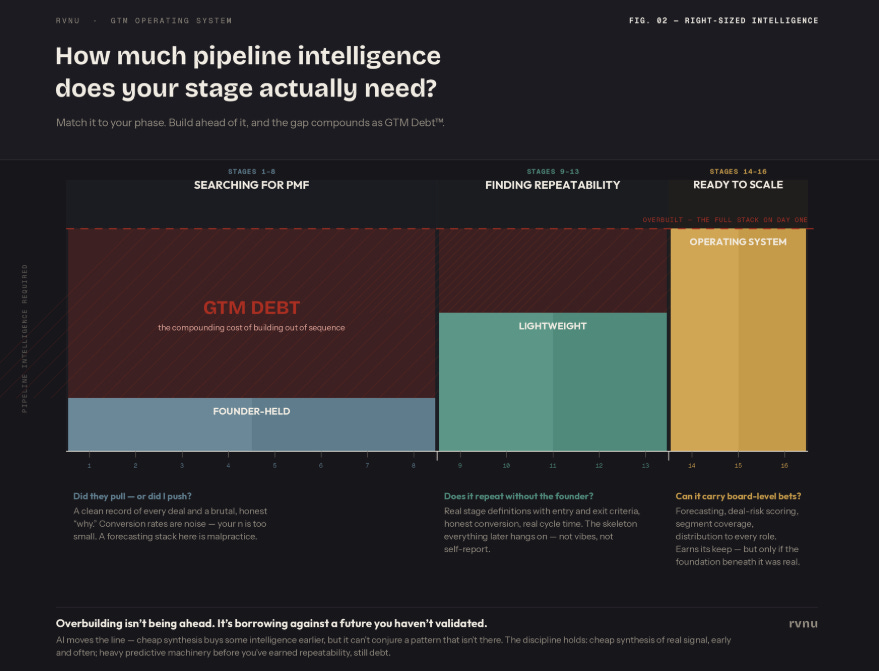
If you are searching for product-market fit: You don’t have a pipeline. You have a series of experiments. The intelligence you need is qualitative and founder-held such as: did this person pull the product toward them, or did I push it, and why did they buy, not buy, or churn? Conversion rates are meaningless; your ‘n’ is too small to mean anything. A clean record of every deal plus a brutal, honest “why” on each outcome is correct here. Standing up a forecasting stack at this stage is malpractice. There’s nothing to forecast, and you’ll burn founder-hours instrumenting noise.
If you are finding repeatability (PMF into GTM): Now the question is whether the motion repeats without the founder in the room. You need just enough structure to see the patterns as real stage definitions with entry and exit criteria (not vibes), honest stage conversion, real cycle time. This is where most GTM Debt is created or avoided, because the skeleton you define here is what everything later hangs on. Lightweight, but it has to be behavior-based, not self-reported.
Ready to Scale? Now intelligence becomes an operating system. Multiple reps and segments, a number committed to the board, headcount planned against it. Now forecasting, deal-risk scoring, segment coverage, and distribution to every role earn their keep. Why? because volume exceeds human inspection capacity and the cost of being wrong is measured in runway and board credibility. But it only works if the foundation from the prior stage was real. Scaling on self-reported garbage just produces garbage faster and more expensively.
So can you overbuild too soon? Absolutely.
It’s one of the most expensive mistakes I see. You instrument fiction (precise measurements of randomness you then trust). You calcify the wrong model (heavy infrastructure around an unearned stage definition becomes a cage you can’t afford to change). You burn the scarcest resource (founder time) automating the inspection of a thing that doesn’t exist yet. And worst of all, you manufacture false confidence, because a founder staring at a sophisticated dashboard feels informed and stops doing the messy qualitative work that would actually generate intelligence.
Overbuilding isn’t being ahead. It’s borrowing against a future you haven’t validated. The bill comes due as an AI system spent months building needs ripping out, a model you unlearn, and a team that’s exhausted with your founder “shiny object syndrome” or burnt out not seeing results.
One honest update: AI is moving this line. Cheap synthesis means you can get some intelligence earlier without the heavy stack. But it doesn’t conjure a pattern that isn’t there. So the discipline holds, just cleaner. Cheap synthesis of real customer signal, early and often; heavy predictive machinery before you’ve earned repeatability, still debt.
When pipeline intelligence is real and shared, it stops being a sales asset and becomes the company’s nervous system. Marketing optimizes for closed revenue by segment instead of MQL vanity. Finance hires reps ahead of the number with enough confidence to survive the ramp time, which is literally how you scale a sales org. Product builds what’s blocking qualified pipeline instead of what the highest-paid person finds interesting. CS reads expansion and churn signal early, protecting the net revenue retention that compounds faster than net-new ever will.
That’s the payoff. Not a prettier dashboard (please and thank you). You build a company where every function reads the same truth and acts on its own slice of it.
The eras aren’t a museum. They’re a path you’re supposed to move through deliberately, at the pace your stage can actually support. The goal isn’t to leap to era four because it’s shiny. It’s to be honestly, evidence-backed in the right era for where you are and to advance the moment your motion has earned the next one.
That’s what “responsibly” means. Not the most expensive stack. The right intelligence for your maturity, built in sequence, grounded in behavior instead of belief.
Are you building pipeline intelligence responsibly at your organization’s actual maturity? Don’t gut-check that answer. Gut-checking your own intelligence is the original anti-pattern. Get the data.
Take the assessment and find out which era you’re actually in. www.gtmscore.ai
Comments
Nothing yet. Say the first thing.
Sign in to join the conversation.