
Hey there, we are RVNU. Each week, we share founder stories about building efficient go to market systems, common founder missteps, and tips for accelerating revenue growth as you build your start-up.
So you want “more pipeline.”
It is the single most common thing founders tag as “keeping them up at night” and every time I hear it, I ask the same follow up question: what happens when that pipeline shows up?
Most of the time, the answer is a shrug. Or worse, a very confident answer that falls apart after three follow up questions. That is the real problem. Pipeline is not the thing that is broken. Pipeline is the symptom. The disease is that most founders are running an expensive assumptive motion and calling it a growth strategy.
Everyone’s answer to the symptom is the same: add more outbound, add more AI agents, add more volume. Kyle Poyar’s Growth Unhinged newsletter ran a piece recently with GTM consultant Matteo Tittarelli that gets at why that keeps falling flat. AI agents are not failing because companies need more of them. They are failing because there is no documented system of context underneath them, no locked structure of who the ICP is, who the competitors are, what the positioning actually says. Without that, every agent is guessing fresh each time, and none of it compounds.
Here is what that actually looks like in practice, and it is worse than a vague quality problem:
1. The agent fills the gap with a confident guess, not a visible question mark. Ask it to write outbound copy with no documented ICP and it will not tell you it does not know who this is for. It will infer a persona and write it with total confidence. The failure is not that it looks uncertain. It is that it looks exactly as polished when it is wrong as when it is right.
2. Every session starts from zero, so nothing stays consistent. With no canonical file to read from, the agent re-derives your positioning fresh every time you ask. Outbound copy on Monday and a competitive comparison on Thursday will quietly describe two different companies, because both were independent guesses, not two reads of the same source of truth.
3. None of it teaches the system anything. A rep who gets the ICP wrong eventually learns from the rejections. An agent with nowhere to write back what it learned starts over every time. Run a thousand sends and the agent is exactly as uninformed on send one thousand and one as it was on send one.
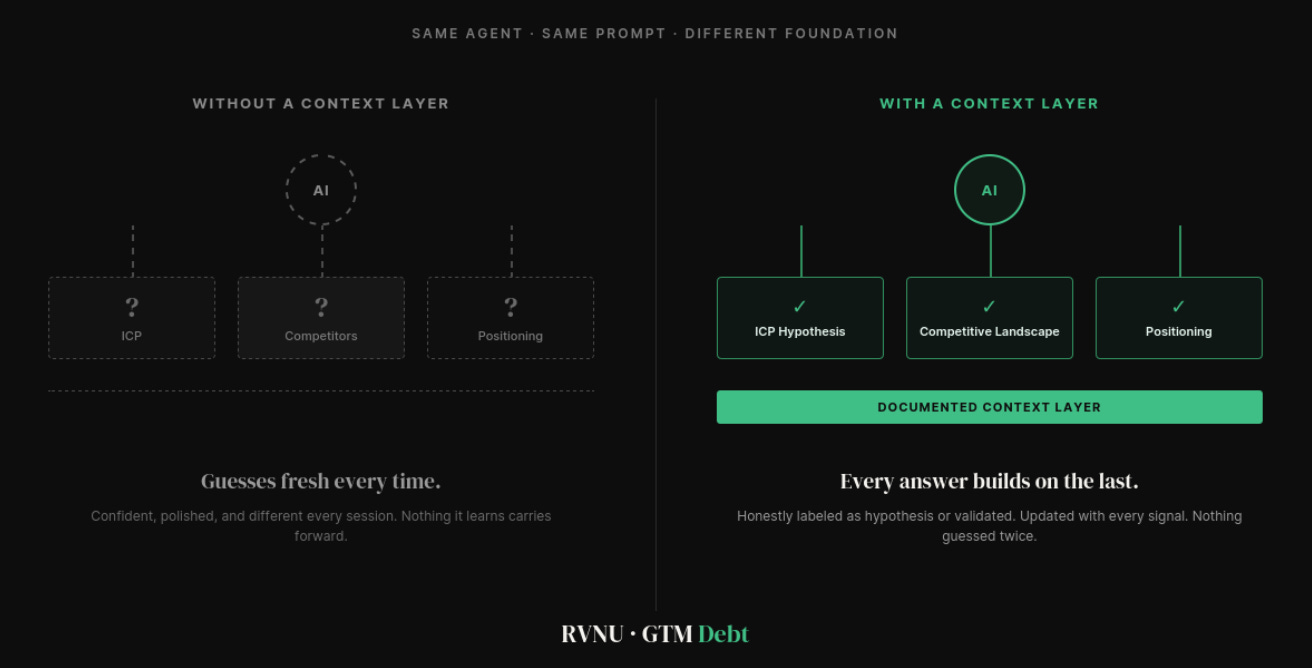
For a company already past PMF, the fix is what Kyle’s piece describes: lock the context down, since it is already known to be true. That is a true and useful diagnosis for a later stage company scaling a GTM motion it has already proven.
It leaves out the question that matters most for an earlier stage founder still pre PMF. Those same three failures do not go away just because you have not locked anything down yet. If anything they get worse, because there is no locked truth to fall back on. The agent is not repeating a known ICP inconsistently. It is confidently generating an ICP, a competitive set, and positioning for a company that has not validated any of it, and handing it back with the same polish as if it had. So what does AI do for you before any of that is locked down, while you are still testing whether your hypothesis about the market is even right?
The honest answer is that AI can still help, but only if the context layer underneath it is built for a different job. Not locking down what you know. Capturing what you are still finding out. That context layer is not static. It changes with every single piece of signal that validates or negates your hypothesis, your expertise, and the passion that got you started in the first place. Get that part wrong and you are not scaling a proven motion. You are just running your assumptions faster and calling the speed progress.
Here is the distinction that gets skipped constantly. If you are past PMF, you already know your ICP. You already know your positioning. Locking that down so your AI tools stop reinventing it every session is the correct next move.
If you are not past PMF yet, you do not have anything to lock down. You have hypotheses. Passion, research, and experience that has not been tested against a paying customer. Building the same rigid context layer at this stage does not protect you. It just gets your AI tools confidently generating positioning decks and outbound sequences for a company that does not yet know what is true.
We define it plainly at RVNU: 20 or more paying customers who have realized value in your product, and can tell you so in their own words. Not signed logos. Not a revenue number you hit once. Real customers, describing real value, consistently, without you leading the witness.
Most founders asking for more pipeline have not hit that number. Which means the honest question is not “how do we get more meetings.” It is “do we actually know what we are testing when we take one.”
Finding this helpful? Help share these insights with others by clicking the below ‘Share button’
Here is what happens when you scale outbound before you have done this work. You hire SDRs or build sequences around a message that is still a guess. Every reply, every meeting, every dollar spent is testing that guess at scale, without a system built to catch what you are actually learning. Three months later you have a lot of activity and almost nothing you can point to and say “we now know this is true.” You have just paid to run the same experiment over and over without recording the results.
The fix is not fewer experiments. It is building the thing that lets each experiment teach you something before you run the next one.
This is the sequence we walk founders through. It is meant to move fast. Fast does not mean reckless. It means shortening the loop between doing something and learning from it.
1. Document your Idea Market Fit hypotheses, honestly labeled as hypotheses. Founder Thesis, ICP, Competitive Landscape. One current version of each, dated, written as a guess you are trying to break, not a fact you are defending.
2. Build one place every real signal lands. Every call, every meaningful email thread, every outbound reply that actually says something. Tag each one to the hypothesis it touches. If you cannot tell which hypothesis a piece of feedback relates to, that is worth noticing too.
3. Make logging signal a same day habit, not a backlog. The value of a customer call decays fast. Log what you heard within 24 hours or it turns into a vague impression instead of usable data.
4. Run outbound as an experiment with a stated hypothesis, not a volume motion. Small batches. A specific message testing a specific belief. You are not trying to fill a calendar yet. You are trying to find out if you are right.
5. Review the signal weekly, not just when something goes wrong. Look for patterns across the week’s calls and replies. Where are three people independently saying the same thing. Where is the data contradicting what you believed a month ago.
6. Only scale outbound once a hypothesis has real evidence behind it. Not “we got some positive replies.” Confirmed, repeated signal from the kind of customer who actually converts and gets value.
This is not slower than what most founders are doing now. It is the same speed, pointed somewhere useful. The failure mode is not moving carefully. It is moving fast in a circle.
We have been building exactly this system inside RVNU: a structured Idea Market Fit context layer in Notion, a lightweight capture pipeline for calls, email and a weekly digest that surfaces patterns and proposes what is ready to move from hypothesis to validated, without ever making that call for you.
If your GTM Debt Assessment score is below 75 percent in Idea Market Fit (hint, take the assessment), this is not a nice to have before you scale outbound. It is the actual next step. Everything else is just a more expensive way of finding that out later.
Take the GTM Debt Assessment at gtmscore.ai
Hi! I’m Laura Wheeler is Co-Founder and COO of RVNU, a B2B SaaS go-to-market advisory firm. We built RVNU to help founders measure and pay down GTM Debt, the accumulated misalignments between go-to-market strategy and execution that quietly throttle growth.
Comments
Nothing yet. Say the first thing.
Sign in to join the conversation.