
I have long been fascinated by small talk.
Can you believe this heat?!
Are you planning to take the Parkway or the Turnpike? At this time of day?!
How about that local sports team?
Small talk is a highly localized art form, varying from place to place and group to group.
It is a performance we engage in to smooth our social interactions with anyone from acquaintances to total strangers. It can be like a warm up before jumping into weightier topics, but just as often it serves as a low-stakes conversation unto itself.
But there is also a dark side to small talk.
As with any good thing, you can have too much of it. So much, in fact, that it crowds out meaningful conversation, productive social friction, and deeper relationships.
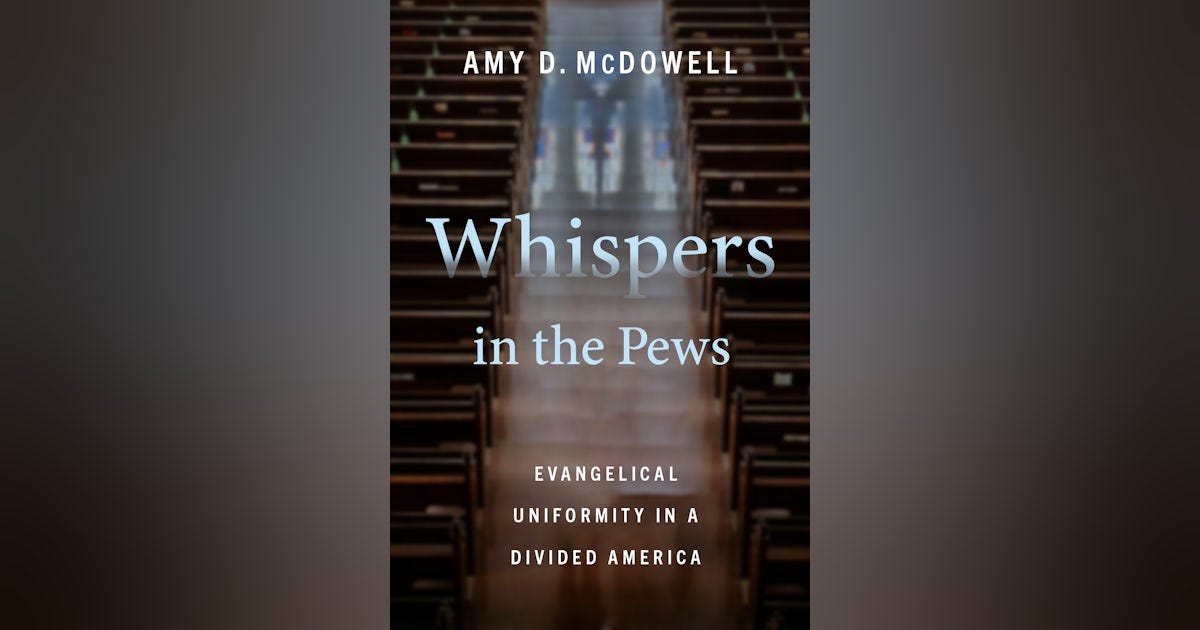
This is one of the many interesting findings of a new book, Whispers in the Pews: Evangelical Uniformity in a Divided America, by the sociologist and author Amy D. McDowell.
The book, which was released earlier this year,
exposes how small talk is utilized to construct an appearance of social and political sameness in evangelical church communities. Based on an ethnography of a church that appeals to students, working class residents, and racial minorities alike in a politically divided Southern college town, McDowell showcases how churchgoers avoid consequential issues that could expose disagreements on border control, electoral politics, race and gender.
Churches are by no means the only organizations that struggle with this dilemma. From neighborhood barbecues to family gatherings to town meetings, there is often a tension between addressing difficult disagreements among members (which can lead to painful revelations, enduring conflict and fractured relationships) or smoothing them over so everyone has a nice time.
This is a challenge I know many people face, so I reached out to see if Amy would answer some questions for us about how this works and what can be done to break through false conformity to forge a deeper community that can weather disagreement.
Amy D. McDowell: A central argument of my book is that excessive small talk limits what a community can consider and become.
To illustrate this, I recall a church potluck I attended the day after Shane Claiborne, an evangelical organizer and co-founder of Red Letter Christians, spoke in town against the death penalty. When I asked churchgoers what they thought of him, several women bonded over his colorful, patchwork pants.
Hoping to steer the conversation beyond his “really cool” pants, I mentioned that I had seen Claiborne in the early 2000s, back when he was taking a theological stance against the Iraq war. My comment went nowhere. The substance of his remarks—his critique of Christian support for state-sanctioned executions in the Bible Belt South—was completely ignored.
It’s easier to talk about pants than the death penalty. But the smoothest, feel-good social interactions aren’t always the healthiest for our communities. They can harm our collective wellbeing by making us believe that sticking to predictable routines makes our communities stronger.
Amy D. McDowell: Churches that dwell on harmony run the risk of alienating their most marginalized members and foreclosing the possibility of deep contemplation and relationships. The members of the church I studied felt compelled to push their differences aside and in doing that effectively amplified the voices of the church’s White, married conservative majority.
That said, I can imagine a few practices that could de-center the status quo while strengthening, rather than fracturing, community bonds in times of social and political turmoil.
If someone raises an issue that appears important to them, give them space to say more. It can be as simple as being an active listener—asking follow-up questions and acknowledging what was shared.
Also, be proactive about facilitating discussions that encourage the congregation to reflect on how its tacit assumptions influence who speaks up and who stays quiet.
Finally, embrace complexity with the understanding that every issue, dispute, or question raised doesn’t need a quick fix or answer.
Amy D. McDowell: The discussion format of small groups is a good place to start. ‘Unspeakable’ topics already loom large in these settings, and people are often very skilled at pretending they don’t notice them. Congregants can gently open a conversation by naming what feels awkward to talk about and why. My students, for instance, find it easier to discuss race and racism when we acknowledge that the conversation feels prickly and then explore why it feels that way.
Clear communication from the pulpit is also essential. Leaders of the church I studied frequently used ambiguous language when referring to events or conflicts that were headline news, making it hard to know exactly what they meant.
Take, for instance, the church’s handling of the news that a Black church was burned down in the Mississippi Delta. The pastor told the congregation that it pained him to hear what “happened,” without giving any details or addressing the social and political context of the crime. That vagueness turned a sensitive subject into a forbidden topic, silencing honest conversation.
In my view, stifling open dialogue exacerbates polarization, making us fear what others have to say, even within our own communities. Church leaders who use precise language help make the unspeakable less taboo and easier to discuss productively.
Comments
Nothing yet. Say the first thing.
Sign in to join the conversation.