
If you enjoy my writing, or find it helpful, please consider upgrading your subscription for £4/month or £40/year. You can cancel at any time though I always appreciate your commitment over time, as I offer mine to you. I write most weeks of the year, and offer a blend of creative reflection and contemplation, solace, mindful travel inspiration, rune and card readings, and occasional very short fiction. My most recent book is Weathering on geology and therapy. My first book Grounded is an illustrated guide to nature connectedness. Thank you for your continued support.

I usually review my reading list at the end of each year, sharing the books that have been my favourites in categories and genres. This is fun, but it’s also a congested time with the internet full of book recommendations. I also notice every year that aside from a few stand-outs, my mind tends to favour the books I have read most recently, with the books earlier in the year fading from memory. I keep a diary of everything I read, so this process ought to eliminate the recency factor, but still I think the earliest books suffer from how time erodes vitality.
With that in mind, and off the back of a few ‘heavier’ posts of late, I thought I would share with you my favourite books from the first 6 months of the year. So far I have finished 32 books, one of which was a re-read. The 32 have been a mix of fiction and non-fiction. I’ve not included poetry as I have not bought any new poetry books yet this year. I’ve also not included work texts or very academic books, which I think are a little niche to share.
As I look over my list, I notice a few ‘writing craft’ and ‘on creativity’ books that were lovely enough, but haven’t grabbed me in this first half of the year in the way that they might have done in a different year. That said, I have enjoyed them just not enough to rave about. I also note a few fiction ‘best sellers/award winners’ from the last year or two that I found didn’t meet the hype. This is so often the case, I find.
It’s actually proven quite difficult to reduce the list to just a handful - there were lots of middling-to-good books - but I have gone with instinct and tried not to overthink it when it comes to The Best. When you look at a list of titles I think you just know by the little tingle you get in your stomach, right? So those are the ones I am listing here - five tingles for the time being…
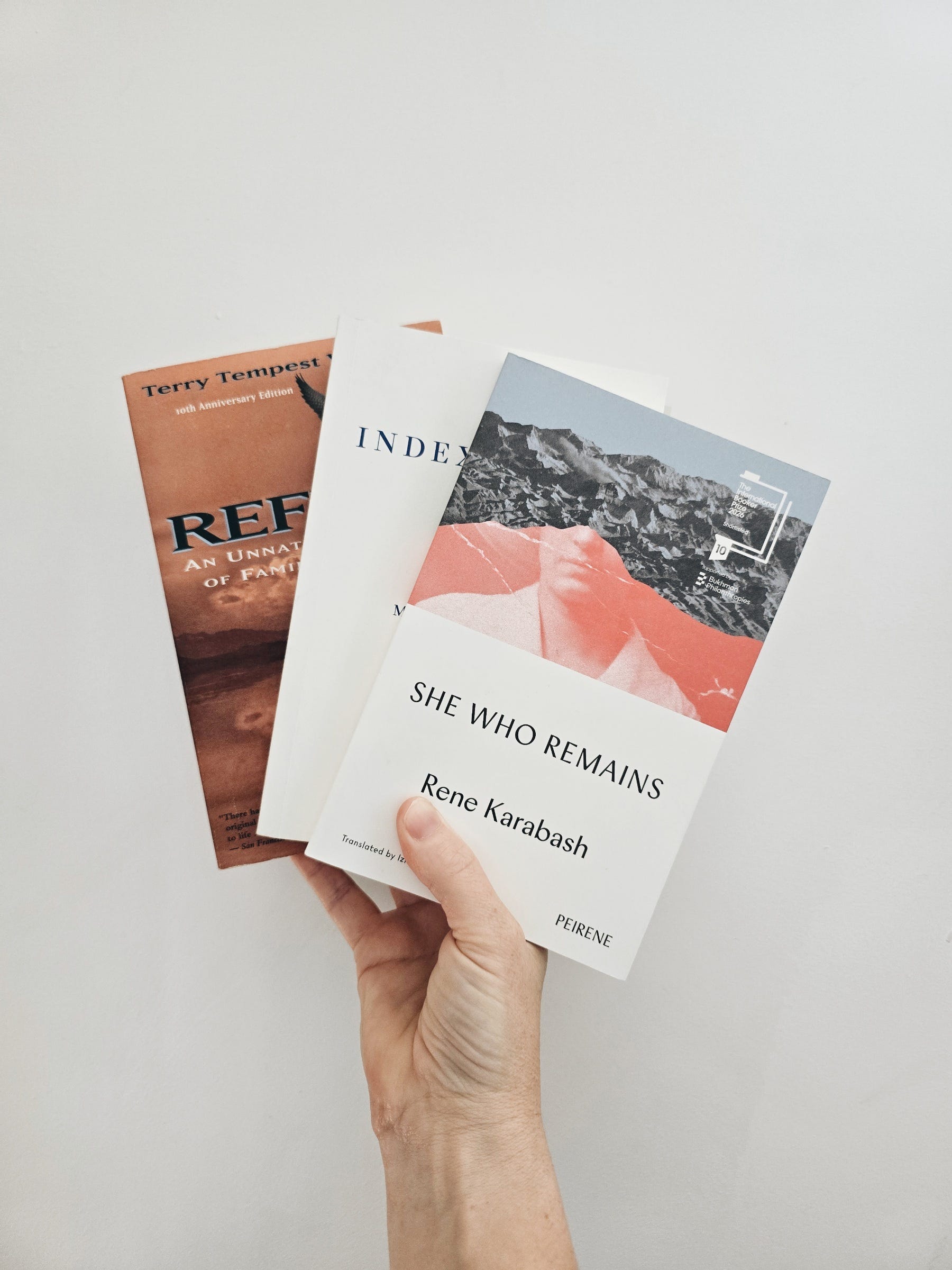
Index Cards by Moyra Davey
This ‘collection’ of ‘essays’ (which is actually a book length series of vignette pieces or ‘index card’ length prose notes), was one of the first non-fiction books I read this year. While some of her index cards I skipped through quickly, many were engrossing and wise and incredibly smart in the connections she is able to weave between ideas and sources and so forth. This is the sort of book that is about everything and nothing, and is perhaps most interesting for its overall assemblage as a complete work. It’s no secret that I like my vignettes, but I do also seem to have a particular penchant for photographers writing - last year I loved Sally Mann’s memoir Hold Still. There’s something about the way photographers view and write about the world in images that I find incredibly captivating as someone who is perhaps always dabbling in the other direction. I write, but I photograph too. Increasingly, I like to put both together. I love how they complete each other’s sentences somehow. But this is definitely far from only being about photography. It’s really a book of life. In one of her final ‘index cards’ titled ‘The Problem with Reading’ she quotes essayist Montaigne: to live is the most illustrious of your occupations…to compose our character is our duty, not to compose books”. Wisdom, buried in wisdom - this book is full of such notes to self. Some people write on set themes and preoccupations and show little of themselves, some of us write in such a way that we mostly show ourselves over and over through a disparate bunch of ideas. I think I fall into the latter, and enjoy finding other writers who do the same (but better).
She Who Remains by Rene Karabash
This is my favourite book of the year so far. My tastes are so defined at this point in my life that I know if I’m going to love a book sometimes based simply on title and (indie) publisher, and this was exactly the case with She Who Remains, which made it onto the International Booker shortlist. Firstly, it’s set in the Albanian Accursed Mountains - an area of the world I have an unnatural fascination with. Secondly, it’s novella length with a slightly quirky form on the page. Thirdly, it is poetic and immediate, written in a briskly paced first person point of view. Fourthly, it is on a ‘real’ topic I know little about - the last Sworn Virgins of the Albanian Highlands - but raises contemporary issues around freedom, love and societal norms. Lastly, it is a book in translation (brilliantly). BINGO! Yes, all the ingredients were there and delivered as I knew they would. I won’t say much more than I already have, I simply encourage you to read it if these sorts of things are on your bingo list too. It’s sat here in a special place in my office reserved for books that I wish I had written; books that have become my ‘hero books’, to whom I look for inspiration on style, form and execution.
The Island of Sea Women by Lisa See
I’m surprised it has taken me as long to read this book as it has, but it was one of the selections for our village book club and so I was delighted to finally get stuck in (also delighted to read a book club read that I actually like!). Set on Jeju Island, South Korea, the book follows the lives and bond of two best friends as they become haenyeo or free-divers in the matriarchal society of pre-war Korea, and follows them to the modern day when so much has changed through war, colonisation, political betrayals and personal tragedies. I absolutely loved how immersive this book was, carrying me through decades of time, in a place I have never been but have a lot of interest in knowing more about. I don’t read many big historical fiction novels because I often find them too sprawling, but this never felt overly long even at its most disturbing points. In the end, it’s a remarkable tale of generational trauma and forgiveness in a unique female culture that today teeters on the brink of extinction (a theme it shared with She Who Remains). A best-seller for a reason.
Refuge by Terry Tempest Williams
I adore Terry Tempest Williams but seem to be reading most of her back catalogue backwards. Which is odd. Somehow I started with Erosions and have only now made it to Refuge. In fact, I didn’t know of its existence until I was researching the theme ‘Refuge’ this year in preparation for a project that I started to shape in 2025, and which I will be exploring on residency this summer. I couldn’t have been reading the ‘Also by the author’ pages very closely! This is a memoir by the author written back in the 1990s that charts the time in her 30s when many of the women folk in her family were being diagnosed with cancers, later attributed to the fall out of nuclear testing in the 1950s. In the book, TTW documents the sanctuary she sought in the Great Basin Lake bird refuge, Utah, as its waters rose and fell over a period of years, tracking the changes within her own family and sense of security/precarity in her changing environment. Each chapter is named after a bird, the lake level noted, as she reflects on the changing meanings of the word ‘refuge’. At first, I was predictably aghast to find a book doing something tangentially similar to what I had in mind for my project - exploring refuge - but quickly had the profound feeling that I was simply picking up yet another thread of conversation with her. What a gift then! I know I’ll be keeping this close as I explore what ‘refuge’ means to me 35 years later. There’s nothing new under the sun, and sometimes there is odd comfort in that.
Mere by Danielle Giles
I’m going to be completely honest - I’m very taken with convent literature (con-fic? nun-lit?) and absolutely can’t resist a tale of abbesses behaving badly, exiled modern women fleeing to cloistered places, strong female characters having their habits dishevelled by other nuns, folk traditions troubling the catholic dogmas. Yes, please. Set in AD 990 in Norfolk, this book follows one bleak season or so when dark trouble arrives at the monastery on the mere, told through the eyes of the convent Infirmarian. I think what I love about nun-lit aside from their female focus, is how they can’t help but take on a fablistic or allegorical quality - they are always in a world set apart, they are always timelessly removed from modern trappings, they can’t help but have a morality baked in even if that gets turned on its head. I realise as I write this, that the genre embodies that theme of ‘refuge’ that I’m interested in more widely, which is to say a convent is a type of refuge, and so a book about a refuge, then becomes a meta-refuge…throw in some strong women, some suppressed women, some matriarchal women…and I’m straight back in my usual preoccupations. Not all convent books are created equal, but I especially loved the well-researched poetic prose in this one. It’s a bit lusty, a bit magic and very waterlogged.
It will be interesting to see whether my selection now still holds come December. I already feel bad for the close-runners that narrowly made the cut, of which there were about ten! Will these ones still shimmer, or will they be dulled by greater finds in the second half of the year?
I also have a few books on the go that I didn’t finish in time for this review but that I am really valuing - books like Memento Mori by Joanna Ebenstein, which I am studying slowly - so I am loathe to nail my colours to the mast too early as there are going to be some influential books incoming!
Let’s see!
Comments
Nothing yet. Say the first thing.
Sign in to join the conversation.