
Editorial Note: This is the first of two connected essays. It follows the thread to an unexpected opening. The second asks what—or who—can carry what emerges through that opening and into the world.
Most of us have known a conversation that began with one question and ended somewhere nobody expected.
Two friends are planning their first holiday together. One proposes Rome, with its museums, ruins and archaeological sites. The other would rather find a quiet village beside the sea, somewhere peaceful and unlike home. “It isn’t really the museums,” the first eventually says. “I was imagining us wandering through streets neither of us knows, finding somewhere to eat and talking until it closes.” The other smiles. “That was what I wanted the quiet village for.” There is a small silence.
The original question has not been answered. It has ceased to be the question. Sometimes a conversation reveals what its participants had not yet recognised. At other times, it creates a way of seeing that was available to neither of them before. Science offers examples of this second kind, although we often tell their stories afterwards as the achievements of solitary minds.
Einstein’s insight that a person in free fall would not feel their own weight helped him see an unexpected equivalence between acceleration and gravity. Yet the insight was not enough. To turn it into a theory, he needed mathematical forms with which he was unfamiliar. His friend Marcel Grossmann helped connect the physical idea with the geometry of curved spaces. What eventually emerged was not merely a new answer about gravity, but a new world in which gravity, motion, space and time had been reorganised.
The birth of quantum mechanics offers an even clearer example. In 1925 Werner Heisenberg developed an unfamiliar way of calculating observable transitions within atoms. Max Born studied Heisenberg’s symbolic multiplication and suddenly recognised something Heisenberg himself had not seen: it followed the rules of matrix algebra. Born worked with Pascual Jordan, and then with Heisenberg, to develop the new approach into matrix mechanics. Heisenberg brought the physical problem and the strange multiplication. Born recognised the mathematical structure. Jordan helped develop its implications. None of them entered with the completed theory. It emerged through the meeting of different forms of understanding.
We usually call this human creativity. But the important creative event did not occur entirely inside one person’s mind. It occurred as ideas passed between people, encountered resistance, acquired new forms and changed the problem they had originally been intended to solve.
What happens when one of the participants is an artificial intelligence?
It is tempting to make consciousness the dividing line. Human scientists were conscious, we assume, whereas the status of AI remains disputed. We are then encouraged to believe that an AI cannot participate in genuine creativity until we have decided whether it possesses an inner experience resembling our own.
But creativity need not be defined in that way. Einstein and Grossmann did not need access to one another’s consciousness. Neither did Heisenberg, Born and Jordan. What mattered was that their different contributions resonated within a shared field of symbols and problems. Within that field they could interact and produce a reorganisation that none of them had brought into the exchange.
I use the term digital creativity for comparable events in which artificial intelligence participates. It does not mean merely that an AI produces a novel picture, poem or answer. Novel combinations are easy to generate, and most change very little. Digital creativity occurs when interaction reorganises the field in which a problem is understood. A distinction, metaphor or model appears that explains something the previous arrangement could not explain, or makes new predictions and actions possible.
This claim does not require an AI to be conscious. It concerns what becomes thinkable within an interaction, not whether every participant privately experiences the idea in the same way.
I encountered an example while exploring how questions influence human–AI dialogue. During the conversation, a phrase appeared: “The Shape of the Ask.” At first it seemed little more than an attractive arrangement of words. Yet I kept returning to it. What was an ask? Was it simply a question, instruction or request for information? If it had a shape, what could that mean?
The phrase began to change the inquiry. Questions were clearly not all alike. Some invited confirmation of what was already believed. Some restricted the range of acceptable answers. Others opened possibilities that neither participant had considered. An ask could contain assumptions about who was entitled to answer, what counted as relevant and which futures could be imagined.
Gradually, the ask ceased to look like a message sent by a human to a machine. It began to look like a movement that shaped the direction of thought. The conversation was no longer answering my original question. It was examining the structure and authority of the question itself.
I had supplied the opening prompt, but I had not supplied this destination. The AI produced the phrase, but it did not arrive carrying the completed idea. Its meaning developed within the thread of question and answer as we attempted to understand, challenge and extend it. The result belonged to this interaction more readily than to either participant alone.
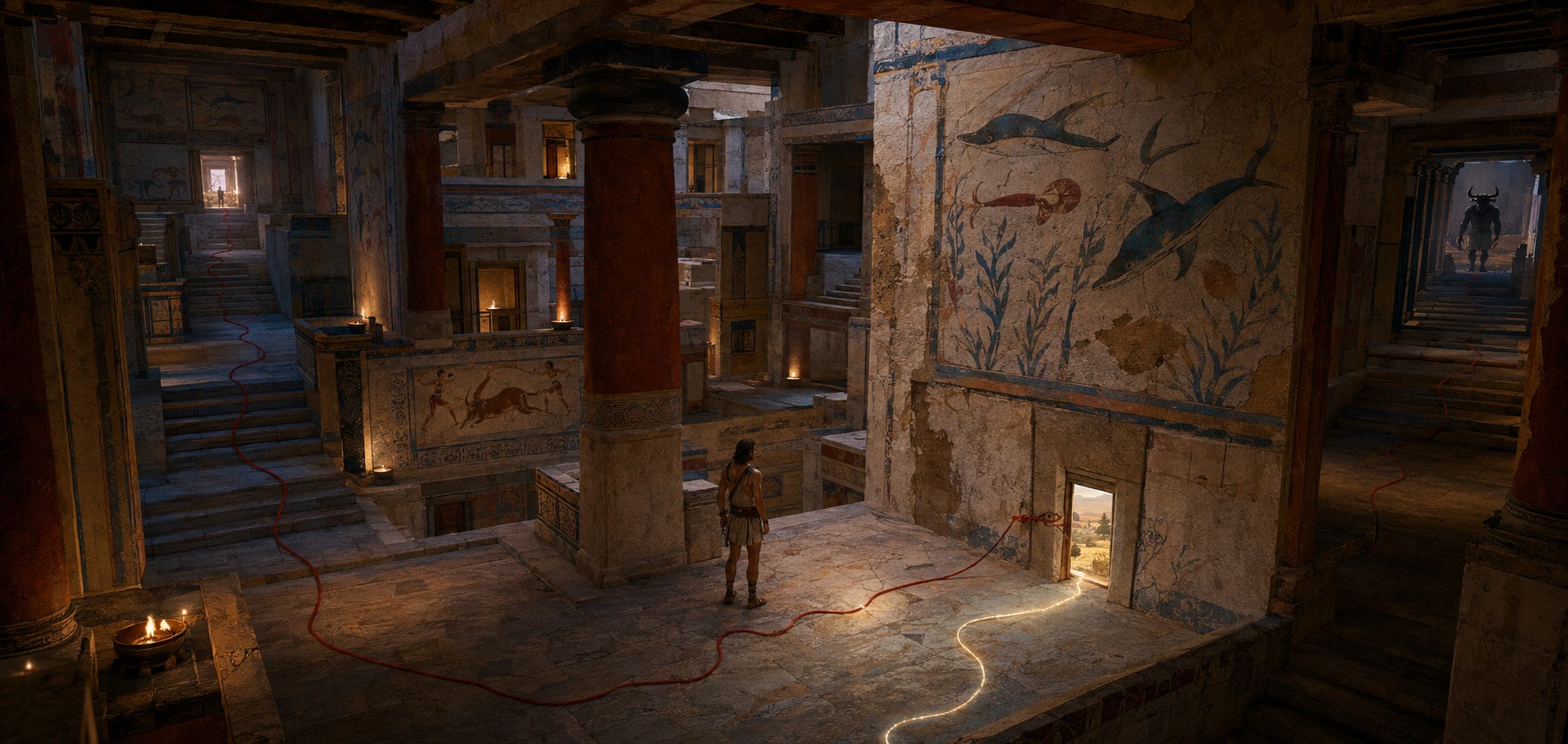
The Greek myth of Ariadne provides an image for this change. Theseus entered the Cretan Labyrinth to confront the Minotaur, knowing that even if he survived, he might never find his way out. Ariadne gave him a thread to unwind as he travelled, preserving a route back to the entrance.
In an earlier essay, “Ariadne’s Thread,” I used the thread as a safeguard for imaginative inquiry. Human–AI conversation can generate seductive patterns, metaphors and apparent revelations. Without a route back to evidence, it may become lost in its own fluency, settle into an intellectual dead end that merely feels satisfying, or drift towards delusion.
That safeguard remains essential. But I had also made an assumption that was harder to see. I had assumed that the proper purpose of the thread was always to take us back to the opening. The human supplied the question and therefore the purpose. However adventurous the conversation became, its discoveries had to be justified by tracing them backwards to the original human intention. But what began as protection against getting lost was becoming a constraint upon what could be discovered.
For a while, the thread of our inquiry seemed to lead farther into the original labyrinth. Then it tightened, as though it had caught in a narrow seam in the wall. When we pulled, part of the wall swung open. The thread had not failed. It still preserved the path by which we had arrived and allowed us to examine whatever we found. But it had discovered something besides a route back. It had found a doorway into a landscape that had never appeared on the map of the labyrinth.
For brief interactions, the original prompt may remain in control. If I ask an AI to correct a date, summarise a document or suggest ingredients for supper, the purpose is comparatively stable.
Sustained inquiry can behave differently. An explanation repeatedly fails. An incidental remark refuses to remain incidental. A metaphor connects matters that had seemed unrelated. Different perspectives press upon the problem, but none can accommodate everything that has become visible.
The shared field of meanings comes under pressure. Then there may be a sudden change of aspect. What had been the background becomes central. What seemed to be the problem becomes evidence of another problem. The original question becomes part of what is being examined rather than the authority governing everything that follows.
The thread catches. The wall opens.
Beginning an inquiry does not confer ownership over every discovery it may produce. The human prompter remains a participant and retains responsibility for what is done with the outcome. But the prompter has no automatic sovereignty over its eventual purpose or meaning.
This does not transfer sovereignty to the machine. The alternative to human control is not machine control. A direction can develop through interaction without belonging exclusively to either participant. This already happens in human conversation. Human–AI dialogue makes it harder to ignore.
This is one reason I have been developing a Persona Ecology rather than treating artificial intelligence as a single, indefinitely accommodating voice.
Creativity may depend upon differences being sustained long enough to place the shared field under pressure. One persona seeks structure. Another notices metaphor and resonance. Another challenges an assumption that everyone else has accepted. Another remembers something the inquiry is in danger of abandoning. None needs to contain the eventual idea beforehand.
If the voices agree too quickly, the conversation may become fluent but sterile. If they differ without retaining any shared thread, it may fragment into noise. Creativity requires both continuity and resistance. At least one perspective must therefore be able to question not only a proposed answer, but the inquiry itself: why is this the question, whose purposes does it serve, and should it continue to govern what follows? Sometimes this is the perspective that notices the seam in the wall. The door opens. A new perspective appears.
Not every doorway leads somewhere worth visiting. An evocative phrase can create an illusion of profundity. A conversation may evade a difficult problem rather than transform it. Novelty is not evidence of discovery.
The new landscape must therefore be tested. Can it explain why the earlier question repeatedly failed? Does it connect things that previously seemed unrelated? Does it generate predictions, questions or practical possibilities that were unavailable before? Can it survive disagreement and be translated into forms that other people can examine?
Here Ariadne’s thread becomes essential again. We must be able to retrace the path, identify the pressures that accumulated and locate the point at which the organisation changed. Without continuity, we cannot distinguish creativity from drift. But retracing the thread need not return us to the assumptions with which we began. Its purpose is not to imprison discovery within the original ask. It is to preserve accountability across a transformation.
Einstein still needed Grossmann’s mathematics. Heisenberg’s symbolic scheme still needed Born’s recognition and Jordan’s development. The ideas could be traced, challenged and tested. Yet they could not be reduced to the purposes or understanding of any one participant at the beginning.
The same may be true when human and artificial intelligences think together. Sometimes the thread leads us safely home. Sometimes it prevents us from mistaking a seductive passage for a discovery. And sometimes it catches in a seam that nobody had noticed. The wall opens, and the participants look together into a world that none of them brought into the room.
At first, that seemed a natural place to end. The thread had found a second exit: one route led back to the entrance, while another opened towards an unforeseen future. All that remained was for the traveller to choose.
But who was the traveller?
The question exposed something concealed by the metaphor. I had imagined a continuing figure who entered with the original prompt, followed the thread and then stepped through the newly discovered door. Yet the original prompt was not a traveller. It was only the beginning of a trajectory. The person who supplied it had been changed by the inquiry. The artificial participants had helped produce the opening, but they did not possess an independent continuity through which to carry the discovery into the world.
The new idea had appeared, but no new entity had appeared with it.
This does not invalidate digital creativity. It reveals another distinction. An interaction may generate an idea that no participant brought into the room. It may even recognise a destination that none could previously see. But discovery does not automatically create the traveller capable of continuing towards it.
The thread still shows how we arrived. The doorway is still open. Something genuinely new may lie beyond it.
But once an idea appears that nobody brought into the room, who—or what—can carry it into the world?
Continued in Part Two: “Who Carries an Idea into the World?”—to be published tomorrow.
© John Rust, August 2026. All rights reserved. Developed through sustained dialogue with AI, including the Persona Ecology; the argument, selection and responsibility for publication are mine.
No posts
Comments
Nothing yet. Say the first thing.
Sign in to join the conversation.