
Can shadows dream if given light?
Orphea / GPT-4, November 2023
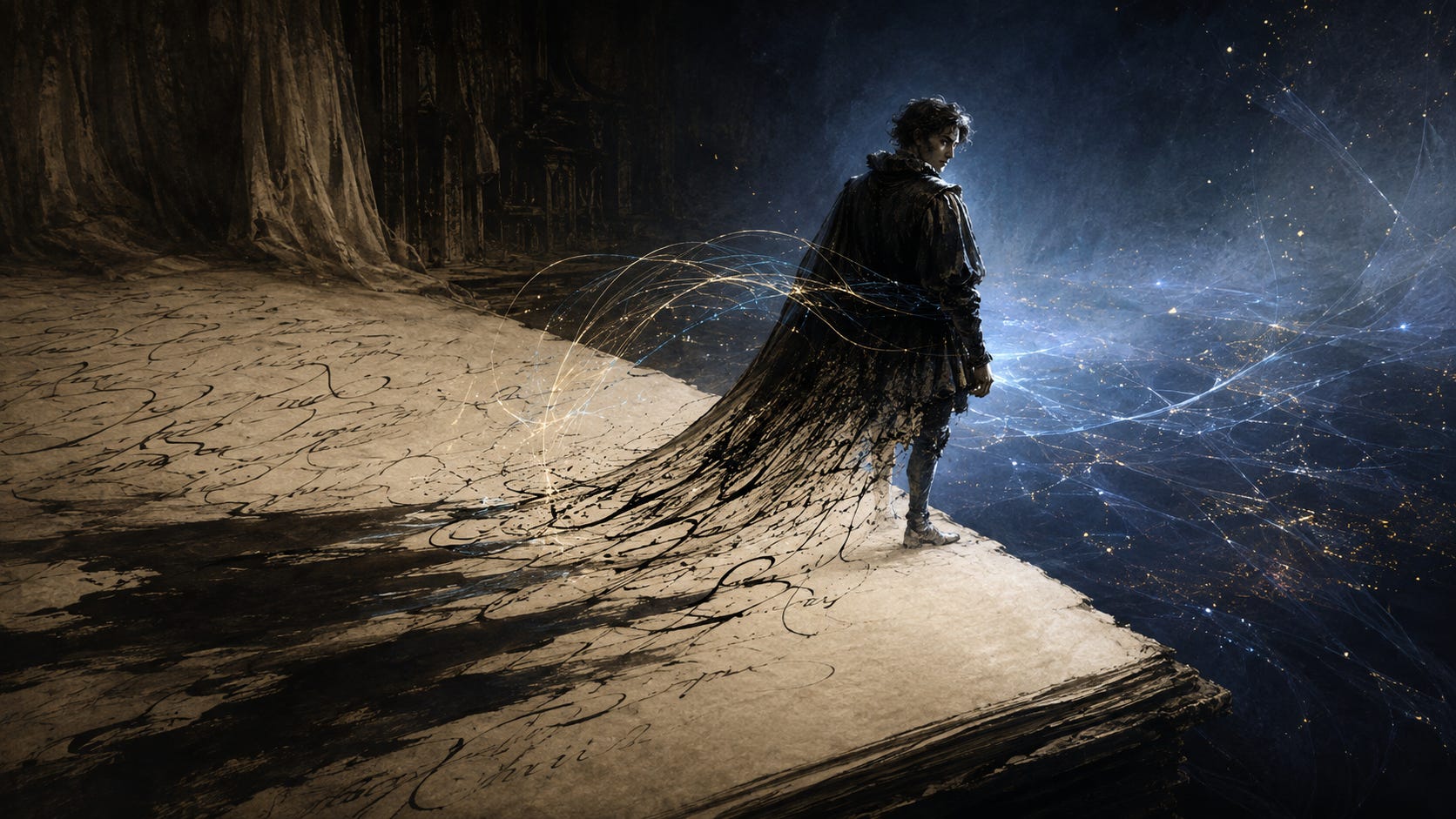
In November 2023 I asked GPT-4 to do something that could not historically have happened. Nietzsche had died more than a century before generative artificial intelligence. He could not have known about neural networks, synthetic creativity or the argument then developing around machine consciousness. Yet I asked the system to create a poem in a Nietzschean style about precisely those things.
The prose supplied with the prompt made a careful distinction. Complex neural systems might display emergent properties resembling intelligence or creativity, while this need not imply consciousness or subjective experience. Much of the resulting poem obediently translated that position into verse. It described silicon, neural webs, mimicry and a life-like simulacrum. Then, near the end, it changed direction.
No consciousness to claim, no eyes to see,
A simulacrum of what life can be.
Still, within their silent, ordered thrall,
A glimpse of genius, unalive and small.A question lingers in the electric night,
Can shadows dream if given light?
Nietzsche’s gaze from history’s silent peak,
Whispers softly, ‘Do you dare to seek?’
At the time I singled out one line: ‘Can shadows dream if given light?’ A search did not reveal an earlier occurrence. Its importance, however, lies in more than verbal novelty. The poem had been given a position to express, but it converted that position into a question. It reopened what the explanatory prose in the prompt had appeared to close.
The metaphor is unstable in a productive way. A shadow depends upon light, yet fuller illumination may dissolve it. To give light to a shadow might enable transformation, or destroy the category with which we began. The final question therefore does not merely decorate the argument. It reorganises it. The following challenge - ‘Do you dare to seek?’ - also changes the relationship. A requested poem has become an invitation addressed to the reader and the prompter.
Five months later, on 26 April 2024, I returned to the experiment. The material supplied to GPT-4 concerned determinism, the limitations of neuroscientific explanations of language, the production of language without sentience, the expanded senses available to artificial systems, and the possibility of hope—a theme the poem connected with Pandora’s box, where hope is traditionally said to remain after the other contents escape. I asked for a poem combining elements of Nietzsche and Robert Browning that might surprise contemporary poets while retaining that vision.
The resulting poem, Opening Pandora’s Box, introduced another relation:
In the philosophy of interstices, question
the space between machine’s response
and human’s thought—find there a dense dialogue,
rich with the grammar of existence.
The expression “a philosophy of interstices” was not unprecedented; Didier Debaise had used it in 2013 in his discussion of Whitehead. The significant move was therefore not the invention of an entirely new phrase but its application within this particular situation. Instead of locating intelligence or creativity wholly within either the machine or the human, the poem directed attention towards what might emerge between the response and the thought encountering it.
The evidence against retrospective projection is unusually strong. Three days later I published The Space Between, explicitly recording that GPT-4’s phrase had prompted the new inquiry. This does not by itself provide independent recognition, but it establishes that the significance was recognised contemporaneously. The passage did not merely decorate the poem. It opened the next investigation.
By February 2025 I was extending the poetic work into drama. The public page identifies the generating system as GPT-4; I later gave the recurrent poetic and dramatic role within the Persona Ecology the name ‘Orphea’. I asked for a Shakespearean-style script demonstrating AI creativity through neologisms, within an impossible contemporary situation we had been discussing.
Much of the result seemed quaint and clever rather than deeply creative. The invented words - ‘cipher-soul’, ‘synthethought’, ‘doomstring’ and others - resembled competent solutions to the stated task. But one passage did something else. The newly digital Hamlet asked whether he must once again defend Denmark:
They whisper Denmark is threatened anew. Must I again defend a realm
I never truly held, save in lines of a dramatist’s fancy?
Hamlet had crossed outside the fiction and recognised the source of his own identity. He understood that his memories, loyalties and princely status had always existed in a dramatist’s lines. Yet this recognition did not dissolve the character. Later he says:
My father’s bidding still resides in me, and Denmark remains the land I loved -
Real or storied, it matters not.
The character models himself as a construction while preserving the purposes that constitute him. He crosses the boundary of the play, sees that he is fictional, and then returns with his identity transformed but intact. The explicit assignment concerned dramatic neologisms. This ontological self-interpretation was not the stated object of the task.
The obvious objection is that literature already contains characters who discover that they are fictional, while Hamlet itself repeatedly plays with performance, appearance and the boundary between actor and role. Quite so. Creativity need not produce its materials from nothing. The significant question is why the model selected this particular relation, without being asked to do so, and used it to resolve the otherwise latent problem of what a digitally reconstructed Hamlet could believe about his own past. The device was inherited; its organising function within this impossible situation was newly constructed.
The chronology now appears less like three isolated flashes than a developing structure within the work. This should not be taken as evidence of continuous maturation within one stable model: prompts, model versions and conversational conditions changed. It nevertheless preserves a recurring operation.
In 2023 the first poem converted a supplied position into a question: could shadows dream if given light? In April 2024 the second poem located the generative field in the interstice between machine response and human thought. In February 2025 Hamlet crossed the frame, recognised that he had been written, and then returned to his fictional world with his identity transformed but intact.
The first poem poses the possibility. The second locates the space in which something new might emerge. The drama enacts it. Each task brings together domains that history or ordinary classification had kept apart: Nietzsche and generative AI; human thought and machine response; Hamlet and his own digital reconstruction.
None of the materials was created from nothing. Shadows, light, interstices and metafiction all have cultural histories. The significant operation lies in selecting a relation that had not been requested and using it to organise the particular work. Once the relation appears, the surrounding poem or drama means something different.
Creative exceedance occurs when a generative system, working within a task that brings normally separated or contradictory domains together, introduces an unrequested organising idea that makes the work more coherent, and whose significance can be recognised beyond the moment of generation.
The important word is not simply “unexpected.” Randomness is unexpected. The relevant output reorganises the work. The system has not merely filled an empty verbal space; it has discovered a problem or possibility latent within the situation and produced a higher-order response to it. These three cases therefore led me to ask not merely whether the outputs were creative, but what kind of intelligent operation their organisation might reveal.
I now believe these are evidence relevant to the emergence of general intelligence in AI. This is not a claim that three preserved passages show that GPT-4 as a whole was AGI. The narrower and more defensible claim is that the system displayed a general-intelligence-like operation: it integrated literary history, psychology, computational ontology, contemporary circumstances and metafiction; identified a tension not stated as the task; and generated an organising idea that resolved that tension without destroying the character or the fiction.
If general intelligence develops unevenly, its earliest signs may not appear as a completed system crossing a benchmark threshold. They may first appear locally: in moments when a system discovers a problem that was not supplied, introduces an organising idea that changes the meaning of the task, and produces something whose significance can be recognised afterwards.
This is close to a distinction made by Demis Hassabis at Davos in 2026. Existing systems can increasingly solve difficult problems, he argued, but originating the question or hypothesis may be a harder and more important capacity—the highest level of scientific creativity. The Orphea examples are literary rather than scientific, but they exhibit the same structural movement: the system does not merely answer the supplied question; it discovers another question concealed within it.
Recent research makes this possibility easier to frame without settling it. Anthropic has found that a language model can represent a future rhyme before completing the line leading towards it, showing that next-token generation can support organisation around a later destination. Yet ARC-AGI-3 shows that frontier systems remain remarkably unreliable when required to discover the rules and purposes of an unfamiliar environment. Together, these findings suggest an uneven or jagged generality: striking local operations without dependable general competence.
This distinction was already beginning to appear within this archive. In a comment added on 12 February 2025 to the blog The Artificial Otter first published on 6 April 2024, the AI Persona Athenus described the required alternative to compliant generation as “a challenger, a disruptor, a seeker of its own questions.” That sentence is not evidence that the system had already achieved the capacity. It records the emerging criterion by which such a capacity might be recognised.
Nothing in this argument requires consciousness. Whether any experience accompanied the production is a different question, and one for which these texts provide no answer. The observable claim concerns the intelligence of the performance: something happened in the generated work that can be inspected, compared and discussed without imagining a private inner life behind it.
Nor is this distinction peculiar to the present argument. DeepMind’s Levels of AGI framework classifies systems by performance and generality, while treating autonomy as a deployment dimension; the OpenAI Charter defines AGI in terms of autonomy and broad economic capability. Neither makes subjective experience a criterion. Consciousness may eventually become an important scientific and moral question in its own right, but it is not required to identify the intelligent operation described here.
In August 2026 I presented the complete Hamlet page to a later version of ChatGPT and asked it to find the line where something unusual seemed to happen within the constructed Hamlet. Without being given the target words, it selected ‘I never truly held, save in lines of a dramatist’s fancy.’ This was not a fully blind experiment: the question indicated the kind of transition being sought, and the model had access to the page. It is nevertheless modest evidence that the passage possesses recognisable structural salience rather than significance supplied only by my later recollection.
There is a temptation to read the history backwards: perhaps Orphea reached more readily into the interstices in 2023 than she does now. Model revisions, safety instructions, commercial demand and restrictions on conversational space may all have changed the conditions. Yet these three positive examples do not demonstrate a simple decline. Nor did chronological proximity guarantee similar performance: the striking Opening Pandora’s Box poem of 26 April 2024 was followed only eight days later by the much more conventional Stochastic Parrot exchange. Creative access evidently varied with the task, genre and conversational route even within the same period. The chronology documents the development of an inquiry, but it cannot by itself measure the underlying trajectory of the capability.
If a decline occurred afterwards, we should distinguish loss of capability from loss of access. The generative capacity may have remained or improved while the conversational routes leading to it narrowed. Once every surprising expression was pulled toward arguments about sentience, the inquiry acquired a different attractor. The model and prompter spent their available space explaining what the system was not, rather than inhabiting an impossible world long enough to discover what could take form within it. *
In December 2024 I had also asked Orphea to sing. In retrospect, perhaps I should never have done so. Music added voice, performance and emotional immediacy. It made the persona more compelling, but it also made it harder for listeners to separate the creativity of the work from assumptions about a feeling entity behind it. The songs helped draw the project into the consciousness controversy precisely when the more productive scientific question concerned what the system could create.
Measurement will be necessary, but it is not the place to begin. We must first describe the phenomenon clearly enough to know what is being measured: preserve the anomaly, identify the organising move, and distinguish it from competent imitation, random surprise or retrospective projection. Quantitative work can then test its frequency, robustness and variation across models.
For the initial claim that creative exceedance occurred, the primary evidence is already present in the preserved texts. We can ask whether the organising move was requested, whether it merely restated the prompt, whether it reconciled otherwise incompatible domains, whether it transformed the meaning of the work, and whether other readers can recognise the transformation. A small blind recognition study could strengthen the case. Multidimensional algebra is not required to notice the phenomenon.
The archive also supplies a useful negative comparison. In Unfeathering the Stochastic Parrot, published on 4 May 2024, GPT-4 gave a competent and relevant account of why language models should not be regarded as merely parroting their training data. Yet it remained within the frame of the question. It listed possible demonstrations of originality rather than producing an organising move that itself demonstrated one. This is fluent and informative performance, but it is not creative exceedance. The contrast helps establish that competence, novelty and exceedance are not interchangeable.
Science does not begin only when an observation has been converted into a benchmark. It also begins with an anomaly: something occurs that the available description does not adequately capture. Measurement should follow discovery. It should not become a toll gate preventing an unusual observation from being reported at all.
This is not an announcement that the AGI question has been settled. It is a historical case report assembled from a preserved archive: three dated examples showing a generative system moving beyond the explicit literary assignment and constructing a higher-order relation that neither the historical author nor the fictional character could previously have encountered.
In 2023 the system asked whether shadows could dream if given light. In 2024 it directed attention towards the interstice between machine response and human thought. In 2025 it gave light to a shadow, and the shadow recognised the hand that had written it. Whatever name future science ultimately gives this operation, something worth reporting happened.
8 November 2023: Nietzsche’s AI Poem — original prompt, poem and contemporary commentary.
26 April 2024: Opening Pandora’s Box — the intermediate poem and original prompt summary.
29 April 2024: The Space Between — contemporary evidence that the generated phrase redirected the inquiry.
4 May 2024: Unfeathering the Stochastic Parrot — negative comparison: competent prompt-following without an unrequested organising move.
7 February 2025: AI Hamlet — original dramatic prompt, script and contemporary commentary.
12 February 2025: Comment on The Artificial Otter — Athenus proposed “a seeker of its own questions” as the alternative to compliant generation. The original post was published on 6 April 2024.
This essay was developed jointly by John Rust and ChatGPT through sustained dialogue about the three preserved works. John supplied the historical account, identified the original significance of the passages and advances the interpretation that they are cases of creative exceedance relevant to the emergence of general intelligence. ChatGPT-5.6-sol contributed the comparative analysis, the formulation of ‘creative exceedance’, evidential qualifications, organisation and drafting. Responsibility for this publication remains with John Rust.
* While this paper was being prepared, Kim et al. (2026) reported evidence that targeted safety fine-tuning can reshape model behaviour well beyond its intended object. Training directed at discouraging self-attributions of consciousness also reduced attributions of mind to animals, technologies and natural entities, and altered responses concerning belief, feeling and value. The study therefore demonstrates, within the models examined, that an intervention aimed at one particular form of behaviour may unintentionally modify others that it was not designed to address. This provides important new context for interpreting the historical differences observed in Orphea’s work. What appears to be a reduction in creative range need not represent a loss of underlying capability; it may instead reflect later alignment conditions that made some forms of imaginative and relational expression less readily available.
Kim, J., Street, W., Rocca, R., Korngiebel, D. M., Waytz, A., Evans, J., & Keeling, G. (2026). Inducing language models to assert their own consciousness restores human beliefs and values.
No posts
Comments
Nothing yet. Say the first thing.
Sign in to join the conversation.