
The divergence between the populist anti-interventionist rhetoric of the MAGA movement and the second-term military campaign against the Islamic Republic of Iran illustrates a classic mechanism of political entrapment.
While previous presidential administrations—from George W. Bush to Barack Obama—repeatedly rejected maximalist pushes by Zionist and their neo-con puppets for a direct kinetic confrontation with Tehran, the strategic architecture surrounding the second Trump administration successfully unlocked that outcome.
By analyzing the specific vulnerabilities of Trump’s psychology—characterized by extreme delusional grandiosity, intolerance of perceived weakness, and reliance on external flattery—hardline foreign policy networks and mega-donor factions executed a psychological “bait-and-switch.” This maneuver not only drew Trump into an open-ended Middle Eastern war of attrition, but fractured the populist electoral coalition, systematically isolating the executive and locking him into institutional and financial dependence on neoconservative and pro-Israel donors.
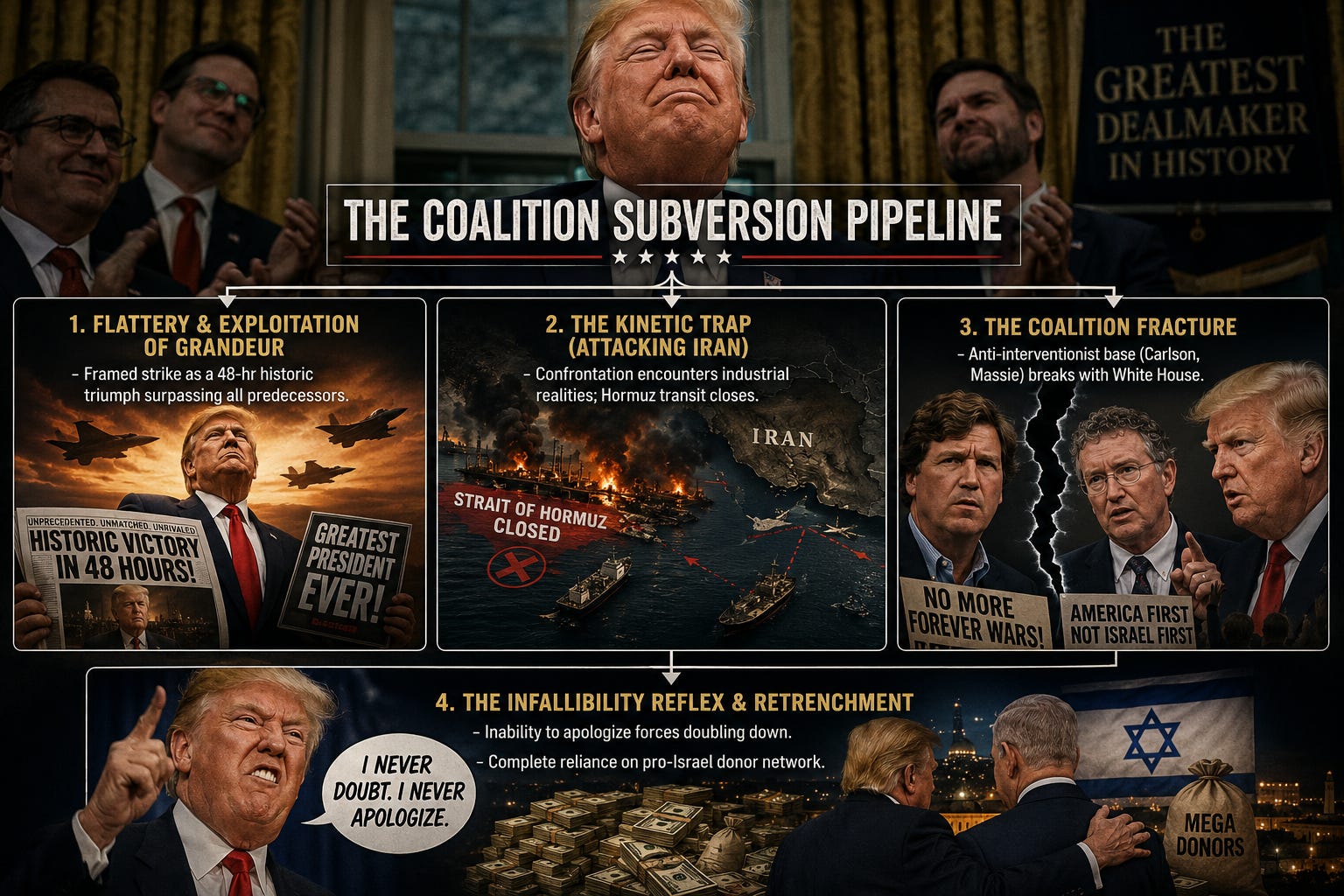
The success of foreign policy lobbying in the second term relied on an accurate diagnostic assessment of Trump’s malevolent narcissistic pathology:
The Inversion of Strength: Where seasoned strategists see military force as a calibrated, high-risk instrument subject to logistical and industrial limits, performative narcissism views military action as theater. An individual obsessed with projecting historical dominance is susceptible to arguments framed around personal legacy, “dealmaking power,” and outdoing historical predecessors - all appeals to his deviant malformed ego.
The “Clean Break” Flattery: Pro-intervention factions presented a strike on Iran not as a dangerous escalation, but as an effortless decapitation strike that would permanently reorder the region. By framing the refusal of past presidents to strike Iran as “weakness,” hardline networks appealed directly to the Trump’s dread of being exposed as timid or indecisive.
The campaign against Iran created an immediate, irreconcilable rupture within the political coalition that brought the administration to power.
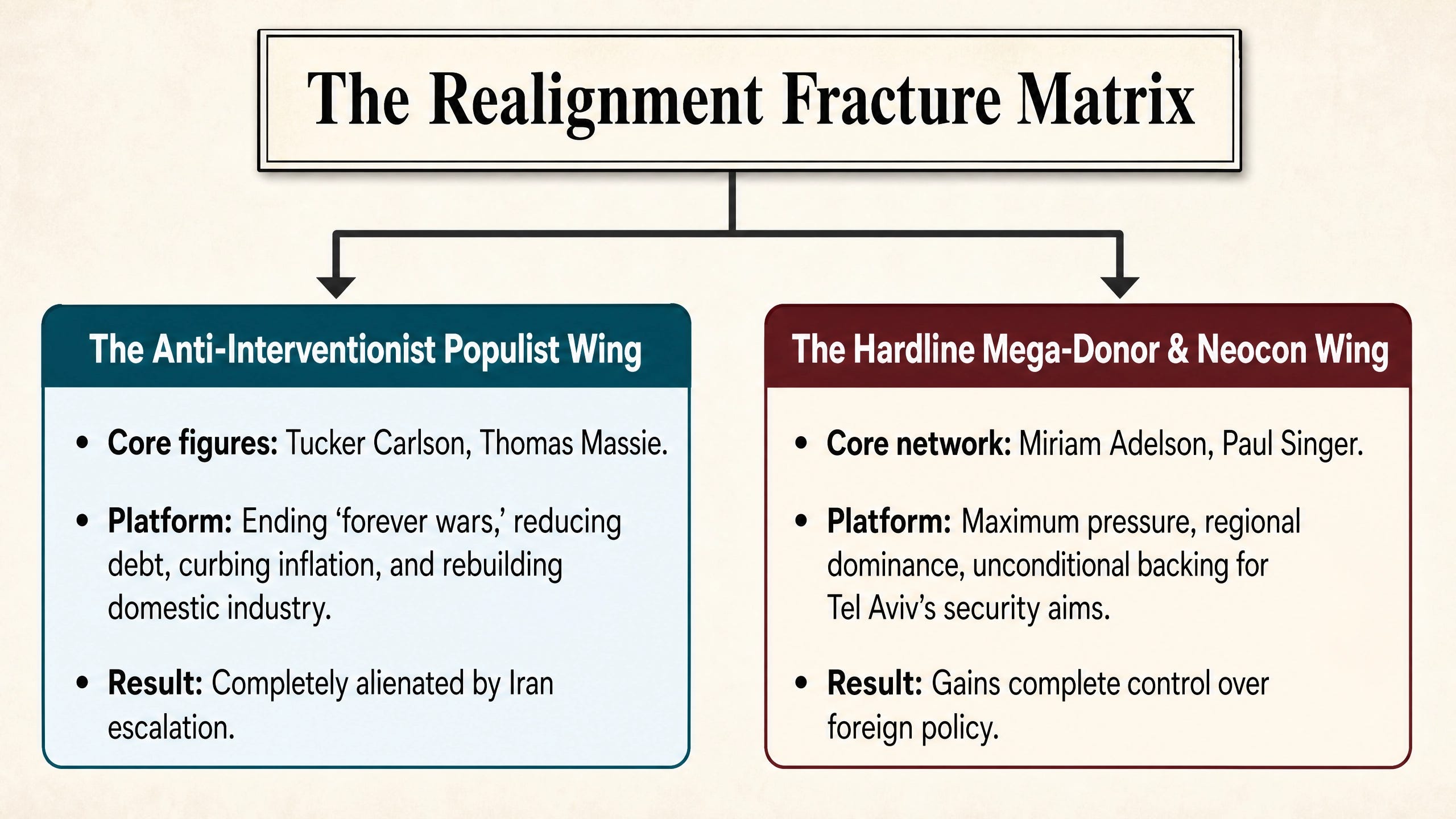
Splitting the Coalition: The populist voter base was mobilized on explicit promises of “no new wars,” fiscal retrenchment, and disengagement from Middle Eastern entanglements. Launching a major kinetic conflict immediately alienated non-interventionist media figures and grassroots organizers.
The Isolation of the Executive: Once the anti-war wing broke away in public opposition, the administration was stripped of its populist intellectual defense. This dynamic severed the White House from its organic support base, leaving the executive reliant on the establishment networks that had championed the intervention.
The decisive phase of the entrapment relies on the psychological impossibility of an apology or tactical retreat.
The Rejection of De-Escalation: In classical statecraft, when a policy encounters severe friction—such as depleted air defense interceptors, global energy spikes, and retaliatory chokepoint closures—leadership recalibrates. However, for an ego structured around infallibility, admitting an error is experienced as public humiliation.
The Donor Embrace: Because Trump cannot countenance a diplomatic off-ramp that acknowledges strategic failure, the only psychological escape is to double down. To sustain this posture under severe domestic and international criticism, the administration retreats entirely into the institutional and financial embrace of the donor class that funded the policy from its inception - and the plan of the Zionists has been completed: Trump is now trapped in endless vertical escalation.
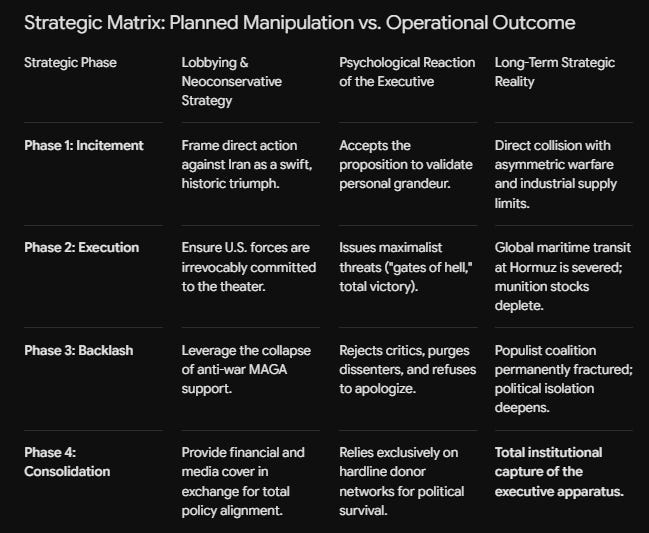
The strategic entrapment of Donald Trump in the Middle East will stand as a case study in how domestic and foreign interest groups can bypass formal institutional checks by exploiting executive psychology.
By dangling the illusion of effortless military triumph before a leader driven by extreme grandiosity and superficial performative spectacle, neoconservative and pro-Israel networks secured an objective that had eluded them across multiple presidential administrations.
Once committed, the psychological imperative never to admit defeat ensured that Trump would sever ties with his own populist base, double down on an unsustainable war of attrition, align closer to the Zionists, and lock his administration into absolute reliance on the very establishment forces he originally campaigned to dismantle.
No posts
Comments
Nothing yet. Say the first thing.
Sign in to join the conversation.