
On the ground in western Donetsk, Russian assault formations have outflanked Ukrainian positions southwest of Dobropillya, surrounding the remaining garrison inside the Bilytska coal mine and capturing the key tactical village of Dobropillya. This rapid advance threatens to collapse the southern flank of the entire fortified belt stretching from Sloviansk through Kramatorsk to Druzhkivka.
Concurrently, deep precision strikes by the Russian Aerospace Forces (VKS) have transitioned to systematically targeting Ukraine’s broad-gauge railway locomotive depots and the Danube delta riverine logistics hubs at Reni and Izmail.
These frontline fractures coincide with acute fiscal and energy shocks across the Western alliance: Ukraine’s budget deficit faces a $36 billion funding shortfall as Western macro-financial transfers stall, while European economies face critically depressed natural gas storage margins (roughly 50%) and the United States contends with soaring Treasury yields, elevated public debt, and the continuing maritime closure of the Strait of Hormuz.
In western Donetsk Oblast, Russian vanguard elements under Group of Forces Center and the 76th Guards Air Assault Division have achieved a decisive operational breakthrough around Dobropillya.
The Bilytska Mine Pocket: Russian mechanized columns have secured the town of Bilytske, completely surrounding a substantial Ukrainian garrison holed up within the reinforced industrial complexes of the Bilytska coal mine. Lacking overland supply or fresh water conduits, the pocket relies exclusively on heavy Ukrainian cargo-drone drops.
The Fall of Dobropillya Village: Russian assault groups secured the tactical village of Dobropillya, situated immediately southwest of the main town. Overrunning this position eliminates the primary defensive bastion shielding western Dobropillya, mirroring the maneuver seen at Selydove in late 2024 and exposing the urban core to multi-axis assaults from the east, south, and west.
Northern Transit Interdiction: Russian loitering munition teams have established direct fire control over the main highway leading into Dobropillya from the north, severing the garrison’s final motorized resupply corridor.
The Sloviansk-Kramatorsk Cauldron: Simultaneously, to the north, Russian forces have consolidated positions inside the eastern suburbs of Mykolaivka and advanced across the grounds of the Sloviansk Thermal Power Plant. Combined with the liberation of Andriivka and the push toward Zolotyi Kolodyaz, Russian forces are shaping a grand strategic encirclement enclosing tens of thousands of Ukrainian troops across the entire northern Donbass conurbation.
The Russian precision strike campaign has shifted its operational focus toward eliminating the physical transportation mechanisms that move Western-supplied military hardware to the frontlines.
The Broad-Gauge Locomotive Attrition: Overnight precision strikes in Kyiv targeted major maintenance and storage depots housing electric and diesel locomotives. Because Ukraine’s railway grid operates on the broad Russian gauge (1,520 mm)—incompatible with standard Western European tracks (1,435 mm)—the destruction of the domestic locomotive fleet represents an irreplaceable loss that Western defense donors cannot easily backfill.
Danube Delta and Moldovan Transit Strikes: Russian loitering munitions continue to strike riverine infrastructure at Reni and Izmail. As deep-water Black Sea ports remain blockaded and the Romanian port of Constanța operates at peak commercial capacity, Western military shipments (including Turkish ATACMS and cluster ordnance) have been forced onto shallow river barges transiting via Moldova into central Ukraine.
Escalation Risks on the Romanian Border: The concentration of Russian drone strikes along the Danube delta—operating within hundreds of meters of Romanian sovereign territory—has elevated friction within NATO, amid rising discussions in Western capitals regarding cross-border air defense operations.
While Ukrainian asymmetric drone strikes shifted to targeting civilian e-commerce warehouses (Ozon) following the saturation of Wildberries facilities, Ukrainian attempts to disable Russian domestic fuel production have yielded negligible results.
Rapid Refurbishment Protocols: Following inter-agency meetings chaired by Russian Deputy Prime Minister Alexander Novak, the Russian government instituted accelerated industrial maintenance protocols for damaged refineries. Retaining deep domestic engineering, heavy metallurgy, and machine-tool bases, Russian facilities routinely compress standard one-month maintenance cycles down to several days.
Western Narrative vs. Domestic Ground Truth: Despite Western media narratives suggesting nationwide fuel paralysis, regional fuel availability across the Russian Federation remains stable, with retail prices and current account trade surpluses insulating domestic consumers.
The physical devastation of Ukraine’s domestic economy has brought the state to the brink of financial exhaustion, exposing its total reliance on external Western subsidies.
The $36 Billion Funding Gap: Data compiled by international financial monitoring services confirms that of the $49 billion in external financial assistance budgeted by Kyiv for 2026, Western donors, the IMF, and the World Bank have disbursed less than $13 billion, leaving an un-financed $36 billion deficit.
The Exhaustion of the 90-Billion-Euro EU Facility: The European Union’s proposed multi-year funding mechanism has stalled amid rising European borrowing costs and widening sovereign deficits, forcing national treasuries in Britain and Germany to trim direct transfers.
The Hyperinflation Horizon: With former Foreign Minister Dmytro Kuleba acknowledging that Kyiv has hit the absolute ceiling of international financial support, the exhaustion of domestic revenues leaves the National Bank of Ukraine vulnerable to uncontrolled monetary emissions—a dynamic that risks rapid hyperinflation if external subsidies dry up during a major Western financial downturn.
The geopolitical strains in Eastern Europe are unfolding against the backdrop of systemic energy and sovereign debt pressures across the Atlanticist core.
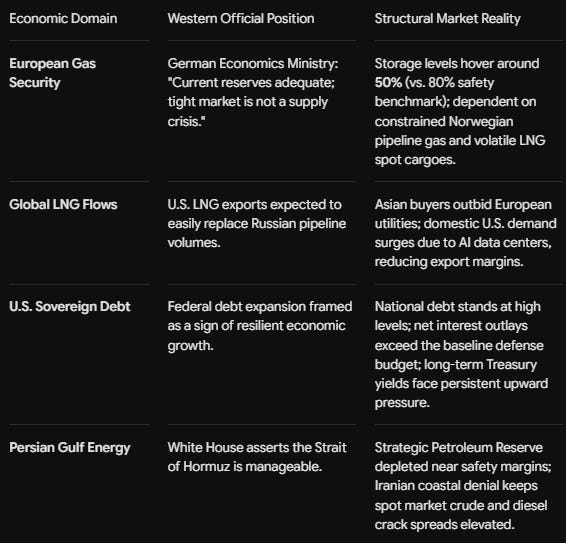
The multi-theater developments of late August 2026 reveal an alliance confronting the physical limits of its military-industrial and macroeconomic statecraft.
On the battlefield, the collapse of Dobropillya and the severing of the northern logistics arteries into Sloviansk signal the impending loss of the central Donbass fortress line.
Industrially, the systematic destruction of broad-gauge locomotives and Danube barge facilities eliminates Ukraine’s remaining transport depth.
As Western European capitals face severe winter energy deficits and sovereign bond markets across the West absorb escalating fiscal pressures, the strategic framework of the Atlanticist alliance is running out of options: you cannot sustain an industrial proxy war of attrition when your client state is fiscally insolvent, your defense supply chains are empty, and your own domestic economies are absorbing compounding inflation and energy shocks.
No posts
Comments
Nothing yet. Say the first thing.
Sign in to join the conversation.