
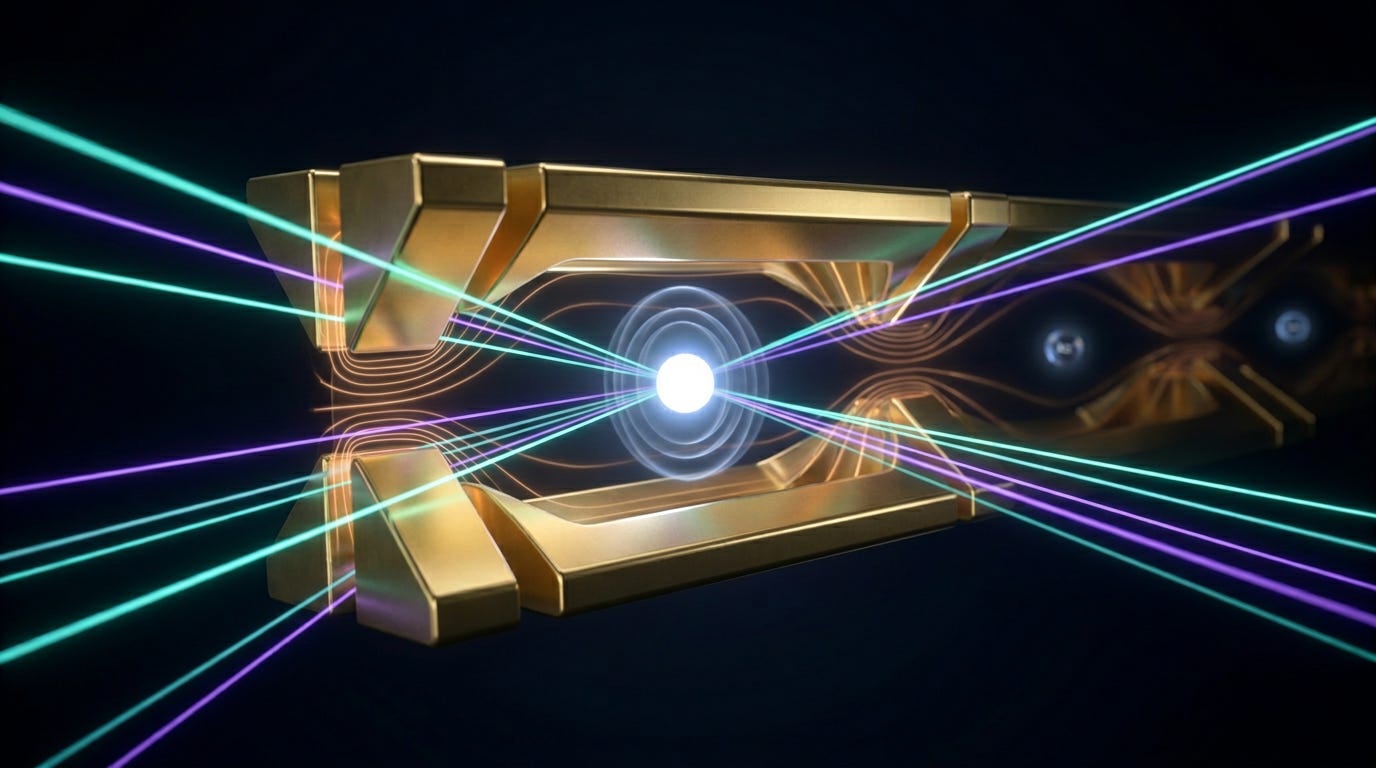
I’ve been posting about Quantum for about six years and two of my most popular posts to-date have been focused on the different Quantum Computing (QC) modalities. Because the industry continues to advance rapidly and there are now nearly 100 different companies pursuing various QC modalities, I’m revisiting this survey and breaking it out into a separate post on each of the main modalities. You can see my first post in this series, on Neutral-Atoms, here.
For each post, I’ll briefly review the key features of the modality, review some performance metrics, describe the company landscape, and select two featured companies, an “Alpha Dog” (IonQ for this post) as well as a “Breakout Contender” (Quantinuum) that has the potential, in my opinion, to jump to into the lead.
This isn’t a technology survey for physicists. It’s a briefing for people who need to make sense of the commercial and investment landscape — and who want to understand why trapped ions are producing both the industry’s most accurate quantum computers and its first real quantum revenue business. The quantum hardware race isn’t just a qubit-counting contest, nor is it a gate fidelity or circuit depth contest. Ultimately — and I say this as an investor — it’s a revenue contest. The companies that figure out how to turn quantum hardware into a scalable business win. Technical brilliance without commercial traction is a research project. And by that measure, the trapped ion space already has a winner-in-the-making: IonQ which is a publicly traded company that crossed $100 million in annual revenue in 2025, the first quantum hardware company ever to do so, and is guiding toward $235 million in 2026. That’s not vaporware or a science experiment, it’s a real business.
That said, the quantum hardware race is genuinely competitive, and the trapped ion modality has a second company — Quantinuum which privately held (with stated plans to IPO), technically exceptional, and recently valued at $10 billion. It is building a legitimate challenge from a different angle: world-record fidelity, a blue-chip investor roster, and an error-correction story that is, frankly, unlike anything else in the industry.
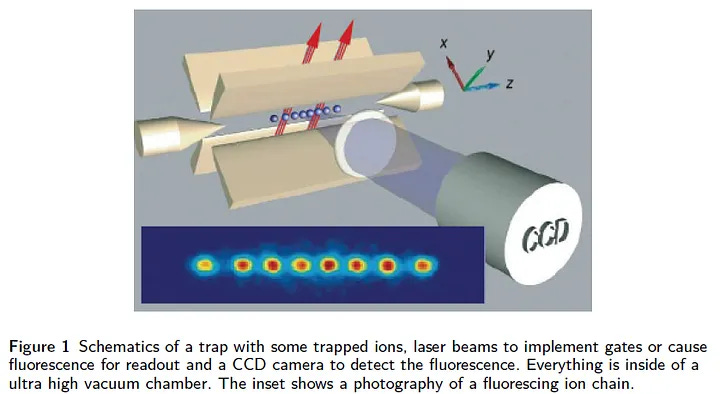
Imagine you could take a single atom, strip away one of its outer electrons so it becomes electrically charged (an ion), and then suspend it in mid-air using carefully tuned electric and magnetic fields. The atom isn’t touching anything. It’s just floating there, held in place by invisible electric forces — what physicists call an “ion trap”.
Now imagine you can use a precisely tuned laser pulse to flip the quantum state of that floating atom That’s your qubit. And because the atom is isolated from nearly everything physical — no vibrations, no nearby materials, no thermal noise from a substrate — it stays in its quantum state for an extraordinarily long time.
To perform two-qubit operations (the basic gates that create entanglement and enable real computation), you bring ions close enough together that they interact via their mutual electrical repulsion — the same “Coulomb force” that makes your hair stand on end after rubbing a balloon. This interaction, carefully choreographed with laser pulses, is what creates entanglement.
The traditional trapped ion architecture uses lasers to control qubit states — precise laser pulses write, read, and entangle the ions. This is the approach used by IonQ’s legacy systems and Quantinuum’s H-series and Helios. A second, emerging approach uses microwaves instead of lasers. Oxford Ionics (now part of IonQ) and Universal Quantum both built systems where gates are driven by microwave pulses delivered through electrodes integrated into a semiconductor chip. As you add more qubits, routing many individual laser beams to each ion can be an engineering challenge. Microwaves, delivered electronically through chip-fabricated electrodes, are more compatible with semiconductor manufacturing and, potentially, more scalable.
The tradeoff: microwave gates can be slower than laser-based ones, and the hardware engineering of a chip with thousands of electrodes has its own complexity. But the semiconductor fabrication path is a powerful ally for long-term scaling — which is a big part of why IonQ paid $1.075 billion to acquire Oxford Ionics in 2025.
1. Fidelity leads all modalities. Trapped ions hold every major gate accuracy record that matters. That lead is the foundation for everything — error correction, logical qubit demonstrations, and ultimately fault-tolerant computing.
2. All-to-all connectivity is a structural advantage. Unlike most other platforms, trapped ions don’t need extra “routing” operations to entangle distant qubits. This reduces circuit depth and gives them an inherent advantage on algorithms that matter in practice.
3. The laser-vs-microwave debate is where this race could pivot. Laser systems win on fidelity today; microwave/chip-based systems may win on scalability tomorrow. The industry is actively betting on both — sometimes simultaneously.
Performance Metrics Snapshot
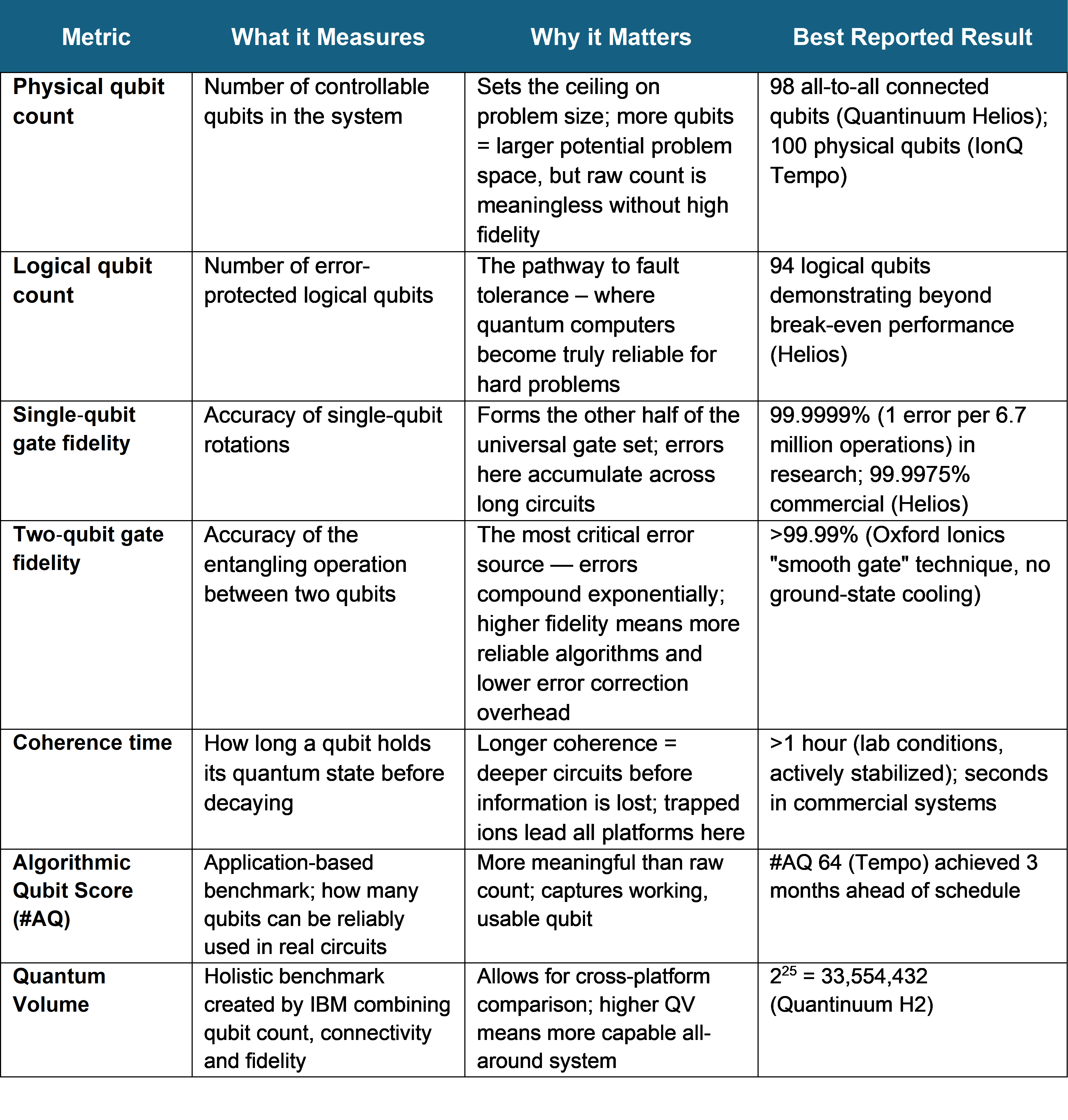
The table below is a snapshot of where trapped ion systems stood as of early 2026. This is not a permanent scoreboard — fidelity records fall every few months, and roadmap systems scheduled for late 2026 and 2027 will shift these numbers materially.
Trapped ion quantum computing is the most commercially mature of the leading quantum hardware modalities. It has the industry’s only publicly traded pure-play hardware company, the only quantum hardware company to have crossed $100M in annual revenue, and demonstrable quantum error correction milestones that no other platform has matched. The landscape has a clear two-tier structure: IonQ and Quantinuum dominate the commercial layer with full-stack systems, enterprise customers, and government contracts. Behind them is a cluster of serious contenders including Alpine Quantum Technologies (AQT), Universal Quantum, Quantum Art and eleQtron. Big tech (Microsoft, NVIDIA) participates primarily as partner and cloud integrator rather than hardware builder, though Microsoft’s Azure Quantum relationship with Quantinuum runs deep.

IonQ is my Alpha Dog in trapped ion quantum computing, and the thesis is simple: in venture investing, revenue is the scoreboard. Not qubit count. Not benchmark results. Not academic citations. Revenue. Last year IonQ crossed $100 million in annual revenue, the first quantum hardware company ever to pass that threshold, posting $130 million in full-year GAAP revenue, up 202% year-over-year. That’s not a one-time government contract, it’s a pipeline of enterprise customers including defense agencies, cloud providers, and Fortune 500 companies, translating into contracted revenue with a $370 million backlog at year-end. IonQ guided for $225-245 million in revenue this year, which would represent 70-80% growth. For a company that was recently called “a decade away from relevance,” that trajectory is remarkable.
The commercial traction is backed by increasingly serious hardware. The Tempo system reached #AQ 64, meaning 64 reliably usable qubits in real algorithm contexts, three months ahead of the public roadmap commitment. The acquisition of Oxford Ionics in 2025 for $1.075 billion brought the world’s best single-qubit gate fidelity (0.000015% error rate) and the microwave “smooth gate” technique that enabled IonQ to announce >99.99% two-qubit gate fidelity, a number that had previously been Quantinuum’s exclusive territory. And in January 2026, IonQ announced the acquisition of SkyWater Technology for $1.8 billion, making it the only vertically integrated, U.S.-based quantum platform with its own semiconductor foundry. The strategic logic is compelling: control your own chip fabrication, accelerate wafer iteration cycles, reduce supply chain risk, and position as a Trusted Foundry for Department of Defense contracts. The target of testing 200,000-qubit chips by 2028 is now contingent on this manufacturing infrastructure, not just engineering cleverness.
IonQ is also no longer just a quantum computing hardware company — it’s explicitly building across quantum computing, networking, sensing, and security. The 256-qubit system targeted for late 2026 is designed around Oxford Ionics’ microwave architecture, combined with IonQ’s existing compute and networking stack. If delivered at 99.99% fidelity, that would put IonQ in serious contention on a combined fidelity-times-scale metric that no competitor has previously achieved.

Revenue is the only benchmark that doesn’t lie. $130M in 2025 GAAP revenue, 202% growth, $370M backlog — those are audited numbers from a public company with SEC filings. Every other metric in quantum computing is either self-reported or benchmarking-context dependent. Revenue is real.
The AQ64 milestone delivered 3 months ahead of schedule is a rare thing in quantum: actual outperformance vs. public commitments. That pattern of beating guidance — technically and financially — is the kind of execution signal that changes how I think about a management team.
The acquisition sequence is strategically coherent, not random. Oxford Ionics plugged the fidelity gap; SkyWater plugs the manufacturing gap. The moves fit together into a vertical integration thesis that, if executed, would create a moat no purely fabless quantum company can match.
$3.3B in cash with no debt means IonQ can afford to lose money for years while building the infrastructure that will matter at scale. In a capital-intensive technology race, financial durability is a strategic weapon.
The platform breadth (computing + networking + sensing + security) is the right long-term bet. Quantum computing is not a standalone product — it’s infrastructure. The companies that win long-term will be the ones that own multiple layers of the quantum stack.
Quantinuum is my Breakout Contender — and let me be direct about why “contender” is not a consolation prize here. In almost any other industry, a company with a $10B valuation, $800M raised, Nvidia and JPMorgan on the cap table, and the world’s most accurate commercial quantum computer would be the Alpha Dog by default. In this particular post, it’s in second place for one reason: commercial revenues.
Quantinuum was formed in 2021 from the merger of Honeywell Quantum Solutions and Cambridge Quantum Computing. In the years since, it has produced an almost unbroken string of technical firsts: the highest Quantum Volume of any system (2²⁵ = 33,554,432 as of September 2025); the first beyond-break-even demonstration of quantum error correction at scale (94 logical qubits on Helios); “unconditional quantum information supremacy” demonstrated with UT Austin — the first demonstration of quantum advantage that doesn’t rest on unproven complexity assumptions, using a 12-qubit circuit to complete a task provably requiring 62-382 classical bits. That last one is a genuine scientific milestone, not a marketing benchmark. It was run on Quantinuum’s H1-1 system, and it matters.
The Helios system launched in November 2025 is the current state of the art for accuracy: 98 all-to-all connected qubits, 99.9975% single-qubit gate fidelity, 99.921% two-qubit gate fidelity, and integration with NVIDIA’s GB200 systems via NVQLink for real-time error correction. Four named enterprise customers — Amgen, BMW Group, JPMorganChase, and SoftBank — were announced at launch. The Microsoft Azure partnership has produced logical qubit milestones that reset the industry’s estimates of how many physical qubits you need for fault tolerance by roughly 10x. When Microsoft invests that kind of deep co-engineering effort with a vendor, it’s a signal worth paying attention to.
The “Breakout” framing comes from this: the technical foundation is already there. What Quantinuum needs to do now — and what would meaningfully re-rate the company — is convert that foundation into revenue traction and find its path to a liquidity event. An IPO in the next ~12 months, combined with Sol (2027) delivering on schedule, could be the catalyst that closes the commercial gap with IonQ.
The Apollo roadmap (Helios 2025 → Sol 2027 → Apollo 2029) is the most ambitious credibly-sourced roadmap in the industry, and Quantinuum has a documented pattern of delivering on public milestones. If Sol delivers on-schedule and on-fidelity, it re-rates the company significantly.
An IPO would be a major catalyst. Quantinuum has been IPO-rumored for years. A successful public offering at or near the $10B private valuation would create liquidity, broaden the shareholder base, and potentially unlock a round of enterprise customer validation that only comes when a quantum company has the visibility of a public filing.
The logical qubit story is about to become commercially legible. Right now, “94 logical qubits beyond break-even” is a technical headline that most enterprise buyers can’t easily translate into business value. As error correction workflows become productized — which Quantinuum is actively working on — this technical lead becomes a product moat.
The NVIDIA GB200 integration puts Quantinuum inside the dominant AI infrastructure stack — the GB200 is the chip powering the next generation of AI training clusters. If quantum-classical hybrid workflows start running on that infrastructure, Quantinuum has a distribution advantage that no purely cloud-native quantum company can match.
Watch for the first Helios-based application that demonstrates clear ROI for a paying customer. Amgen and JPMorgan are the two most likely candidates — drug discovery and financial risk modeling are the application areas where quantum has the clearest near-term value thesis. A published case study from either would be a material signal for the broader sector.
The central challenge for trapped ions going forward is not fidelity, which they currently excel in. The challenge is scale with fidelity preserved. Current commercial systems sit in the 98–100 qubit range. Getting to thousands of physical qubits while maintaining the accuracy that makes trapped ions valuable requires either making single traps much larger (more ions means more noise, more heating, and more complex control) or connecting multiple small traps together into a modular architecture.
Quantum error correction is the other major focus. Quantinuum has now demonstrated that trapped ion systems can achieve “beyond break-even” logical qubits, meaning error correction actually helps rather than hurts. And if IonQ’s 256-qubit system can be delivered at leading fidelity this year, it would put a second major player into the error-correction-capable tier. The transition from “interesting” to “indispensable” requires demonstrating clear ROI for a specific enterprise workflow and bringing cost per qubit-operation down enough that quantum is competitive with classical HPC for that workflow. Drug discovery (Amgen’s stated interest area) and financial risk modeling (JPMorgan’s ongoing work) are the leading candidates to demonstrate objected quantum commercial advantage.
Does IonQ’s 256-qubit system demonstrate 99.99% two-qubit fidelity at scale and will it be delivered this year as promised? This is the critical proof-point for the Oxford Ionics microwave architecture. If achieved, it would be the most significant trapped ion hardware milestone since Helios — and would close the technical gap with Quantinuum on a combined fidelity-times-scale basis.
Does the SkyWater acquisition close cleanly, and does IonQ’s first home-fabricated ion trap chip work? Vertical integration is theoretically powerful but operationally hard. Watching for the first chips tested on SkyWater’s fabs in 2026-2027 will tell you a lot about whether the integration thesis is delivering.
Does Quantinuum’s Sol system (targeted 2027) deliver on-schedule at >192 qubits? The Sol architecture requires a transition to a 2D grid layout — an untested configuration at scale. On-time delivery would be a major validation of the Apollo roadmap and a signal that Quantinuum’s technical lead is durable.
Does any enterprise customer announce a production (not research) use case on a trapped ion system? The shift from “we’re running experiments” to “we’re running a live financial model” would be a commercial milestone that validates the entire sector. JPMorgan, Amgen, and SoftBank are the names to watch.
Does Quantinuum IPO? A successful public offering at or near the $10B valuation would be a significant sector validation event, unlock a new comparison set for IonQ, and create competitive pressure that benefits the entire ecosystem.
The honest framing is this: trapped ion quantum computing is in the most interesting phase of any deep-tech sector — past “can it work?” and approaching “can it scale?” IonQ has answered the “can it generate revenue?” question ahead of schedule. Quantinuum has answered the “can it correct errors?” question at a level no competitor has matched. Both answers matter enormously. The companies that survive to the fault-tolerant era will be the ones that figured out both.
The next few posts in this series will look at other hardware modalities — superconducting (where the qubit counts are impressive but the error correction story is still catching up), photonics (the modular long-shot) and the other assortment of qubit modalities (silicon spin, quantum dots, topological, etc.) Each is a fascinating story in its own right. But if you want to understand where fault-tolerant quantum computing is heading, and who is building the commercial infrastructure to profit from it, the trapped ion story is where you start.
Disclosure: The author is a venture investor with investment interests in quantum and may have an interest in companies discussed in this post. The views expressed herein are solely the views of the author and are not necessarily the views of Corporate Fuel Partners or any of its affiliates or any companies it has investment interests in. Views are not intended to provide and should not be relied upon for investment advice.

References:
Graphic credit: Schematic of a trap by Blatt & Wineland, “Entangled states of trapped atomic ions,” Nature, June 18, 2008. Cover created by author using Perplexity.com
AQT announces its trapped-ion quantum computer now available on Amazon Braket, Alpine Quantum Technologies, November 2025
IonQ Achieves Record Breaking Quantum Performance Milestone of #AQ 64, IonQ, September 25, 2025
IonQ Announces Fourth Quarter and Full Year 2025 Financial Results, IonQ, February 2026
IonQ to buy SkyWater for $1.8 billion to expand hardware capabilities, Reuters, January 2026
Ivezick, Marin, IonQ's 99.99% Breakthrough and What It Means for Q Day, PostQuantum.com, October 2025
Jones, Scott and Murali, Dr. Prakash, “Architecting Scalable Trapped Ion Quantum Computers using Surface Codes”, arXiv, October 27, 2025
Monroe, C., and Kim, J., “Scaling the Ion Trap Quantum Processor,” Science, March 8, 2013
Pires, Francisco, “The future of Quantum computing - the tech, companies, and roadmaps that map out a coherent quantum future, “Tomshardware.com, February 16, 2026
Quantinuum Achieves Quantum Volume of 2²⁵ on System Model H2, Quantum Computing Report, September 2025
Quantinuum Launches Helios Quantum Computer with Industry-Leading Fidelity, Quantum Computing Report, November 2025
Quantinuum valued at $10 billion after $600 million venture round, Constellation Research, September 2025
Sutor, Dr. Bob, Quantinuum Announces 5-Year Roadmap to Apollo, Futurum Group, September 2024
Swayne, Matt, Quantinuum Researchers Demonstrate Quantum Computations with Dozens of Protected Logical Qubits, The Quantum Insider, March 2026
Wang, Luan, Qiao, Um, Zhang et al, “Single ion qubit with estimated coherence time exceeding one hour,” Nature Communications, January 11, 2021
No posts
Comments
Nothing yet. Say the first thing.
Sign in to join the conversation.