
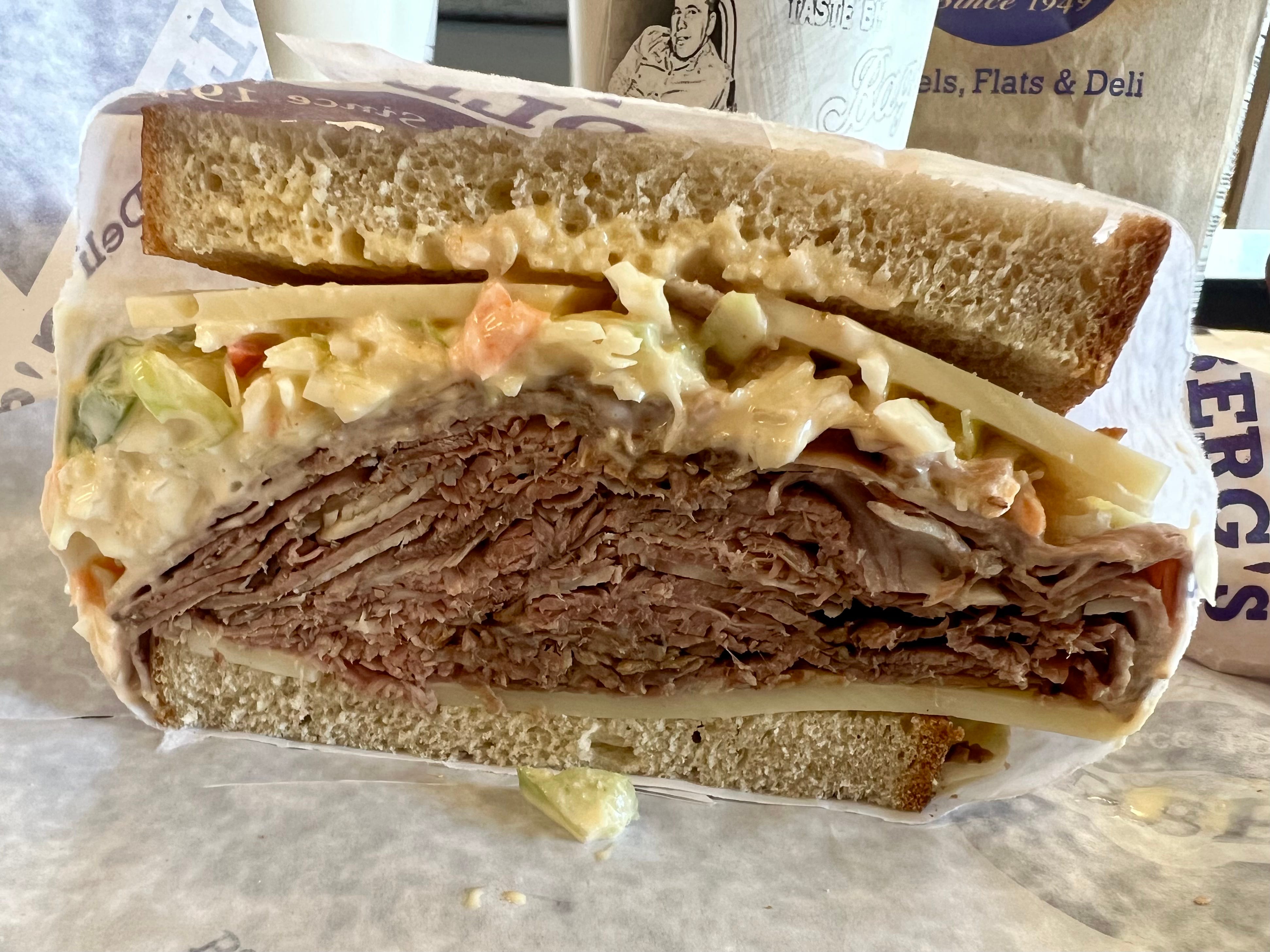
There is one area above all others that New York excels in—not economic standing, architectural design, or engineering marvels. Nor is it population diversity, cultural absorption, theatrical awards, baseball, or even high-end shopping. For New York’s most prestigious superpower is sandwich making.
The Cambridge Dictionary defines a sandwich as “two pieces of bread with food such as cheese, salad, or meat between them.”
This seems alarmingly outdated, narrowly focused, and frankly upsetting.
I would now like to submit a request to update our sandwich definition to more accurately reflect their global footprint.
The Russell Dictionary defines a sandwich as: “A prepared food in which an edible outer container holds or encloses a filling, typically eaten as a handheld meal or snack.”
Every culture seems to have a type of sandwich—under my definition:
• Subs
• Handburgers (yes, “hand” burgers)
• Paninis
• Tacos and burritos
• Samosas
• Bao
• Kebabs
• Börek
• Cornish pasty
• Egg roll
• Calzone
And many, many others.
Maybe the UN needs to focus on the things that really matter—and appoint a new umbrella word that encompasses this global taxonomy of sandwiches.
As for NYC, there is no greater American institution than a New York deli. None. Forget Carnegie Hall, Lady Liberty, and even the Ghostbusters building. Italian Americans rewrote the sandwich rulebook.
A NYC deli is typically (though not exclusively) a small, unassuming store—maybe inside a less attractive building, side street, or convenience store. The selection of meats, fillings, breads, rolls, and ingredients is second to none. And somehow, even when and where you least expect it, it’s fresher than anything you can buy in my Canadian neck of the woods.
The best thing though is the size. A good deli sandwich weighs the same as a newborn hippo and exerts the same gravitational force as a mid-sized projectile from the Kuiper Belt. A proper deli sandwich is said to be so dense it can absorb the force of a Ford F150 impacting at 50kph.
Its size is often enough to feed one person for two meals, or one chonky Englishman for ten minutes.
English sandwiches by comparison barely qualify under our new legally binding definition. Two pieces of cheap bread, one slice of ham so thin the pig it came from is still alive, and one slice of cheese too small to touch the bread’s edge. I hated sandwiches as a kid—unless I made them. When my mum wasn’t looking I’d stack ham, cheese and salad, cut thick wedges of bread, add any sauces or coleslaw I wanted, and then bask in the glory of my creation.
I knew a guy who ate tomato ketchup sandwiches. Nothing else—just ketchup. That is disqualified under the UN’s new rules and perpetrators can face heavy fines or imprisonment for such gross sandwich making negligence.
Somehow in their rich history, the Italian Americans nailed it. Maybe a Roman God of Sandwiches the history books deemed too dangerous to record? It’s the only sensible answer.
The price one pays is high though. A good sandwich can set you back almost $30 CAD. But to make one in Canada would cost $50—and there’s no way you could even get hold of New York’s signature ingredients like pastrami, corned beef, American cheeses, or breads. Nope, $30 is a small price to pay for such a high valued delicacy.
Comments
Nothing yet. Say the first thing.
Sign in to join the conversation.