

This week, we will be running a series titled Data Center Summer, examining how multi-million dollar campaigns completely misjudge rural voters’ attitudes towards large-scale industrial projects like AI data centers during this summer’s primary season.
Data centers are turning out to be a huge issue this election cycle. The United States has more than 3,000 data centers, and that number is expected to grow substantially in the years ahead. More than 1,500 new data centers are in various stages of development nationwide and two-thirds of those facilities are in Rural America.
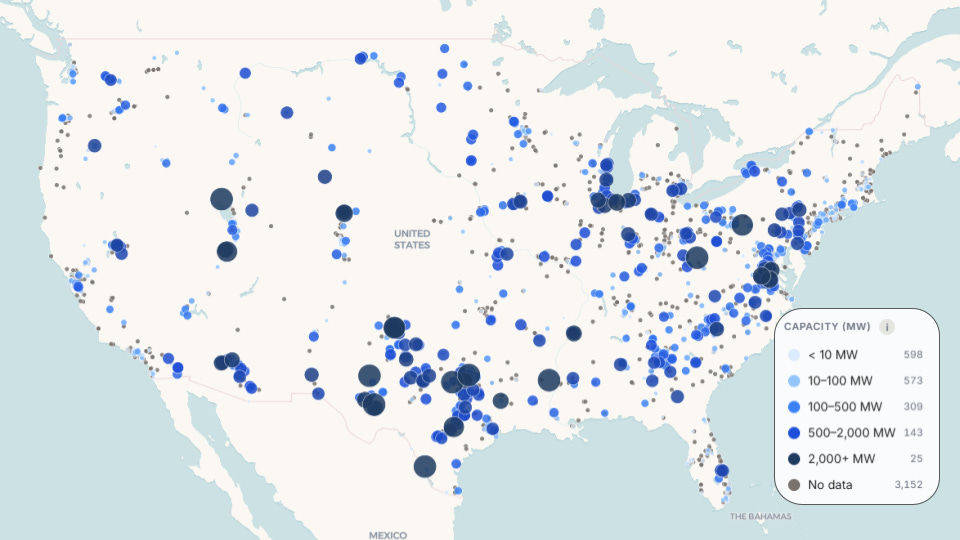
We’re kicking off the series looking at Michigan.
On August 4, Abdul El-Sayed beat Congresswoman Haley Stevens for the Democratic Senate nomination.
Plenty of political factors went into that result, and no one can claim one issue decided it. But the two candidates disagreed publicly on data centers, and voters were paying close attention. So was the Beltway media.
While millions of Rural Americans have been tuning into local data center fights for the last few years, the Michigan primary was the first time many national observers watched local politics play out in real life. Not just in the Senate race, but up and down the ballot.
By the height of the primary season, opposition to data centers in Michigan was so broad that Kenny Clevenger, a Republican running for the Michigan state Senate, put Rashida Tlaib, one of the most progressive members of the House from Detroit, in one of his own campaign ads.
The ad highlighted a hyperscale data center in Saline Township, a project Tlaib had also criticized. Clevenger said he does not agree with her on much, but he said they agree on one thing: stopping local data centers.
When politicians that far apart on the political spectrum land on the same side of an issue, somebody in the middle has made a horrible political miscalculation.
As we saw last week, Stevens was the one in the middle. At the Mackinac Policy Conference in May, she said she supports the construction of data centers as long as Michigan residents and ratepayers do not pay a penny for them, and that she was eager to see Michigan lead on the moon shots of the 21st century. At the July 7 debate, she tied the buildout to job creation and competing with China. Nine days later, she was still telling Reuters that AI is a revolutionary technology.
Watch: Rep. Haley Stevens says she supports the construction of data centers as long as Michigan residents and ratepayers do not pay a penny for them at the Mackinac Policy Conference
But in the remaining month of the campaign, it became clear that Stevens was out of step with voters. Polls showed high grassroots anxiety, with 63 percent of likely Democratic primary voters opposed to data centers in or near their communities, driven by concerns over electricity and water usage.
On July 29, six days before the primary, a reporter asked her after a Lansing appearance where she stood on the Saline Township project. She pivoted to a nuanced tech industry talking point. When the reporter tried a follow-up, a staffer said she was out of time.
El-Sayed spent that same week in front of the Saline Township site with the residents fighting it, telling reporters in Lansing that people really effing hate data centers.
Watch: Abdul El-Sayed attends anti-Saline Township data center press conference
But it’s not just Michigan.
Wisconsin votes tomorrow. At a debate in June, six Democrats running for governor there were asked whether they supported a one-year moratorium on data center construction.
One raised a green thumbs-up in support of the moratorium. The other five raised red in opposition to it. The one who raised green has been leading in the polls.

JT Cestkowski@JTCestkowski
I asked six of the leading Democrats running for governor of Wisconsin if they support a data center moratorium. Only one said yes. Last night, I moderated a forum on working-class issues. Here are the most interesting yes/no questions I asked, and what the candidates said. ⬇️
7:10 PM · Jun 3, 2026 · 52.8K Views
8 Replies · 24 Reposts · 142 Likes
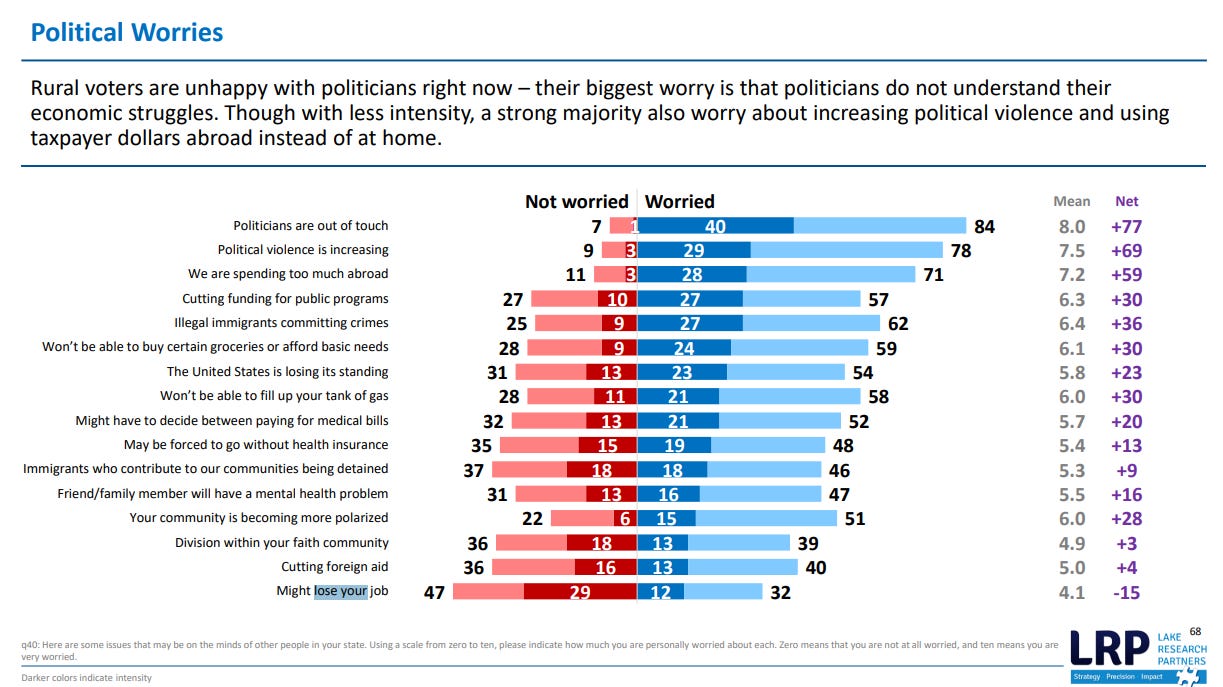
This spring, Lake Research Partners surveyed 600 likely voters in rural counties across thirteen Senate battleground states. Eighty-four percent said politicians are out of touch with how hard it is to make ends meet. Out of sixteen worries tested, that one finished first.
The top five economic concerns in rural counties were all expenses. Food at 40 percent, gas at 24, health care at 21, utilities at 21, housing at 20. Jobs came sixth at 17. Of those sixteen worries, losing your job finished dead last. It was the only item where more people said they were not worried than worried.
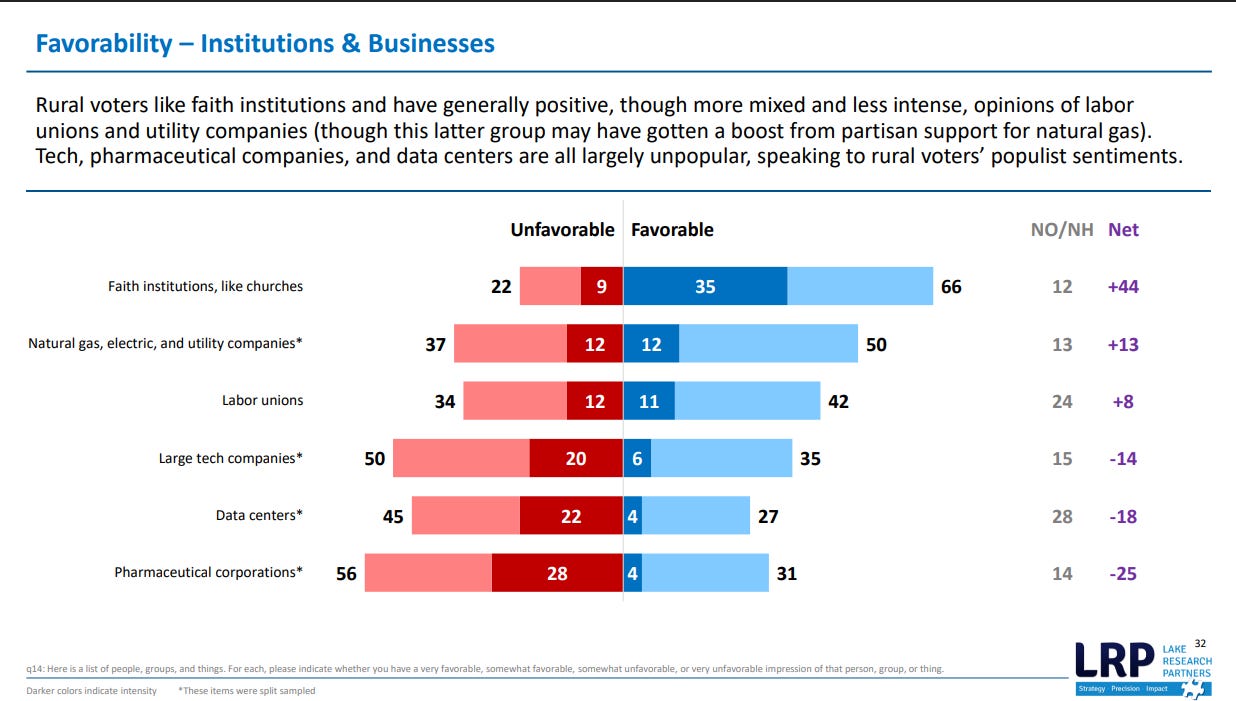
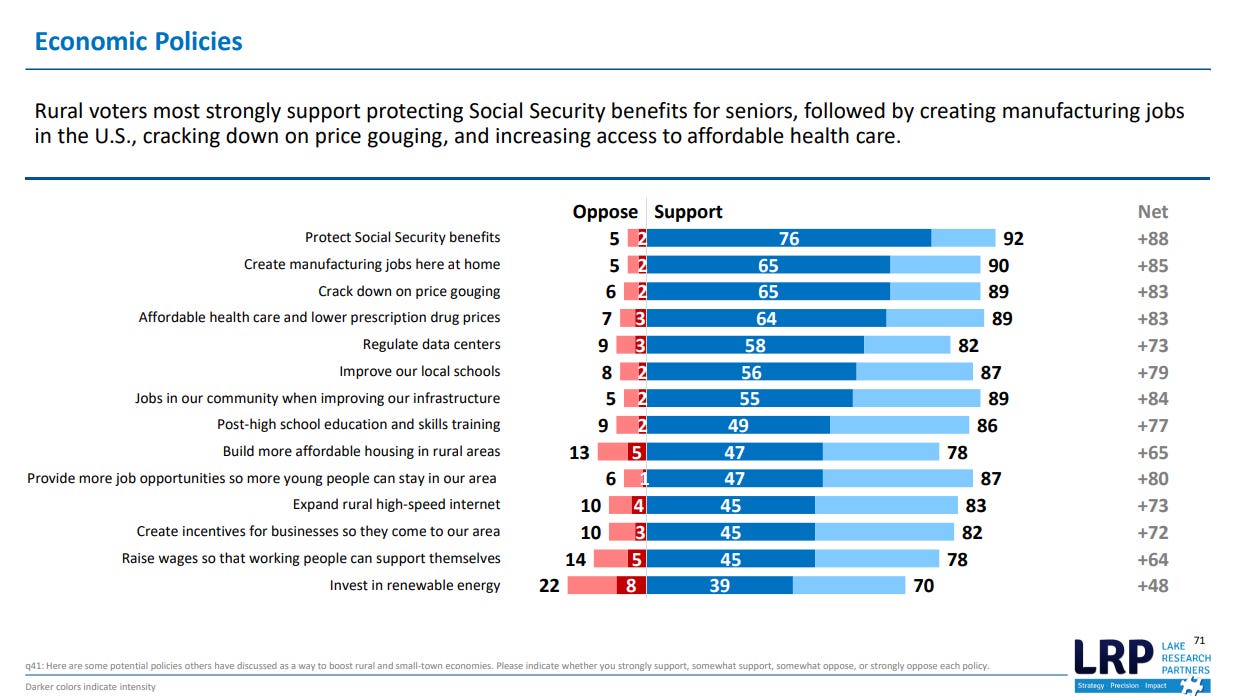
Of fourteen policies tested, business incentives came in near the bottom at 45 percent strong support. Protecting Social Security came in at 76. Data centers landed at minus 18 net favorability, and they were underwater with every partisan group in the survey, including Republicans.
But regulating data centers so they do not pass energy costs to rural residents or overuse water drew 58 percent strong support, and it was a top-four issue for Republicans and for older white men.
None of this should have surprised anybody. Opposition to top-down, taxpayer-funded big tech economic development projects has been building for years.
Candidates and special interest groups were pitching jobs. Voters were worried about expenses.
At Rural Progress, we have been getting the same answer at the door since 2022.
That year we ran what we called Local Progress Reports in three Ohio counties: Athens, Fairfield, and Licking. We used a drop-off and pick-up survey method, which reduces the nonresponse problem that skews much ordinary polling. Our local partners chose which census tracts to sample based on their own knowledge of who gets left out. They helped write the questions. Then we knocked on the doors and came back until we got the answers.
Two findings have stayed with me.
The first is what people said they needed. Across all three counties, the top five priorities were dominated by daily expenses. Food and grocery costs. Healthcare and prescription costs. Housing. Utilities. In three demographically different Ohio counties, including a university town in Appalachia, these priorities barely moved.
We ran statistical tests looking for clusters by geography, race, income—anything. Concern about daily expenses cut across all demographics.
The second finding reframed my entire understanding of job creation programs in small towns and rural communities. Licking County is where Intel was building its microchip plant, one of the largest federal investments in the region’s history. Our Local Progress Reports asked people whether the project would help their household, hurt it, or not affect them.
What we found was that the closer people lived to the microchip plant, the more likely they were to expect harm rather than benefit—this is the opposite of how place-based economic development should work. The benefits should be perceived and felt by those closest to the development. Yet these Ohioans recognized that they weren’t trained to work in the high skilled tech industry and that the types of people who would be hired at the microchip plant would likely move to town from other places and ultimately raise their cost of living.
And they have been right so far. Intel said the facilities would be finished and making chips by 2025, employing three thousand people at an average salary of $135,000. Four years and roughly $2 billion in state incentives later, the site has produced no chips and no permanent jobs.
The first factory is now scheduled for completion in 2030 and might not open until 2031. The second will not run until 2032. Intel has started training some Ohioans, but a county commissioner in Licking County, a Republican, put it plainly: most of those bold promises turned out to be a little pie in the sky.
Now, four years later, a Republican in Michigan and a Democratic Socialist in Wisconsin are running on the same policy of holding tech companies accountable for decades of broken promises, and turning the conventional wisdom among the professional class in Washington on its head.
So what happened? How did local residents across such a wide political divide become so unified in their opposition to AI data centers? And how did so many multi-million dollar political campaigns completely miss the warning signs?
That’s what we will be uncovering this week.
Tomorrow is election day in Wisconsin. We will be processing the results as soon as they are available and highlighting more data center political insights in our next post.
Stay tuned.
No posts
Comments
Nothing yet. Say the first thing.
Sign in to join the conversation.