
Last Spring, Ezra Klein and Derek Thompson published a book called Abundance. It was a New York Times bestseller about the lack of progress on ambitious projects in the United States and how technology will usher in a new era of prosperity if we can fix the regulatory landscape. It took the Beltway by storm. Members of Congress even launched a caucus to support the “abundance movement.”
The book opens with a picture of the year 2050.
You wake up in a city. You’re in a house running on solar panels overhead and clean power piped in from wind, small nuclear, and geothermal sources. You turn on the tap and out comes desalinated ocean water. The apples and tomatoes in your refrigerator were grown on tiered shelves under LED lights in a tall greenhouse a few miles away.
The beef was grown in a lab. Outside, an autonomous drone is delivering someone’s medication, synthesized in an automated factory in low Earth orbit. Your friend texts on the way to the airport. He will be in London in two hours.
According to Klein and Thompson, in this future, field agriculture is gone. So is livestock. The authors note that a quarter of the world’s land was once used to raise animals for food, and that this is unimaginable now. As they put it, “Much of that land has rewilded.”
What?!? Rewilded?
It’s no wonder that Rural Americans have spent the summer revolting against the data centers that are so critical to this vision of “progress” and reshaping the political landscape of Rural America in the process.
Data Center Watch, an industry tracker, counts forty-two activist groups campaigning against data centers in Virginia alone. There is a Coalition for Responsible Data Center Development in Minnesota, a volunteer nonprofit with no paid staff, founded by a Farmington resident. There is a Coalition to Protect Prince William County in Virginia that began with one woman getting her neighbors together. There is SWMO Citizens Against Data Centers in Missouri and North Beaver Township Residents United in Pennsylvania.
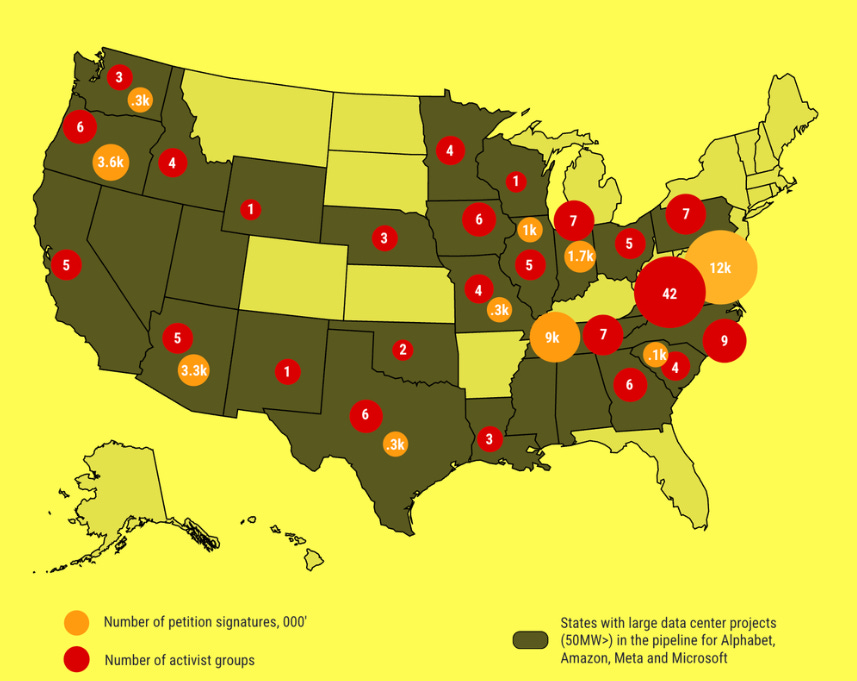
These unpaid, local organizers are getting dozens, if not hundreds, of counties across the country to issue a moratorium on data center development while local leaders work to better understand the costs and benefits. The list of counties with data center moratoriums spans the entire political spectrum and now includes Sioux County, Iowa, where 85% of the county voted for Donald Trump in 2024.
It’s a shift that many politicians, especially Donald Trump, didn’t see coming, as the President seems to be one of the politicians most out of step with rural voters on data centers.
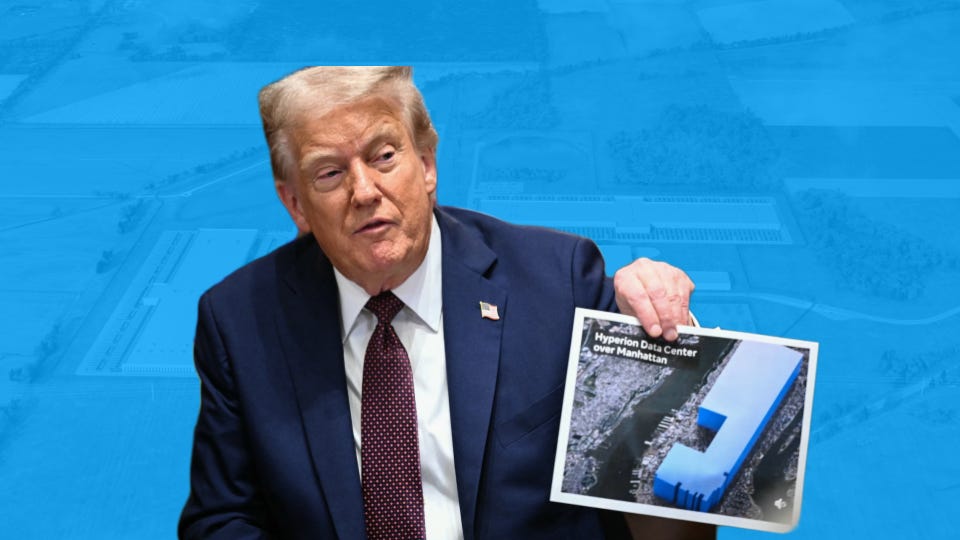
“I don’t think they’re unsightly,” President Trump said recently. “I mean, I’m looking at some of these data centers — the most incredible buildings I’ve ever seen. They go for two-and-a-half, three miles.”
I’m sure he would feel differently if they were building one next to Mar-A-Lago.
But many Democrats have struggled to capitalize on Trump’s political miscalculation in small towns in rural communities, as they too have found themselves out of step with public opinion on data centers.
So how did we get here?
What Donald Trump and some Democrats are missing is that there is a long history of rural people getting screwed by developers. In fact, it’s almost a whole genre within country music.
Ernie Carpenter is my favorite example. He was a fiddler from Braxton County, West Virginia. In 1938, Congress authorized a dam that would flood his family property. He stayed as long as he could and spent years fighting it. His neighbors left, but he didn’t. The work crews blocked the roads, and he found other ways onto his property until those were closed off too. He said he was the last one to leave.
Ultimately, he got the Army Corps of Engineers to raise what they paid him; then he tore the old house down, hauled the lumber up the hill, and built part of it into a new one. He wrote a tune about it. What came out is called “Elk River Blues.” It is slow and sad, and is now a standard that old-time country players still learn all over the country.
Watch: “Elk River Blues,” written by Ernie Carpenter and performed by The McMillan’s Camp Boys
This is just one Country ballad about life in a sacrifice zone. Johnny Cash sang one. And so did Old Crow Medicine Show. But of course, Rural America isn’t the only one being asked to sacrifice in the name of someone else’s progress.
In 1970, Gil Scott-Heron recorded “Whitey on the Moon.” It’s a poem about living in poverty while watching the first man walk on the moon.
Watch: “Whitey on the Moon” by Gil Scott-Heron
Gil Scott-Heron was not making an argument against space travel. He was making an argument about who gets to define progress and benefit from it. It’s a question that tends to unite working people in small towns, rural communities, and big cities, as well as across traditional lines of partisan division. And that’s what is happening this summer.
The people defining progress in 2026 are the ones who benefit from the AI buildout. They tell us the moment is urgent, that we cannot fall behind China, that the future of the country depends on how fast we can put these buildings in the ground. We keep hearing that technology will solve our problems and that AI data centers are an important source of revenue for local communities, but all we see is that with each new technological innovation, the gap between the rich and the poor only continues to grow.
Sure, there are a handful of examples where communities have leveraged data centers in the past for local benefits. And some places do have the conditions that can make these projects work. We will look closely at some of them later in this series. But even in the absolute best cases, community members are just tolerating these data centers.
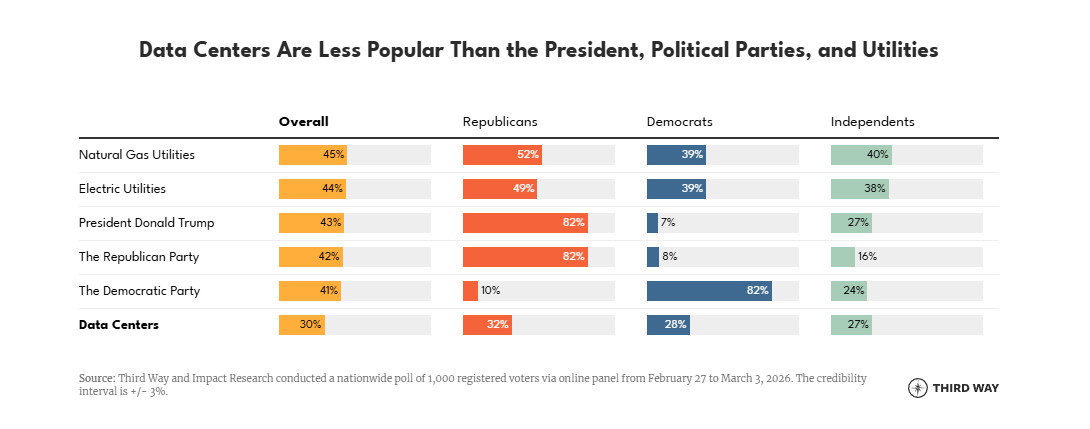
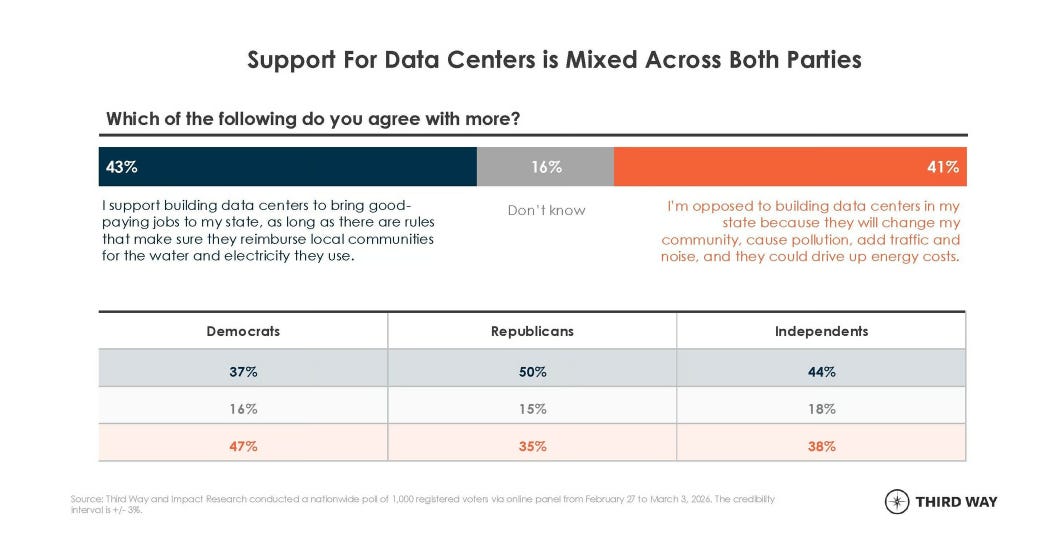
On March 12, Third Way, an advocacy group that supports the current data center build-out, published an influential memo for Democratic campaigns titled Do Americans Believe Banning Data Centers Will Lower Electricity Prices?. In the survey they conducted, data centers came back at 30 percent favorability, lower than every institution they tested, including the President, both political parties, and utilities. Asked whether they would support a data center if developers reimbursed the community for water and electricity, support rose to 43 percent, while opposition rose to 41 percent.
In June, Third Way conducted focus groups with a hundred swing voters and told them hypothetical projects would use no water and pass no costs to ratepayers. A slight majority was still opposed. People were handed the best version of the deal and still turned it down.
One participant pointed out that data centers bring a wave of construction jobs and very few permanent ones. He is right. Operating headcount at one of these facilities runs in the dozens. He did the math and got the right answer. But, oddly, the memo filed his response under a section about building trust.
Another watched Sam Altman testify to Congress about the benefits of AI and said Altman is selling his own medicine. That is a reasonable person discounting a witness with a financial stake. His comments were also filed under trust.
Third Way’s conclusion in their memo was that data centers need to focus on building local trust. But that’s not what voters were telling them. Voters looked at the evidence, did the math, and drew their own conclusions: the costs don’t outweigh the benefits.
Democratic candidates who followed the advice in Third Way’s campaign memo likely didn’t realize that the group’s goal is to build support for data centers, not necessarily win elections. That’s why so many Democratic candidates followed Third Way’s pro-data center talking points that Democratic voters opposed by more than 10 points.
Half of Americans struggle to meet even their most basic needs in this economy. And it takes years for data centers to generate any revenue for rural communities. Voters are looking for a solution now, and building an affordability platform around bringing good paying jobs years down the road is a horrible political strategy.
The Marquette Law School Poll has been tracking public opinion on data centers for a year. In October 2025, 55 percent said the benefits don’t outweigh the costs. By February, it was 70 percent, and by July, it was 76 percent. Nationally, the Annenberg Public Policy Center found opposition rising from 49 percent to 61 percent over four months, while support fell from 21 percent to 14 percent.
While many politicians misjudged the data center outrage, some candidates, both Republicans and Democrats, have figured out how to leverage the local backlash.
Tom Tiffany won the Wisconsin Republican governor primary with 95 percent of the vote and the endorsement of the President and the state party. His campaign catchphrase is “We are America’s Dairyland, not America’s Dataland.” He says data centers should not raise residential electricity bills and must include local community input before construction begins. He has pledged to repeal the subsidies, keep the facilities off farmland, and eliminate the nondisclosure agreements that conceal these deals from the public.
In Minnesota, Lisa Demuth won the Republican nomination with 45.1 percent, beating both the candidate the President endorsed and the candidate the state convention endorsed. As House Speaker, she had agreed to repeal the electricity sales tax exemption for data centers, thereby raising costs for those companies. At the time, it was written up as attack fodder from her tax-averse fellow Republicans.
She took the hit for making data centers pay more in the Republican primary, and beat a Trump endorsement anyway.
There was a similar dynamic at play in the Wisconsin Democratic governor primary. Francesca Hong raised a green thumbs-up at a June debate when six Democrats were asked about a one-year moratorium on data centers. Every other candidate raised a red thumbs-down. Eight weeks later she was the front-runner.
Then two candidates dropped out, David Crowley re-entered with the governor’s endorsement, and a fractured field became a two-candidate race. Hong lost by just a fraction of a point, but she wasn’t even a top candidate before the moratorium fight.
And data center politics were dominant in Wisconsin’s Third District as well. Rebecca Cooke declined the moratorium at a forum in mid-July. Her opponent called on her publicly to join it. Three weeks later Cooke went up with an ad calling for a one-year pause. She won by fifteen points. Three weeks—that is how fast the conventional wisdom shifted. But, in retrospect, it looks like the conventional wisdom was wrong from the beginning.
I have talked with thousands of rural voters over the last decade. When you ask them what they want their community to look like in twenty years, almost all of them say the same thing.
“Like it does now.”
It does not matter where you ask. New subdivisions in wealthy exurbs. Distressed coal towns in Appalachia. Farm counties in the upper Midwest. The answer comes back the same. People want the place they live in to remain recognizable to them.
For many of us in Rural America, change is the threat. The “bad change” is obvious, because more unemployment and more addiction and more crime take a wrecking ball to quality of life. But we’re skeptical of “good change” too. Ask anybody who watched their kid get priced out of the town or neighborhood they grew up in once good things started to happen.
Most of the folks I talk to actually like the dive bar. They like the empty lot across the street where the neighborhood kids play football, and they would prefer for it to stay empty rather than someone build a fancy condo there. But more importantly, especially in this economy, they would like health care, child care, and elder care to cost less, the school to stay open, and their grandkids to be able to afford a house in town.
In Rural America, we’re taught to protect what we have. Preserve what works. And be suspicious of anybody who shows up with a vision of the future we did not ask for. But for the big tech-funded think tanks in Washington, D.C., growth and innovation are taken as gospel.
Progress and innovation are beautiful things for those who will benefit, and Ezra Klein isn’t being asked to sacrifice anything in his 2050 vision of a techno-utopia in which Rural America has been “rewilded” and rendered obsolete.
I worry “big thinkers” in the big city, especially those with Abundance-Brain, don’t realize that in Rural America, we don’t see ourselves in Ezra Klein’s vision for the future. Our only representation in his future is hosting the data centers powering his AI robots, or being erased—rewilded—altogether.
Candidates do not have to agree with our rural perspective. But they cannot win if they don’t take it seriously.
Next up in our “Data Center Summer” series: Rural America is being told we should sacrifice our sense of place to power the next technological revolution, but it’s not even clear that this technology is profitable. Stay tuned as we dive into the AI investor hype and what the AI bubble could mean for Rural America.
No posts
Comments
Nothing yet. Say the first thing.
Sign in to join the conversation.