
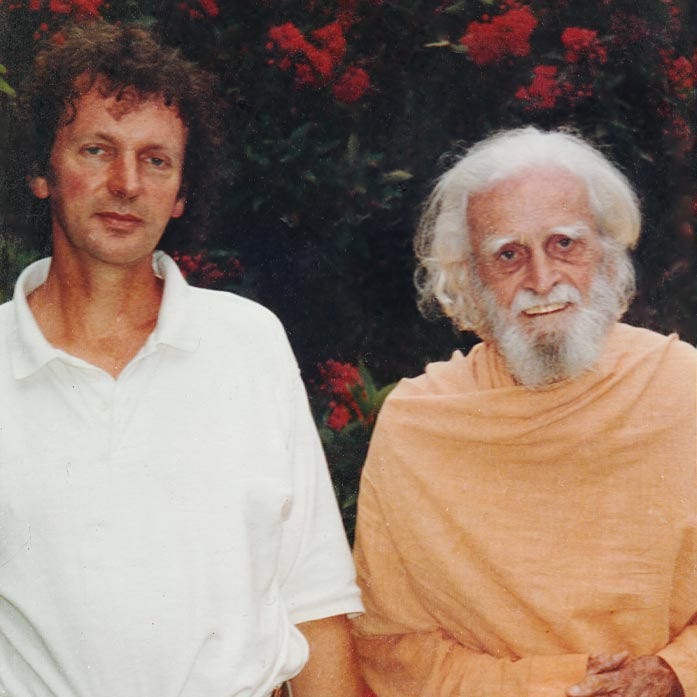
Father Bede Griffiths was a Benedictine monk who went to India after first being a monk at Prinknash Abbey in Gloucestershire. At Oxford he had been a student of C.S. Lewis, and he remained a great friend of his. He was the most remarkable man, and I was fortunate enough to spend two years living in his Christian ashram in South India, on the bank of a sacred river, the River Cauvery.
He wore the orange robes of a sannyasin, an Indian sadhu or holy man. His ashram was a Christian one, built in the Indian style of religious community: Indian in form, Christian in substance. Indian ashrams usually grow up around a teacher, forming a community where people eat and live together. It is a little like a monastery, but less formal.
Father Bede was part of the inculturation movement in India, which was unleashed by the Second Vatican Council. The whole point of inculturation was to bring the Christian religion into the context of the local culture.
For years, Christian missionaries from Europe had gone to India to convert Indians to Christianity. After decades of effort, and with all the backing of the British government in India, the total proportion of the Indian population that is Christian stands at around 2%. Most of those were Christian anyway, because the St. Thomas Christians in Kerala have been Christians since St. Thomas went to India in the first century AD. So when the Portuguese arrived to make converts, they found that many people were already Christian, though the Portuguese they thought they were the wrong kind, since they belonged to the Syrian Orthodox Church rather than to Rome.
What Father Bede was doing was looking at the whole context of India. The missionaries in the British period had arrived with very European ideas, and they converted some Indians, but they did it in European packaging. For example, the missionaries wore shoes in church. Poor Indian Christians, who would not normally wear shoes at all, and who, like everyone in India, removed their shoes on entering any holy place, a mosque, a temple, even a house, nonetheless bought shoes simply so they could wear them to church. It was all rather perverse.
Father Bede’s point was that inculturation means bringing the Christian message into a genuinely Indian context. So in the ashram we took our shoes off in the chapel, we sat on the floor, and we ate vegetarian meals off banana leaves. It was thoroughly Indian, a village-level Indian style of life.
One of his other points was that Christianity, a Semitic religion, comes to us wrapped in Greek philosophy and in Roman forms of government, because that is how it was packaged as it moved West, starting with St Paul. When it moved east instead, as in the Syrian Orthodox Church, it became very different, and the Orthodox liturgy reflects that. We are used to the Greco-Roman packaging, which is not necessarily the most fruitful way for Christianity to flourish in India.
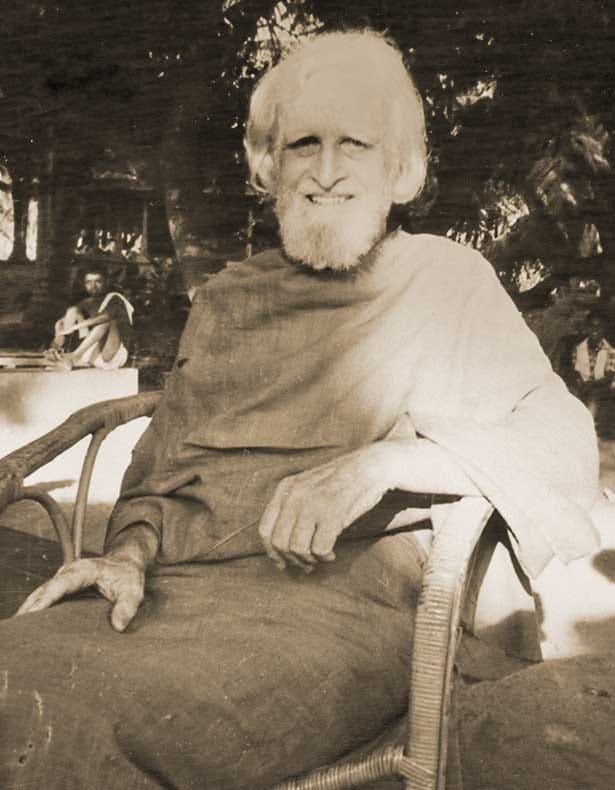
Father Bede was something of a romantic. When he graduated from Oxford, where he was at Magdalen College and where C.S. Lewis taught him, he and two friends went to live in a cottage in the Cotswolds: off-grid, no electricity, no modern conveniences. They tried to make a living farming and milking cows. It did not work very well, and lasted only about a year. One of them, Martin Skinner, remained a lifelong friend and wrote an epic poem called The Return of Arthur.
It is interesting that C.S. Lewis was himself drawn to this Arthurian theme. Those who have read his novel That Hideous Strength will recall that it concerns the return of Merlin in a dystopian Britain of the future, complete with nuclear power stations and sinister government forces.
Bede then felt a calling to the monastic life and went to Prinknash Abbey. He later served as guest master at Pluscarden Abbey when an ancient ruined monastery in Scotland was revived; it is now a Benedictine monastery. That sufficed for a while, but he felt a deeper calling to India, because he believed the Western Church had lost much of the mystical tradition on which it was founded and on which it had so depended in the Middle Ages.
He said he wanted to discover the other half of his soul. So he went to India, living at first in a monastic ashram in Kerala, where the community supported itself with a dairy farm. That was acceptable, but it remained too institutional for him.
Then an ashram in Tamil Nadu, on the bank of the Cauvery, fell vacant. It had been founded by a French Benedictine, Abhishiktananda, and another Frenchman, Father Jules Monchanin, who had come to India twenty years before Bede in search of the same connection with the Indian mystical tradition. India is full of holy men living in caves and forests, meditating; it is crisscrossed everywhere with pilgrims. It is so different from the more rationalistic approach to religion that has come to dominate the West. The two Frenchmen founded this small ashram on the riverbank, and after they both died it stood vacant. Bede was invited to take it over, which he did, bringing several monks from Kurisumala in Kerala, in 1968.
I had not gone to India to join an ashram. In fact, when I arrived I was not even a Christian. I was deeply into meditation and inspired by psychedelics, exploring consciousness through meditation and yoga, and I was much influenced by the Indian tradition. I went there to take up a job at an international agricultural research institute, ICRISAT, the International Crops Research Institute for the Semi-Arid Tropics, as the principal plant physiologist. I wanted to be in India and also wanted to do something useful with my science, something that might help poor farmers grow crops more effectively.
While I was there, I was drawn back toward a Christian path, having visited many Hindu ashrams and temples and having had a Sufi teacher for a year in Hyderabad, where I was living. I was confirmed in the Church of South India. It was pleasant enough going to Anglican services with creaking ceiling fans and organs riddled with faults from the climate, pumped from behind by a man in a dhoti working a hand pump because the electricity was too unreliable, singing the Merbecke settings in tropical heat with a congregation mostly of Anglo-Indians who largely worked on the railways. It was all right, but something felt lacking compared with the spiritual depths of the Indian tradition.
So when a friend of mine, who travelled around the ashrams and had stayed with me in Hyderabad, found Father Bede, he sent me a postcard saying: “I’ve found the perfect ashram for you. Go if you can”. He gave no details. I knew nothing about it, but I trusted his judgement. I took a weekend off work, caught the night train to Madras from Hyderabad, then the train to Tiruchirapalli, then a bus twenty miles to a village near the ashram, and walked in.
It was like paradise. Here was this peaceful place called Shantivanam, “Forest of Peace,” with palm trees and thatched huts. Then Father Bede appeared in his orange robes, looking rather like Gandalf. I could hardly believe that anything like this could exist.

Most of my time is dedicated to scientific research, regularly published in peer-reviewed journals, and free to read on sheldrake.org. Since exploratory research of this kind rarely attracts traditional funding, your support makes all the difference, bringing more essays and videos to you and the public. Thank you!
Rupert Sheldrake
Father Bede was deeply learned and steeped in the Upanishads, the Bhagavad Gita and the Hindu scriptures, as well as being profoundly versed in Western philosophy and especially medieval theology. In the ashram we meditated in the mornings, then there was yoga, then an early chanting prayer period. The Mass began with the chanting of the Gayatri Mantra, a very fundamental mantra in the Hindu tradition, a prayer and an invocation to the glorious light of the sun, the divine light, to illuminate our meditation.
On my first visit I asked him how he could have the Gayatri Mantra and Tamil devotional songs in a Catholic ashram. His answer: “Precisely because it’s Catholic. Catholic means universal, and any path to God that excludes others is merely a sect.”
He took this very inclusive view, and for me it was a wonderful experience, because what he emphasised was the Indian understanding of the divine and how the divine works, so different from the emphasis in the West. He illustrated it like this: ask Christian children in India where God is, and they point up to the sky; ask a group of Indian children, and they point to their heart, for God is within. It is this sense of the immanence of the divine that is so strong in India. There are holy trees in every village, holy animals, sacred cows, sacred snakes, and sacred termite mounds.
I discovered this for myself while living in Hyderabad. I lived in a wing of a crumbling palace, and one day I went into my lavatory, one of those squatting lavatories, to find a cobra coiled around it. I called my cook and said we had to get rid of it; should we kill it? “Oh, sahib [sir], we cannot kill this” he said. “This is a sacred naga. It is a sacred snake.”
A few weeks later I came home from work and my cook announced that it was Nag Puja day, a holy day for snakes. He explained that the cobra lived in a small termite mound on the crumbling terraces of the palace, with a hole where it sheltered. Everyone knew it lived there. A little saucer of milk had been set out, and joss sticks were burning, and people were chanting cobra mantras, because it is a holy animal.
There was another such episode. One night, asleep under my mosquito net, I felt something on my face, then something scaly dragging across it, and realised a rat was walking over me. I was paralysed; it was the only time I have ever had sleep paralysis. I tried to move and could not.
I told my cook about the rat and asked him to set a trap and kill it. “Sahib, we cannot kill the rat,” he said. “It is a holy animal, sahib. It is the vehicle of Lord Ganesh, the elephant god.” I insisted he at least get rid of it. When I came back that evening, there was a live trap with a rat inside. Could he kill it now? No, he could not; he would take it somewhere else. He cycled off with the trap on the back of his bicycle and returned about an hour later, having released it far away.
After that, going around Hyderabad, I noticed other people cycling about with traps and rats on the back of their bikes, doing exactly the same thing. The total number of rats stayed the same. They were simply being redistributed.
Father Bede loved that side of India, and he also kept up the anti-mechanisation streak he had shown in his Cotswold commune. In the ashram we had cows for milk, and the cow dung went into a gas digester that produced gas for cooking. Transport was by ox cart. When he had to go to conferences, he would set off in his orange robe on the back of the ox cart to the station about two miles away, then take the train. When I finally left the ashram after a year and a half, with a big box of books I had accumulated while writing, I too left on the ox cart to the station. The Indian brothers were terribly keen to get a motorbike, but he was firmly against it. He wanted nothing mechanical.
One of the great points he made was that in the Indian tradition, ultimate reality is consciousness. In the Advaitic tradition this is Sat-Chit-Ananda. Sat is the ground of being, which is conscious. Chit is names and forms, the contents of consciousness. Ananda is joy or bliss. His ashram is called Saccidananda Ashram, and in English the Ashram of the Holy Trinity. He believed this Hindu model of ultimate divine consciousness gave a very deep insight into the meaning of the Holy Trinity, and I greatly agree with him.
Part of the Hindu tradition is the idea that Atman, the consciousness within us, is a kind of fractal derivative of the ultimate divine consciousness. The consciousness in us is not different from that consciousness; it is a more limited form, but derived from it. One familiar Hindu image is of buckets of water at night, each reflecting the moon. It looks as though there are hundreds of moons, but there is only one, and these are all reflections of it. We are all part of that one divine consciousness.
Father Bede gave discourses every day, sitting under a palm tree, sometimes on the Gospels, sometimes on Aquinas and Christian theology, sometimes on the Upanishads. One of his favourite texts was from the Kena Upanishad:
Not that which is seen by the eye, but that whereby the eye can see: know that alone to be Brahman, the Lord, and not what people here adore.
In other words: not what we see, but our very ability to see, the consciousness that makes seeing possible, that is what belongs to God. It is that part within us, part of our very being, sustained continually by God.
This side of his teaching was, for me, enormously helpful. He always grounded it in a sense of the divine source, which can be known through mystical experience. His view was that all religions begin from a direct experience of the divine, a direct participation in divine consciousness. They do not begin with the founders of religion doing PhDs at seminaries. The Buddha did not become enlightened by studying scriptures; he became enlightened by sitting under trees and meditating for years, until the moment of enlightenment came. Jesus, learned though he no doubt was in rabbinical tradition, recognised his affinity with God not through study but, at the moment of his baptism, through direct experience.
Father Bede used the metaphor of the palm of the hand and the fingers. The palm is the direct experience, known by people in every culture; it is the preserve of none and the source of all religions. But as soon as people emerge from that unitive state, they interpret it in their own languages, cultures, histories and traditions. The fingers are the different religious traditions, each interpreting that one experience in its own way. At root, they are united, not always in exactly the same mystical experience, but in that direct sense of a unity far beyond the discursive mind.
He wrote a number of books. Return to the Centre is a series of short meditations, only a page or two each, that cross-fertilise the Eastern and Western scriptures. One of his most helpful, I think, is The Marriage of East and West, where he shows how the traditions of East and West can come together. His point was never that one tradition is wrong and another right, but that they are complementary, each with a different emphasis. The immanence of God is present in the Christian tradition, not alien to it. There is plenty of Christian mystical writing about divine immanence and God within; it simply is not the usual principal emphasis, and certainly not the main emphasis of Protestant theology after the scientific revolution.
In the seventeenth century came the vision of the universe as a machine, like inanimate clockwork: the famous Cartesian split. The universe was conceived as completely mechanical and autonomous, and God as supernatural, outside nature, having designed the machinery, pressed the start button, and then let it run automatically according to mechanistic science. On this view, God was an optional extra who might occasionally intervene, suspending the laws of nature to work a miracle and then withdrawing again. That is the kind of God atheists do not believe in, and I do not believe in either. But it is not at all the God of traditional, pre-mechanistic Christianity, nor of the other religions.
What Father Bede showed, and I think it is a fundamental difference, is that the Western tradition, drawing on its Jewish roots, sees history as a movement in time, a progressive movement. The paradigm is the journey: the journey of the people of Israel out of slavery in Egypt, through the wilderness, to the Promised Land. A journey has a goal, and the goal was a land flowing with milk and honey, an image of paradise restored. Of course, that is not quite what happened, because the Promised Land already had inhabitants who did not want newcomers taking their land, which led to endless wars. So the hope shifted to a Second Coming, a future time when the Messiah would come and all would be transformed.
When Jesus came and was identified by Christians as the Messiah, history nonetheless continued; the world was not wholly transformed, and the end did not arrive as many early Christians expected. So people placed the Second Coming at some future time. Throughout the Middle Ages there followed a whole series of millenarian movements. Those who have read Norman Cohn’s The Pursuit of the Millennium will know this was a recurrent theme.
Then, in the seventeenth century, Sir Francis Bacon, the great prophet of modern science, secularised this vision: the kingdom of heaven, the ultimate millennium at the end of ordinary history, would come through the transformation of the earth by what we now call science and technology. This gave rise to the idea of progress, the notion that things will get better and better through science and technology. That idea underlies all our thought. We have exported it to the rest of the world through the language of “underdeveloped” and “developing” countries, which ought to develop more and more, with more industry, more gross national product and, of course, more pollution.
Father Bede pointed out that this is a very unusual model of history. In many cultures, history is cyclical. Empires rise and fall, nature has its cycles, human lives turn through cycles of rebirth or reincarnation. In the Hindu model there are great cosmic cycles, cycles within nature, cycles of reincarnation. If there is an overall trajectory, it runs not up but down. At the beginning of the universe everything is in good order, a golden age; as time goes on, more and more disorder creeps in, until the last age, the Kali Yuga, which is the age we are in now. Its characteristic features are disharmony between people and nature, between men and women, within families, and between nations, with a general sense of things falling apart. Viewed through that lens, the present moment seems a fairly convincing fit. Yet our instinct is always to look onwards and upwards.
In Eastern spiritual life, the aim of Hindu and Theravada Buddhist spirituality is to get off this endless cycle of rebirth altogether. When people in the West become interested in reincarnation they often grow enthusiastic, thinking it a fine thing. In the East, where it is taken for granted, most people regard it as a misfortune, because it means coming back and starting all over again: school exams again, getting into university again, or much worse. You might not be fortunate enough to go to school, or to be born in Britain; you might be born somewhere genuinely terrible, into suffering, persecution, war or famine. So the aim of the spiritual life is a kind of vertical take-off. If you meditate enough, practise enough austerities, and burn up your karma, you may achieve moksha, liberation: a whoosh! – a vertical take-off into a realm beyond space and time, absorbed back into the divine, while the rest of the world carries on through its hopeless series of reincarnations and sufferings.
It was when I realised, after a year or two in India, that this really was their model of spirituality, that I understood I was much more Christian than I had thought. That was one reason I turned back to a Christian path. Part of our model is that liberation is not merely individual. The Jewish, Christian and Islamic traditions are about community, not just individual liberation. We are in it together, and we should help one another. There is not much of that sense in the Hindu tradition. People help others within their family or caste, but they feel little responsibility for those of different castes; you look after yourself and your own group.
These are very different models, and in The Marriage of East and West Father Bede makes clear that, different as they are, they can be complementary. We can learn from the Eastern traditions about the immanence of God; and India has largely embraced the progressivist view of history and is now thoroughly committed to progress through science and technology. The Ramakrishna Mission, much influenced by Christian missionaries, tried to build an Indian religious movement to help the poor, but that impulse was not originally part of the tradition; it was, in a sense, borrowed from the West.
One of Father Bede’s interests was the pre-seventeenth-century cosmology of angels: the very different picture Christianity once held in Europe, where in the Middle Ages nature was alive. Animals and plants were living beings; the Earth was alive; the stars and planets were living beings. This is the world C.S. Lewis wrote about in The Discarded Image. Our great Gothic cathedrals date from a period when everyone in Europe was a kind of Christian animist. Nature was alive; our planet was Mother Earth. It was not a misty ball of rock hurtling around the sun according to mathematical equations, which is what it became for Newton.
I want to give you a flavour of Father Bede through a talk he gave when he was 85, in 1992, the year before he died. He and I were together in Munich on the Feast of St. Michael and All Angels, the 29th of September. We had not planned it that way. We were at the Benedictine monastery of St. Boniface, for a double bill that evening, with the two of us talking about science and religion. Over dinner I suggested that, since it was the Feast of St. Michael and All Angels, we should talk about the angels. He thought it a good idea, and without further preparation we launched into a dialogue.
I had spoken about the way nature is coming back to life within the context of science, moving beyond the idea that it is mere machinery. The Big Bang cosmology has the universe beginning very small, smaller than the head of a pin, and very hot, then growing and expanding with more and more structure, bringing forth stars, galaxies, planets, and then life, at least on this planet. It is a vast evolutionary process, much more like a developing organism than a machine or clockwork. And, far more now than when we held this dialogue, there is a growing sense that consciousness may be widely distributed in nature, not confined to human or animal brains on a single planet in an otherwise dead and unconscious universe. Panpsychism has become quite fashionable in the philosophy of mind.
After my talk, this is what Father Bede said:
Angels. Here among us, at this very moment, the angels are present. Rupert, in particular, will try to suggest to you, from a scientific point of view, how we can conceive of the angels as present in the whole creation: in the stars, the sun, the whole world around us. That is the theme of our talk tonight.
Rupert has shown you how science today is recovering the sense of the earth as a living organism, and now extending that to the sun and the stars: that there is some kind of intelligence at work in the sun and the stars.
As he indicated, that is the traditional belief of the ancient cultures of the world. Let us not forget that the seventeenth century in Europe was a break with the whole human tradition of wisdom: in China, in India, in Greece, in the whole civilised world. And in that world they all believed that the stars were intelligences.
Aristotle, who spoke for the Greek world, held that the stars themselves were intelligences. That came down through the Arabian philosophers and the Western philosophers, and through them to St. Thomas Aquinas and the Catholic theologians of the Middle Ages. In the theology of St. Thomas, he does not say that the stars are angels, but he does say that the angels act through the stars. The angels are the powers, the intelligences, that work through the stars, the sun, the moon, the planets, and all this earth.
So in that cosmology there is an intelligence at work throughout the whole of nature. And I would suggest that in modern physics we say this world is a field of energies. The whole physical world is a field of energies, and that field is organised and structured in a mathematical form, and therefore there is intelligence in matter from the beginning.
There are atoms of forms, so many protons and electrons in a mathematical order. The best scientists today see mathematical structure throughout the whole physical universe. So we are learning that nature is energy, and that this energy is organised by an intelligence. And in the ancient tradition it was believed that this energy and this intelligence had their source in the supreme being, who was both fully intelligent and full energy.
If you like to think of the Christian Trinity in those terms: the Father is the source of all, the origin from which everything comes, you and I and the whole creation. The Son is the intelligence of the Father, the Word by which he expresses himself; the Godhead expresses itself through an intelligence, and that intelligence embraces the whole creation. Then the Godhead communicates itself in the Spirit. The Spirit is the energy, the uncreated energy, which produces all the energy of the stars and the physical universe. That is the conception of the divine being, from the ancient tradition.
He could go into the small particulars of texts when he wished, but his was a wonderfully synthetic vision, embracing East and West.
My favourite theologian at present is David Bentley Hart, and my favourite of his books is The Experience of God: Being, Consciousness, Bliss. In a more systematic and academic way, he develops some of the very ideas Father Bede was talking about. But Bede was talking about them while I lived in his ashram in 1978 and 1979, and I remained in touch with him until he died in 1993. He was speaking this way in the 1970s, long before it was widely discussed in the West. In many ways he was tremendously ahead of his time.
Those familiar with C.S. Lewis will see some of his influence here, though Father Bede’s theology was much more mystically inclined. Lewis was doing something different; he gave talks to troops during the war, often from fairly uneducated backgrounds and with very practical concerns, a very different audience. But both men had the sense of something lost through the mechanistic transformation of our culture, the driving out of life and spirit from the universe, leaving it dead, mechanical and unconscious. And both had a vision of that awareness returning. I think Father Bede was a prophet. When he said these things in the 1970s and 1980s there was little sign of them coming true, but I think it is now happening all around us: a rebirth of nature, a renewed sense of the life of nature, a rediscovery of the mystical side of human consciousness and experience. He still has a great deal to teach us.
If you want to learn more, a Google search will turn up several videos of him. This particular dialogue on the angels is on my own website, Sheldrake.org, in the audio section: there is a picture of Father Bede, and clicking on it leads to the whole recording. His autobiography, The Golden String, is a classic about his early life up to his years as a monk in England. It begins with his first sense of mystical illumination, at sixteen or seventeen, on the playing fields of Christ’s Hospital School, when he had a sudden sense of God in nature and of everything filled with the divine spirit. That illumination shaped his whole life. He also compiled an anthology of the sacred texts of the world, Universal Wisdom, whose wonderful introduction, only 36 pages long, summarises what is happening across all these different traditions and how we might learn from each of them.
Comments
Nothing yet. Say the first thing.
Sign in to join the conversation.