
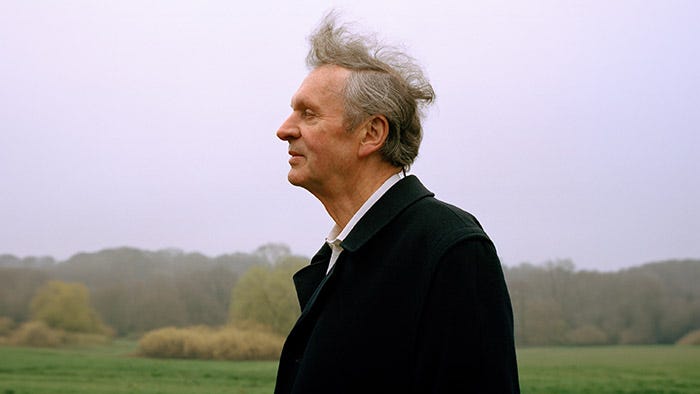
In this Church Times article published July 24, 2026 in the Notebook column, Rupert reflects on the revival of patronal festivals – when parishes celebrate the feast day of their patron saint – and Rogation parish-boundary walks, and makes the case for gratitude and graces before meals as practices linked to greater happiness and health.
ON TRINITY SUNDAY, about 50 pilgrims gathered for blessings beside a spring under an ancient sycamore tree at Hawkwood, near Stroud. We walked through the woods and fields of the Slad Valley for choral evensong in Holy Trinity, Slad, sung by the choir of All Saints’, Stroud. The church was full, and afterwards there were delicious refreshments on the terrace of the Woolpack Inn just across the road, made famous by Laurie Lee’s memoir Cider with Rosie. There were happy faces everywhere.
This was one of about 150 newly revived, evensong-based patronal festivals or feasts of title being celebrated this year in parish churches across the UK. In many parishes, this is the first time that the church’s festival has been observed in living memory. Bells have rung out before services; some parishes combined the festival with a fête, formed community choirs specially for the occasion, welcomed school choirs, or sponsored local pilgrimages. Receptions were held in churches, churchyards, village halls, and barns. Practically all were great successes. In some churches, there was standing room only.
These festivals were supported by one-off grants from the Choral Evensong Trust, of which I am a trustee: £500 for churches needing a visiting choir, and £250 for those with their own. This year, many of the grants were funded by the churches’ patrons, including the King, the Dean and Chapter of Westminster, the Bishop of Southwell & Nottingham, the Duke of Rutland, the Earl of Plymouth, New College, Oxford, Eton College, and the Goldsmiths’ Company. Applications for 2027 open on St Andrew’s Day (30 November) and close at Candlemas (details — along with reports and photos from this year’s celebrations and a calendar of upcoming festivals — are on choralevensong.org).
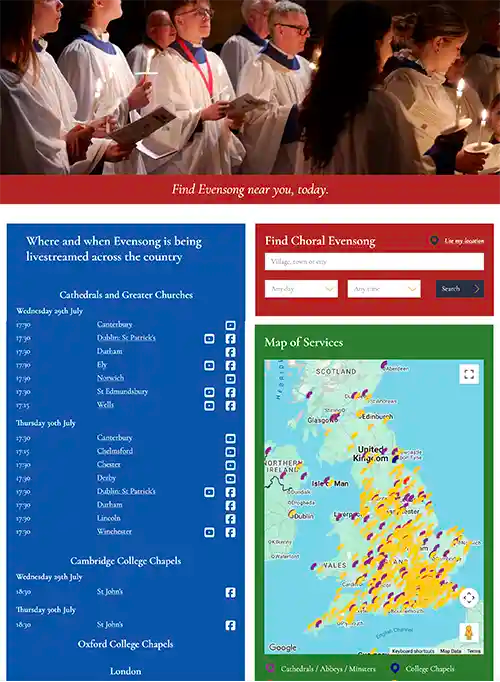
The website’s main function is to enable anyone to find choral evensong anywhere in Britain and Ireland — in cathedrals, college chapels, and hundreds of parish churches. I find it especially useful in Oxford or Cambridge, where, in term-time, there are more evensongs per square mile than anywhere else on earth. As a result, I have had blissful experiences in chapels that I had never visited before, notably at Merton College, Oxford, and Queens’ College, Cambridge.
The website’s home page also has a daily directory of live-streamed evensongs. On most days, about eight cathedrals stream their evensong, some with hundreds of viewers online — more than are present in person.
ON ROGATION SUNDAY, Dr Guy Hayward (director of the British Pilgrimage Trust) and I led about 60 people along the bounds of Hampstead parish, on Hampstead Heath, where old boundary stones and the great Boundary Oak still mark the line between the ancient parishes of Hampstead and St Pancras.
We started at Hampstead Parish Church with a blessing from the Vicar, the Revd Carol Barrett Ford; picnicked in a meadow; and ended at All Hallows’, Gospel Oak, where we sang “To be a pilgrim”, lit candles, and were blessed by the Vicar, the Revd James Elston. It was a lovely walk among friendly people, but going with a prayerful intention made it something more.
Some parishes have longstanding traditions of Rogation processions, but many do not. A revival of parish pilgrimages began last year, sponsored by the British Pilgrimage Trust with £250 grants for processions, land blessings, and a shared lunch. The community at Youlgrave and Middleton, in Derbyshire, covered all 16 miles of their boundary with members of the Youlgrave Harriers running group, as well as walkers, completing different sections. All finished in time for holy communion, followed by prayers overlooking the fields of the parish and a hearty picnic lunch.
This year, the British Pilgrimage Trust sponsored 20 more Rogation pilgrimages. All Saints’, Bighton, in Hampshire, combined a service, a talk on parish history, and a walk along part of a boundary first recorded in 959; they plan to walk a different stretch each year for the next three years.
On Ascension Day, the parishes of Tyberton and Preston-on-Wye, in Herefordshire, took Rogation back to its roots with a gentle reinvention. Whereas medieval communities once beat the bounds with stripped willow to drive off malevolent spirits, sometimes coming to blows where parishes met, these parishes chose to re-enchant the custom through song, greeting one another at a holy well, reading poetry beside ancient oaks, and proclaiming Trinitarian blessings over wilderness, hedgerows, and crops. There was time, too, for refreshments at the Yew Tree pub, a toast to the apple orchards, and a walk home at dusk beneath flying geese.
As with patronal festivals, a recurring theme was welcoming people who do not usually come to church. At St Mary’s, Lower Heyford, in Oxfordshire, 60 people walked, against a parish electoral roll of 19. The biggest event, with 248 walking or supporting, journeyed between four churches around Whitacre, Lea Marston, and Shustoke, in Warwickshire, fortified by sausage rolls, ploughman’s lunches, strawberries, and “a small mountain” of cake.
I AM a scientist as well as an Anglican, and I like the way in which science and religion come together in the study of spiritual practices. God cannot be measured, but the physiological, mental, and health effects of religious practices can.
Research (summarised in my book Science and Spiritual Practices, Coronet, 2018) shows that, on average, religious people are happier and healthier than non-religious people, and less prone to anxiety, depression, and addiction. There is now much evidence that religious practices, including prayer, communal celebrations, and singing together, are good for you.
One of the simplest practices, gratitude, has been extensively studied by positive psychology, which seeks to find out what makes people happy. In one study, some people were asked to list five things that they were grateful for in the previous week; others were asked to list five grievances, or describe five events. The researchers found that those who had focused on gratitude were more optimistic and felt better about their lives.
As Christians, we have our own traditions of gratitude, embedded in prayers and liturgies, not least by saying grace before meals, still observed at some church festivities and at formal dinners, though now extinct in most homes. Bringing back grace can be helpful. In my own family, we hold hands before eating, sometimes in silence, sometimes with a spoken or sung grace. My current favourite is “Thanks be to God for all the blessings on our lives, for this food and for our time together. Amen.”
What about a national competition for the best new grace of the year?
Comments
Nothing yet. Say the first thing.
Sign in to join the conversation.